I was rummaging around the house where I'm staying, looking for something to read, when I encountered an old favorite from my childhood, choreographer Agnes De Mille's memoir And Promenade Home.
While skimming through it, I came across a passage in which De Mille, a newlywed whose husband has gone off to fight World War II (he was to remain abroad for the two remaining years of the war but returned unharmed), describes some of the conversations she endured at social events during her long wait:
For dark, personal reasons, many people could not resist this chance at cruelty. There were the intellectuals who demanded aggressively if we believed in war and asked across our dinner tables did we relish the idea of being the widows of dead heroes? There were men of peace who fulminated against destruction and argued that no idea was worth fighting for that leveled Casino or Dresden....There were the newscasters who, after the fourth Martini, swore with something akin to professional pride that the war would last another eight years....
And this was World War II, the Good War. Interesting, no?
Saturday, June 10, 2006

Friday, June 09, 2006
Targeted assassinations and Zarqawi: he's really most sincerely dead
As Alan Dershowitz quite rightly points out (via Solomonia), the manner of Zarqawi's death is really no different from what is known as "targeted assassinations," often condemned when performed by Israel, and yet in the case of Zarqawi roundly applauded throughout the Western world.
Why the distinction? The Dershowitz piece is short and doesn't really attempt an analysis, except to say that the difference between the two acts appears to be that Israel can do no right in the eyes of many in the international community.
But, although I pretty much agree with Dershowitz that an enormous double standard is always applied to Israel, certainly the international community is not ordinarily in the habit of cutting the US much slack, either.
So I believe something additional is involved here, and that is the fact that Zarqawi was a terrorist whom even extreme leftists and Hamas apologists have had trouble wrapping their minds around. He resembled nothing more than the bogeyman, a figure of horrific brutality more appropriate to the nightmares of childhood.
And yet here he was, seeming to revel in his status as the biggest, baddest, meanest, most-sadistic sonofabitch in the world. With video to prove it. Only the furthest gone on the left (such as, unfortunately, Nicholas Berg's father; see here for a transcript and discussion of Berg's post-Zarqawi's death interview) can find empathy for Zarqawi himself.
The terrorist mastermind targets of Israel's bombs are for the most part faceless to most of us. Their propaganda machines are much slicker than Zarqawi's, and their profiles are much lower. Zarqawi made the error of getting most of the world to hate him with great passion. It's what he wanted, of course; but the consequence is that even most of those who condemn the same acts when committed by Israel can't find it in their hearts to condemn this one.
The form the condemnation takes is rather, a bunch of "yes, buts...", especially the idea that this killing won't help--that, like the proliferating broomsticks in "The Sorcerer's Apprentice" of Disney's "Fantasia" (another archtypical child's nightmare), striking down a terrorist only causes a thousand more to spring up in his place.
This is a statement of faith rather than a proven fact, but no matter; it makes good copy. My guess is that not too many have been inspired by the Z-man or the manner of his death, but I certainly cannot prove it.
But in news that has been somewhat overshadowed by Zarqawi's death, it is appears that only hours after the announcement a stalemate was broken and three appointees of the new Iraqi government were approved by its legislature. Austin Bay is paying attention, however, and he has an excellent roundup of the positive strategic implications of Zarqawi's death and of developments in the new government of that beleaguered country. These do not seem insignificant; please take a look.
So, once again: Ding-dong. He's really most sincerely dead.
[Mayor]: As Mayor of the Munchkin City,
In the County of the Land of Oz,
I welcome you most regally.
[Barrister]: But we've got to verify it legally, to see
[Mayor]: To see?
[Barrister]: If she
[Mayor]: If she?
[Barrister]: Is morally, ethic'lly
[Father No.1]: Spiritually, physically
[Father No. 2]: Positively, absolutely
[Munchkins]: Undeniably and reliably Dead
[Coroner]: As Coroner I must aver,
I thoroughly examined her.
And she's not only merely dead,
she's really most sincerely dead.
[Mayor]: Then this is a day of Independence
For all the Munchkins and their descendants...
Why the distinction? The Dershowitz piece is short and doesn't really attempt an analysis, except to say that the difference between the two acts appears to be that Israel can do no right in the eyes of many in the international community.
But, although I pretty much agree with Dershowitz that an enormous double standard is always applied to Israel, certainly the international community is not ordinarily in the habit of cutting the US much slack, either.
So I believe something additional is involved here, and that is the fact that Zarqawi was a terrorist whom even extreme leftists and Hamas apologists have had trouble wrapping their minds around. He resembled nothing more than the bogeyman, a figure of horrific brutality more appropriate to the nightmares of childhood.
And yet here he was, seeming to revel in his status as the biggest, baddest, meanest, most-sadistic sonofabitch in the world. With video to prove it. Only the furthest gone on the left (such as, unfortunately, Nicholas Berg's father; see here for a transcript and discussion of Berg's post-Zarqawi's death interview) can find empathy for Zarqawi himself.
The terrorist mastermind targets of Israel's bombs are for the most part faceless to most of us. Their propaganda machines are much slicker than Zarqawi's, and their profiles are much lower. Zarqawi made the error of getting most of the world to hate him with great passion. It's what he wanted, of course; but the consequence is that even most of those who condemn the same acts when committed by Israel can't find it in their hearts to condemn this one.
The form the condemnation takes is rather, a bunch of "yes, buts...", especially the idea that this killing won't help--that, like the proliferating broomsticks in "The Sorcerer's Apprentice" of Disney's "Fantasia" (another archtypical child's nightmare), striking down a terrorist only causes a thousand more to spring up in his place.
This is a statement of faith rather than a proven fact, but no matter; it makes good copy. My guess is that not too many have been inspired by the Z-man or the manner of his death, but I certainly cannot prove it.
But in news that has been somewhat overshadowed by Zarqawi's death, it is appears that only hours after the announcement a stalemate was broken and three appointees of the new Iraqi government were approved by its legislature. Austin Bay is paying attention, however, and he has an excellent roundup of the positive strategic implications of Zarqawi's death and of developments in the new government of that beleaguered country. These do not seem insignificant; please take a look.
So, once again: Ding-dong. He's really most sincerely dead.
[Mayor]: As Mayor of the Munchkin City,
In the County of the Land of Oz,
I welcome you most regally.
[Barrister]: But we've got to verify it legally, to see
[Mayor]: To see?
[Barrister]: If she
[Mayor]: If she?
[Barrister]: Is morally, ethic'lly
[Father No.1]: Spiritually, physically
[Father No. 2]: Positively, absolutely
[Munchkins]: Undeniably and reliably Dead
[Coroner]: As Coroner I must aver,
I thoroughly examined her.
And she's not only merely dead,
she's really most sincerely dead.
[Mayor]: Then this is a day of Independence
For all the Munchkins and their descendants...
Seattle: observations from the green city
I've barely scratched the surface of the Seattle experience, but I already have the following observations:
Seattle is indeed a very green city. It's not only green in the literal sense, because of all the rain, but in the political sense as well.
The area where I'm staying, Mercer Island (with some wonderful and exceptionally hospitable relatives), approaches rain forest dimensions--if not by strict climactic definitions, then at least visually. Swooping vistas of mossy ferny dense vegetation, lush and massed, interspersed with towering evergreens. Canyons and curves and tasteful woodsy-appropriate homes and tiny little lanes that strain the driving skills of residents who wield their SUVs down them.
Yesterday I had occasion to drive on one of the local freeways, and since there was more than one human in the car we were able to use the diamond lane. It was rush hour, so one would think that in eco-conscious Seattle there would be many other cars there as well, reflections of conscientious carpooling.
But no. As far as the eye could see, we had the diamond lane nearly to ourselves. Glancing to my right, I could see only a solitary driver in car after car--proving, not that residents of Seattle are evil; but that, like most people, they like independence in their wheels.
To continue the green theme, last night I ate dinner at a restaurant called Cedars, which I now hereby plug. Crowded, warm, noisy but not so noisy you couldn't carry on a conversation, and an interestingly eclectic menu of both Indian and Mideastern. Why so crowded? The winning combination: good food, plenty of it, and very reasonably priced.
Seattle is indeed a very green city. It's not only green in the literal sense, because of all the rain, but in the political sense as well.
The area where I'm staying, Mercer Island (with some wonderful and exceptionally hospitable relatives), approaches rain forest dimensions--if not by strict climactic definitions, then at least visually. Swooping vistas of mossy ferny dense vegetation, lush and massed, interspersed with towering evergreens. Canyons and curves and tasteful woodsy-appropriate homes and tiny little lanes that strain the driving skills of residents who wield their SUVs down them.
Yesterday I had occasion to drive on one of the local freeways, and since there was more than one human in the car we were able to use the diamond lane. It was rush hour, so one would think that in eco-conscious Seattle there would be many other cars there as well, reflections of conscientious carpooling.
But no. As far as the eye could see, we had the diamond lane nearly to ourselves. Glancing to my right, I could see only a solitary driver in car after car--proving, not that residents of Seattle are evil; but that, like most people, they like independence in their wheels.
To continue the green theme, last night I ate dinner at a restaurant called Cedars, which I now hereby plug. Crowded, warm, noisy but not so noisy you couldn't carry on a conversation, and an interestingly eclectic menu of both Indian and Mideastern. Why so crowded? The winning combination: good food, plenty of it, and very reasonably priced.
Thursday, June 08, 2006
Zarqawi's death
I woke up today to the news of Zarqawi's death.
This is the best day of its kind since the announcement of Saddam's capture. And it does not seem this time as though reports of Zarqawi's death have been greatly exaggerated; this appears to be the real deal at last.
There's an especially interesting roundup of views at Pajamas Media. Note particularly the ones from Iraqi bloggers. And please contrast their attitude with Dr. Sanity's compendium of views on the left, fine exemplars of the art of the "yes, but...".
The NY Times reports an interesting incident of Tony Snow's prescience:
As news that United States forces had killed the most wanted terrorist in Iraq began to spread through the American security apparatus late Wednesday afternoon, President Bush and his top advisers were meeting in the White House with congressional leaders, who were nervous about continued trouble in Iraq.
"What you really need to do," Representative Ray LaHood of Illinois told the president, "is go get Zarqawi," according to an account by the White House press secretary, Tony Snow, who was at the meeting.
"I said 'Yeah, we'll just order that up right now,' " Mr. Snow recalled in an interview this morning.
Minutes after that exchange, at 3:45 p.m., the national security adviser, Stephen J. Hadley, left the room in response to a Blackberry message to call the American ambassador to Iraq in Baghdad, Zalmay Khalilzad.
"We think we have Zarqawi," Mr. Khalilzad told him.
Was Zarqawi the source of all evil in Iraq? No. Will his death make the insurgency go away? Not a chance. But it's another victory on the long slow and arduous road to some sort of functioning and democratic government in Iraq, and a message to others of his ilk as to what fate awaits them. And, if the Iraqi bloggers are any indication, a cause for ordinary Iraqis to rejoice.
Celebration at the death of an evildoer--and if there was a clearer example of an evildoer than Zarqawi on the face of this earth I can't quite think of one at the moment--is a tricky phenomenon. Zarqawi was human, of that I am certain. As a human being, he deserves some sort of respect. But a long time ago he forfeited the right to be mourned in the usual way, and it is appropriate to be glad of the fact that he is no longer among us to inspire whomever it might be who found his particular brand of sociopathic thuggery impressive and charismatic.
For a sociopathic thug he almost undoubtedly was, with roots in garden-variety criminality, writ large over time through political opportunity and positioning so that he could work his evil on a vaster scale than most ordinary psychopaths. If we or anyone else shed a tear for Zarqawi, it should be for the fact that a human being can become so corrupted and lost, so brutal and bereft of humanity, that his death would cause such universal and justifiable rejoicing.
Who turned him in? He certainly didn't lack enemies, including those in Jordan angered by his killing his own, like a rabid dog. The twenty-five million dollar reward probably sweetened the pot.
But celebration is clearly in order today, so sing it high, sing it low.
This is the best day of its kind since the announcement of Saddam's capture. And it does not seem this time as though reports of Zarqawi's death have been greatly exaggerated; this appears to be the real deal at last.
There's an especially interesting roundup of views at Pajamas Media. Note particularly the ones from Iraqi bloggers. And please contrast their attitude with Dr. Sanity's compendium of views on the left, fine exemplars of the art of the "yes, but...".
The NY Times reports an interesting incident of Tony Snow's prescience:
As news that United States forces had killed the most wanted terrorist in Iraq began to spread through the American security apparatus late Wednesday afternoon, President Bush and his top advisers were meeting in the White House with congressional leaders, who were nervous about continued trouble in Iraq.
"What you really need to do," Representative Ray LaHood of Illinois told the president, "is go get Zarqawi," according to an account by the White House press secretary, Tony Snow, who was at the meeting.
"I said 'Yeah, we'll just order that up right now,' " Mr. Snow recalled in an interview this morning.
Minutes after that exchange, at 3:45 p.m., the national security adviser, Stephen J. Hadley, left the room in response to a Blackberry message to call the American ambassador to Iraq in Baghdad, Zalmay Khalilzad.
"We think we have Zarqawi," Mr. Khalilzad told him.
Was Zarqawi the source of all evil in Iraq? No. Will his death make the insurgency go away? Not a chance. But it's another victory on the long slow and arduous road to some sort of functioning and democratic government in Iraq, and a message to others of his ilk as to what fate awaits them. And, if the Iraqi bloggers are any indication, a cause for ordinary Iraqis to rejoice.
Celebration at the death of an evildoer--and if there was a clearer example of an evildoer than Zarqawi on the face of this earth I can't quite think of one at the moment--is a tricky phenomenon. Zarqawi was human, of that I am certain. As a human being, he deserves some sort of respect. But a long time ago he forfeited the right to be mourned in the usual way, and it is appropriate to be glad of the fact that he is no longer among us to inspire whomever it might be who found his particular brand of sociopathic thuggery impressive and charismatic.
For a sociopathic thug he almost undoubtedly was, with roots in garden-variety criminality, writ large over time through political opportunity and positioning so that he could work his evil on a vaster scale than most ordinary psychopaths. If we or anyone else shed a tear for Zarqawi, it should be for the fact that a human being can become so corrupted and lost, so brutal and bereft of humanity, that his death would cause such universal and justifiable rejoicing.
Who turned him in? He certainly didn't lack enemies, including those in Jordan angered by his killing his own, like a rabid dog. The twenty-five million dollar reward probably sweetened the pot.
But celebration is clearly in order today, so sing it high, sing it low.
Wednesday, June 07, 2006
The tie that bonds, the bond that ties
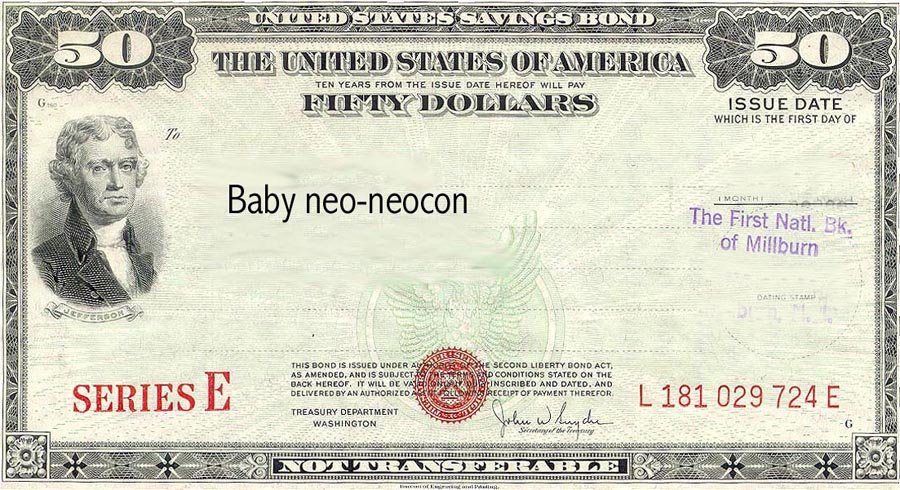
I found them deep in the bottom of the safe deposit box, put there so long ago they'd been virtually forgotten. Three US Savings Bonds, gifts to me on the occasion of my birth.
The denominations didn't seem huge: 100, 50, and 25 dollars. But, readjusted for the rate of inflation, the gifts were very generous indeed at the time they were given. You'll have to guess the date of issue yourself; as you can see, a little judicious editing has been performed by a friend less technically challenged than I on the above reproduction of one of the bonds.
I'm not sure who the donors were, but I know they had to be family friends or relatives. The stamp on the bond in the photo says "The First National Back of Millburn," so that's a pretty good clue; my mother had first cousins who lived there.
When I took the bonds out of the box to study them, they seemed old--older than they ought to, far far older than I. Something like the Confederate money I remember my grandmother showing me in my youth, or the far more interesting mourning jewelry her mother had worn--chains made from the hair of the deceased, on which lockets containing the loved ones' photos were hung.
These US Savings Bonds were evidence that, as a newborn, I was surrounded by a group of people who didn't even know me yet but who wished me well. And not only did they wish me well, but they were putting their hard-earned money where their mouths were, and planned that some day these bonds would pay me back with interest.
And now that day had come, belatedly. No doubt the givers thought the bonds would have been redeemed quite some time ago, perhaps even to help pay for a college education, when that kind of money could actually get you something more than a textbook or two. But somehow, instead, the bonds had been laid aside long ago and forgotten.
The bonds made me think of the banks of my youth, so different from today's user-friendly ones. Those 50s banks were meant to be intimidating; they were manned (and "manned" was not just a figure of speech; the employees were all males) only until two o'clock in the afternoon or so, the classic "banker's hours." They featured a lot of icy marble, and the tellers hid behind grates, with only a bit of their faces showing. The effect was enhanced by the fact that I was too small to really see up that high; I just presented my savings account book and they gave it the mysterious and official stamp.
Now, of course, the bank I visit to redeem the bonds is a wide-open space, full of light and artwork. The tellers are all women--although actually, to me, they look like young girls--with nary a grate in sight.
I present my bonds, and the teller studies them, her eyes widening, her mouth forming a little "O" and giving out a slight puff of air. She actually calls the others over to look, and soon the lot gather around, murmuring "We've never seen one of these before; look how OLD!!" and gaze up at me in wonder.
I'm a bit hurt. "Hold on about old, that's me you're talking about. They were given to me the day I was born," I say, and they smile and shake their heads. Others are called in, and a consultation ensues. What to do? How to look this up?
A higher-up comes out and determines that, with interest, the bonds are worth $921.92, which respresents a nice windfall, and an unexpected one as well. I can feel those long-ago givers smiling on me, joyful at the birth of that baby girl so long ago. What were their hopes and dreams for her, their fears and secret sorrows? I don't even really know who they were; just that they wished me well--and that, so many years later, I receive their gifts once again.
Tuesday, June 06, 2006
Oh, Canada!--the arrests
Varifrank has a good roundup and summary of news about the Canadian explosives arrests.
The situation was potentially explosive in more ways than one. As Varifrank points out, not only was the alleged network international in scope, not only did it involve Canadian nationals and even minors, but the target was--Canada.
It's hard to imagine anything so logical as a reason for targeting Canada. But I supose the country represented what might be called a target of opportunity. Like Everest, it's there; although unlike Everest, it may have been tempting because it was thought to be relatively easy to operate in. It's also Western, of course, and America-like.
It's encouraging that intelligence and law enforcement worked together on an international scale to thwart this particular effort. The Canadian authorities have certainly not been lulled into a false sense of security because of their country's politics. Of that I--and many millions af Canadians--am glad.
The fact that we are all potential targets is not fearmongering, as many will no doubt say. It's a simple fact. And saying it doesn't mean the speaker is especially afraid--although it's not a pleasant prospect, to be sure.
But it's reality. And if that reality wasn't already as clear as the billiant blue skies of a certain Tuesday in September of 2001, then it certainly should be that clear by now.
The situation was potentially explosive in more ways than one. As Varifrank points out, not only was the alleged network international in scope, not only did it involve Canadian nationals and even minors, but the target was--Canada.
It's hard to imagine anything so logical as a reason for targeting Canada. But I supose the country represented what might be called a target of opportunity. Like Everest, it's there; although unlike Everest, it may have been tempting because it was thought to be relatively easy to operate in. It's also Western, of course, and America-like.
It's encouraging that intelligence and law enforcement worked together on an international scale to thwart this particular effort. The Canadian authorities have certainly not been lulled into a false sense of security because of their country's politics. Of that I--and many millions af Canadians--am glad.
The fact that we are all potential targets is not fearmongering, as many will no doubt say. It's a simple fact. And saying it doesn't mean the speaker is especially afraid--although it's not a pleasant prospect, to be sure.
But it's reality. And if that reality wasn't already as clear as the billiant blue skies of a certain Tuesday in September of 2001, then it certainly should be that clear by now.
Monday, June 05, 2006
Losing your turns
What's a pirouette? Here's the Wikipedia defintion--and, as a former dancer, I can attest to its correctness:
One of the most famous ballet movements; this is where the dancer spins around on demi-pointe or pointe on one leg. The other leg can be in various different positions; the standard one being retiré. Others include the leg in attitude, and grand battement level, second position. They can also finish in arabesque or attitude positions. A pirouette can be en dehors - turning outwards, starting with both legs in plie, or en dedans - turning inwards.
The above definition may seem Greek to you (actually, of course, French) but to me the terms are as familiar as English. The terminology of ballet, repeated to me from the age of four till my late thirties, when I quit dancing, gets drummed into the brain until it becomes reflexive.
The diagram, for instance, shows an en dehors turn, since the dancer is spinning in the opposite direction from the leg supporting her weight, and her other leg is held in the postion known as passe.
But I'm not here to teach you dance--fortunately for both of us, since that would be quite a trick, online. I want to talk about the psychological phenomenon every dancer knows about, which is known as "losing your turns."
All of dance is hard for the dancer, although it's incredibly satisfying and rewarding, a completely absorbing meshing of the physical, musical, artistic, and spiritual. But turns are notoriously, especially hard for most people.
Certain people are different, however; they're that rare phenomenon known as "natural turners." Some strange trick of brain and inner ear, some unusual sense of centered balance, allows them to turn easily almost from the moment the step is first introduced to them. Natural turners almost never lose their turns; but the rest of us not only have to struggle to learn to turn, but always retain the perception that the knack can be lost.
Every person has a preferred side to which turning is easier, almost always the right. There have been only a few famous dancers who are/were "left-turners" (the extraordinary Fernando Bujones and the elegant Anthony Dowell come to mind), so most ballet choreography features turns to the right. The favored side for turning has no relation to handedness, by the way; it's an entirely separate issue (I'm left-handed and a right turner, for example).
So the way the brain is structured is definitely part of what makes turns easy or hard. Turns are also especially challenging because, more than any other part of ballet, they require strength and relaxation in almost equal measure. Tension is a great turn-killer, especially tension of the head and neck, which have to work together to move fluidly in the manner known as "spotting" in order to avoid getting too dizzy (spotting involves keeping the eyes on a single "spot" until the last moment of the turn, and then whipping the head around quickly to come back and focus on that object again).
The best comparison I can think of is to baseball: the batter's swing and the pitcher's curve ball. Both are notorious for disappearing for unknown reasons, sometimes for a long time (sometimes ending a career, actually), and then mysteriously reappearing. When a batter loses his swing, he works with a coach, trying to locate the problem, fine-tuning things till it returns.
Likewise with dancers. You can see them practicing their turns after class, over and over and over, looking in the ever-present mirror to see if they can detect that elusive flaw that's spoiling their turns. Because when turns go, it's not a pretty sight. Balance is a thing that's either on or off; a person who could once do four flawless revolutions from a single push-off preparation will now have trouble getting around twice--perhaps even hopping to complete the revolutions or, (for a female) falling off pointe, which can involve an ignominious and dangerous pratfall.
Virtually all dancers know that losing one's turns is a possibility every time they take the preparation for a turn (unsually a momentary pause in fourth or fifth position with the knee bend known as a demi-plie, eyes fixed on ahead for the "spotting," arms poised to whip and then close in for a bit of added impetus [see diagram]) . It's a leap--well, not exactly a leap--of faith, a push into the unknown. Will the turn hold? The dancer has to have the confidence that it will, and relax into it, bringing together all his/her technique and knowledge without really thinking about it. It's part of the dancer's body memory, and trust has to enter into it.
Strangely enough, writing a blog has some aspects of this process, too. No, it doesn't have that element of physical release--au contraire, it's physically quite static. But every day, or even several times a day, the blogger faces that blank screen and has to take a little preparation and push off, assuming the turn (of phrase) will come. It's different from other types of writing, because there's so little time to prepare, and even less time to polish. One must produce at a fairly fast clip, digesting the news and what's being said on other blogs (sometimes swallowing whole without chewing enough) and then saying one's piece.
I'm not complaining; it's a self-imposed labor of love. Sometimes I face that blank screen with eager anticipation--I've got an idea, the words flow, and the thing practically writes itself. A quadruple turn, as it were. Other times I cast about for something to say, or I have an idea but my thoughts are hard to sort out, or I realize that to do justice to the topic I'd really have to write a small book. Sometimes the product is only so-so; sometimes I'm just hopping around and fall off pointe. But the next day I usually return to take my place again, make my preparation, and try to relax into the turn with confidence. And, if it doesn't turn out quite right, I try again the next day.
One of the most famous ballet movements; this is where the dancer spins around on demi-pointe or pointe on one leg. The other leg can be in various different positions; the standard one being retiré. Others include the leg in attitude, and grand battement level, second position. They can also finish in arabesque or attitude positions. A pirouette can be en dehors - turning outwards, starting with both legs in plie, or en dedans - turning inwards.
The above definition may seem Greek to you (actually, of course, French) but to me the terms are as familiar as English. The terminology of ballet, repeated to me from the age of four till my late thirties, when I quit dancing, gets drummed into the brain until it becomes reflexive.
The diagram, for instance, shows an en dehors turn, since the dancer is spinning in the opposite direction from the leg supporting her weight, and her other leg is held in the postion known as passe.
But I'm not here to teach you dance--fortunately for both of us, since that would be quite a trick, online. I want to talk about the psychological phenomenon every dancer knows about, which is known as "losing your turns."
All of dance is hard for the dancer, although it's incredibly satisfying and rewarding, a completely absorbing meshing of the physical, musical, artistic, and spiritual. But turns are notoriously, especially hard for most people.
Certain people are different, however; they're that rare phenomenon known as "natural turners." Some strange trick of brain and inner ear, some unusual sense of centered balance, allows them to turn easily almost from the moment the step is first introduced to them. Natural turners almost never lose their turns; but the rest of us not only have to struggle to learn to turn, but always retain the perception that the knack can be lost.
Every person has a preferred side to which turning is easier, almost always the right. There have been only a few famous dancers who are/were "left-turners" (the extraordinary Fernando Bujones and the elegant Anthony Dowell come to mind), so most ballet choreography features turns to the right. The favored side for turning has no relation to handedness, by the way; it's an entirely separate issue (I'm left-handed and a right turner, for example).
So the way the brain is structured is definitely part of what makes turns easy or hard. Turns are also especially challenging because, more than any other part of ballet, they require strength and relaxation in almost equal measure. Tension is a great turn-killer, especially tension of the head and neck, which have to work together to move fluidly in the manner known as "spotting" in order to avoid getting too dizzy (spotting involves keeping the eyes on a single "spot" until the last moment of the turn, and then whipping the head around quickly to come back and focus on that object again).
The best comparison I can think of is to baseball: the batter's swing and the pitcher's curve ball. Both are notorious for disappearing for unknown reasons, sometimes for a long time (sometimes ending a career, actually), and then mysteriously reappearing. When a batter loses his swing, he works with a coach, trying to locate the problem, fine-tuning things till it returns.
Likewise with dancers. You can see them practicing their turns after class, over and over and over, looking in the ever-present mirror to see if they can detect that elusive flaw that's spoiling their turns. Because when turns go, it's not a pretty sight. Balance is a thing that's either on or off; a person who could once do four flawless revolutions from a single push-off preparation will now have trouble getting around twice--perhaps even hopping to complete the revolutions or, (for a female) falling off pointe, which can involve an ignominious and dangerous pratfall.
Virtually all dancers know that losing one's turns is a possibility every time they take the preparation for a turn (unsually a momentary pause in fourth or fifth position with the knee bend known as a demi-plie, eyes fixed on ahead for the "spotting," arms poised to whip and then close in for a bit of added impetus [see diagram]) . It's a leap--well, not exactly a leap--of faith, a push into the unknown. Will the turn hold? The dancer has to have the confidence that it will, and relax into it, bringing together all his/her technique and knowledge without really thinking about it. It's part of the dancer's body memory, and trust has to enter into it.
Strangely enough, writing a blog has some aspects of this process, too. No, it doesn't have that element of physical release--au contraire, it's physically quite static. But every day, or even several times a day, the blogger faces that blank screen and has to take a little preparation and push off, assuming the turn (of phrase) will come. It's different from other types of writing, because there's so little time to prepare, and even less time to polish. One must produce at a fairly fast clip, digesting the news and what's being said on other blogs (sometimes swallowing whole without chewing enough) and then saying one's piece.
I'm not complaining; it's a self-imposed labor of love. Sometimes I face that blank screen with eager anticipation--I've got an idea, the words flow, and the thing practically writes itself. A quadruple turn, as it were. Other times I cast about for something to say, or I have an idea but my thoughts are hard to sort out, or I realize that to do justice to the topic I'd really have to write a small book. Sometimes the product is only so-so; sometimes I'm just hopping around and fall off pointe. But the next day I usually return to take my place again, make my preparation, and try to relax into the turn with confidence. And, if it doesn't turn out quite right, I try again the next day.
Sunday, June 04, 2006
Writing about Haditha, thinking about Haditha
I haven't written about Haditha yet.
I know that we don't yet know what happened there, or why. So all we can do is speculate, and to me the speculation seems rather obvious: if innocent civilians were murdered by the Marines there, and if the situation did not involve well-motivated and understandable mistaken identity of some sort, then it was a war crime and should (and will) be deplored by all right-thinking (and I mean that in the moral, not the political, sense) people, including myself. And it should, and will, be prosecuted as such, to the fullest extent of the law.
Those things are so obvious to me that they almost go without saying. But I'm saying them anyway, just to be clear.
But this is a post not so much about Haditha itself but about the current speculation about Haditha, and what that might mean. I've noticed that Haditha follows certain patterns that seem familiar. I wrote about those patterns back in late April, in this post about My Lai and the press:
The massacre at My Lai was a turning point in America's perception of itself. It represented a loss of innocence about the military, who until then had been thought incapable of the kind of atrocity that occurred there. It also made Americans more cynical towards the military command and its ability to investigate its own wrongdoings. And lastly, the press was seen in the role of heroes bent on publicizing the truth.
These three elements are still in play today. Whether or not Haditha ends up proving to be in the mold of My Lai, My Lai remains the template, the frame for all subsequent events that might fall into the category of possible American war crimes.
My Lai itself was a war crime, and there's no doubt the initial internal military field investigation was a coverup:
The facts of My Lai were sensational, and they make shocking reading today, even in our far more jaded age. I've written about My Lai before, here. It was an event of great complexity, and I highly recommend this must-read teaching case study on the subject, which comes as close to explaining what happened there--and why it happened--as I think anything ever could.
I want to reiterate the must-read status of the teaching case. Even if you think you know all about My Lai and what happened there--and especially why it happened--please think again, and read it if you haven't already done so.
There's an old saying to the effect that the military is always fighting the previous war rather than the present one. That's another way of saying it's hard to foresee what will happen, and much easier (although still surprisingly difficult) to know what already has happened, and that institutions have a tendency to become hidebound in their thinking processes. Creativity is needed, although creativity is risky--but it's just as risky to lack it.
The military seems to be a bit better nowadays at thinking ahead, although far from perfect. But it's the press that seems stuck in fighting previous wars--especially the previous war in which the press believes itself to have been the hero, Vietnam. Haditha fits quite well into that vision; it may indeed be the My Lai the press has long been expecting, or it may not (and please, read Belmont Club on the subject of press coverage of Haditha so far).
Is a new set of rules emerging under which modern warfare must be waged by the West? Here are those rules, as best I can determine them (with only a little bit of exaggeration):
(1) Wars cannot last more than a few weeks.
(2) In the "hot" stage of the war, no civilians can die.
(3) In the aftermath of a war, no civilians can die.
(4) All military investigations of possible war crimes and atrocities must be treated by the press as though they are already coverups. The accused are guilty until proven innocent. And, of course, since the military always lies and covers up, the accused can never really be proven innocent by a military court.
What would these rules do? They would set up war as an impossible to execute but morally black and white situation in which we keep our hands impeccably clean (see here for my previous essay on that subject.)
Yes indeed, the goal is to be perfect--to never commit a war crime, to never have an innocent civilian die. But realistically, that goal will never be reached. The best we--or any nation--can do is to train our troops as well as possible in order to reduce the number of such incidents to almost nothing, and to ruthlessly investigate and prosecute them whenever they do occur.
Because the truth is that in wars innocent civilians will always be killed, and always tragically--whether it be in targeted and precision bombing raids gone awry in the "hot" segment of the war, or even in true war crimes during the later "assymetrical guerilla and/or terrorist warfare" stage.
Some would say that the best way to remain morally pure--if that is our interest--is to never wage war. But that ignores the price of inaction and passivity. Back in November I wrote the following, which still seems relevant:
Yes, indeed, there's enough blood to go around. There always is in war; wars involve blood on everyone's hands, including pacifists, who are responsible for some of the blood involved in feeding the crocodile.
Of course, the price that inaction would have cost is always speculative--and therefore deniable--if action has been taken instead. And the price of an action taken is relatively real and quantifiable. It's only if inaction has been followed that we can know its true consequences.
Take your choice of which price you would like to pay. Please remember that neither can be known in advance, that all decisions must be made based on incomplete and possibly flawed information, and that hindsight is always 20/20.
I know that we don't yet know what happened there, or why. So all we can do is speculate, and to me the speculation seems rather obvious: if innocent civilians were murdered by the Marines there, and if the situation did not involve well-motivated and understandable mistaken identity of some sort, then it was a war crime and should (and will) be deplored by all right-thinking (and I mean that in the moral, not the political, sense) people, including myself. And it should, and will, be prosecuted as such, to the fullest extent of the law.
Those things are so obvious to me that they almost go without saying. But I'm saying them anyway, just to be clear.
But this is a post not so much about Haditha itself but about the current speculation about Haditha, and what that might mean. I've noticed that Haditha follows certain patterns that seem familiar. I wrote about those patterns back in late April, in this post about My Lai and the press:
The massacre at My Lai was a turning point in America's perception of itself. It represented a loss of innocence about the military, who until then had been thought incapable of the kind of atrocity that occurred there. It also made Americans more cynical towards the military command and its ability to investigate its own wrongdoings. And lastly, the press was seen in the role of heroes bent on publicizing the truth.
These three elements are still in play today. Whether or not Haditha ends up proving to be in the mold of My Lai, My Lai remains the template, the frame for all subsequent events that might fall into the category of possible American war crimes.
My Lai itself was a war crime, and there's no doubt the initial internal military field investigation was a coverup:
The facts of My Lai were sensational, and they make shocking reading today, even in our far more jaded age. I've written about My Lai before, here. It was an event of great complexity, and I highly recommend this must-read teaching case study on the subject, which comes as close to explaining what happened there--and why it happened--as I think anything ever could.
I want to reiterate the must-read status of the teaching case. Even if you think you know all about My Lai and what happened there--and especially why it happened--please think again, and read it if you haven't already done so.
There's an old saying to the effect that the military is always fighting the previous war rather than the present one. That's another way of saying it's hard to foresee what will happen, and much easier (although still surprisingly difficult) to know what already has happened, and that institutions have a tendency to become hidebound in their thinking processes. Creativity is needed, although creativity is risky--but it's just as risky to lack it.
The military seems to be a bit better nowadays at thinking ahead, although far from perfect. But it's the press that seems stuck in fighting previous wars--especially the previous war in which the press believes itself to have been the hero, Vietnam. Haditha fits quite well into that vision; it may indeed be the My Lai the press has long been expecting, or it may not (and please, read Belmont Club on the subject of press coverage of Haditha so far).
Is a new set of rules emerging under which modern warfare must be waged by the West? Here are those rules, as best I can determine them (with only a little bit of exaggeration):
(1) Wars cannot last more than a few weeks.
(2) In the "hot" stage of the war, no civilians can die.
(3) In the aftermath of a war, no civilians can die.
(4) All military investigations of possible war crimes and atrocities must be treated by the press as though they are already coverups. The accused are guilty until proven innocent. And, of course, since the military always lies and covers up, the accused can never really be proven innocent by a military court.
What would these rules do? They would set up war as an impossible to execute but morally black and white situation in which we keep our hands impeccably clean (see here for my previous essay on that subject.)
Yes indeed, the goal is to be perfect--to never commit a war crime, to never have an innocent civilian die. But realistically, that goal will never be reached. The best we--or any nation--can do is to train our troops as well as possible in order to reduce the number of such incidents to almost nothing, and to ruthlessly investigate and prosecute them whenever they do occur.
Because the truth is that in wars innocent civilians will always be killed, and always tragically--whether it be in targeted and precision bombing raids gone awry in the "hot" segment of the war, or even in true war crimes during the later "assymetrical guerilla and/or terrorist warfare" stage.
Some would say that the best way to remain morally pure--if that is our interest--is to never wage war. But that ignores the price of inaction and passivity. Back in November I wrote the following, which still seems relevant:
Yes, indeed, there's enough blood to go around. There always is in war; wars involve blood on everyone's hands, including pacifists, who are responsible for some of the blood involved in feeding the crocodile.
Of course, the price that inaction would have cost is always speculative--and therefore deniable--if action has been taken instead. And the price of an action taken is relatively real and quantifiable. It's only if inaction has been followed that we can know its true consequences.
Take your choice of which price you would like to pay. Please remember that neither can be known in advance, that all decisions must be made based on incomplete and possibly flawed information, and that hindsight is always 20/20.
Arrival
Well, I'm in Seattle!
My clever ploy to take an umbrella evidently worked, because it was quite lovely all day yesterday, and it's only cloudy today--not so bad--with a downpour only during the night. I even left some Seattle weather behind at Logan Airport, where there was a driving rain as my airplane took off, three hours behind schedule.
Despite the delay, the flight itself was unremarkable--which means excellent. However, since I arrived so late, I went to bed Friday night (Saturday morning, that is) at the equivalent of 6AM, east coast time. That's why I took the day off yesterday to chill out and visit and recover.
Speaking of recovery, about twenty-four hours before my departure I sensed I was coming down with a nasty cold. You know how it is--one moment you're fine, going about your business, and the next moment you know you're not only about to get sick, you actually already are sick. So, desperate to avoid becoming really sick on vacation, I tried taking some of those zinc lozenges I'd heard so much about.
I hereby report, much to my delight, that they seem to be working. Even though I know I can't scientifically prove it by this sample of a single cold, so far the symptoms have been so much less severe than usual that I'm willing to do my bit to advertise the zinc treatment to those few of you who might have previously been aware of it. The worst that seems to happen is that you are forced to suck on a pretty decent-tasting zinc-laced hard candy every couple of hours. Sad, isn't it?
My clever ploy to take an umbrella evidently worked, because it was quite lovely all day yesterday, and it's only cloudy today--not so bad--with a downpour only during the night. I even left some Seattle weather behind at Logan Airport, where there was a driving rain as my airplane took off, three hours behind schedule.
Despite the delay, the flight itself was unremarkable--which means excellent. However, since I arrived so late, I went to bed Friday night (Saturday morning, that is) at the equivalent of 6AM, east coast time. That's why I took the day off yesterday to chill out and visit and recover.
Speaking of recovery, about twenty-four hours before my departure I sensed I was coming down with a nasty cold. You know how it is--one moment you're fine, going about your business, and the next moment you know you're not only about to get sick, you actually already are sick. So, desperate to avoid becoming really sick on vacation, I tried taking some of those zinc lozenges I'd heard so much about.
I hereby report, much to my delight, that they seem to be working. Even though I know I can't scientifically prove it by this sample of a single cold, so far the symptoms have been so much less severe than usual that I'm willing to do my bit to advertise the zinc treatment to those few of you who might have previously been aware of it. The worst that seems to happen is that you are forced to suck on a pretty decent-tasting zinc-laced hard candy every couple of hours. Sad, isn't it?
Thursday, June 01, 2006
More on politics and friends
I want to spotlight this question that appeared in the comments section of my earlier thread on politics and friendship [some spelling corrections made here]:
...if this is the state of your personal relationships, is the blog a chance to say all those things you can't with them, a place to find ideological fellowship, or both or neither? Do [your friends] know about the blog? Just curious.
I began this blog mainly because I was spending so much time reading and commenting on other blogs that I figured I might as well start one of my own. At the time, I was writing quite a few emails to Andrew Sullivan, and a great many of them were being published on his blog (this was back when he was still featuring a couple of emails a day). It was fun to think that, because of the enormous volume of Sullivan's traffic, many people were probably reading my words.
But at the beginning, I never thought this blog would generate much traffic. I started out very slowly and tentatively here around the time of the build-up to the 2004 election, not ever thinking I'd be using it as much more than a dump for a few of the emails I'd sent to Andrew, or some of my longer comments on other blogs.
But I did have an idea; that's why I gave the blog the name I did. As I said, I really wasn't thinking that I'd ever have much traffic. But I was thinking that I wanted to make this a place to discuss the changes I'd undergone post-9/11, and to make it a place where people who'd had similar experiences would feel especially welcome. I knew I'd be discussing change in general, and it's interesting to me that so many of my posts have indeed continued to deal with that topic in one form or other.
And yes, since I began the blog in the intense period of the buildup to the 2004 Presidential election, it was at least partly an effort to channel the energy I had to speak about these things away from friends and family, most of whom had made it clear that they wanted to take such topics off the table. I was only too happy to oblige, because the experience with them had been so unproductive and unpleasant.
So the answer to the first question from the commenter is "both." Primarily, however, this blog has been a way to say things I just feel I need to say, and to make them available for others read them. In that I think I resemble most bloggers: we like to get our thoughts out there in written form.
As for the second question, whether my friends know about the blog, the answer is also "yes." I've given all those who are close to me--and many who are less close, but still friends--the URL. I've invited them to read it, with the caveat that they probably would disagree with my viewpoints. But of course, most of them already know that.
I've never sent them links to any political posts of mine, however, unless they've specifically requested that--and very few have. To send such things to them at this point would constitute a sort of mild harassment. Now politics only comes up if they choose to bring it up.
There are two family members who read my blog regularly. It is probably no coincidence that those are the two closest to me, and that they also happen to be the two who have come (at least partially, and to different degrees) over to the dark side along with me. There's one good friend who remains staunchly liberal who reads here regularly and thoughtfully. But most of you probably won't be surprised to learn that the rest of my friends virtually never come here, although I do send them links to some of my lighter, nonpolitical, pieces from time to time, if I think they'd enjoy that.
Of course, there are many possible explanations for my friends' general lack of interest in reading my blog. I was drawn to blogs the moment I first found them, back in 2002. Something about them just resonated with me--I liked the personal voice, the lively give and take, the sense of a Greek chorus (sometimes humorous) commenting on the news that had heretofore been intoned mostly by the likes of Cronkite and Rather.
But since the majority of people don't read blogs--left or right--most of my friends fall squarely into that category. Therefore the fact that they never read my blog isn't all that strange. But I still like to think that, if the tables were reversed, and I was the non-blog-reader and my friends the bloggers, I would have enough curiosity to go to their blogs and read from time to time.
But nothing I write here is a secret, not only in the sense that a blog is in the public domain, but also in the sense that I've given the information out to friends. What they do with it is their business.
I've found a lack of general interest on both sides in reading much of what the other side has to say. Since I'm the Tiresias of bloggers (metaphorically, that is!), I've spent quite a bit of time reading on both sides now. I think that's especially true of other "changers." And I still do quite a bit of reading of the NY Times and the Boston Globe, as well as my old favorite, the New Yorker, as well as a smattering of articles decidedly to the left of those publications.
But back when I was a liberal Democrat, I hardly ever recall reading periodicals on the right. One reason was that I thought I already was reading media that presented both sides fairly (the above MSM publications). I think that's a common perception still, among liberals.
There's also a perception that there's no need to read the other side because it's all garbage any way. And no doubt there are many on the right who feel that way about the other side, as well. But I think it's a bit harder for those on the right to avoid reading views from the liberal side, since it's so well represented in the MSM. And it always strikes me as strange that liberals, who pride themselves on openminded reflection and inclusion, as well as respect for different "truths," should so often be doctrinaire about shutting out the voices on the right from their own consciousness. If liberal stereotypes about the right are to believed, that's exactly the sort of behavior one would expect from the narrow-minded right, isn't it?
...if this is the state of your personal relationships, is the blog a chance to say all those things you can't with them, a place to find ideological fellowship, or both or neither? Do [your friends] know about the blog? Just curious.
I began this blog mainly because I was spending so much time reading and commenting on other blogs that I figured I might as well start one of my own. At the time, I was writing quite a few emails to Andrew Sullivan, and a great many of them were being published on his blog (this was back when he was still featuring a couple of emails a day). It was fun to think that, because of the enormous volume of Sullivan's traffic, many people were probably reading my words.
But at the beginning, I never thought this blog would generate much traffic. I started out very slowly and tentatively here around the time of the build-up to the 2004 election, not ever thinking I'd be using it as much more than a dump for a few of the emails I'd sent to Andrew, or some of my longer comments on other blogs.
But I did have an idea; that's why I gave the blog the name I did. As I said, I really wasn't thinking that I'd ever have much traffic. But I was thinking that I wanted to make this a place to discuss the changes I'd undergone post-9/11, and to make it a place where people who'd had similar experiences would feel especially welcome. I knew I'd be discussing change in general, and it's interesting to me that so many of my posts have indeed continued to deal with that topic in one form or other.
And yes, since I began the blog in the intense period of the buildup to the 2004 Presidential election, it was at least partly an effort to channel the energy I had to speak about these things away from friends and family, most of whom had made it clear that they wanted to take such topics off the table. I was only too happy to oblige, because the experience with them had been so unproductive and unpleasant.
So the answer to the first question from the commenter is "both." Primarily, however, this blog has been a way to say things I just feel I need to say, and to make them available for others read them. In that I think I resemble most bloggers: we like to get our thoughts out there in written form.
As for the second question, whether my friends know about the blog, the answer is also "yes." I've given all those who are close to me--and many who are less close, but still friends--the URL. I've invited them to read it, with the caveat that they probably would disagree with my viewpoints. But of course, most of them already know that.
I've never sent them links to any political posts of mine, however, unless they've specifically requested that--and very few have. To send such things to them at this point would constitute a sort of mild harassment. Now politics only comes up if they choose to bring it up.
There are two family members who read my blog regularly. It is probably no coincidence that those are the two closest to me, and that they also happen to be the two who have come (at least partially, and to different degrees) over to the dark side along with me. There's one good friend who remains staunchly liberal who reads here regularly and thoughtfully. But most of you probably won't be surprised to learn that the rest of my friends virtually never come here, although I do send them links to some of my lighter, nonpolitical, pieces from time to time, if I think they'd enjoy that.
Of course, there are many possible explanations for my friends' general lack of interest in reading my blog. I was drawn to blogs the moment I first found them, back in 2002. Something about them just resonated with me--I liked the personal voice, the lively give and take, the sense of a Greek chorus (sometimes humorous) commenting on the news that had heretofore been intoned mostly by the likes of Cronkite and Rather.
But since the majority of people don't read blogs--left or right--most of my friends fall squarely into that category. Therefore the fact that they never read my blog isn't all that strange. But I still like to think that, if the tables were reversed, and I was the non-blog-reader and my friends the bloggers, I would have enough curiosity to go to their blogs and read from time to time.
But nothing I write here is a secret, not only in the sense that a blog is in the public domain, but also in the sense that I've given the information out to friends. What they do with it is their business.
I've found a lack of general interest on both sides in reading much of what the other side has to say. Since I'm the Tiresias of bloggers (metaphorically, that is!), I've spent quite a bit of time reading on both sides now. I think that's especially true of other "changers." And I still do quite a bit of reading of the NY Times and the Boston Globe, as well as my old favorite, the New Yorker, as well as a smattering of articles decidedly to the left of those publications.
But back when I was a liberal Democrat, I hardly ever recall reading periodicals on the right. One reason was that I thought I already was reading media that presented both sides fairly (the above MSM publications). I think that's a common perception still, among liberals.
There's also a perception that there's no need to read the other side because it's all garbage any way. And no doubt there are many on the right who feel that way about the other side, as well. But I think it's a bit harder for those on the right to avoid reading views from the liberal side, since it's so well represented in the MSM. And it always strikes me as strange that liberals, who pride themselves on openminded reflection and inclusion, as well as respect for different "truths," should so often be doctrinaire about shutting out the voices on the right from their own consciousness. If liberal stereotypes about the right are to believed, that's exactly the sort of behavior one would expect from the narrow-minded right, isn't it?
Wednesday, May 31, 2006
Be careful what you wish for: the 1968 Chicago Democratic Convention riots and their aftermath
In a recent post, I mentioned the antiwar demonstrations and resultant police brutality at the 1968 Democratic Convention in Chicago. I now want to expand on some thoughts connected with those events.
In Chicago, Mayor Daley's police did in fact go on an unwarranted and well-documented rampage. Until then, the rank and file of antiwar protestors had felt somewhat protected by the relative safety of demonstrations in this country. Chicago 1968 changed that perception, even though no one was killed (but that sorrowful eventuality was less than two years in the future, at Kent State).
This contemporaneous article from Time magazine (hardly a right-wing fringe publication) discusses the intent of the leaders of the 1968 Chicago Convention demonstrations:
[The protestors] left Chicago more as victors than as victims. Long before the Democratic Convention assembled, the protest leaders who organized last week's marches and melees realized that they stood no chance of influencing the political outcome or reforming "the system." Thus their strategy became one of calculated provocation. The aim was to irritate the police and the party bosses so intensely that their reactions would look like those of mindless brutes and skull-busters. After all the blood, sweat and tear gas, the dissidents had pretty well succeeded in doing just that.
Some demonstrators came prepared; defensively:
...many were equipped with motorcycle crash helmets, gas masks (purchasable at $4.98 in North Side army-navy surplus stores), bail money and anti-Mace unguents.
And a few, offensively:
A handful of hard-liners in the "violence bag" also carried golf balls studded with spikes, javelins made of snow-fence slats, aerosol cans full of caustic oven-cleaning fluids, ice picks, bricks, bottles, and clay tiles sharpened to points that would have satisfied a Cro-Magnon bear hunter.
The leaders were also prepared:
Most of the protest leaders stayed in the background. Mobilization Chairman David Tyre Dellinger, 53, the shy editor-publisher of Liberation, who led last fall's Pentagon March, studiously avoided the main confrontation before the Hilton. His chief aide, Tom Hayden, 28, a New Left author who visited Hanoi three years ago, was so closely tailed by plainclothesmen that he finally donned a yippie-style wig to escape their attentions. Nonetheless, he was arrested. Rennie Davis, 28, the clean-cut son of a Truman Administration economic adviser, took a more active part as one of the Chicago organizers: his aim, he said, was "to force the police state to become more and more visible, yet somehow survive in it." At Grant Park on Wednesday afternoon, he both succeeded and failed....
And here's David Horowitz's insider-turned-apostate version:
In fact, the famous epigram from '68 "Demand the Impossible" which Talbot elsewhere cites, explains far more accurately why it was Hayden, not Daley, who set the agenda for Chicago, and why it was Hayden who was ultimately responsible for the riot that ensued. The police behaved badly, it is true and they have been justly and roundly condemned for their reactions. But those reactions were entirely predictable. After all, it was Daley who, only months before, had ordered his police to "shoot looters on sight" during the rioting after King's murder. In fact the predictable reaction of the Chicago police was an essential part of Hayden's calculation in choosing Chicago as the site of the demonstration in the first place.
I disagree with Horowitz's statement that Hayden was ultimately responsible for the riot that ensued. Just because a group (in this case, the leaders of the demonstrations) is counting on provoking a brutal reaction does not mean that those reacting are not totally responsible for what they do, especially if that reaction is an overreaction, which appears to have been the case here. The police, and those in charge of the police, bear full responsibility for the fact that they behaved badly in just the very way that the demonstration leaders had predicted.
The organizers of the demonstrations in Chicago in 1968 were far from terrorists. But they did have the same intent as terrorists in one respect, and one respect only: to act from a weakened position to provoke, by their actions, a repressive response from authorities (in this case, the police) that would then further inflame public opinion against those authorities, and engender more sympathy for the cause of the planners.
In that endeavor, they were wildly successful in Chicago, but that success required an overreaction on the part of the Chicago police, who kindly obliged and played their predicted part in the drama.
And what of other intents of the demonstration leaders, and other consequences? Horowitz again:
In a year when any national "action" would attract 100,000 protestors, only about 10,000 (and probably closer to 3,000) actually showed up for the Chicago blood-fest. That was because most of us realized there was going to be bloodshed and didn't see the point. Our ideology argued otherwise as well. The two-party system was a sham; the revolution was in the streets. Why demonstrate at a political convention? In retrospect, Hayden was more cynical and shrewder than we were. By destroying the presidential aspirations of Hubert Humphrey, he dealt a fatal blow to the anti-Communist liberals in the Democratic Party and paved the way for a takeover of its apparatus by the forces of the political left, a trauma from which the party has yet to recover.
One reason the left has obscured these historical facts is that the nostalgists don't really want to take credit for electing Richard Nixon, which they surely did.
So, should they take "credit" for Nixon's election? Is this a case of "be careful what you wish for?" I believe the election of Nixon was more of an unintended consequence. The real goal seems to have been to fuel a trend toward the relative radicalization of the Democratic Party, and to gain support for the antiwar movement. In both senses, they were successful.
That "success," however, did in fact help pave the way for a string of Republican Presidents--with the sole exception of Jimmy Carter's single term--until the election of Bill Clinton. And in Clinton's first Presidential campaign, he consciously attempted to counter those long-ago forces from the 60s that had moved the Democratic Party to the left, despite his being a child of said era. This move towards the center is probably what enabled his election in the first place.
Was his move cynical and strategic, or from conviction? At any rate and for whatever reason, the fact is that Clinton had positioned himself as a "New Democrat" as far back as 1985, when he became heavily involved with the Democratic Leadership Council. Its focus was multifaceted, and included domestic issues, particularly fiscal responsibility. But transforming Democratic foreign policy was definitely also a stated intent, according to Clinton (emphasis added):
I opened the [DLC] convention with a keynote address designed to make the case that America needed to change course and that the DLC could and should lead the way. I began with a litany of America's problems and challenges and a rebuke of the years of Republican neglect, then noted that the Democrats had not been able to win elections, despite Republican failures, "because too many of the people that used to vote for us, the very burdened middle class we are talking about, have not trusted us in national elections to defend our national interests abroad, to put their values into our social policy at home, or to take their tax money and spend it with discipline.
Regardless of whether those promises were--like the majority of campaign promises on both sides--ultimately unfulfilled, my point here is that they were made with the conscious purpose of pulling the Democratic Party back from the disastrous and losing course it had set itself on (at least, regarding Presidential elections) back in the late 60s.
If the goal was to win the Presidential election for the Democrats, Clinton was remarkably and stupendously successful, at least for eight years. If the goal was to actually pull the Party back from the influence of the left in foreign policy, that goal has not been achieved.
The 2008 election promises to be an interesting one, does it not?
In Chicago, Mayor Daley's police did in fact go on an unwarranted and well-documented rampage. Until then, the rank and file of antiwar protestors had felt somewhat protected by the relative safety of demonstrations in this country. Chicago 1968 changed that perception, even though no one was killed (but that sorrowful eventuality was less than two years in the future, at Kent State).
This contemporaneous article from Time magazine (hardly a right-wing fringe publication) discusses the intent of the leaders of the 1968 Chicago Convention demonstrations:
[The protestors] left Chicago more as victors than as victims. Long before the Democratic Convention assembled, the protest leaders who organized last week's marches and melees realized that they stood no chance of influencing the political outcome or reforming "the system." Thus their strategy became one of calculated provocation. The aim was to irritate the police and the party bosses so intensely that their reactions would look like those of mindless brutes and skull-busters. After all the blood, sweat and tear gas, the dissidents had pretty well succeeded in doing just that.
Some demonstrators came prepared; defensively:
...many were equipped with motorcycle crash helmets, gas masks (purchasable at $4.98 in North Side army-navy surplus stores), bail money and anti-Mace unguents.
And a few, offensively:
A handful of hard-liners in the "violence bag" also carried golf balls studded with spikes, javelins made of snow-fence slats, aerosol cans full of caustic oven-cleaning fluids, ice picks, bricks, bottles, and clay tiles sharpened to points that would have satisfied a Cro-Magnon bear hunter.
The leaders were also prepared:
Most of the protest leaders stayed in the background. Mobilization Chairman David Tyre Dellinger, 53, the shy editor-publisher of Liberation, who led last fall's Pentagon March, studiously avoided the main confrontation before the Hilton. His chief aide, Tom Hayden, 28, a New Left author who visited Hanoi three years ago, was so closely tailed by plainclothesmen that he finally donned a yippie-style wig to escape their attentions. Nonetheless, he was arrested. Rennie Davis, 28, the clean-cut son of a Truman Administration economic adviser, took a more active part as one of the Chicago organizers: his aim, he said, was "to force the police state to become more and more visible, yet somehow survive in it." At Grant Park on Wednesday afternoon, he both succeeded and failed....
And here's David Horowitz's insider-turned-apostate version:
In fact, the famous epigram from '68 "Demand the Impossible" which Talbot elsewhere cites, explains far more accurately why it was Hayden, not Daley, who set the agenda for Chicago, and why it was Hayden who was ultimately responsible for the riot that ensued. The police behaved badly, it is true and they have been justly and roundly condemned for their reactions. But those reactions were entirely predictable. After all, it was Daley who, only months before, had ordered his police to "shoot looters on sight" during the rioting after King's murder. In fact the predictable reaction of the Chicago police was an essential part of Hayden's calculation in choosing Chicago as the site of the demonstration in the first place.
I disagree with Horowitz's statement that Hayden was ultimately responsible for the riot that ensued. Just because a group (in this case, the leaders of the demonstrations) is counting on provoking a brutal reaction does not mean that those reacting are not totally responsible for what they do, especially if that reaction is an overreaction, which appears to have been the case here. The police, and those in charge of the police, bear full responsibility for the fact that they behaved badly in just the very way that the demonstration leaders had predicted.
The organizers of the demonstrations in Chicago in 1968 were far from terrorists. But they did have the same intent as terrorists in one respect, and one respect only: to act from a weakened position to provoke, by their actions, a repressive response from authorities (in this case, the police) that would then further inflame public opinion against those authorities, and engender more sympathy for the cause of the planners.
In that endeavor, they were wildly successful in Chicago, but that success required an overreaction on the part of the Chicago police, who kindly obliged and played their predicted part in the drama.
And what of other intents of the demonstration leaders, and other consequences? Horowitz again:
In a year when any national "action" would attract 100,000 protestors, only about 10,000 (and probably closer to 3,000) actually showed up for the Chicago blood-fest. That was because most of us realized there was going to be bloodshed and didn't see the point. Our ideology argued otherwise as well. The two-party system was a sham; the revolution was in the streets. Why demonstrate at a political convention? In retrospect, Hayden was more cynical and shrewder than we were. By destroying the presidential aspirations of Hubert Humphrey, he dealt a fatal blow to the anti-Communist liberals in the Democratic Party and paved the way for a takeover of its apparatus by the forces of the political left, a trauma from which the party has yet to recover.
One reason the left has obscured these historical facts is that the nostalgists don't really want to take credit for electing Richard Nixon, which they surely did.
So, should they take "credit" for Nixon's election? Is this a case of "be careful what you wish for?" I believe the election of Nixon was more of an unintended consequence. The real goal seems to have been to fuel a trend toward the relative radicalization of the Democratic Party, and to gain support for the antiwar movement. In both senses, they were successful.
That "success," however, did in fact help pave the way for a string of Republican Presidents--with the sole exception of Jimmy Carter's single term--until the election of Bill Clinton. And in Clinton's first Presidential campaign, he consciously attempted to counter those long-ago forces from the 60s that had moved the Democratic Party to the left, despite his being a child of said era. This move towards the center is probably what enabled his election in the first place.
Was his move cynical and strategic, or from conviction? At any rate and for whatever reason, the fact is that Clinton had positioned himself as a "New Democrat" as far back as 1985, when he became heavily involved with the Democratic Leadership Council. Its focus was multifaceted, and included domestic issues, particularly fiscal responsibility. But transforming Democratic foreign policy was definitely also a stated intent, according to Clinton (emphasis added):
I opened the [DLC] convention with a keynote address designed to make the case that America needed to change course and that the DLC could and should lead the way. I began with a litany of America's problems and challenges and a rebuke of the years of Republican neglect, then noted that the Democrats had not been able to win elections, despite Republican failures, "because too many of the people that used to vote for us, the very burdened middle class we are talking about, have not trusted us in national elections to defend our national interests abroad, to put their values into our social policy at home, or to take their tax money and spend it with discipline.
Regardless of whether those promises were--like the majority of campaign promises on both sides--ultimately unfulfilled, my point here is that they were made with the conscious purpose of pulling the Democratic Party back from the disastrous and losing course it had set itself on (at least, regarding Presidential elections) back in the late 60s.
If the goal was to win the Presidential election for the Democrats, Clinton was remarkably and stupendously successful, at least for eight years. If the goal was to actually pull the Party back from the influence of the left in foreign policy, that goal has not been achieved.
The 2008 election promises to be an interesting one, does it not?
Tuesday, May 30, 2006
Petite woman of the world,unite! You have nothing to lose but your dowdy, ill-fitting dresses
Listen up--you are about to receive some intimate personal information about neo-neocon: I'm five feet, four inches tall. And, what's more, I tend to do better in petite sizes, despite the fact that 5'4" is ordinarily the cut-off for petites.
Trying on dresses, I usually look like a child borrowing my mother's clothing if I put on a regular misses size (and yes guys, you can tune out here if you like; this is gonna be bor-ing). Even if the dress fits elsewhere, the sleeves flop over my hands, the waist lies somewhere around my hips, and the shoulders are too big.
And now--quelle horreur!--I read that petite clothing sizes may be in jeopardy. Yes, three stores--Neiman-Marcus, Saks, and Bloomingdale's--have suddenly and simultaneously eliminated their petite departments.
Bummer and double bummer, even though I don't shop there. And I'm not alone in these feelings:
Feeling overlooked and undervalued, [petite customers] have written the stores angry letters and groused, often loudly, to salespeople. "It's horrible, just horrible," said Laurel Bernstein, 60, a 5-foot-1 Manhattan resident who stormed out of Saks's flagship store in March after learning that the company had stopped carrying petite sizes. A lifelong Saks shopper, she has not returned since.
The emotional response from petite consumers has proved so strong that Saks is reconsidering its decision. "It appears that we have frustrated some customers," said Ron Frasch, the chief merchant at Saks. "We are trying to figure out how many we have frustrated."
Some manufacturers of more upscale petite clothing have followed suit (pun intended) and plan to stop making their lines. But what they really need to do instead is change their lines.
Because one thing I can tell you is that it is hard work finding attractive clothing in petite sizes. Long ago I noticed that petite clothing tended to be dowdy. The Times article agrees:
...petite departments gained a reputation for traditional — some would say frumpy — career-oriented clothing. Chic looks, clothing executives said, never made the leap from regular sizes to petite. So the very word petite became synonymous with many women who shopped there — working women over the age 50.
I never could figure out the reason the styles were so old-fashioned and old-ladyish, until I looked around one day while shopping in the petite department and noticed that a great many of the other customers were elderly women who appeared to have shrunk.
That's not me, fortunately; I'm merely middle-aged, and I'm the same height I always was. And don't tell me to go to the junior department--not any more, although every now and then I do venture in there. But even though I'm not a frump (or, at least, I try not to be), jeans that end an inch above the top of my thighs and tops that end many inches above that are not exactly what I'm looking for.
But Ann Stordahl, executive vice president for women's apparel at Neiman Marcus, has a plan. She says that:
...designers were making clothing smaller than a decade ago and that Neiman Marcus orders extra size zeros and twos, knowing they will appeal to petite women. Even without petite sizes, she said, "there are many offerings for the smaller size customer."
Extra size zeros and twos, how marvelous!! Earth to Ms. Stordahl: "petite" does not mean "size zero or two." Although I draw the line at telling my dress size (revealing my height is quite enough disclosure for one day), let's just say it's a trifle larger than that. The same is certainly true for most petite women.
When I was younger, I don't think they even made size twos; at least, I don't recall seeing them in stores. Six was the lowest the sizes went, to the best of my recollection--a size I (sigh) recall wearing for a time in my ballet dancing days.
Now, though, there's been a proliferation of miniscule sizes (what's next, negative numbers?), as well as fashionable clothing in the Plus sizes so many women need. I suppose it's all another example of greater diversity, and we should applaud it. Which I do. But why, oh why, can't the petite woman be part of this trend and have some snazzier clothes?
Trying on dresses, I usually look like a child borrowing my mother's clothing if I put on a regular misses size (and yes guys, you can tune out here if you like; this is gonna be bor-ing). Even if the dress fits elsewhere, the sleeves flop over my hands, the waist lies somewhere around my hips, and the shoulders are too big.
And now--quelle horreur!--I read that petite clothing sizes may be in jeopardy. Yes, three stores--Neiman-Marcus, Saks, and Bloomingdale's--have suddenly and simultaneously eliminated their petite departments.
Bummer and double bummer, even though I don't shop there. And I'm not alone in these feelings:
Feeling overlooked and undervalued, [petite customers] have written the stores angry letters and groused, often loudly, to salespeople. "It's horrible, just horrible," said Laurel Bernstein, 60, a 5-foot-1 Manhattan resident who stormed out of Saks's flagship store in March after learning that the company had stopped carrying petite sizes. A lifelong Saks shopper, she has not returned since.
The emotional response from petite consumers has proved so strong that Saks is reconsidering its decision. "It appears that we have frustrated some customers," said Ron Frasch, the chief merchant at Saks. "We are trying to figure out how many we have frustrated."
Some manufacturers of more upscale petite clothing have followed suit (pun intended) and plan to stop making their lines. But what they really need to do instead is change their lines.
Because one thing I can tell you is that it is hard work finding attractive clothing in petite sizes. Long ago I noticed that petite clothing tended to be dowdy. The Times article agrees:
...petite departments gained a reputation for traditional — some would say frumpy — career-oriented clothing. Chic looks, clothing executives said, never made the leap from regular sizes to petite. So the very word petite became synonymous with many women who shopped there — working women over the age 50.
I never could figure out the reason the styles were so old-fashioned and old-ladyish, until I looked around one day while shopping in the petite department and noticed that a great many of the other customers were elderly women who appeared to have shrunk.
That's not me, fortunately; I'm merely middle-aged, and I'm the same height I always was. And don't tell me to go to the junior department--not any more, although every now and then I do venture in there. But even though I'm not a frump (or, at least, I try not to be), jeans that end an inch above the top of my thighs and tops that end many inches above that are not exactly what I'm looking for.
But Ann Stordahl, executive vice president for women's apparel at Neiman Marcus, has a plan. She says that:
...designers were making clothing smaller than a decade ago and that Neiman Marcus orders extra size zeros and twos, knowing they will appeal to petite women. Even without petite sizes, she said, "there are many offerings for the smaller size customer."
Extra size zeros and twos, how marvelous!! Earth to Ms. Stordahl: "petite" does not mean "size zero or two." Although I draw the line at telling my dress size (revealing my height is quite enough disclosure for one day), let's just say it's a trifle larger than that. The same is certainly true for most petite women.
When I was younger, I don't think they even made size twos; at least, I don't recall seeing them in stores. Six was the lowest the sizes went, to the best of my recollection--a size I (sigh) recall wearing for a time in my ballet dancing days.
Now, though, there's been a proliferation of miniscule sizes (what's next, negative numbers?), as well as fashionable clothing in the Plus sizes so many women need. I suppose it's all another example of greater diversity, and we should applaud it. Which I do. But why, oh why, can't the petite woman be part of this trend and have some snazzier clothes?
Monday, May 29, 2006
The whole world isn't watching: rioting in Iran
At the 1968 Democratic convention in Chicago, antiwar-protesters who massed outside were beaten with bully clubs by Chicago police. The entire episode was covered heavily by the media. This fact was not lost on the students, who chanted loudly, "The whole world is watching."
If it was not literally true that the entire world was watching--after all, CNN was barely a twinkle in Ted Turner's eyes at the time--it was most certainly true that the police brutality at the Convention was widely covered, and that it paradoxically played into the hands of the protesters, the leaders of whom wanted to spark a police overreaction and thereby gain sympathy for their cause (see link for discussion of these motivations).
One of the reasons the brutality in Chicago in 1968 was so shocking to those of us watching on television--and I count myself among them--was that its extent was unexpected. Some tear gas, yes; but wading into the crowd and indiscriminately cracking people's skulls with billy clubs? No. Although many of the protestor's organizers may have counted on some sort of violence of that type, many of the rest of us did not. We had grown used to relative police restraint--although there is some history, even in this country, of violent official reactions to rioting and/or demonstrations (see the Bonus March of the Great Depression).
But even the police violence in Chicago, although deplorable and excessive by almost all accounts, resulted in no deaths. And this is also part of what the demonstrators relied on; they never thought they were risking their lives.
Not so with many other demonstrators around the world. In fact, recently in Iran, there have been a series of demonstrations in which protestors have died.
There appear to be two sets of types of protests going on right now in Iran. The first type seems to have been sparked by ethnic strife; the result, naturalment, of US provocation, according to Iran's leader Ahmadinejad.
The ethnic protests erupted over a cartoon (how odd that cartoons have been the subject of so many recent protests that have led to deaths):
Four people were killed and 70 were injured in riots last week in the Azeri region northwest of here, according to local news reports, as tensions spread after the publication of a cartoon that has outraged Iran's Azeri population.
The Azeris are Turkish in origin, and the region in which they live was (at least, according to the article) one of the strongholds of Iran's 1979 revolution. The cartoon, by the way, depicted an Azeri-speaking character as a cockroach. It is significant, I think, that the cartoon is described as having been published in an "official" newspaper, and therefore to have had some sort of government approval.
The demonstrators have other demands as well:
...the release of jailed protesters and the right to start independent television channels that would broadcast in Turkish Azeri.
Independent television channels--sounds like a desire for more freedom of speech. Although perhaps not; the article is not very forthcoming on what's really going on here. In fact, note the passive voice for the rioting deaths: "four people were killed."
I'd like to know a lot more. Were they killed by police, or did they somehow get trampled in the demonstrations? Gateway Pundit has fairly extensive coverage of the story, and there are reports that police have fired on demonstrators and killed them in some of the protests.
The other type of Iranian demonstrators are anti-government students; ironic, because many of their parents were probably in the forefront of the 1979 revolution, back when they were students. And, despite the increased ability of the post-1968 media to cover these events and beam them instantaneously around the globe, I can't say that the slogan "the whole world is watching" applies.
Here's some opinion from a blogger who bills himself as "Winston," a "Canadian based Pro-America Iranian neo-conservative, seeking a democratic regime change in Iran."
Winston links to this report at Rooz Online, which mentions accusations of police brutality and students in critical condition.
Of course, these are not unbiased sources. But the same could be said for much of the media. At any rate, it's impossible to know exactly what's really happening in Iran right now, or what effect it might have on the Iranian government. My guess is, on the latter question, not much.
But I think it's logical to suppose that the less the western MSM covers it, the better it is for the Iranian leaders. If the whole world really were watching, it would be a good thing. But it's not likely to happen.
Is this the fault of our MSM? Partly, I suppose. But it's also due to the fact that student protests have been going on sporadically in Iran for many years, and it's old news, not new--it doesn't seem all that dramatically different.
Generally, something is news because it's different. Although the police in Chicago had never been known for their gentleness, police brutality against student rioters in Chicago was bigger news, paradoxically, because it was not the norm; it was different, and therefore shocking.
Another paradox is that, in a society with a free press and a fair amount of transparency, even events that make government look bad can be freely covered and widely disseminated. Not so in repressive countries that make it much harder to get such information. The Rooz article reports that coverage of the student demonstrations has been almost nonexistent in Iran itself, except for a short article downplaying them. This, of course, is to be expected. If, as Rooz writes, local reporters are not allowed into the university, it's exceedingly difficult to cover the event properly, even if the will to do so existed.
Blogger "Iranian Woman" thinks these protests may be the start of something big, however. Wishful thinking? I haven't a clue. But if she's correct, the whole world will soon be watching.
[MORE: At the end of this post, Gateway Pundit offers links to other Gateway posts on the subject. Pajamas Media likewise has a roundup of links here).
If it was not literally true that the entire world was watching--after all, CNN was barely a twinkle in Ted Turner's eyes at the time--it was most certainly true that the police brutality at the Convention was widely covered, and that it paradoxically played into the hands of the protesters, the leaders of whom wanted to spark a police overreaction and thereby gain sympathy for their cause (see link for discussion of these motivations).
One of the reasons the brutality in Chicago in 1968 was so shocking to those of us watching on television--and I count myself among them--was that its extent was unexpected. Some tear gas, yes; but wading into the crowd and indiscriminately cracking people's skulls with billy clubs? No. Although many of the protestor's organizers may have counted on some sort of violence of that type, many of the rest of us did not. We had grown used to relative police restraint--although there is some history, even in this country, of violent official reactions to rioting and/or demonstrations (see the Bonus March of the Great Depression).
But even the police violence in Chicago, although deplorable and excessive by almost all accounts, resulted in no deaths. And this is also part of what the demonstrators relied on; they never thought they were risking their lives.
Not so with many other demonstrators around the world. In fact, recently in Iran, there have been a series of demonstrations in which protestors have died.
There appear to be two sets of types of protests going on right now in Iran. The first type seems to have been sparked by ethnic strife; the result, naturalment, of US provocation, according to Iran's leader Ahmadinejad.
The ethnic protests erupted over a cartoon (how odd that cartoons have been the subject of so many recent protests that have led to deaths):
Four people were killed and 70 were injured in riots last week in the Azeri region northwest of here, according to local news reports, as tensions spread after the publication of a cartoon that has outraged Iran's Azeri population.
The Azeris are Turkish in origin, and the region in which they live was (at least, according to the article) one of the strongholds of Iran's 1979 revolution. The cartoon, by the way, depicted an Azeri-speaking character as a cockroach. It is significant, I think, that the cartoon is described as having been published in an "official" newspaper, and therefore to have had some sort of government approval.
The demonstrators have other demands as well:
...the release of jailed protesters and the right to start independent television channels that would broadcast in Turkish Azeri.
Independent television channels--sounds like a desire for more freedom of speech. Although perhaps not; the article is not very forthcoming on what's really going on here. In fact, note the passive voice for the rioting deaths: "four people were killed."
I'd like to know a lot more. Were they killed by police, or did they somehow get trampled in the demonstrations? Gateway Pundit has fairly extensive coverage of the story, and there are reports that police have fired on demonstrators and killed them in some of the protests.
The other type of Iranian demonstrators are anti-government students; ironic, because many of their parents were probably in the forefront of the 1979 revolution, back when they were students. And, despite the increased ability of the post-1968 media to cover these events and beam them instantaneously around the globe, I can't say that the slogan "the whole world is watching" applies.
Here's some opinion from a blogger who bills himself as "Winston," a "Canadian based Pro-America Iranian neo-conservative, seeking a democratic regime change in Iran."
Winston links to this report at Rooz Online, which mentions accusations of police brutality and students in critical condition.
Of course, these are not unbiased sources. But the same could be said for much of the media. At any rate, it's impossible to know exactly what's really happening in Iran right now, or what effect it might have on the Iranian government. My guess is, on the latter question, not much.
But I think it's logical to suppose that the less the western MSM covers it, the better it is for the Iranian leaders. If the whole world really were watching, it would be a good thing. But it's not likely to happen.
Is this the fault of our MSM? Partly, I suppose. But it's also due to the fact that student protests have been going on sporadically in Iran for many years, and it's old news, not new--it doesn't seem all that dramatically different.
Generally, something is news because it's different. Although the police in Chicago had never been known for their gentleness, police brutality against student rioters in Chicago was bigger news, paradoxically, because it was not the norm; it was different, and therefore shocking.
Another paradox is that, in a society with a free press and a fair amount of transparency, even events that make government look bad can be freely covered and widely disseminated. Not so in repressive countries that make it much harder to get such information. The Rooz article reports that coverage of the student demonstrations has been almost nonexistent in Iran itself, except for a short article downplaying them. This, of course, is to be expected. If, as Rooz writes, local reporters are not allowed into the university, it's exceedingly difficult to cover the event properly, even if the will to do so existed.
Blogger "Iranian Woman" thinks these protests may be the start of something big, however. Wishful thinking? I haven't a clue. But if she's correct, the whole world will soon be watching.
[MORE: At the end of this post, Gateway Pundit offers links to other Gateway posts on the subject. Pajamas Media likewise has a roundup of links here).
For Memorial Day: on nationalism and patriotism
The story "The Man Without a Country" used to be standard reading matter for seventh graders. In fact, it was the first "real" book--as opposed to those tedious Dick and Jane readers--that I ever was assigned to read in school. As such it was exciting, since it dealt with an actual story with some actual drama to it. It struck me as terribly sad--and unfair, too--that Philip Nolan was forced to wander the world, exiled, for one moment of cursing the United States. "The Man Without a Country" was the sort of paean to patriotism that probably would never be assigned nowadays to students.
Patriotism has gotten a very bad name during the last few decades. I think part of this feeling began (at least in this country), like so many things, with the Vietnam era. But patriotism and nationalism seem to have been rejected by a large segment of Europeans even earlier, as a result of the devastation both sentiments were seen to have wrought during WWI and WWII. Of course, WWII in Europe was a result mainly of German nationalism run amok, but it seemed to have given nationalism as a whole a very bad name.
Here's author Thomas Mann on the subject, writing in 1947 in the introduction to the American edition of Herman Hesse's Demian:
If today, when national individualism lies dying, when no single problem can any longer be solved from a purely national point of view, when everything connected with the "fatherland" has become stifling provincialism and no spirit that does not represent the European tradition as a whole any longer merits consideration..."
A strong statement of the post-WWII idea of nationalism as a dangerous force, mercifully dead or dying, to be replaced (hopefully) by a pan-national (or, rather, anational) Europeanism. Mann was a German exile from his own country, who had learned to his bitter regret the excesses to which unbridled and amoral nationalism can lead. His was an understandable and common response, one that helped lead to the formation of the EU. The nationalism of the US is seen by those who agree with him as a relic of those dangerous days of nationalism gone mad without any curb of morality or consideration for others.
But the pendulum is swinging back. The US is not Nazi Germany, however much the far left may try to make that analogy. And, in fact, that is one of the reasons they try so hard to make that particular analogy--because Nazi Germany is one of the very best examples of the dangers of unbridled and amoral nationalism.
But, on this Memorial Day, I want to say there's a place for nationalism, and for love of country. Not a nationalism that ignores morality, but one that embraces it and strives for it, keeping in mind that--human nature being what it is--no nation on earth can be perfect or anywhere near perfect. The US is far from perfect, but it is a good country nevertheless, striving to be better.
So, I'll echo the verse that figured so prominently in "The Man Without a Country," and say (corny, but true): this is my own, my native land. And I'll also echo Francis Scott Key and add: the star-spangled banner, O long may it wave, O'er the land of the free and the home of the brave.
Patriotism has gotten a very bad name during the last few decades. I think part of this feeling began (at least in this country), like so many things, with the Vietnam era. But patriotism and nationalism seem to have been rejected by a large segment of Europeans even earlier, as a result of the devastation both sentiments were seen to have wrought during WWI and WWII. Of course, WWII in Europe was a result mainly of German nationalism run amok, but it seemed to have given nationalism as a whole a very bad name.
Here's author Thomas Mann on the subject, writing in 1947 in the introduction to the American edition of Herman Hesse's Demian:
If today, when national individualism lies dying, when no single problem can any longer be solved from a purely national point of view, when everything connected with the "fatherland" has become stifling provincialism and no spirit that does not represent the European tradition as a whole any longer merits consideration..."
A strong statement of the post-WWII idea of nationalism as a dangerous force, mercifully dead or dying, to be replaced (hopefully) by a pan-national (or, rather, anational) Europeanism. Mann was a German exile from his own country, who had learned to his bitter regret the excesses to which unbridled and amoral nationalism can lead. His was an understandable and common response, one that helped lead to the formation of the EU. The nationalism of the US is seen by those who agree with him as a relic of those dangerous days of nationalism gone mad without any curb of morality or consideration for others.
But the pendulum is swinging back. The US is not Nazi Germany, however much the far left may try to make that analogy. And, in fact, that is one of the reasons they try so hard to make that particular analogy--because Nazi Germany is one of the very best examples of the dangers of unbridled and amoral nationalism.
But, on this Memorial Day, I want to say there's a place for nationalism, and for love of country. Not a nationalism that ignores morality, but one that embraces it and strives for it, keeping in mind that--human nature being what it is--no nation on earth can be perfect or anywhere near perfect. The US is far from perfect, but it is a good country nevertheless, striving to be better.
So, I'll echo the verse that figured so prominently in "The Man Without a Country," and say (corny, but true): this is my own, my native land. And I'll also echo Francis Scott Key and add: the star-spangled banner, O long may it wave, O'er the land of the free and the home of the brave.
Sunday, May 28, 2006
Holiday
The weather was beaufiful for the holiday, and I took a holiday. Hope you all had a good one, as well. See you tomorrow!
Saturday, May 27, 2006
Memorial Day: freedom isn't free
[This is a repost from last Memorial Day.]
Austin Bay delivered this Memorial Day speech in Texas a few days ago, at the request of a group called "Tejanos in Action." Reading the speech, and speculating on what many of my liberal or leftist friends would think of it (and, knowing it's always dangerous to speak for others, I'm writing this with the caveat that I could be wrong about their reactions), I came to the conclusion that I don't think they would understand his speech in the way it was meant. To them, it would sound like mere platitudes and cliches.
I am virtually certain that all of my friends feel sorrow at the death of young men and women in the military--they are not cold-hearted, far from it. But I think they see them as victims, not as people who freely chose to do this, knowing that the possible cost might be their very lives. And yes, I know that not all in the military, especially those in the Guard, thought all of this through when they signed up. But I believe that the majority of those in the military were well aware of the risks when they enlisted.
I don't think most of my friends can conceive of a person making such a choice of his/her own free will. And of course it is difficult to comprehend; that kind of courage is not ordinary, and will never be ordinary. I think my friends look on military volunteers of today as being either bloodthirsty warmongers (the minority), or poverty-stricken and brainwashed cannon fodder who have no idea what they're getting into (the majority). Someone such as Lance Corporal Perez, of whom Austin Bay speaks, a young man who served in the Marines and was killed in Iraq, would probably be seen as the quintessential victim of Bush, Rumsfeld, et. al., because of his Hispanic heritage.
I think my friends would certainly understand this part of Bay's speech:
Military service is hard service. Everyone who’s ever worn the uniform knows that. It is a special burden, particularly in a free society.
The idea of hardship is one with which they would agree, and the idea of burden. But not the sad necessity of it, expressed in this part of the speech:
In some ways it is the hardest job as well as the most necessary job. It is the job of the soldier that makes our liberty possible, and it is our liberty that makes everything else possible.
Many, if not most, of my friends live in a dreamworld where such things can be avoided, if only we listened to and revered the UN, Europe, and Jimmy Carter. There is no problem that can't be solved with love, understanding, and talk. Perhaps I'm exaggerating, but not by a whole lot, I'm afraid. Would that they were correct, and that human nature worked this way!
I was watching the news the other day--I think it was MSNBC, but I'm not certain. They had a feature on a young Hispanic man who had been killed in Iraq. I don't think he was the same young man of whom Bay spoke, Lance Corporal Perez, but it's possible that he might have been, because this man had also been nineteen years old when he died, as I recall. The news showed wonderful photos of a handsome and smiling young man who looked nearly like a kid (well, he wasn't so far away from having been one, was he?), and an interview with his father.
The father's courage and dignity were almost unbearably moving. It seems the young man was not a citizen, but he'd signed up anyway. The father showed some sort of memorial statuette of the twin towers that he owned, and he pointed to it and said that the son had been greatly affected by 9/11, and determined to join and serve. The father said he'd asked his son, if he had to join up, why couldn't he be something like a cook? But the son had said no; he felt he needed to do more than that. Then the father went over to an American flag he had on his wall, and put his finger on one of the red stripes, and said something like this (only far more eloquently), "When I see this red stripe, it symbolizes the blood of my son and all the others who died so that we could be free--because freedom isn't free."
Heartbreaking and well said, on this Memorial Day.
Austin Bay delivered this Memorial Day speech in Texas a few days ago, at the request of a group called "Tejanos in Action." Reading the speech, and speculating on what many of my liberal or leftist friends would think of it (and, knowing it's always dangerous to speak for others, I'm writing this with the caveat that I could be wrong about their reactions), I came to the conclusion that I don't think they would understand his speech in the way it was meant. To them, it would sound like mere platitudes and cliches.
I am virtually certain that all of my friends feel sorrow at the death of young men and women in the military--they are not cold-hearted, far from it. But I think they see them as victims, not as people who freely chose to do this, knowing that the possible cost might be their very lives. And yes, I know that not all in the military, especially those in the Guard, thought all of this through when they signed up. But I believe that the majority of those in the military were well aware of the risks when they enlisted.
I don't think most of my friends can conceive of a person making such a choice of his/her own free will. And of course it is difficult to comprehend; that kind of courage is not ordinary, and will never be ordinary. I think my friends look on military volunteers of today as being either bloodthirsty warmongers (the minority), or poverty-stricken and brainwashed cannon fodder who have no idea what they're getting into (the majority). Someone such as Lance Corporal Perez, of whom Austin Bay speaks, a young man who served in the Marines and was killed in Iraq, would probably be seen as the quintessential victim of Bush, Rumsfeld, et. al., because of his Hispanic heritage.
I think my friends would certainly understand this part of Bay's speech:
Military service is hard service. Everyone who’s ever worn the uniform knows that. It is a special burden, particularly in a free society.
The idea of hardship is one with which they would agree, and the idea of burden. But not the sad necessity of it, expressed in this part of the speech:
In some ways it is the hardest job as well as the most necessary job. It is the job of the soldier that makes our liberty possible, and it is our liberty that makes everything else possible.
Many, if not most, of my friends live in a dreamworld where such things can be avoided, if only we listened to and revered the UN, Europe, and Jimmy Carter. There is no problem that can't be solved with love, understanding, and talk. Perhaps I'm exaggerating, but not by a whole lot, I'm afraid. Would that they were correct, and that human nature worked this way!
I was watching the news the other day--I think it was MSNBC, but I'm not certain. They had a feature on a young Hispanic man who had been killed in Iraq. I don't think he was the same young man of whom Bay spoke, Lance Corporal Perez, but it's possible that he might have been, because this man had also been nineteen years old when he died, as I recall. The news showed wonderful photos of a handsome and smiling young man who looked nearly like a kid (well, he wasn't so far away from having been one, was he?), and an interview with his father.
The father's courage and dignity were almost unbearably moving. It seems the young man was not a citizen, but he'd signed up anyway. The father showed some sort of memorial statuette of the twin towers that he owned, and he pointed to it and said that the son had been greatly affected by 9/11, and determined to join and serve. The father said he'd asked his son, if he had to join up, why couldn't he be something like a cook? But the son had said no; he felt he needed to do more than that. Then the father went over to an American flag he had on his wall, and put his finger on one of the red stripes, and said something like this (only far more eloquently), "When I see this red stripe, it symbolizes the blood of my son and all the others who died so that we could be free--because freedom isn't free."
Heartbreaking and well said, on this Memorial Day.
Politics and friendship
I've written many times before about conflict with old friends and relatives over post-9/11 politics. I know I'm not alone; many here and elsewhere have similar stories to tell, and some have shared them with me, both on this blog and in private emails.
In my experience, the phenomenon most often occurs in the context of a social event, small or large. Almost invariably one ends up listening to someone go on and on with fierce anti-Bush invective, usually laced with more than a sprinkling of obscenities. And this is done without any thought that there might be someone within earshot who could find this offensive or even the least bit controversial.
If I voice even a mild objection, such as "I think Bush actually has done some decent things," the invective has sometimes been turned on me. And this can happen with good and old friends, as well as close relatives.
I virtually never raise the issue of politics anymore (this blog takes care of that need), but it's raised for me, over and over again. Therefore I can't avoid it. And, strangely enough, at times after I've voiced my mild rejoinder, people who had been silent in the surrounding crowd have come up to me and whispered that they agree with me, but are undercover for fear of losing friends and/or jobs. Astounding.
By now, for the most part, my close friends and family have settled down, only occasionally raising the issue when I'm around. I encounter the phenomenon far more commonly when I'm in a group who don't know me well. And I've only lost one close friend because of it, although there's been a noticeable cooling on the part of a few others. I do get some teasing at times, but I'll take that over the other.
So it drew my interest when, in a link from Dean Esmay to my post "Anger: still in style" (Dean's observation, "Neo's experiences mostly match mine"), commenter DBrooks offered the following story from his personal experience:
I find the level of discourse depressing and disheartening. What I have been struck by in my own experience with friends on the Left is they seem to think it is acceptable, even righteous, that they can be offensive, yet one is not allowed to be offended. To disagree or offer contrary evidence is viewed with scorn and intolerance.
An example--my wife and I have very dear friends whom we love like family. We have known them for 12 years, and have traveled in the Keys, New Mexico, North Carolina, and Colorado with them. They came for dinner last month, and the woman went up to my 10-year-old son's room with him to look at some drawings he had done. He has a poster of GWB, and one of Ronald Reagan on his wall. These were given to him by his aunt. My good friend commented, "Why do you have that asshole on your wall?" referring to GWB.
My son was upset, and told me that she had used "bad language" talking about President Bush. He told me what she said, and, over dinner, I told her that I thought it was inappropriate for her to say something like that to a 10-year-old. Instead of apologizing, she became more and more angry, and told me I was "brainwashing the kid." I said I would never think of commenting on some child's choice of wall posters, at least not in a negative manner--unless it was someone like Stalin, Che, or Hitler. Her response? She said, "My point exactly."
We haven't spoken to them since by their choice, and my wife, who is very upset about the whole thing, really thinks they may never speak to us again. That we could lose such close friends over this incident is incomprehensible to me. Her anger seems more important to her than reality, or the people in her life. Just another casualty of our current political environment.
At one time it would have seemed incomprehensible to me; no longer. I highlight this story because it includes a point that actually makes the reaction comprehensible, even though I think the reasoning behind that reaction is flat-out wrong. The point is that this woman believes that Bush actually is someone like Stalin or Hitler (although I doubt she'd include Che; in fact he may be a hero of hers). So her statement, "My point exactly," is--well, her point, exactly.
If one takes the absurd Bush=Hitler equation seriously, then of course speaking up about a child's wall poster would be a righteous thing to do. Apparently, at least some on the left in this country--or whatever appellation one gives to the point of view this woman is espousing--have come to believe their own rhetoric about Bush.
So, Bush isn't just a President with whom they disagree; he's Hitler, he's Stalin. Once that equation is accepted, anyone who supports his policies is a Nazi or a Stalinist: the enemy. The lack of actual concordance with Hitler or Stalin is irrelevant. Once the belief system is in place and that first premise is accepted, all the rest follows.
In my experience, the phenomenon most often occurs in the context of a social event, small or large. Almost invariably one ends up listening to someone go on and on with fierce anti-Bush invective, usually laced with more than a sprinkling of obscenities. And this is done without any thought that there might be someone within earshot who could find this offensive or even the least bit controversial.
If I voice even a mild objection, such as "I think Bush actually has done some decent things," the invective has sometimes been turned on me. And this can happen with good and old friends, as well as close relatives.
I virtually never raise the issue of politics anymore (this blog takes care of that need), but it's raised for me, over and over again. Therefore I can't avoid it. And, strangely enough, at times after I've voiced my mild rejoinder, people who had been silent in the surrounding crowd have come up to me and whispered that they agree with me, but are undercover for fear of losing friends and/or jobs. Astounding.
By now, for the most part, my close friends and family have settled down, only occasionally raising the issue when I'm around. I encounter the phenomenon far more commonly when I'm in a group who don't know me well. And I've only lost one close friend because of it, although there's been a noticeable cooling on the part of a few others. I do get some teasing at times, but I'll take that over the other.
So it drew my interest when, in a link from Dean Esmay to my post "Anger: still in style" (Dean's observation, "Neo's experiences mostly match mine"), commenter DBrooks offered the following story from his personal experience:
I find the level of discourse depressing and disheartening. What I have been struck by in my own experience with friends on the Left is they seem to think it is acceptable, even righteous, that they can be offensive, yet one is not allowed to be offended. To disagree or offer contrary evidence is viewed with scorn and intolerance.
An example--my wife and I have very dear friends whom we love like family. We have known them for 12 years, and have traveled in the Keys, New Mexico, North Carolina, and Colorado with them. They came for dinner last month, and the woman went up to my 10-year-old son's room with him to look at some drawings he had done. He has a poster of GWB, and one of Ronald Reagan on his wall. These were given to him by his aunt. My good friend commented, "Why do you have that asshole on your wall?" referring to GWB.
My son was upset, and told me that she had used "bad language" talking about President Bush. He told me what she said, and, over dinner, I told her that I thought it was inappropriate for her to say something like that to a 10-year-old. Instead of apologizing, she became more and more angry, and told me I was "brainwashing the kid." I said I would never think of commenting on some child's choice of wall posters, at least not in a negative manner--unless it was someone like Stalin, Che, or Hitler. Her response? She said, "My point exactly."
We haven't spoken to them since by their choice, and my wife, who is very upset about the whole thing, really thinks they may never speak to us again. That we could lose such close friends over this incident is incomprehensible to me. Her anger seems more important to her than reality, or the people in her life. Just another casualty of our current political environment.
At one time it would have seemed incomprehensible to me; no longer. I highlight this story because it includes a point that actually makes the reaction comprehensible, even though I think the reasoning behind that reaction is flat-out wrong. The point is that this woman believes that Bush actually is someone like Stalin or Hitler (although I doubt she'd include Che; in fact he may be a hero of hers). So her statement, "My point exactly," is--well, her point, exactly.
If one takes the absurd Bush=Hitler equation seriously, then of course speaking up about a child's wall poster would be a righteous thing to do. Apparently, at least some on the left in this country--or whatever appellation one gives to the point of view this woman is espousing--have come to believe their own rhetoric about Bush.
So, Bush isn't just a President with whom they disagree; he's Hitler, he's Stalin. Once that equation is accepted, anyone who supports his policies is a Nazi or a Stalinist: the enemy. The lack of actual concordance with Hitler or Stalin is irrelevant. Once the belief system is in place and that first premise is accepted, all the rest follows.
Friday, May 26, 2006
You say you don't want a revolution
In case you missed it, here's John J. Miller's list of the fifty greatest conservative rock songs (and here's a NY Times article about the list).
"Conservative rock songs"--sounds like an oxymoron, doesn't it? And I have to admit that some of the tunes on Miller's list do represent a bit of a stretch. Witness the Beach Boys' "Wouldn't It Be Nice," which is less a conservative song than one describing a more culturally and socially conservative time, the era in which it was composed and performed (ah yes, I remember it well). Mellencamp's "Small Town" doesn't seem especially conservative, either, so much as populist or non-elitist. And one could probably criticize many of the other choices, as well.
One song I particularly remember in context was the Beatles's "Revolution." Here are the lyrics:
You say you want a revolution
Well, you know
We all want to change the world
You tell me that it's evolution
Well, you know
We all want to change the world
But when you talk about destruction
Don't you know that you can count me out
Don't you know it's gonna be all right
all right, all right
You say you got a real solution
Well, you know
We'd all love to see the plan
You ask me for a contribution
Well, you know
We're doing what we can
But when you want money
for people with minds that hate
All I can tell is brother you have to wait
Don't you know it's gonna be all right
all right, all right
Ah
ah, ah, ah, ah, ah...
You say you'll change the constitution
Well, you know
We all want to change your head
You tell me it's the institution
Well, you know
You better free you mind instead
But if you go carrying pictures of chairman Mao
You ain't going to make it with anyone anyhow
Don't you know it's gonna be all right
all right, all right
all right, all right, all right
all right, all right, all right
It's a song that appears to come more from a pacifist than a conservative viewpoint, and this impression was solidified when I looked up some background to the song, here: Written in 1968, it:
...was the first overtly political Beatles song. It was John Lennon's response to the Vietnam War. John Lennon wrote this in India while The Beatles were at a transcendental meditation camp with The Maharishi. The original slow version appears on The White Album. The fast, loud version was released as a single. In the slow version, Lennon says "count me in" as well as "count me out" when referring to violence. This gives the song a dual meaning.
An ambivalence that is not exactly surprising, given the times. But the lyrics as written were considered fairly hard-hitting when they came out, and were a pretty bold slap in the face of many of the Beatles's college-age fans, who fancified themselves revolutionaries, as so many did in the 60s.
So I guess it qualifies as at least a partly conservative song after all, one that's stood the test of time. Yes, good old Chairman Mao; the test of time has been less kind to him (except, perhaps, in China itself):
In the epilogue to her biography of Mao Tse-tung, Jung Chang and her husband and cowriter Jon Halliday lament that, "Today, Mao's portrait and his corpse still dominate Tiananmen Square in the heart of the Chinese capital." For Chang, author of Wild Swans, this fact is an affront, not just to history, but to decency. Mao: The Unknown Story does not contain a formal dedication, but it is clear that Chang is writing to honor the millions of Chinese who fell victim to Mao's drive for absolute power in his 50-plus-year struggle to dominate China and the 20th-century political landscape. From the outset, Chang and Halliday are determined to shatter the "myth" of Mao, and they succeed with the force, not just of moral outrage, but of facts. The result is a book, more indictment than portrait, that paints Mao as a brutal totalitarian, a thug, who unleashed Stalin-like purges of millions with relish and without compunction, all for his personal gain. Through the authors' unrelenting lens even his would-be heroism as the leader of the Long March and father of modern China is exposed as reckless opportunism, subjecting his charges to months of unnecessary hardship in order to maintain the upper hand over his rival, Chang Kuo-tao, an experienced military commander.
Using exhaustive research in archives all over the world, Chang and Halliday recast Mao's ascent to power and subsequent grip on China in the context of global events. Sino-Soviet relations, the strengths and weakness of Chiang Kai-shek, the Japanese invasion of China, World War II, the Korean War, the disastrous Great Leap Forward, the vicious Cultural Revolution, the Vietnam War, Nixon's visit, and the constant, unending purges all, understandably, provide the backdrop for Mao's unscrupulous but invincible political maneuverings and betrayals. No one escaped unharmed. Rivals, families, peasants, city dwellers, soldiers, and lifelong allies such as Chou En-lai were all sacrificed to Mao's ambition and paranoia. Appropriately, the authors' consciences are appalled. Their biggest fear is that Mao will escape the global condemnation and infamy he deserves. Their astonishing book will go a long way to ensure that the pendulum of history will adjust itself accordingly.
"Conservative rock songs"--sounds like an oxymoron, doesn't it? And I have to admit that some of the tunes on Miller's list do represent a bit of a stretch. Witness the Beach Boys' "Wouldn't It Be Nice," which is less a conservative song than one describing a more culturally and socially conservative time, the era in which it was composed and performed (ah yes, I remember it well). Mellencamp's "Small Town" doesn't seem especially conservative, either, so much as populist or non-elitist. And one could probably criticize many of the other choices, as well.
One song I particularly remember in context was the Beatles's "Revolution." Here are the lyrics:
You say you want a revolution
Well, you know
We all want to change the world
You tell me that it's evolution
Well, you know
We all want to change the world
But when you talk about destruction
Don't you know that you can count me out
Don't you know it's gonna be all right
all right, all right
You say you got a real solution
Well, you know
We'd all love to see the plan
You ask me for a contribution
Well, you know
We're doing what we can
But when you want money
for people with minds that hate
All I can tell is brother you have to wait
Don't you know it's gonna be all right
all right, all right
Ah
ah, ah, ah, ah, ah...
You say you'll change the constitution
Well, you know
We all want to change your head
You tell me it's the institution
Well, you know
You better free you mind instead
But if you go carrying pictures of chairman Mao
You ain't going to make it with anyone anyhow
Don't you know it's gonna be all right
all right, all right
all right, all right, all right
all right, all right, all right
It's a song that appears to come more from a pacifist than a conservative viewpoint, and this impression was solidified when I looked up some background to the song, here: Written in 1968, it:
...was the first overtly political Beatles song. It was John Lennon's response to the Vietnam War. John Lennon wrote this in India while The Beatles were at a transcendental meditation camp with The Maharishi. The original slow version appears on The White Album. The fast, loud version was released as a single. In the slow version, Lennon says "count me in" as well as "count me out" when referring to violence. This gives the song a dual meaning.
An ambivalence that is not exactly surprising, given the times. But the lyrics as written were considered fairly hard-hitting when they came out, and were a pretty bold slap in the face of many of the Beatles's college-age fans, who fancified themselves revolutionaries, as so many did in the 60s.
So I guess it qualifies as at least a partly conservative song after all, one that's stood the test of time. Yes, good old Chairman Mao; the test of time has been less kind to him (except, perhaps, in China itself):
In the epilogue to her biography of Mao Tse-tung, Jung Chang and her husband and cowriter Jon Halliday lament that, "Today, Mao's portrait and his corpse still dominate Tiananmen Square in the heart of the Chinese capital." For Chang, author of Wild Swans, this fact is an affront, not just to history, but to decency. Mao: The Unknown Story does not contain a formal dedication, but it is clear that Chang is writing to honor the millions of Chinese who fell victim to Mao's drive for absolute power in his 50-plus-year struggle to dominate China and the 20th-century political landscape. From the outset, Chang and Halliday are determined to shatter the "myth" of Mao, and they succeed with the force, not just of moral outrage, but of facts. The result is a book, more indictment than portrait, that paints Mao as a brutal totalitarian, a thug, who unleashed Stalin-like purges of millions with relish and without compunction, all for his personal gain. Through the authors' unrelenting lens even his would-be heroism as the leader of the Long March and father of modern China is exposed as reckless opportunism, subjecting his charges to months of unnecessary hardship in order to maintain the upper hand over his rival, Chang Kuo-tao, an experienced military commander.
Using exhaustive research in archives all over the world, Chang and Halliday recast Mao's ascent to power and subsequent grip on China in the context of global events. Sino-Soviet relations, the strengths and weakness of Chiang Kai-shek, the Japanese invasion of China, World War II, the Korean War, the disastrous Great Leap Forward, the vicious Cultural Revolution, the Vietnam War, Nixon's visit, and the constant, unending purges all, understandably, provide the backdrop for Mao's unscrupulous but invincible political maneuverings and betrayals. No one escaped unharmed. Rivals, families, peasants, city dwellers, soldiers, and lifelong allies such as Chou En-lai were all sacrificed to Mao's ambition and paranoia. Appropriately, the authors' consciences are appalled. Their biggest fear is that Mao will escape the global condemnation and infamy he deserves. Their astonishing book will go a long way to ensure that the pendulum of history will adjust itself accordingly.
Hope--and spring--springs eternal
It's spring--really spring this time, not just the spring the calendar declares on March 20th or 21st, which usually isn't springlike at all here.
I write about my garden every now and then, as you may have noticed. But don't conclude that I'm some sort of garden freak, or even a garden expert. I most assuredly am not.
In fact, growing up, I didn't know much about gardening at all. Oh, we had a few plants in the yard--very few. The neighborhood boasted some flowers, mostly tulips and daffodils and some annuals like marigolds. I only knew the names of the first two; I was fairly garden illiterate. No one I knew had a perennial garden, and I didn't even know the difference between annuals and perennials.
By the way, this might be as good a time as any to introduce my perennial joke (that is to say, my joke about perennials):
Q: What's the definition of a perennial?
A: A plant that comes back every year, if it had lived.
Yet, quite a few years back, when I was a New Hampshire resident, I had a family and a house and a yard and I decided I'd spruce it up a bit with a bit of gardening. I started with vegetables--in much of New England, when you say you have a garden, a vegetable garden is what you actually mean.
I knew nothing about growing vegetables or growing much of anything else, but I got a bunch of books out of the library and set forth. After a couple of years of this I learned the bitter truth of vegetable gardening in northern New England, at least as neophytes such as myself often experience it, and that is: you get a ton of green tomatoes, and I don't like them (even though I bought a book of recipes for green tomatoes and gamely tried a few), and you can't even give zucchini away.
So I switched to flowers, which I like better anyway. Books again; I learned the perennial/annual distinction (duh!) and ordered a bunch of plants from a mail order catalogue because in those days it was much harder to find interesting perennials at the local garden store.
I thereby learned the truth of the above joke. Much of what I planted didn't return, and the portion that did was random. Speaking of random, when I decided to plant a bed of poppies, I ordered six plants that were supposed to be a paler version of the traditional ones--a beautiful peachy color instead of the usual flame red. They arrived, I planted, and when they flowered it turned out I'd been sent five peach ones and one red. They looked rather odd together, not at all what I'd planned. Not at all what I'd planned--remember that as your gardening mantra.
But in the end it turned out to be A Good Thing, because those peachy ones died after that first year, while the red one lived. Turns out that those specialty items tend to be far less hardy than the originals, which have stood the test of time and evolution (hmmm, there must be a message there). The red ones thrived for about fifteen years before they finally died after an especially wet and cold winter.
That particular garden never really got going, though. Perhaps something about the soil, the light, my tender loving care--who knows? But when I moved to my present home about five years ago I took custody of a fairly well-established perennial garden, or set of gardens.
My home is actually quite modest, as is the yard. But my predecessor was a gardening fiend. There's a sun garden in front, a semishade rock garden on the side, and a shade garden in back. When I was looking for a home I was so happy to find one that I didn't think much about the gardens, but that first spring-summer in residence I realized I had a choice: let it all go to seed, as it were; or rise to the occasion.
I've tried to do the latter. I've moved things around, cleaned things up, planted new ones, replaced those that died out. And I have to say I think it looks pretty good, although I sometimes resent the chore I've taken on as a sort of inheritance. But I love looking at the garden, and I love the compliments I get--just don't ask me too many gardening questions!
This is all a long-winded intro (long winded? moi?) to my central point, which is this: I love this particular time in the garden year. It's been raining (as it often does in late spring), so things are lush and green, not dried out as they often get later on.
For this is the time of garden hope: everything will be wonderful this year, of course! I can tell. The weeds haven't really taken hold yet. There are hardly any bugs in sight. Those repulsive Japanese beetles and voracious lily beetles that take over every year and force me to confront the toxic spray decision won't come back this year, right? Right.
The first flowering plants are in delicate bloom:

After my dog of fifteen years died and I decided not to take on the pet responsibility right now, I got this one, who chases a metal butterfly in the rock garden. I don't usually like cutesy little garden sculptures, but this one--well:

And then there are the irises. When I moved in, one of the pleasant surprises was a couple of irises of a very spectacular variety. I don't know their name, but I did a search once and I think it's "Witch of Endor." At any rate, they look like this, only much much more beautiful (the color is much deeper and richer than it photographs):

Last spring those iris plants came up far more plentifully than in the past. I had two sections of them with about fifteen plants each. I was eagerly anticipating their beautiful bloom, so I waited. And waited. And it turns out that all I got was foliage--not a single flower.
No one could tell me exactly what had happened. So this year I watched that plentiful that foliage come up with more trepidation--would they, or wouldn't they? And, sure enough, here they are, about to bloom. Although it's clear that most of the plants still aren't going to flower this year, but some clearly will:

I can't wait.
You might say, "get a life." But I think I have one, and flowers happen to have become part of it. A person could do worse than looking forward to the return of spring.
I write about my garden every now and then, as you may have noticed. But don't conclude that I'm some sort of garden freak, or even a garden expert. I most assuredly am not.
In fact, growing up, I didn't know much about gardening at all. Oh, we had a few plants in the yard--very few. The neighborhood boasted some flowers, mostly tulips and daffodils and some annuals like marigolds. I only knew the names of the first two; I was fairly garden illiterate. No one I knew had a perennial garden, and I didn't even know the difference between annuals and perennials.
By the way, this might be as good a time as any to introduce my perennial joke (that is to say, my joke about perennials):
Q: What's the definition of a perennial?
A: A plant that comes back every year, if it had lived.
Yet, quite a few years back, when I was a New Hampshire resident, I had a family and a house and a yard and I decided I'd spruce it up a bit with a bit of gardening. I started with vegetables--in much of New England, when you say you have a garden, a vegetable garden is what you actually mean.
I knew nothing about growing vegetables or growing much of anything else, but I got a bunch of books out of the library and set forth. After a couple of years of this I learned the bitter truth of vegetable gardening in northern New England, at least as neophytes such as myself often experience it, and that is: you get a ton of green tomatoes, and I don't like them (even though I bought a book of recipes for green tomatoes and gamely tried a few), and you can't even give zucchini away.
So I switched to flowers, which I like better anyway. Books again; I learned the perennial/annual distinction (duh!) and ordered a bunch of plants from a mail order catalogue because in those days it was much harder to find interesting perennials at the local garden store.
I thereby learned the truth of the above joke. Much of what I planted didn't return, and the portion that did was random. Speaking of random, when I decided to plant a bed of poppies, I ordered six plants that were supposed to be a paler version of the traditional ones--a beautiful peachy color instead of the usual flame red. They arrived, I planted, and when they flowered it turned out I'd been sent five peach ones and one red. They looked rather odd together, not at all what I'd planned. Not at all what I'd planned--remember that as your gardening mantra.
But in the end it turned out to be A Good Thing, because those peachy ones died after that first year, while the red one lived. Turns out that those specialty items tend to be far less hardy than the originals, which have stood the test of time and evolution (hmmm, there must be a message there). The red ones thrived for about fifteen years before they finally died after an especially wet and cold winter.
That particular garden never really got going, though. Perhaps something about the soil, the light, my tender loving care--who knows? But when I moved to my present home about five years ago I took custody of a fairly well-established perennial garden, or set of gardens.
My home is actually quite modest, as is the yard. But my predecessor was a gardening fiend. There's a sun garden in front, a semishade rock garden on the side, and a shade garden in back. When I was looking for a home I was so happy to find one that I didn't think much about the gardens, but that first spring-summer in residence I realized I had a choice: let it all go to seed, as it were; or rise to the occasion.
I've tried to do the latter. I've moved things around, cleaned things up, planted new ones, replaced those that died out. And I have to say I think it looks pretty good, although I sometimes resent the chore I've taken on as a sort of inheritance. But I love looking at the garden, and I love the compliments I get--just don't ask me too many gardening questions!
This is all a long-winded intro (long winded? moi?) to my central point, which is this: I love this particular time in the garden year. It's been raining (as it often does in late spring), so things are lush and green, not dried out as they often get later on.
For this is the time of garden hope: everything will be wonderful this year, of course! I can tell. The weeds haven't really taken hold yet. There are hardly any bugs in sight. Those repulsive Japanese beetles and voracious lily beetles that take over every year and force me to confront the toxic spray decision won't come back this year, right? Right.
The first flowering plants are in delicate bloom:

After my dog of fifteen years died and I decided not to take on the pet responsibility right now, I got this one, who chases a metal butterfly in the rock garden. I don't usually like cutesy little garden sculptures, but this one--well:

And then there are the irises. When I moved in, one of the pleasant surprises was a couple of irises of a very spectacular variety. I don't know their name, but I did a search once and I think it's "Witch of Endor." At any rate, they look like this, only much much more beautiful (the color is much deeper and richer than it photographs):

Last spring those iris plants came up far more plentifully than in the past. I had two sections of them with about fifteen plants each. I was eagerly anticipating their beautiful bloom, so I waited. And waited. And it turns out that all I got was foliage--not a single flower.
No one could tell me exactly what had happened. So this year I watched that plentiful that foliage come up with more trepidation--would they, or wouldn't they? And, sure enough, here they are, about to bloom. Although it's clear that most of the plants still aren't going to flower this year, but some clearly will:

I can't wait.
You might say, "get a life." But I think I have one, and flowers happen to have become part of it. A person could do worse than looking forward to the return of spring.
Thursday, May 25, 2006
Old singers never die, they just Sail to Byzantium
Commenter "snowonpine" made an interesting observation in the American Idol thread, in response to my praise of the getting-on-in-years Dionne Warwick's performance:
Ms. Warwick seemed, to me, to exemplify the inability of a star--be it a TV star, prize fighter or singer--to let go and retire gracefully at the top of their form rather than drag it out, year after weary year until all that made them great has vanished and only an embarrasing croak or just the ability to take punishment remains. When they start to rearrange your charts, so that notes you once sang with ease but which are now unattainable are eliminated and the song is changed, its time to retire.
I can understand snowonpine's point; sometimes performers stay way too long at the fair. And if all that had made Ms. Warwick great had vanished, I would agree with snowonpine that it was time for her to hang it up.
But listening to Warwick at this point--when of course her voice has changed and isn't what it once was--was still wonderful, and far more enjoyable (to me) than listening to the Idol contestants with young, strong, more perfect voices. Warwick still retains that je ne sais quoi that made her great.
Another analogy is to ballet dancers. The really great ones (Fonteyn, Ulanova) tended to dance long past their prime of optimal technical skill. But those same really great ones made up for it in artistry, often exhibiting a growth in spirit and the ability to convey something meaningful through their art. In the end, they transcended technique.
Of course there comes a time for many, if they live long enough, when technique falls so very precipitously that performance is an embarrassment and it is indeed time to retire. But that time's a while away for Warwick, at least for this listener.
Since I'm in a poetry-quoting mood today, I'll post one of my favorite poems, Yeats's "Sailing to Byzantium." And it just happens to be especially relevant, as I think you'll see:
That is no country for old men. The young
In one another's arms, birds in the trees -
Those dying generations - at their song,
The salmon-falls, the mackerel-crowded seas,
Fish, flesh, or fowl, commend all summer long
Whatever is begotten, born, and dies.
Caught in that sensual music all neglect
Monuments of unageing intellect.
An aged man is but a paltry thing,
A tattered coat upon a stick, unless
Soul clap its hands and sing, and louder sing
For every tatter in its mortal dress,
Nor is there singing school but studying
Monuments of its own magnificence;
And therefore I have sailed the seas and come
To the holy city of Byzantium.
O sages standing in God's holy fire
As in the gold mosaic of a wall,
Come from the holy fire, perne in a gyre,
And be the singing-masters of my soul.
Consume my heart away; sick with desire
And fastened to a dying animal
It knows not what it is; and gather me
Into the artifice of eternity.
Once out of nature I shall never take
My bodily form from any natural thing,
But such a form as Grecian goldsmiths make
Of hammered gold and gold enamelling
To keep a drowsy Emperor awake;
Or set upon a golden bough to sing
To lords and ladies of Byzantium
Of what is past, or passing, or to come.
Ms. Warwick seemed, to me, to exemplify the inability of a star--be it a TV star, prize fighter or singer--to let go and retire gracefully at the top of their form rather than drag it out, year after weary year until all that made them great has vanished and only an embarrasing croak or just the ability to take punishment remains. When they start to rearrange your charts, so that notes you once sang with ease but which are now unattainable are eliminated and the song is changed, its time to retire.
I can understand snowonpine's point; sometimes performers stay way too long at the fair. And if all that had made Ms. Warwick great had vanished, I would agree with snowonpine that it was time for her to hang it up.
But listening to Warwick at this point--when of course her voice has changed and isn't what it once was--was still wonderful, and far more enjoyable (to me) than listening to the Idol contestants with young, strong, more perfect voices. Warwick still retains that je ne sais quoi that made her great.
Another analogy is to ballet dancers. The really great ones (Fonteyn, Ulanova) tended to dance long past their prime of optimal technical skill. But those same really great ones made up for it in artistry, often exhibiting a growth in spirit and the ability to convey something meaningful through their art. In the end, they transcended technique.
Of course there comes a time for many, if they live long enough, when technique falls so very precipitously that performance is an embarrassment and it is indeed time to retire. But that time's a while away for Warwick, at least for this listener.
Since I'm in a poetry-quoting mood today, I'll post one of my favorite poems, Yeats's "Sailing to Byzantium." And it just happens to be especially relevant, as I think you'll see:
That is no country for old men. The young
In one another's arms, birds in the trees -
Those dying generations - at their song,
The salmon-falls, the mackerel-crowded seas,
Fish, flesh, or fowl, commend all summer long
Whatever is begotten, born, and dies.
Caught in that sensual music all neglect
Monuments of unageing intellect.
An aged man is but a paltry thing,
A tattered coat upon a stick, unless
Soul clap its hands and sing, and louder sing
For every tatter in its mortal dress,
Nor is there singing school but studying
Monuments of its own magnificence;
And therefore I have sailed the seas and come
To the holy city of Byzantium.
O sages standing in God's holy fire
As in the gold mosaic of a wall,
Come from the holy fire, perne in a gyre,
And be the singing-masters of my soul.
Consume my heart away; sick with desire
And fastened to a dying animal
It knows not what it is; and gather me
Into the artifice of eternity.
Once out of nature I shall never take
My bodily form from any natural thing,
But such a form as Grecian goldsmiths make
Of hammered gold and gold enamelling
To keep a drowsy Emperor awake;
Or set upon a golden bough to sing
To lords and ladies of Byzantium
Of what is past, or passing, or to come.
Subscribe to:
Posts (Atom)