Happy Easter to all my celebratory Christian readers, and to all those who just enjoy the holiday as well!
One year when my son was little, I spent the week prior to Easter blowing out eggs and dying them. Now that he's grown and away, the eggs are packed away in boxes and stored in parts unknown. If I could get my hands on them I'd photograph them for you, because even all these years later they are beautiful, with dyes both subtle and unsubtle, interesting etched patterns and rainbow effects--definitely one of my finest crafts hours (to tell the truth, I didn't have so many fine crafts hours, although there was also a gingerbread house we made that was stored in the attic and alas, eaten by small creatures--and not human ones, at that.)
Blown-out eggs are well worth the trouble, and why? Because they last. And nothing eats them. You only have to do them once, and you're all set. They are a bit fragile, but not so very.
So here's my Easter present to you (not that you couldn't find it yourself): the instructions for blowing eggs:
First, you'll need to make a tiny pin hole on each end of the egg. A pin works well, or a wooden kitchen skewer or even the tip of a sharp knife. Gently work the tip of the pin/skewer/knife in a circular motion until a tiny hole appears. Repeat on the other side. Then insert the pin or skewer (the knife will be too big here) far enough into the egg to break the yolk. Use your mouth [blow] to expel the contents of the egg.
And here is a more complex--but perhaps better--way, for those obsessive-compulsives among us.
Sunday, April 16, 2006

Saturday, April 15, 2006
Critical thinking is---critical
Much of what I write on this blog refers back to history, with the goal of trying to make connections between then and now. Many times after I've written a post of that sort (or any sort, actually), I read a comment that seems especially obtuse, and I'm torn between the thought that the commenter's failure to understand what I've said (forget agreeing with it; we're talking about simple understanding here) represents a problem with critical thinking, and the notion that the commenter actually has a difficulty with reading comprehension.
Then again, it could be both. Or perhaps neither; maybe its just impatience and laziness coupled with hubris: a tendency to barely skim a post or article, think one has understood it, and then proceed to respond and try to refute it without even trying to comprehend the arguments being presented in the first place.
Or, then again, maybe the commenter is just a troll, and the "incomprehension" is feigned, strategic, and purposeful. Trolls get off on provoking all the other commenters (and the blogger, too, if possible) to dance and jump around and to generally wear themselves out in an effort to explain and to answer and to defend. So maybe the commenter has understood all too well what was said, and is just having fun stirring the pot and watching the steam rise as the stew bubbles fast and furiously.
But let's be kind, and assume for the moment that there really is some sort of comprehension problem, at least for many. Which reminds me that I've often thought by far the most important task of education is the teaching of critical thinking. With this skill mastered, students would be set for life, able to assimilate and evaluate new information reliably and to use good judgment in making decisions (including those all-important voting decisions, not to mention composing blog posts and blog comments).
But without the ability to think critically, it really doesn't matter how many facts a person has at his/her fingertips, because the information will be useless as a guide to writing, or to action--or to life itself.
Santayana's old adage, "those who cannot remember the past are condemned to repeat it," often feels all too true (and, I might mention, even those who do remember are often dragged right along with them into that repetition, tragic Cassandras shouting vainly into the wind). But is the failure to "remember" the past a literal one? Are people condemned to repeat history because they don't learn the facts--the dates, the battles, the famous movers and shakers? That's certainly part of it, in many cases.
But it may be more crucial that, even armed with facts, people often seem to lack the ability to put them into context, to evaluate them and the spin different sides give to them, to extract meaning and guide future action by applying them to the present day. And, after all, why else learn history, if not to help us act in the present and the future?
Again, I'm not talking merely about those who disagree with me. I can recognize that there are logical, well-thought-out arguments on the other side, those that don't misrepresent what opponents are saying in the first place. I may not agree with the premises or the conclusions, but I can follow the reasoning. It's distortions and sophistry and failures of logic that bother me the most.
A major part--maybe the major part--of critical thinking is learning to recognize logical fallacies in argument. Why is this not ordinarily taught in school and considered a required subject, as important--if not more so--as history or English, or even reading?
I don't know about you, but I certainly was never even introduced to the topic, despite having received a fairly decent public school education in the honors classes of a New York City high school, and attendance at several major well-known and highly respected universities as both an undergraduate and then a graduate student.
So, what's going on here? Critical thinking seems to be considered mostly the realm of logic studies, which are easily avoided at most universities (see this list of colleges that presently require some sort of critical thinking courses of their students; note that although the University of California system appears to require one such course of all students, in actuality the category is defined so broadly as to be virtually useless).
Some are trying hard to remedy the situation, even at a pre-college level; here's the website of a group called "The National Center for Teaching Thinking" based in Boston, for example. But, quite obviously, we have an awfully long way to go.
So I've got another series contemplated: my plan is to every now and then take one logical fallacy and write about it. First up on the agenda (although not today): the strawman fallacy.
We'll see how far I get with this; I'm learning some of it as I go along, myself. And my tendency towards Blogger Attention Deficit Disorder (BADD, or ideaphoria; I've got ideas for about two hundred different unwritten posts churning around right now, with short notes on most of them) has been known to get in my way.
But I'm trying to do my bit--although, of course, the vast majority of my readers are already critical thinkers, right?
[ADDENDUM: Okay, okay, this is getting a little weird. I wrote most of this post yesterday, was busy earlier today, and just now as I went to post it I happened to check over at Dr. Sanity's, and found this, which I had not seen before.
I guess it was an idea whose time had come, especially for psychobloggers.}
Then again, it could be both. Or perhaps neither; maybe its just impatience and laziness coupled with hubris: a tendency to barely skim a post or article, think one has understood it, and then proceed to respond and try to refute it without even trying to comprehend the arguments being presented in the first place.
Or, then again, maybe the commenter is just a troll, and the "incomprehension" is feigned, strategic, and purposeful. Trolls get off on provoking all the other commenters (and the blogger, too, if possible) to dance and jump around and to generally wear themselves out in an effort to explain and to answer and to defend. So maybe the commenter has understood all too well what was said, and is just having fun stirring the pot and watching the steam rise as the stew bubbles fast and furiously.
But let's be kind, and assume for the moment that there really is some sort of comprehension problem, at least for many. Which reminds me that I've often thought by far the most important task of education is the teaching of critical thinking. With this skill mastered, students would be set for life, able to assimilate and evaluate new information reliably and to use good judgment in making decisions (including those all-important voting decisions, not to mention composing blog posts and blog comments).
But without the ability to think critically, it really doesn't matter how many facts a person has at his/her fingertips, because the information will be useless as a guide to writing, or to action--or to life itself.
Santayana's old adage, "those who cannot remember the past are condemned to repeat it," often feels all too true (and, I might mention, even those who do remember are often dragged right along with them into that repetition, tragic Cassandras shouting vainly into the wind). But is the failure to "remember" the past a literal one? Are people condemned to repeat history because they don't learn the facts--the dates, the battles, the famous movers and shakers? That's certainly part of it, in many cases.
But it may be more crucial that, even armed with facts, people often seem to lack the ability to put them into context, to evaluate them and the spin different sides give to them, to extract meaning and guide future action by applying them to the present day. And, after all, why else learn history, if not to help us act in the present and the future?
Again, I'm not talking merely about those who disagree with me. I can recognize that there are logical, well-thought-out arguments on the other side, those that don't misrepresent what opponents are saying in the first place. I may not agree with the premises or the conclusions, but I can follow the reasoning. It's distortions and sophistry and failures of logic that bother me the most.
A major part--maybe the major part--of critical thinking is learning to recognize logical fallacies in argument. Why is this not ordinarily taught in school and considered a required subject, as important--if not more so--as history or English, or even reading?
I don't know about you, but I certainly was never even introduced to the topic, despite having received a fairly decent public school education in the honors classes of a New York City high school, and attendance at several major well-known and highly respected universities as both an undergraduate and then a graduate student.
So, what's going on here? Critical thinking seems to be considered mostly the realm of logic studies, which are easily avoided at most universities (see this list of colleges that presently require some sort of critical thinking courses of their students; note that although the University of California system appears to require one such course of all students, in actuality the category is defined so broadly as to be virtually useless).
Some are trying hard to remedy the situation, even at a pre-college level; here's the website of a group called "The National Center for Teaching Thinking" based in Boston, for example. But, quite obviously, we have an awfully long way to go.
So I've got another series contemplated: my plan is to every now and then take one logical fallacy and write about it. First up on the agenda (although not today): the strawman fallacy.
We'll see how far I get with this; I'm learning some of it as I go along, myself. And my tendency towards Blogger Attention Deficit Disorder (BADD, or ideaphoria; I've got ideas for about two hundred different unwritten posts churning around right now, with short notes on most of them) has been known to get in my way.
But I'm trying to do my bit--although, of course, the vast majority of my readers are already critical thinkers, right?
[ADDENDUM: Okay, okay, this is getting a little weird. I wrote most of this post yesterday, was busy earlier today, and just now as I went to post it I happened to check over at Dr. Sanity's, and found this, which I had not seen before.
I guess it was an idea whose time had come, especially for psychobloggers.}
Thursday, April 13, 2006
In celebration of freedom: Passover and beyond
It's the holiday season, and one of those rare years when Passover and Easter come close together, as they did during the original Easter. So I get a twofer when I wish my readers "Happy Holidays!"
In recent years whenever I've attended a Seder (as I did last night), I've been impressed by the fact that Passover is a religious holiday dedicated to an idea that's not really primarily religious: freedom. Yes, it's about a particular historical (or perhaps legendary) event: the liberation of the Israelites from slavery in Egypt. But the Seder ceremony makes clear that, important though that specific event may be, freedom itself is also being celebrated.
Offhand, I can't think of another religious holiday that takes the trouble to celebrate freedom. Nations certainly do: there's our own Fourth of July, France's Bastille Day, and various other independence days around the world. But these are secular holidays rather than religious ones.
For those who've never been to a Seder ceremony, I suggest attending one (and these days it's easier, since they are usually a lot shorter and more varied than in the past). A Seder is an amazing experience, a sort of dramatic acting out complete with symbols and lots of audience participation. Part of its power is that events aren't placed totally in the past tense and regarded as ancient and distant occurrences; rather, the participants are specifically instructed to act as though it is they themselves who were slaves in Egypt, and they themselves who were given the gift of freedom, saying:
"This year we are slaves; next year we will be free people..."
Passover acknowledges that freedom is an exceedingly important human desire and need. That same idea is present in the Declaration of Independence (which, interestingly enough, also cites the Creator):
We hold these truths to be self-evident, that all men are created equal, that they are endowed by their Creator with certain inalienable Rights, that among these are Life, Liberty, and the pursuit of Happiness.
It is ironic, of course, that when that Declaration was written, slavery was allowed in the United States. That was rectified, but only after great struggle, which goes to show how wide the gap often is between rhetoric and reality, and how difficult freedom is to achieve. And it comes as no surprise, either, that the Passover story appealed to slaves in America when they heard about it; witness the lyrics of "Let My People Go."
Yes, the path to freedom is far from easy, and there are always those who would like to take it away. Sometimes an election merely means "one person, one vote, one time," if human and civil rights are not protected by a constitution that guarantees them, and by a populace dedicated to defending them at almost all costs. Wars such as that in Iraq only give an opportunity for liberty, they do not guarantee it; and what we're observing there now is the hard, long, and dangerous task of attempting to secure it in a place with no such tradition, and with neighbors dedicated to its obliteration.
Sometimes those who are against liberty are religious, like the mullahs. Sometimes they are secular, like the Communists. Sometimes they are cynical and power-mad; sometimes they are idealists who don't realize that human beings were not made to conform to their rigid notions of the perfect world, and that attempts to force them to do so seem to inevitably end in horrific tyranny, and that this is no coincidence.
As one of my favorite authors Kundera wrote, in his Book of Laughter and Forgetting:
...human beings have always aspired to an idyll, a garden where nightingales sing, a realm of harmony where the world does not rise up as a stranger against man nor man against other men, where the world and all its people are molded from a single stock and the fire lighting up the heavens is the fire burning in the hearts of men, where every man is a note in a magnificent Bach fugue and anyone who refuses his note is a mere black dot, useless and meaningless, easily caught and squashed between the fingers like an insect."
Note the seamless progression from lyricism to violence: no matter if it begins in idealistic dreams of an idyll, the relinquishment of freedom to further that dream will end with humans being crushed like insects. History has borne that out, I'm afraid. That's one of the reasons the people of Eastern Europe have been more inclined to ally themselves recently with the US than those of Western Europe have--the former have only recently come out from under the Soviet yoke of being regarded as those small black and meaningless dots in the huge Communist "idyll."
Dostoevsky did a lot of thinking about freedom as well. In his cryptic and mysterious Grand Inquisitor, a lengthy chapter from The Brothers Karamazov, he imagined (appropriately enough for the approaching Easter holiday) a Second Coming. But this is a Second Coming in which the Grand Inquisitor rejects what Dostoevsky sees as Jesus's message of freedom:
Oh, never, never can [people] feed themselves without us [the Inquisitors and controllers]! No science will give them bread so long as they remain free. In the end they will lay their freedom at our feet, and say to us, "Make us your slaves, but feed us." They will understand themselves, at last, that freedom and bread enough for all are inconceivable together, for never, never will they be able to share between them! They will be convinced, too, that they can never be free, for they are weak, vicious, worthless, and rebellious. Thou didst promise them the bread of Heaven, but, I repeat again, can it compare with earthly bread in the eyes of the weak, ever sinful and ignoble race of man?
Freedom vs. bread is a false dichotomy. Dostoevsky was writing before the Soviets came to power, but now we have learned that lack of freedom, and a "planned" economy, is certainly no guarantee of bread (just ask the Ukrainians).
Is freedom a "basic need, then? Ask, also, the Vietnamese "boat people." And then ask them what they think of John Kerry's assertion, during his 1971 Senate testimony, that they didn't care what sort of government they had as long as their other "basic needs" were met:
How important is freedom? We found most people didn't even know the difference between communism and democracy. They only wanted to work in rice paddies without helicopters strafing them and bombs with napalm burning their villages and tearing their country apart...
So that when we in fact state, let us say, that we will have a ceasefire or have a coalition government, most of the 2 million men you often hear quoted under arms, most of whom are regional popular reconnaissance forces, which is to say militia, and a very poor militia at that, will simply lay down their arms, if they haven't done so already, and not fight. And I think you will find they will respond to whatever government evolves which answers their needs, and those needs quite simply are to be fed, to bury their dead in plots where their ancestors lived, to be allowed to extend their culture, to try and exist as human beings. And I think that is what will happen...
I think that politically, historically, the one thing that people try to do, that society is structured on as a whole, is an attempt to satisfy their felt needs, and you can satisfy those needs with almost any kind of political structure, giving it one name or the other. In this name it is democratic; in others it is communism; in others it is benevolent dictatorship. As long as those needs are satisfied, that structure will exist.
I beg to differ. I think there's another very basic need, one that perhaps can only really be appreciated when it is lost: liberty.
Happy Passover, and Happy Easter! And that's no non sequitor.
In recent years whenever I've attended a Seder (as I did last night), I've been impressed by the fact that Passover is a religious holiday dedicated to an idea that's not really primarily religious: freedom. Yes, it's about a particular historical (or perhaps legendary) event: the liberation of the Israelites from slavery in Egypt. But the Seder ceremony makes clear that, important though that specific event may be, freedom itself is also being celebrated.
Offhand, I can't think of another religious holiday that takes the trouble to celebrate freedom. Nations certainly do: there's our own Fourth of July, France's Bastille Day, and various other independence days around the world. But these are secular holidays rather than religious ones.
For those who've never been to a Seder ceremony, I suggest attending one (and these days it's easier, since they are usually a lot shorter and more varied than in the past). A Seder is an amazing experience, a sort of dramatic acting out complete with symbols and lots of audience participation. Part of its power is that events aren't placed totally in the past tense and regarded as ancient and distant occurrences; rather, the participants are specifically instructed to act as though it is they themselves who were slaves in Egypt, and they themselves who were given the gift of freedom, saying:
"This year we are slaves; next year we will be free people..."
Passover acknowledges that freedom is an exceedingly important human desire and need. That same idea is present in the Declaration of Independence (which, interestingly enough, also cites the Creator):
We hold these truths to be self-evident, that all men are created equal, that they are endowed by their Creator with certain inalienable Rights, that among these are Life, Liberty, and the pursuit of Happiness.
It is ironic, of course, that when that Declaration was written, slavery was allowed in the United States. That was rectified, but only after great struggle, which goes to show how wide the gap often is between rhetoric and reality, and how difficult freedom is to achieve. And it comes as no surprise, either, that the Passover story appealed to slaves in America when they heard about it; witness the lyrics of "Let My People Go."
Yes, the path to freedom is far from easy, and there are always those who would like to take it away. Sometimes an election merely means "one person, one vote, one time," if human and civil rights are not protected by a constitution that guarantees them, and by a populace dedicated to defending them at almost all costs. Wars such as that in Iraq only give an opportunity for liberty, they do not guarantee it; and what we're observing there now is the hard, long, and dangerous task of attempting to secure it in a place with no such tradition, and with neighbors dedicated to its obliteration.
Sometimes those who are against liberty are religious, like the mullahs. Sometimes they are secular, like the Communists. Sometimes they are cynical and power-mad; sometimes they are idealists who don't realize that human beings were not made to conform to their rigid notions of the perfect world, and that attempts to force them to do so seem to inevitably end in horrific tyranny, and that this is no coincidence.
As one of my favorite authors Kundera wrote, in his Book of Laughter and Forgetting:
...human beings have always aspired to an idyll, a garden where nightingales sing, a realm of harmony where the world does not rise up as a stranger against man nor man against other men, where the world and all its people are molded from a single stock and the fire lighting up the heavens is the fire burning in the hearts of men, where every man is a note in a magnificent Bach fugue and anyone who refuses his note is a mere black dot, useless and meaningless, easily caught and squashed between the fingers like an insect."
Note the seamless progression from lyricism to violence: no matter if it begins in idealistic dreams of an idyll, the relinquishment of freedom to further that dream will end with humans being crushed like insects. History has borne that out, I'm afraid. That's one of the reasons the people of Eastern Europe have been more inclined to ally themselves recently with the US than those of Western Europe have--the former have only recently come out from under the Soviet yoke of being regarded as those small black and meaningless dots in the huge Communist "idyll."
Dostoevsky did a lot of thinking about freedom as well. In his cryptic and mysterious Grand Inquisitor, a lengthy chapter from The Brothers Karamazov, he imagined (appropriately enough for the approaching Easter holiday) a Second Coming. But this is a Second Coming in which the Grand Inquisitor rejects what Dostoevsky sees as Jesus's message of freedom:
Oh, never, never can [people] feed themselves without us [the Inquisitors and controllers]! No science will give them bread so long as they remain free. In the end they will lay their freedom at our feet, and say to us, "Make us your slaves, but feed us." They will understand themselves, at last, that freedom and bread enough for all are inconceivable together, for never, never will they be able to share between them! They will be convinced, too, that they can never be free, for they are weak, vicious, worthless, and rebellious. Thou didst promise them the bread of Heaven, but, I repeat again, can it compare with earthly bread in the eyes of the weak, ever sinful and ignoble race of man?
Freedom vs. bread is a false dichotomy. Dostoevsky was writing before the Soviets came to power, but now we have learned that lack of freedom, and a "planned" economy, is certainly no guarantee of bread (just ask the Ukrainians).
Is freedom a "basic need, then? Ask, also, the Vietnamese "boat people." And then ask them what they think of John Kerry's assertion, during his 1971 Senate testimony, that they didn't care what sort of government they had as long as their other "basic needs" were met:
How important is freedom? We found most people didn't even know the difference between communism and democracy. They only wanted to work in rice paddies without helicopters strafing them and bombs with napalm burning their villages and tearing their country apart...
So that when we in fact state, let us say, that we will have a ceasefire or have a coalition government, most of the 2 million men you often hear quoted under arms, most of whom are regional popular reconnaissance forces, which is to say militia, and a very poor militia at that, will simply lay down their arms, if they haven't done so already, and not fight. And I think you will find they will respond to whatever government evolves which answers their needs, and those needs quite simply are to be fed, to bury their dead in plots where their ancestors lived, to be allowed to extend their culture, to try and exist as human beings. And I think that is what will happen...
I think that politically, historically, the one thing that people try to do, that society is structured on as a whole, is an attempt to satisfy their felt needs, and you can satisfy those needs with almost any kind of political structure, giving it one name or the other. In this name it is democratic; in others it is communism; in others it is benevolent dictatorship. As long as those needs are satisfied, that structure will exist.
I beg to differ. I think there's another very basic need, one that perhaps can only really be appreciated when it is lost: liberty.
Happy Passover, and Happy Easter! And that's no non sequitor.
How many does it take to tango?
When I was just a tiny child, there was a popular song called "It Takes Two to Tango."
A family story--perhaps apocryphal, perhaps true--is that when I was just a toddler, my parents took me to see the ice show at Madison Square Garden. A couple started skating to the tune. Picture the hushed auditorium, the spotlight on the dazzling pair, and then the exclamation of a mesmerized young girl (me) shouting out in awe above the music, "Gee, it really does take two to tango!"
I went on to become a dancer and dance teacher myself, but of the ballet variety. Social dancing? I grew up in the age of every man (and woman) for himself: get out there, stand in the general vicinity of your partner (or not, as the case may be), and do whatever comes to mind. But do it essentially alone.
Ah yes, there was "slow" dancing, where people touched. But that wasn't really dancing; it was a sort of shuffle-shuffle-hold-hold, an opportunity to press bodies together to a musical background. Nothing wrong with that, actually, and very easy to learn. And "fast" dancing was improvisational--no routines necessary--as well as individualistic. It didn't matter what one's partner was doing, except in some vague and general sense; no need to follow or lead.
As best I can recall, this non-touch dancing started with the Twist (although the Stroll preceded it, that was technically a line dance), going on to the Watusi and the Jerk and the--well, take a look here.
But there was a parallel track of ballroom dancing of the traditional type, that never stopped and is still going strong today. My parents were spectacular ballroom dancers, the sort who, when they got on the dance floor, would actually cause others to step back and watch and then applaud. They took lessons, they had routines, they danced a lot, and they enjoyed every minute of it.
I enjoyed watching them, as well. It seemed effortless to look at, but I knew better. I knew better because, every now and then at a wedding or other occasion where there was a dance band, my father would ask me to dance.
I still remember the feeling of dread that would come to the pit of my stomach. Somehow, he always seemed to choose a fox trot, a dance of which I knew virtually nothing, rather than one I had at least a passing familiarity with, like the cha-cha or the merengue (the dance, that is, not the dessert--and yes, I checked the spelling). He would lead, and I was supposed to follow--to somehow intuit, like a mindreader, what was going to happen next. The more self-conscious and worried I became, the more I would freeze. The more I would freeze, the harder it became to follow. The harder it became to follow, the more I would try, the more I would freeze--well, you get the picture, and it's not a pretty one.
Fast-forward to now. Because of an old back injury--and well, just being old--my ballet days are most definitely over. And my ballroom dancing days never began. But I was at a party about a month ago speaking to a couple I know, and they said they were having a lot of fun taking tango lessons.
Tango. The tango! Maybe, just maybe, I could do that. After all, I used to be a dancer, right? And I certainly look Latin. How hard could it be? And then I did some research and discovered that there's actually a little ballroom dance place in my town, and they have group beginner classes for an extremely nominal fee.
Well, folks, I found out just how hard it could be. Very hard. Very very hard. Makes the foxtrot with my father look like a walk in the park; a cakewalk. I had no idea. I had no idea! (Did I say that I HAD NO IDEA?)
Because in case you, just like me, had watched Al Pacino dance a fabulous and sexy tango in "Scent of a Woman" and thought, "That looks like a lot of fun":
(and yes, isn't her back awfully bony? We wouldn't want bony backs like that, would we, ladies? We're glad our backs are--are---unbony, right? Right?) I'm here to tell you that yes, it does look like a lot of fun. It probably is a lot of fun, once you can do it. But I'm finding that hard to imagine, now that I've tried it.
Picture, instead, a dance in which there are about a thousand possible steps and combinations of steps (see this). The steps are not easy to do; they are actually fiendishly difficult to learn (at least for me). It's not so much the steps themselves as it is the weight shifting and the stance and the feel of it all (I think a ballet background may actually be counterproductive--at least, I'll use that as part of my excuse).
And these steps never come in any order or pattern; it's all improvised by the man, or "leader." The woman--the "follower"--must somehow read his body, or his mind, or both, and do what's required. The man must know exactly what he's going to do and telegraph it unequivocally, with no hesitation, or the woman will become confused--if she isn't already, like me.
I'd never really thought much about it before, but ballet dancers are very into control and predictability in the dance form. Ordinarily, every movement is prescribed and choreographed; the dancer knows where even his/her fingers are supposed to be, and it's all rehearsed over and over again. Of course, within that form, there's a strange sort of freedom--the dance itself is so large, the movements so glorious, that the feeling is of flight and soaring and lyric oneness with the music. But it's achieved through a strict control.
Not so the tango. At my introductory lesson, the other beginners were not nearly as beginnerish as me. The tango seems to attract the young (that is, people in their twenties) and the getting-on-in-years (that is, those older than I am). All of them tried to be polite when paired up with the most inexperienced novice there--moi. But I could see something in their eyes (and when you dance tango, you can really see their eyes, up close and personal) that said "Get me outta here; this lady hasn't a clue what she's doing."
I managed not to step on any toes, including my own. And I may indeed go back for more. They say tango is not only difficult, it's addictive:
Students--even if they are experienced dancers--discuss how hard it is to survive their first attempts at the complex steps. Emil Waldteufel, the chef-owner of Emil's restaurant in Santa Rosa, has studied all kinds of dance in his life, including tap dancing in the hoofer style. He has even performed onstage. "The first few lessons, I found tango difficult. I was blurting out 'I'm sorry' all the time, but I've progressed well. Sometimes a breath of the music will come over me while I'm working and I'll happily execute a little step...
Paul, a 58-year-old vineyard mechanic...describes tango as "a dance for overachievers. It draws intelligent people because it's not easy to learn. But it still has soul. Tango has a way of making you yearn for it."
We'll see.
A family story--perhaps apocryphal, perhaps true--is that when I was just a toddler, my parents took me to see the ice show at Madison Square Garden. A couple started skating to the tune. Picture the hushed auditorium, the spotlight on the dazzling pair, and then the exclamation of a mesmerized young girl (me) shouting out in awe above the music, "Gee, it really does take two to tango!"
I went on to become a dancer and dance teacher myself, but of the ballet variety. Social dancing? I grew up in the age of every man (and woman) for himself: get out there, stand in the general vicinity of your partner (or not, as the case may be), and do whatever comes to mind. But do it essentially alone.
Ah yes, there was "slow" dancing, where people touched. But that wasn't really dancing; it was a sort of shuffle-shuffle-hold-hold, an opportunity to press bodies together to a musical background. Nothing wrong with that, actually, and very easy to learn. And "fast" dancing was improvisational--no routines necessary--as well as individualistic. It didn't matter what one's partner was doing, except in some vague and general sense; no need to follow or lead.
As best I can recall, this non-touch dancing started with the Twist (although the Stroll preceded it, that was technically a line dance), going on to the Watusi and the Jerk and the--well, take a look here.
But there was a parallel track of ballroom dancing of the traditional type, that never stopped and is still going strong today. My parents were spectacular ballroom dancers, the sort who, when they got on the dance floor, would actually cause others to step back and watch and then applaud. They took lessons, they had routines, they danced a lot, and they enjoyed every minute of it.
I enjoyed watching them, as well. It seemed effortless to look at, but I knew better. I knew better because, every now and then at a wedding or other occasion where there was a dance band, my father would ask me to dance.
I still remember the feeling of dread that would come to the pit of my stomach. Somehow, he always seemed to choose a fox trot, a dance of which I knew virtually nothing, rather than one I had at least a passing familiarity with, like the cha-cha or the merengue (the dance, that is, not the dessert--and yes, I checked the spelling). He would lead, and I was supposed to follow--to somehow intuit, like a mindreader, what was going to happen next. The more self-conscious and worried I became, the more I would freeze. The more I would freeze, the harder it became to follow. The harder it became to follow, the more I would try, the more I would freeze--well, you get the picture, and it's not a pretty one.
Fast-forward to now. Because of an old back injury--and well, just being old--my ballet days are most definitely over. And my ballroom dancing days never began. But I was at a party about a month ago speaking to a couple I know, and they said they were having a lot of fun taking tango lessons.
Tango. The tango! Maybe, just maybe, I could do that. After all, I used to be a dancer, right? And I certainly look Latin. How hard could it be? And then I did some research and discovered that there's actually a little ballroom dance place in my town, and they have group beginner classes for an extremely nominal fee.
Well, folks, I found out just how hard it could be. Very hard. Very very hard. Makes the foxtrot with my father look like a walk in the park; a cakewalk. I had no idea. I had no idea! (Did I say that I HAD NO IDEA?)
Because in case you, just like me, had watched Al Pacino dance a fabulous and sexy tango in "Scent of a Woman" and thought, "That looks like a lot of fun":
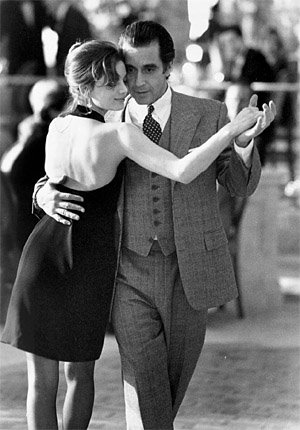
(and yes, isn't her back awfully bony? We wouldn't want bony backs like that, would we, ladies? We're glad our backs are--are---unbony, right? Right?) I'm here to tell you that yes, it does look like a lot of fun. It probably is a lot of fun, once you can do it. But I'm finding that hard to imagine, now that I've tried it.
Picture, instead, a dance in which there are about a thousand possible steps and combinations of steps (see this). The steps are not easy to do; they are actually fiendishly difficult to learn (at least for me). It's not so much the steps themselves as it is the weight shifting and the stance and the feel of it all (I think a ballet background may actually be counterproductive--at least, I'll use that as part of my excuse).
And these steps never come in any order or pattern; it's all improvised by the man, or "leader." The woman--the "follower"--must somehow read his body, or his mind, or both, and do what's required. The man must know exactly what he's going to do and telegraph it unequivocally, with no hesitation, or the woman will become confused--if she isn't already, like me.
I'd never really thought much about it before, but ballet dancers are very into control and predictability in the dance form. Ordinarily, every movement is prescribed and choreographed; the dancer knows where even his/her fingers are supposed to be, and it's all rehearsed over and over again. Of course, within that form, there's a strange sort of freedom--the dance itself is so large, the movements so glorious, that the feeling is of flight and soaring and lyric oneness with the music. But it's achieved through a strict control.
Not so the tango. At my introductory lesson, the other beginners were not nearly as beginnerish as me. The tango seems to attract the young (that is, people in their twenties) and the getting-on-in-years (that is, those older than I am). All of them tried to be polite when paired up with the most inexperienced novice there--moi. But I could see something in their eyes (and when you dance tango, you can really see their eyes, up close and personal) that said "Get me outta here; this lady hasn't a clue what she's doing."
I managed not to step on any toes, including my own. And I may indeed go back for more. They say tango is not only difficult, it's addictive:
Students--even if they are experienced dancers--discuss how hard it is to survive their first attempts at the complex steps. Emil Waldteufel, the chef-owner of Emil's restaurant in Santa Rosa, has studied all kinds of dance in his life, including tap dancing in the hoofer style. He has even performed onstage. "The first few lessons, I found tango difficult. I was blurting out 'I'm sorry' all the time, but I've progressed well. Sometimes a breath of the music will come over me while I'm working and I'll happily execute a little step...
Paul, a 58-year-old vineyard mechanic...describes tango as "a dance for overachievers. It draws intelligent people because it's not easy to learn. But it still has soul. Tango has a way of making you yearn for it."
We'll see.
Wednesday, April 12, 2006
Calling all horticulturalists

I've been seeing these everywhere--bushes that feature branches with startlingly bright red bark, almost as though they've been dipped in paint (even brighter than in the photo). I've never noticed them before, although I can be fairly certain they're not a new phenomenon.
So, what are they? Any bush experts here, of the botanical variety?
The Cuban missile crisis vs. Iran: making an opponent blink
This blog isn't really becoming an "all Iran, all the time" zone. But at the moment, the conundrum we face over Iran is particularly pressing, involving some very basic ethical and tactical questions that interest me. So, here we go again--
The situation reminds me (in several different ways) of an image I recall from the end of the movie "On the Beach" (stuff of nightmares), a banner reading:
There is still time, brothers.
Yes, there is still time. But how much time we have left is not at all certain, although it's fairly clear that all of those speculating on that question do not know the answer.
In today's Washington Post, David Ignatius has written this column on the subject of Iran (via Austin Bay, whose analysis of the Ignatious column appears here). Ignatius's piece illustrates the strange propensity of many writers to make assumptions that they believe are obviously valid--no need to argue the points; enough to merely to state them as though they are tautologies. But are they?
For example, Ignatius writes the following:
The administration insists that it wants diplomacy to do the preemption, even as its military planners are studying how to take out Iran's nuclear facilities if diplomacy should fail. Iran, meanwhile, is pursuing its own version of preemption, announcing yesterday that it has begun enriching uranium -- a crucial first step toward making a bomb. Neither side wants war -- who in his right mind would? -- but both frame choices in ways that make war increasingly likely.
There are two things I notice right away about that paragraph. The first is the tendency of Ignatious to "frame" the situation in terms of symmetry: both sides are thought to be doing what they are doing in order to effect "preemption." But the assumption on the part of Ignatius that preemption is Iran's goal--rather than a first strike on, for example, Israel--is mere speculation, although he bases his argument on it.
But the even more serious speculation in which Ignatius engages is in the last sentence of that paragraph: Neither side wants war--who in his right mind would?
The unfounded assumption in that sentence probably leapt out at any sentient reader. Ignatious's wishful thinking--that Iran's leaders do not want war, because they must be in their right minds--is understandable, but only as wishful thinking, rather than being based on the evidence (not that Ignatious presents any evidence). After all, who among us in his/her right mind would want to believe that the leaders of a large country developing a nuclear strike capacity and in league with global terrorists are not in their right minds?
But, understandable though this wish is--just like Neville Chamberlain's similar hope that Hitler was a gentleman with whom he could do diplomatic business--taking it on faith and believing it is a dangerous idea that could (to use Ignatius's very own words) "frame choices in ways that make war increasingly likely," as a similar notion arguably did in Hitler's day.
After all, even Seymour Hersh's article (which Ignatius has obviously read, since he quotes it in his very next paragraph) indicated that many consider the Iranian leaders to be "nutcases--one hundred percent totally certified nuts." But Ignatius manages to write an entire piece ignoring that elephant in the room by simply dismissing it without discussion in one quick sentence--"who in his right mind," indeed!
Ignatius briefly compares the current Iranian situation to the Cuban missile crisis of 1962. He writes that Kennedy came up with what he calls a "creative" solution to that one [emphasis mine]:
[Kennedy] issued a deadline but privately delayed it; he answered a first, flexible message from Soviet Premier Nikita Khrushchev but not a second unyielding one; he said he would never take U.S. missiles out of Turkey, as the Soviets were demanding, and then secretly did precisely that. Disaster was avoided because Khrushchev believed Kennedy was willing to risk war -- but wanted to avoid it.
I would suggest to Ignatius that, although that is true as far as it goes, he is missing the point. Disaster was avoided for a combination of reasons, and the one he states would not have mattered in the least had not there been an answering echo on the part of Khrushchev who, likewise, was willing to risk war but wanted to avoid it.
And that's not "wanted to avoid it" in the sense of "would have vaguely preferred not to." It means very deeply wished to avoid it, because Khrushchev was a rational actor and believed nuclear war between the superpowers would wreak havoc on the world, as well as his own country and people.
Khrushchev was many things, but he was not a sadistic butcher like his predecessor, Stalin. He believed the Soviet system would triumph, but he wanted the Soviet people to actually survive long enough to do so. He was a practical man, focused quite clearly on this world rather than rewards in the next, and as such, he was indeed a rational actor in the political sense. That meant that he was, in a very real way, a "partner for peace"--or, at least, a partner for cold war rather than hot.
And that was the real reason Khrushchev blinked when confronted with Kennedy's "creative" solutions.
I've written elsewhere that I believe the best course of action right now vis a vis Iran would be to work for regime change though clandestine operations within that country. I also believe we need to have a plan in place to take out Iran's nuclear facilities if need be. I have no idea whether we still have the time, the resources, the expertise, and the will to succeed in either of those endeavors. But I do know that, so far, there has been no evidence that the current Iranian administration qualifies as a rational actor with self-protective instincts towards its own people, and that would preclude us from relying on a particular subset of possible solutions (creative or otherwise) that assume that the Iranian leaders are indeed in their right minds.
The need to protect one's own people in this world--rather than to secure them a place in the world to come--seems to be a prerequisite for traditional deterrence to work. After all, blinking is a self-protective function.
[ADDENDUM: Shrinkwrapped weighs in on the state of mind of the Iranian leaders. And Shrinkwrapped, unlike David Ignatius, is in the business of being able to predict future violent behavior.]
[ADDENDUM II: Unless some important news breaks on the Iran front, I plan to take at least a short break from posts about Iran, starting tomorrow. Promise.]
[ADDENDUM III: Vital Perspectives sums it up rather nicely, I think: ...the pundits tend to fall back on the old models of the Soviet Union and the Cold War. Yet Iran is not the Soviet Union and represents a threat on a completely different level. Simply put, the world has never seen an Islamic extremist terrorist state armed with nuclear weapons.]
The situation reminds me (in several different ways) of an image I recall from the end of the movie "On the Beach" (stuff of nightmares), a banner reading:
There is still time, brothers.
Yes, there is still time. But how much time we have left is not at all certain, although it's fairly clear that all of those speculating on that question do not know the answer.
In today's Washington Post, David Ignatius has written this column on the subject of Iran (via Austin Bay, whose analysis of the Ignatious column appears here). Ignatius's piece illustrates the strange propensity of many writers to make assumptions that they believe are obviously valid--no need to argue the points; enough to merely to state them as though they are tautologies. But are they?
For example, Ignatius writes the following:
The administration insists that it wants diplomacy to do the preemption, even as its military planners are studying how to take out Iran's nuclear facilities if diplomacy should fail. Iran, meanwhile, is pursuing its own version of preemption, announcing yesterday that it has begun enriching uranium -- a crucial first step toward making a bomb. Neither side wants war -- who in his right mind would? -- but both frame choices in ways that make war increasingly likely.
There are two things I notice right away about that paragraph. The first is the tendency of Ignatious to "frame" the situation in terms of symmetry: both sides are thought to be doing what they are doing in order to effect "preemption." But the assumption on the part of Ignatius that preemption is Iran's goal--rather than a first strike on, for example, Israel--is mere speculation, although he bases his argument on it.
But the even more serious speculation in which Ignatius engages is in the last sentence of that paragraph: Neither side wants war--who in his right mind would?
The unfounded assumption in that sentence probably leapt out at any sentient reader. Ignatious's wishful thinking--that Iran's leaders do not want war, because they must be in their right minds--is understandable, but only as wishful thinking, rather than being based on the evidence (not that Ignatious presents any evidence). After all, who among us in his/her right mind would want to believe that the leaders of a large country developing a nuclear strike capacity and in league with global terrorists are not in their right minds?
But, understandable though this wish is--just like Neville Chamberlain's similar hope that Hitler was a gentleman with whom he could do diplomatic business--taking it on faith and believing it is a dangerous idea that could (to use Ignatius's very own words) "frame choices in ways that make war increasingly likely," as a similar notion arguably did in Hitler's day.
After all, even Seymour Hersh's article (which Ignatius has obviously read, since he quotes it in his very next paragraph) indicated that many consider the Iranian leaders to be "nutcases--one hundred percent totally certified nuts." But Ignatius manages to write an entire piece ignoring that elephant in the room by simply dismissing it without discussion in one quick sentence--"who in his right mind," indeed!
Ignatius briefly compares the current Iranian situation to the Cuban missile crisis of 1962. He writes that Kennedy came up with what he calls a "creative" solution to that one [emphasis mine]:
[Kennedy] issued a deadline but privately delayed it; he answered a first, flexible message from Soviet Premier Nikita Khrushchev but not a second unyielding one; he said he would never take U.S. missiles out of Turkey, as the Soviets were demanding, and then secretly did precisely that. Disaster was avoided because Khrushchev believed Kennedy was willing to risk war -- but wanted to avoid it.
I would suggest to Ignatius that, although that is true as far as it goes, he is missing the point. Disaster was avoided for a combination of reasons, and the one he states would not have mattered in the least had not there been an answering echo on the part of Khrushchev who, likewise, was willing to risk war but wanted to avoid it.
And that's not "wanted to avoid it" in the sense of "would have vaguely preferred not to." It means very deeply wished to avoid it, because Khrushchev was a rational actor and believed nuclear war between the superpowers would wreak havoc on the world, as well as his own country and people.
Khrushchev was many things, but he was not a sadistic butcher like his predecessor, Stalin. He believed the Soviet system would triumph, but he wanted the Soviet people to actually survive long enough to do so. He was a practical man, focused quite clearly on this world rather than rewards in the next, and as such, he was indeed a rational actor in the political sense. That meant that he was, in a very real way, a "partner for peace"--or, at least, a partner for cold war rather than hot.
And that was the real reason Khrushchev blinked when confronted with Kennedy's "creative" solutions.
I've written elsewhere that I believe the best course of action right now vis a vis Iran would be to work for regime change though clandestine operations within that country. I also believe we need to have a plan in place to take out Iran's nuclear facilities if need be. I have no idea whether we still have the time, the resources, the expertise, and the will to succeed in either of those endeavors. But I do know that, so far, there has been no evidence that the current Iranian administration qualifies as a rational actor with self-protective instincts towards its own people, and that would preclude us from relying on a particular subset of possible solutions (creative or otherwise) that assume that the Iranian leaders are indeed in their right minds.
The need to protect one's own people in this world--rather than to secure them a place in the world to come--seems to be a prerequisite for traditional deterrence to work. After all, blinking is a self-protective function.
[ADDENDUM: Shrinkwrapped weighs in on the state of mind of the Iranian leaders. And Shrinkwrapped, unlike David Ignatius, is in the business of being able to predict future violent behavior.]
[ADDENDUM II: Unless some important news breaks on the Iran front, I plan to take at least a short break from posts about Iran, starting tomorrow. Promise.]
[ADDENDUM III: Vital Perspectives sums it up rather nicely, I think: ...the pundits tend to fall back on the old models of the Soviet Union and the Cold War. Yet Iran is not the Soviet Union and represents a threat on a completely different level. Simply put, the world has never seen an Islamic extremist terrorist state armed with nuclear weapons.]
Move along; no terror connection here
This article by Stephen F. Hayes in the Weekly Standard discusses the links between Saddam Hussein's regime and worldwide Islamicist terrorism revealed in some of the recently declassified Iraqi documents:
The Saddam Fedayeen also took part in the regime's domestic terrorism operations and planned for attacks throughout Europe and the Middle East. In a document dated May 1999, Saddam's older son, Uday, ordered preparations for "special operations, assassinations, and bombings, for the centers and traitor symbols in London, Iran and the self-ruled areas [Kurdistan]." Preparations for "Blessed July," a regime-directed wave of "martyrdom" operations against targets in the West, were well under way at the time of the coalition invasion.
Why has this news been such a relative non-event in the MSM? (And, is that a rhetorical question?) These documents have been slowly showing, in small dribs and dabs, a clear connection between Saddam's regime and terrorism (the earlier part of the article is all about Saddam's support for Abu Sayyaf, the al Qaeda-linked jihadist group in the Philippines).
Why is all of this considered so very ho-hum? Would it interrupt the preferred narrative? Is it too much to ask that the MSM should bring us news even if the information would challenge prior assumptions many in the MSM have been trying to promote? (And, once again, are these questions rhetorical?)
The Saddam Fedayeen also took part in the regime's domestic terrorism operations and planned for attacks throughout Europe and the Middle East. In a document dated May 1999, Saddam's older son, Uday, ordered preparations for "special operations, assassinations, and bombings, for the centers and traitor symbols in London, Iran and the self-ruled areas [Kurdistan]." Preparations for "Blessed July," a regime-directed wave of "martyrdom" operations against targets in the West, were well under way at the time of the coalition invasion.
Why has this news been such a relative non-event in the MSM? (And, is that a rhetorical question?) These documents have been slowly showing, in small dribs and dabs, a clear connection between Saddam's regime and terrorism (the earlier part of the article is all about Saddam's support for Abu Sayyaf, the al Qaeda-linked jihadist group in the Philippines).
Why is all of this considered so very ho-hum? Would it interrupt the preferred narrative? Is it too much to ask that the MSM should bring us news even if the information would challenge prior assumptions many in the MSM have been trying to promote? (And, once again, are these questions rhetorical?)
Tuesday, April 11, 2006
Mark Steyn on the Iranians: believe what you hear
History (like life) must be lived forwards, but can only be understood backwards, if at all.
That adage came to mind as I was reading this piece by the inimitable Mark Steyn.
Assignment, class: compare and contrast the clarity of the Steyn piece on Iran (not to mention the writing style) to the murky gobbledygook on roughly the same subject that Seymour Hersh recently spewed out onto the pages of the New Yorker, whose editors seem to have taken leave of their editorial senses when they invited him on board.
I discussed Hersh's piece yesterday, here. Today I'm going to discuss Steyn's.
Ah, but who's Steyn? After all, he's only an opinion columnist--unlike the veteran Pulitzer Prize-winning Hersh, who became famous for having My Lai dumped in his lap through a tip in 1969, and then investigating the story and writing a series of articles and a book on the subject. This Salon puff-piece on Hersh makes it clear how much fame and journalistic glory descended on Hersh as a result of his My Lai work. Hersh has tried to follow the winning formula ever since: reliance on the tip, almost always anonymous, to lead him to a story that exposes US atrocities and/or atrocities-in-the-making. And if he can't find them, he'll invent them, or report unsourced rumors and innuendos as fact.
One of these days, one of these days--I plan to write a longer piece about Hersh, whose fingerprints can be found in some of the most surprising places. But for now, I urge you to read this piece on Hersh from the Columbia Journalism Review, hardly a right-wing hit job, but full of interesting stuff nevertheless.
Steyn doesn't have nearly the reputation of Hersh, but he makes use of two items that don't seem to be in Hersh's toolbox: excellent writing; and, more importantly, logic. But now I'll let Steyn speak for himself on the subject of Iran: what sort of leaders it has, what their intentions might be, and whether it is a "rational" or "pragmatic" actor:
If we’d understood Iran back in 1979, we’d understand better the challenges we face today. Come to that, we might not even be facing them...When [the mullahs of Iran] say “Islamic Republic,” they mean it. And refusing to take their words at face value has bedeviled Western strategists for three decades.
Twenty-seven years ago, because Islam didn’t fit into the old cold war template, analysts mostly discounted it....Very few of us considered the strategic implications of an Islamist victory on its own terms—the notion that Iran was checking the neither-of-the-above box and that that box would prove a far greater threat to the Freeish World than Communism...
Our failure to understand Iran in the seventies foreshadowed our failure to understand the broader struggle today. As clashes of civilizations go, this one’s between two extremes: on the one hand, a world that has everything it needs to wage decisive war—wealth, armies, industry, technology; on the other, a world that has nothing but pure ideology and plenty of believers. (Its sole resource, oil, would stay in the ground were it not for foreign technology, foreign manpower, and a Western fetishization of domestic environmental aesthetics.)
For this to be a mortal struggle, as the cold war was, the question is: Are they a credible enemy to us?
For a projection of the likely outcome, the question is: Are we a credible enemy to them?...
If you dust off the 1933 Montevideo Convention on the Rights and Duties of States, Article One reads: “The state as a person of international law should possess the following qualifications: (a) a permanent population; (b) a defined territory; (c) government; and (d) capacity to enter into relations with the other states.” Iran fails to meet qualification (d), and has never accepted it. The signature act of the new regime was not the usual post-coup bloodletting and summary execution of the shah’s mid-ranking officials but the seizure of the U.S. embassy in Tehran by “students” acting with Khomeini’s blessing. Diplomatic missions are recognized as the sovereign territory of that state, and the violation thereof is an act of war...Yet Iran paid no price. They got away with it...Washington should have reversed the affront to international order quickly, decisively, and in a sufficiently punitive manner. At hinge moments of history, there are never good and bad options, only bad and much much worse. Our options today are significantly worse because we didn’t take the bad one back then.
Here's what Steyn has to say on what Iran is prepared to do, and the nature of its reach:
Anyone who spends half an hour looking at Iranian foreign policy over the last 27 years sees five things [right before this Steyn has cited, among other things, the Iranian-led bombing of a Jewish community center in Buenos Aires in 1994, which killed about 100 people and injured another 250] :
1. contempt for the most basic international conventions;
2. long-reach extraterritoriality;
3. effective promotion of radical Pan-Islamism;
4. a willingness to go the extra mile for Jew-killing (unlike, say, Osama);
5. an all-but-total synchronization between rhetoric and action.
Yes, believe: synchronization between rhetoric and action. In analyzing that rhetoric, Steyn goes on to compare the two candidates in Iran's most recent election ("hothead" vs. "moderate"--and, by the way, the "hothead" Ahmadinejad won):
What’s the difference between a hothead and a moderate? Well, the extremist Ahmadinejad has called for Israel to be “wiped off the map,” while the moderate Rafsanjani has declared that Israel is “the most hideous occurrence in history,” which the Muslim world “will vomit out from its midst” in one blast, because “a single atomic bomb has the power to completely destroy Israel, while an Israeli counter-strike can only cause partial damage to the Islamic world.” Evidently wiping Israel off the map seems to be one of those rare points of bipartisan consensus in Tehran, the Iranian equivalent of a prescription drug plan for seniors: we’re just arguing over the details.
So the question is: Will they do it?
And the minute you have to ask, you know the answer. If, say, Norway or Ireland acquired nuclear weapons, we might regret the “proliferation,” but we wouldn’t have to contemplate mushroom clouds over neighboring states. In that sense, the civilized world has already lost: to enter into negotiations with a jurisdiction headed by a Holocaust-denying millenarian nut job is, in itself, an act of profound weakness—the first concession, regardless of what weaselly settlement might eventually emerge.
Conversely, a key reason to stop Iran is to demonstrate that we can still muster the will to do so.
As for those negotiations with Iran, here is Steyn's description:
...the striking characteristic of the long diplomatic dance that brought us to this moment is how September 10th it’s all been. The free world’s delegated negotiators (the European Union) and transnational institutions (the IAEA) have continually given the impression that they’d be content just to boot it down the road to next year or the year after or find some arrangement—this decade’s Oil-for-Food or North Korean deal—that would get them off the hook. If you talk to EU foreign ministers, they’ve already psychologically accepted a nuclear Iran. Indeed, the chief characteristic of the West’s reaction to Iran’s nuclearization has been an enervated fatalism...
I don't know about the "enervated fatalism" part. From the Hersh article, I see something even more frightening than that: an out-of-touch-with-reality denial of the stark truths about Iran that Steyn's article so clearly delineates. It seems to me that many on the left, and in the world of diplomacy, actually and sincerely believe Iran to be a rational and pragmatic actor. Come to think of it, though, maybe that stance comes from one of "enervated fatalism" after all; if there's no way to stop Iran from going nuclear, if the "Hamlet men" of the diplomatic world have all "lost the name of action"--well then, best to believe it'll all be okay, because Iran is a rational actor just blowing hot air with its inflammatory rhetoric.
How much do Iranian leaders care about the possible negative consequences of its own war aims and/or rhetoric on the welfare and lives of its own people, or on others in the Moslem world? Not very, and not a whole lot, says Steyn:
Like Rafsanjani, [Ahmadinejad] would regard, say, Muslim deaths in an obliterated Jerusalem as worthy collateral damage in promoting the greater good of a Jew-free Middle East. The Palestinians and their “right of return” have never been more than a weapon of convenience with which to chastise the West. To assume Tehran would never nuke Israel because a shift in wind direction would contaminate Ramallah is to be as ignorant of history as most Palestinians are: from Yasser Arafat’s uncle, the pro-Nazi Grand Mufti of Jerusalem during the British Mandate, to the insurgents in Iraq today, Islamists have never been shy about slaughtering Muslims in pursuit of their strategic goals....
The remedy? As I wrote yesterday, the answer is not clear, and the choices are not easy. But whether or not it can be accomplished--and, if so, how (and I'm in favor of clandestine operations)--regime change in Iran is a worthy goal.
And if that statement makes me one of those nefarious neocons, then so be it; I may as well live up to my name. And I guess Steyn is one, too:
Nukes have gone freelance, and there’s nothing much we can do about that, and sooner or later we’ll see the consequences—in Vancouver or Rotterdam, Glasgow or Atlanta. But, that being so, we owe it to ourselves to take the minimal precautionary step of ending the one regime whose political establishment is explicitly pledged to the nuclear annihilation of neighboring states.
We owe it to ourselves, and to the world--including the Moslem world.
That adage came to mind as I was reading this piece by the inimitable Mark Steyn.
Assignment, class: compare and contrast the clarity of the Steyn piece on Iran (not to mention the writing style) to the murky gobbledygook on roughly the same subject that Seymour Hersh recently spewed out onto the pages of the New Yorker, whose editors seem to have taken leave of their editorial senses when they invited him on board.
I discussed Hersh's piece yesterday, here. Today I'm going to discuss Steyn's.
Ah, but who's Steyn? After all, he's only an opinion columnist--unlike the veteran Pulitzer Prize-winning Hersh, who became famous for having My Lai dumped in his lap through a tip in 1969, and then investigating the story and writing a series of articles and a book on the subject. This Salon puff-piece on Hersh makes it clear how much fame and journalistic glory descended on Hersh as a result of his My Lai work. Hersh has tried to follow the winning formula ever since: reliance on the tip, almost always anonymous, to lead him to a story that exposes US atrocities and/or atrocities-in-the-making. And if he can't find them, he'll invent them, or report unsourced rumors and innuendos as fact.
One of these days, one of these days--I plan to write a longer piece about Hersh, whose fingerprints can be found in some of the most surprising places. But for now, I urge you to read this piece on Hersh from the Columbia Journalism Review, hardly a right-wing hit job, but full of interesting stuff nevertheless.
Steyn doesn't have nearly the reputation of Hersh, but he makes use of two items that don't seem to be in Hersh's toolbox: excellent writing; and, more importantly, logic. But now I'll let Steyn speak for himself on the subject of Iran: what sort of leaders it has, what their intentions might be, and whether it is a "rational" or "pragmatic" actor:
If we’d understood Iran back in 1979, we’d understand better the challenges we face today. Come to that, we might not even be facing them...When [the mullahs of Iran] say “Islamic Republic,” they mean it. And refusing to take their words at face value has bedeviled Western strategists for three decades.
Twenty-seven years ago, because Islam didn’t fit into the old cold war template, analysts mostly discounted it....Very few of us considered the strategic implications of an Islamist victory on its own terms—the notion that Iran was checking the neither-of-the-above box and that that box would prove a far greater threat to the Freeish World than Communism...
Our failure to understand Iran in the seventies foreshadowed our failure to understand the broader struggle today. As clashes of civilizations go, this one’s between two extremes: on the one hand, a world that has everything it needs to wage decisive war—wealth, armies, industry, technology; on the other, a world that has nothing but pure ideology and plenty of believers. (Its sole resource, oil, would stay in the ground were it not for foreign technology, foreign manpower, and a Western fetishization of domestic environmental aesthetics.)
For this to be a mortal struggle, as the cold war was, the question is: Are they a credible enemy to us?
For a projection of the likely outcome, the question is: Are we a credible enemy to them?...
If you dust off the 1933 Montevideo Convention on the Rights and Duties of States, Article One reads: “The state as a person of international law should possess the following qualifications: (a) a permanent population; (b) a defined territory; (c) government; and (d) capacity to enter into relations with the other states.” Iran fails to meet qualification (d), and has never accepted it. The signature act of the new regime was not the usual post-coup bloodletting and summary execution of the shah’s mid-ranking officials but the seizure of the U.S. embassy in Tehran by “students” acting with Khomeini’s blessing. Diplomatic missions are recognized as the sovereign territory of that state, and the violation thereof is an act of war...Yet Iran paid no price. They got away with it...Washington should have reversed the affront to international order quickly, decisively, and in a sufficiently punitive manner. At hinge moments of history, there are never good and bad options, only bad and much much worse. Our options today are significantly worse because we didn’t take the bad one back then.
Here's what Steyn has to say on what Iran is prepared to do, and the nature of its reach:
Anyone who spends half an hour looking at Iranian foreign policy over the last 27 years sees five things [right before this Steyn has cited, among other things, the Iranian-led bombing of a Jewish community center in Buenos Aires in 1994, which killed about 100 people and injured another 250] :
1. contempt for the most basic international conventions;
2. long-reach extraterritoriality;
3. effective promotion of radical Pan-Islamism;
4. a willingness to go the extra mile for Jew-killing (unlike, say, Osama);
5. an all-but-total synchronization between rhetoric and action.
Yes, believe: synchronization between rhetoric and action. In analyzing that rhetoric, Steyn goes on to compare the two candidates in Iran's most recent election ("hothead" vs. "moderate"--and, by the way, the "hothead" Ahmadinejad won):
What’s the difference between a hothead and a moderate? Well, the extremist Ahmadinejad has called for Israel to be “wiped off the map,” while the moderate Rafsanjani has declared that Israel is “the most hideous occurrence in history,” which the Muslim world “will vomit out from its midst” in one blast, because “a single atomic bomb has the power to completely destroy Israel, while an Israeli counter-strike can only cause partial damage to the Islamic world.” Evidently wiping Israel off the map seems to be one of those rare points of bipartisan consensus in Tehran, the Iranian equivalent of a prescription drug plan for seniors: we’re just arguing over the details.
So the question is: Will they do it?
And the minute you have to ask, you know the answer. If, say, Norway or Ireland acquired nuclear weapons, we might regret the “proliferation,” but we wouldn’t have to contemplate mushroom clouds over neighboring states. In that sense, the civilized world has already lost: to enter into negotiations with a jurisdiction headed by a Holocaust-denying millenarian nut job is, in itself, an act of profound weakness—the first concession, regardless of what weaselly settlement might eventually emerge.
Conversely, a key reason to stop Iran is to demonstrate that we can still muster the will to do so.
As for those negotiations with Iran, here is Steyn's description:
...the striking characteristic of the long diplomatic dance that brought us to this moment is how September 10th it’s all been. The free world’s delegated negotiators (the European Union) and transnational institutions (the IAEA) have continually given the impression that they’d be content just to boot it down the road to next year or the year after or find some arrangement—this decade’s Oil-for-Food or North Korean deal—that would get them off the hook. If you talk to EU foreign ministers, they’ve already psychologically accepted a nuclear Iran. Indeed, the chief characteristic of the West’s reaction to Iran’s nuclearization has been an enervated fatalism...
I don't know about the "enervated fatalism" part. From the Hersh article, I see something even more frightening than that: an out-of-touch-with-reality denial of the stark truths about Iran that Steyn's article so clearly delineates. It seems to me that many on the left, and in the world of diplomacy, actually and sincerely believe Iran to be a rational and pragmatic actor. Come to think of it, though, maybe that stance comes from one of "enervated fatalism" after all; if there's no way to stop Iran from going nuclear, if the "Hamlet men" of the diplomatic world have all "lost the name of action"--well then, best to believe it'll all be okay, because Iran is a rational actor just blowing hot air with its inflammatory rhetoric.
How much do Iranian leaders care about the possible negative consequences of its own war aims and/or rhetoric on the welfare and lives of its own people, or on others in the Moslem world? Not very, and not a whole lot, says Steyn:
Like Rafsanjani, [Ahmadinejad] would regard, say, Muslim deaths in an obliterated Jerusalem as worthy collateral damage in promoting the greater good of a Jew-free Middle East. The Palestinians and their “right of return” have never been more than a weapon of convenience with which to chastise the West. To assume Tehran would never nuke Israel because a shift in wind direction would contaminate Ramallah is to be as ignorant of history as most Palestinians are: from Yasser Arafat’s uncle, the pro-Nazi Grand Mufti of Jerusalem during the British Mandate, to the insurgents in Iraq today, Islamists have never been shy about slaughtering Muslims in pursuit of their strategic goals....
The remedy? As I wrote yesterday, the answer is not clear, and the choices are not easy. But whether or not it can be accomplished--and, if so, how (and I'm in favor of clandestine operations)--regime change in Iran is a worthy goal.
And if that statement makes me one of those nefarious neocons, then so be it; I may as well live up to my name. And I guess Steyn is one, too:
Nukes have gone freelance, and there’s nothing much we can do about that, and sooner or later we’ll see the consequences—in Vancouver or Rotterdam, Glasgow or Atlanta. But, that being so, we owe it to ourselves to take the minimal precautionary step of ending the one regime whose political establishment is explicitly pledged to the nuclear annihilation of neighboring states.
We owe it to ourselves, and to the world--including the Moslem world.
Election in Italy: another close one
I see a trend here, although it's not one I claim to understand: the Italian election is another cliff-hanger, too close to form a clear majority and give a clear mandate:
Final results showed Prodi's alliance taking control of the Chamber, winning by a margin of just 25,224 out of more than 38 million votes cast. Berlusconi's coalition held a one-seat lead in the Senate, with the results of six seats for Italians living abroad to be determined later today.
Shades of Germany last fall:
The outcome of the Italian vote has parallels with the inconclusive election result in Germany in September. Christian Democrat Angela Merkel eventually formed a ``grand coalition'' with the Social Democrats after two months of talks which led to outgoing Social Democrat Chancellor Gerhard Schroeder's retirement from politics.
Our last two Presidential elections were rather close, too, as you might recall.
What does it mean? Beats me. A sort of equal-opportunity disillusionment with all parties?
Final results showed Prodi's alliance taking control of the Chamber, winning by a margin of just 25,224 out of more than 38 million votes cast. Berlusconi's coalition held a one-seat lead in the Senate, with the results of six seats for Italians living abroad to be determined later today.
Shades of Germany last fall:
The outcome of the Italian vote has parallels with the inconclusive election result in Germany in September. Christian Democrat Angela Merkel eventually formed a ``grand coalition'' with the Social Democrats after two months of talks which led to outgoing Social Democrat Chancellor Gerhard Schroeder's retirement from politics.
Our last two Presidential elections were rather close, too, as you might recall.
What does it mean? Beats me. A sort of equal-opportunity disillusionment with all parties?
Monday, April 10, 2006
Only the Shadow Knows: Seymour Hersh on Iran and the neocons
Seymour Hersh, who's hardly ever met a source he was willing to name, has written an article about Iran, the nuclear threat it represents, and what Hersh alleges are the Bush Administration's plans to bomb it with nuclear weapons. The article appears in the current (April 17) New Yorker.
The Hersh piece is written in an especially flat style, with sentence after plain declarative sentence and not a whole lot of analysis: a sort of Dragnet-speak, as it were. It is somewhat impenetrable at first, but then Hersh's agenda (or at least, part of his agenda) slowly emerges: the thing is the fault of those jumpy trigger-happy neocons again, looking for the shootout at the OK Corral.
It's a curious article, because even Hersh seems unable to deny that the current leaders of Iran are dangerous nutcases, talking trash about wasting Israel and the US. And, as with most Hersh articles, it's virtually impossible to evaluate the truth or falsehood of the unsourced assertions he piles up: is the Bush administration actually intending to carry out such an attack and, if so when? And would such as attack consist of a minimal number of bunker busters that would cause relatively few casualties, or would it be much more than that? Or is this all merely one of countless contingency plans that any administration would draw up while brainstorming, in order to be prepared for anything and everything?
Only the Shadow knows--or rather, Hersh's shadowy but nevertheless opinionated sources.
The thrust of Hersh's article is that Bush and the neocon cowboys are jumping the gun in order to effect their real goal, regime change in Iran, and that "all the cooler heads are saying, is give diplomacy a chance" [emphasis mine in the following quote]:
“This is much more than a nuclear issue,” one [nameless] high-ranking diplomat told me [Hersh] in Vienna. “That’s just a rallying point, and there is still time to fix it. But the Administration believes it cannot be fixed unless they control the hearts and minds of Iran. The real issue is who is going to control the Middle East and its oil in the next ten years.”
A [nameless] senior Pentagon adviser on the war on terror expressed a similar view. “This White House believes that the only way to solve the problem is to change the power structure in Iran, and that means war,” he said. The danger, he said, was that “it also reinforces the belief inside Iran that the only way to defend the country is to have a nuclear capability.” A military conflict that destabilized the region could also increase the risk of terror: “Hezbollah comes into play,” the adviser said, referring to the terror group that is considered one of the world’s most successful, and which is now a Lebanese political party with strong ties to Iran. “And here comes Al Qaeda.”
Hezbollah comes into play? And here comes Al Qaeda? And where have they all been until now? Biding their time, just waiting peacefully until Bush (courtesy of Seymour Hersh's article) declares that he might bomb Iran's nuclear facilities?
More on the evil neocons:
The [nameless] Pentagon adviser said that, in the event of an attack, the Air Force intended to strike many hundreds of targets in Iran but that “ninety-nine per cent of them have nothing to do with proliferation. There are people who believe it’s the way to operate”—that the Administration can achieve its policy goals in Iran with a bombing campaign, an idea that has been supported by neoconservatives.
Yes indeed, the speaker knows the administration is planning to bomb random sites which clearly have nothing to do with a weapons program that is, after all, secret, in order to effect regime change--just like those mean old neocons did with Saddam, whom everybody knew at the outset didn't have any WMDs.
The following passage illustrates what things have come to, these days (and includes a rare named source of Hersh's):
Robert Gallucci, a former government expert on nonproliferation who is now the dean of the School of Foreign Service at Georgetown, told me [Hersh], “Based on what I know, Iran could be eight to ten years away” from developing a deliverable nuclear weapon. Gallucci added, “If they had a covert nuclear program and we could prove it, and we could not stop it by negotiation, diplomacy, or the threat of sanctions, I’d be in favor of taking it out. But if you do it”—bomb Iran—“without being able to show there’s a secret program, you’re in trouble.”
It seems that the burden of proof is on us to prove something that by definition cannot be proven--the existence of a secret program, as with Saddam. Nowadays, intelligence is required to be perfect. It matters not that an obviously insane regime is making wild threats that indicate it is developing a bomb and will use it once it has gained the capacity, or even provide it to terrorists. No, that's not enough; we must prove beyond a reasonable doubt that the program is in place and the bomb actually developed before we are allowed to even consider--or, apparently, to even make contingency plans for the possibility of--defending ourselves and others against it.
The fact that by then it may be too late seems irrelevant to this argument. At the present time, all dictators are innocent till proven guilty.
Then there are those neocons again, causing so much trouble, and even causing bombmaker-in-captivity Khan to lie to please them:
In the most recent interrogations, [the Pakistani bombmaker] Khan has provided information on Iran’s weapons design and its time line for building a bomb. “The picture is of ‘unquestionable danger,’ ” the [unnamed] former senior intelligence official said. (The [unnamed] Pentagon adviser also confirmed that Khan has been “singing like a canary.”) The concern, the former senior official said, is that “Khan has credibility problems. He is suggestible, and he’s telling the neoconservatives what they want to hear”—
And here it is, the heart of the Hersh article (you knew it was coming, didn't you?):
The Administration’s case against Iran is compromised by its history of promoting false intelligence on Iraq’s weapons of mass destruction.
Note the clever phrasing--"history of promoting false intelligence." It stops short of saying "lying," although it leaves room for the insinuation. And the fact is that, unfortunately, the failure to find clear evidence of WMDs in Iraq has had this very effect--that any later claims of the same sort would be subject to a sky-high burden of proof, and would be met with "it's just those neocon boys crying wolf again" skepticism. This was always going to be part of the fallout of any errors made on that score--and even if some think the jury is still out on the subject of Saddam and WMDs, there has been no smoking gun found in Iraq as yet, and probably never will be.
Hersh's article is filled with multiple and varied estimates of how close Iran might be to actually having the bomb. But they are all just guesses; it's fairly clear that, in reality, no one has a clue. But our foreign policy must always rely on this sort of imperfect knowledge.
Unfortunately, the potential penalties for a wrong guess in either direction are extremely large: international condemnation and perhaps retaliation if we were to bomb Iran prematurely, especially with any sort of nuclear weaponry (and how could we ever prove ourselves to have been correct in our estimate of their nuclear capacity, ex post facto?); the destruction of Israel, and/or of several US cities, if we were to get it wrong in the other direction. (Oh, but at least, in the latter case, we'd occupy the moral high ground, wouldn't we?)
Here's one of my favorite passages, from an unnamed diplomat:
All of the [IAEA] inspectors are angry at being misled by the Iranians, and some think the Iranian leadership are nutcases—one hundred per cent totally certified nuts,” the diplomat said. He added that ElBaradei’s overriding concern is that the Iranian leaders “want confrontation, just like the neocons on the other side”—in Washington. “At the end of the day, it will work only if the United States agrees to talk to the Iranians.”
How this passage manages to go from the thought expressed in the first sentence ("the Iranian leadership is nuts") to that of the second (they are like the neocons, who want confrontation) and then on to the third (negotiation with the Iranian leadership can work, if only the US is willing to talk) is--well--it's practically nuts, as well. I fail to see even a semblance of logic here. Just to recap: murderous apocalyptic madmen in charge of a country are the equivalent of the people who are eager to stop them, and the latter are to be faulted for not engaging in negotiation with said madmen, which of course would work if attempted.
The Europeans seem to be every bit as dedicated to the maintenance of the current Iranian regime as they were to that of Saddam--which is to say, very dedicated indeed:
The Europeans are rattled, however, by their growing perception that President Bush and Vice-President Dick Cheney believe a bombing campaign will be needed, and that their real goal is regime change.
The rest of the article explains all the dire consequences of attacking Iran, assuming that any attack would unleash forces that would otherwise be held in check. The idea that diplomacy and sanctions can work--against a regime that has shown itself to be profoundly uninterested in either--is not a compelling one. But hope springs eternal, does it not?:
One reason for pursuing diplomacy was, [an unnamed diplomat] said, Iran’s essential pragmatism. “The regime acts in its best interests,” he said. Iran’s leaders “take a hard-line approach on the nuclear issue and they want to call the American bluff,” believing that “the tougher they are the more likely the West will fold.” But, he said, “From what we’ve seen with Iran, they will appear superconfident until the moment they back off.”
"Iran's essential pragmatism." Oh yes. Of course. Right. This unnamed diplomat knows the minds of the mullahs, and that they are just bluffing, and can be worked with. Nutcases and madman who threaten to destroy other states, and who seem to care nothing about the survival of their own people, are like that: very pragmatic, very amenable to sanctions and diplomacy.
Look, the Iranian situation is profoundly terrifying. It is far from clear that there is any solution that wouldn't be catastrophic, although to my way of thinking the best thing to do would be to encourage regime change clandestinely, from within (although the likelihood of success for such an option is unclear--and, unfortunately, time may be running out). But the entire Hersh piece, from beginning to end, is nothing more than a host of mostly nameless people playing guessing games.
The truth is that we may once again be facing (now, or at some unspecified date in the not-too-distant future) the need to make some very hard choices among crazinesses. Which of these is the least crazy--adopting a "wait-and-see" attitude, relying on diplomacy with madmen--or attacking, and dealing with the consequences? I think no one should pretend the answer is either easy or obvious.
In World War II, the "good guys" got the bomb first and then used it to shorten the war, with catastrophic loss of life for the Japanese of Hiroshima and Nagasaki (this was the "choice among crazinesses" that the US leadership made at the time). Some say that, by dropping those bombs on the Japanese, we forfeited our claim to be the good guys, but the argument that those bombings prevented even further bloodshed is quite compelling (I discuss the matter in this post, and in this one as well).
We may soon be facing a similar moral and tactical dilemma in which there is no good solution, although I profoundly hope not. But make no mistake about it: if we do, the fault lies with the Iranian leaders. Their intentions have never really been hidden; it's only now that they appear to be on the verge of acquiring the means to achieve their long-stated aims.
[ADDENDUM: The White House responds to the Hersh article, here, calling such reports "wild speculation." Here's the basic stance:
The White House sought Monday to minimize new speculation about a possible military strike against Iran while acknowledging that the Pentagon is developing contingency plans to deal with Tehran's nuclear ambitions. The Pentagon has refused to describe its planning further.
White House press secretary Scott McClellan refused to confirm or deny The New Yorker report. "Those who are seeking to draw broad conclusions based on normal military contingency planning are misinformed or not knowledgeable about the administration's thinking," he said.]
[ADDENDUM II: Ralph Peters weighs in with this interesting analysis (via Austin Bay).]
The Hersh piece is written in an especially flat style, with sentence after plain declarative sentence and not a whole lot of analysis: a sort of Dragnet-speak, as it were. It is somewhat impenetrable at first, but then Hersh's agenda (or at least, part of his agenda) slowly emerges: the thing is the fault of those jumpy trigger-happy neocons again, looking for the shootout at the OK Corral.
It's a curious article, because even Hersh seems unable to deny that the current leaders of Iran are dangerous nutcases, talking trash about wasting Israel and the US. And, as with most Hersh articles, it's virtually impossible to evaluate the truth or falsehood of the unsourced assertions he piles up: is the Bush administration actually intending to carry out such an attack and, if so when? And would such as attack consist of a minimal number of bunker busters that would cause relatively few casualties, or would it be much more than that? Or is this all merely one of countless contingency plans that any administration would draw up while brainstorming, in order to be prepared for anything and everything?
Only the Shadow knows--or rather, Hersh's shadowy but nevertheless opinionated sources.
The thrust of Hersh's article is that Bush and the neocon cowboys are jumping the gun in order to effect their real goal, regime change in Iran, and that "all the cooler heads are saying, is give diplomacy a chance" [emphasis mine in the following quote]:
“This is much more than a nuclear issue,” one [nameless] high-ranking diplomat told me [Hersh] in Vienna. “That’s just a rallying point, and there is still time to fix it. But the Administration believes it cannot be fixed unless they control the hearts and minds of Iran. The real issue is who is going to control the Middle East and its oil in the next ten years.”
A [nameless] senior Pentagon adviser on the war on terror expressed a similar view. “This White House believes that the only way to solve the problem is to change the power structure in Iran, and that means war,” he said. The danger, he said, was that “it also reinforces the belief inside Iran that the only way to defend the country is to have a nuclear capability.” A military conflict that destabilized the region could also increase the risk of terror: “Hezbollah comes into play,” the adviser said, referring to the terror group that is considered one of the world’s most successful, and which is now a Lebanese political party with strong ties to Iran. “And here comes Al Qaeda.”
Hezbollah comes into play? And here comes Al Qaeda? And where have they all been until now? Biding their time, just waiting peacefully until Bush (courtesy of Seymour Hersh's article) declares that he might bomb Iran's nuclear facilities?
More on the evil neocons:
The [nameless] Pentagon adviser said that, in the event of an attack, the Air Force intended to strike many hundreds of targets in Iran but that “ninety-nine per cent of them have nothing to do with proliferation. There are people who believe it’s the way to operate”—that the Administration can achieve its policy goals in Iran with a bombing campaign, an idea that has been supported by neoconservatives.
Yes indeed, the speaker knows the administration is planning to bomb random sites which clearly have nothing to do with a weapons program that is, after all, secret, in order to effect regime change--just like those mean old neocons did with Saddam, whom everybody knew at the outset didn't have any WMDs.
The following passage illustrates what things have come to, these days (and includes a rare named source of Hersh's):
Robert Gallucci, a former government expert on nonproliferation who is now the dean of the School of Foreign Service at Georgetown, told me [Hersh], “Based on what I know, Iran could be eight to ten years away” from developing a deliverable nuclear weapon. Gallucci added, “If they had a covert nuclear program and we could prove it, and we could not stop it by negotiation, diplomacy, or the threat of sanctions, I’d be in favor of taking it out. But if you do it”—bomb Iran—“without being able to show there’s a secret program, you’re in trouble.”
It seems that the burden of proof is on us to prove something that by definition cannot be proven--the existence of a secret program, as with Saddam. Nowadays, intelligence is required to be perfect. It matters not that an obviously insane regime is making wild threats that indicate it is developing a bomb and will use it once it has gained the capacity, or even provide it to terrorists. No, that's not enough; we must prove beyond a reasonable doubt that the program is in place and the bomb actually developed before we are allowed to even consider--or, apparently, to even make contingency plans for the possibility of--defending ourselves and others against it.
The fact that by then it may be too late seems irrelevant to this argument. At the present time, all dictators are innocent till proven guilty.
Then there are those neocons again, causing so much trouble, and even causing bombmaker-in-captivity Khan to lie to please them:
In the most recent interrogations, [the Pakistani bombmaker] Khan has provided information on Iran’s weapons design and its time line for building a bomb. “The picture is of ‘unquestionable danger,’ ” the [unnamed] former senior intelligence official said. (The [unnamed] Pentagon adviser also confirmed that Khan has been “singing like a canary.”) The concern, the former senior official said, is that “Khan has credibility problems. He is suggestible, and he’s telling the neoconservatives what they want to hear”—
And here it is, the heart of the Hersh article (you knew it was coming, didn't you?):
The Administration’s case against Iran is compromised by its history of promoting false intelligence on Iraq’s weapons of mass destruction.
Note the clever phrasing--"history of promoting false intelligence." It stops short of saying "lying," although it leaves room for the insinuation. And the fact is that, unfortunately, the failure to find clear evidence of WMDs in Iraq has had this very effect--that any later claims of the same sort would be subject to a sky-high burden of proof, and would be met with "it's just those neocon boys crying wolf again" skepticism. This was always going to be part of the fallout of any errors made on that score--and even if some think the jury is still out on the subject of Saddam and WMDs, there has been no smoking gun found in Iraq as yet, and probably never will be.
Hersh's article is filled with multiple and varied estimates of how close Iran might be to actually having the bomb. But they are all just guesses; it's fairly clear that, in reality, no one has a clue. But our foreign policy must always rely on this sort of imperfect knowledge.
Unfortunately, the potential penalties for a wrong guess in either direction are extremely large: international condemnation and perhaps retaliation if we were to bomb Iran prematurely, especially with any sort of nuclear weaponry (and how could we ever prove ourselves to have been correct in our estimate of their nuclear capacity, ex post facto?); the destruction of Israel, and/or of several US cities, if we were to get it wrong in the other direction. (Oh, but at least, in the latter case, we'd occupy the moral high ground, wouldn't we?)
Here's one of my favorite passages, from an unnamed diplomat:
All of the [IAEA] inspectors are angry at being misled by the Iranians, and some think the Iranian leadership are nutcases—one hundred per cent totally certified nuts,” the diplomat said. He added that ElBaradei’s overriding concern is that the Iranian leaders “want confrontation, just like the neocons on the other side”—in Washington. “At the end of the day, it will work only if the United States agrees to talk to the Iranians.”
How this passage manages to go from the thought expressed in the first sentence ("the Iranian leadership is nuts") to that of the second (they are like the neocons, who want confrontation) and then on to the third (negotiation with the Iranian leadership can work, if only the US is willing to talk) is--well--it's practically nuts, as well. I fail to see even a semblance of logic here. Just to recap: murderous apocalyptic madmen in charge of a country are the equivalent of the people who are eager to stop them, and the latter are to be faulted for not engaging in negotiation with said madmen, which of course would work if attempted.
The Europeans seem to be every bit as dedicated to the maintenance of the current Iranian regime as they were to that of Saddam--which is to say, very dedicated indeed:
The Europeans are rattled, however, by their growing perception that President Bush and Vice-President Dick Cheney believe a bombing campaign will be needed, and that their real goal is regime change.
The rest of the article explains all the dire consequences of attacking Iran, assuming that any attack would unleash forces that would otherwise be held in check. The idea that diplomacy and sanctions can work--against a regime that has shown itself to be profoundly uninterested in either--is not a compelling one. But hope springs eternal, does it not?:
One reason for pursuing diplomacy was, [an unnamed diplomat] said, Iran’s essential pragmatism. “The regime acts in its best interests,” he said. Iran’s leaders “take a hard-line approach on the nuclear issue and they want to call the American bluff,” believing that “the tougher they are the more likely the West will fold.” But, he said, “From what we’ve seen with Iran, they will appear superconfident until the moment they back off.”
"Iran's essential pragmatism." Oh yes. Of course. Right. This unnamed diplomat knows the minds of the mullahs, and that they are just bluffing, and can be worked with. Nutcases and madman who threaten to destroy other states, and who seem to care nothing about the survival of their own people, are like that: very pragmatic, very amenable to sanctions and diplomacy.
Look, the Iranian situation is profoundly terrifying. It is far from clear that there is any solution that wouldn't be catastrophic, although to my way of thinking the best thing to do would be to encourage regime change clandestinely, from within (although the likelihood of success for such an option is unclear--and, unfortunately, time may be running out). But the entire Hersh piece, from beginning to end, is nothing more than a host of mostly nameless people playing guessing games.
The truth is that we may once again be facing (now, or at some unspecified date in the not-too-distant future) the need to make some very hard choices among crazinesses. Which of these is the least crazy--adopting a "wait-and-see" attitude, relying on diplomacy with madmen--or attacking, and dealing with the consequences? I think no one should pretend the answer is either easy or obvious.
In World War II, the "good guys" got the bomb first and then used it to shorten the war, with catastrophic loss of life for the Japanese of Hiroshima and Nagasaki (this was the "choice among crazinesses" that the US leadership made at the time). Some say that, by dropping those bombs on the Japanese, we forfeited our claim to be the good guys, but the argument that those bombings prevented even further bloodshed is quite compelling (I discuss the matter in this post, and in this one as well).
We may soon be facing a similar moral and tactical dilemma in which there is no good solution, although I profoundly hope not. But make no mistake about it: if we do, the fault lies with the Iranian leaders. Their intentions have never really been hidden; it's only now that they appear to be on the verge of acquiring the means to achieve their long-stated aims.
[ADDENDUM: The White House responds to the Hersh article, here, calling such reports "wild speculation." Here's the basic stance:
The White House sought Monday to minimize new speculation about a possible military strike against Iran while acknowledging that the Pentagon is developing contingency plans to deal with Tehran's nuclear ambitions. The Pentagon has refused to describe its planning further.
White House press secretary Scott McClellan refused to confirm or deny The New Yorker report. "Those who are seeking to draw broad conclusions based on normal military contingency planning are misinformed or not knowledgeable about the administration's thinking," he said.]
[ADDENDUM II: Ralph Peters weighs in with this interesting analysis (via Austin Bay).]
Sunday, April 09, 2006
The usual suspects
Light blogging today. It's Sunday, beautiful weather, and--among other things--I need to do a bunch of work on my mother's taxes.
But I just wanted to point out that, overnight, something seems to have eaten my tulip leaves ("Eats, Shoots and Leaves"--indeed!).
Take a look; it's a sad and sorry sight, and I want some sympathy:

(The photo doesn't really do justice to the jagged, amputated quality of the leaves, but it's the best I could do).
Each year it happens, if I forget to spray the things with the noxious brew (eau de rotten eggs and hot peppers) known as "Deer Off" in time. This year I tried--I tried--but the friggin nozzle was clogged and could not get unclogged, and I just today managed to get a substitute spray thingee.
But alas, too late. The usual suspects--be they deer, squirrels, dogs with strange culinary tastes, neighbors with same, whoever and whatever their identity--have had their way with my tulip foliage, providing a graphic and all-too-poignant demonstration of the phrase "nipped in the bud."
But at least I got a post out of it.
See you tomorrow.
But I just wanted to point out that, overnight, something seems to have eaten my tulip leaves ("Eats, Shoots and Leaves"--indeed!).
Take a look; it's a sad and sorry sight, and I want some sympathy:

(The photo doesn't really do justice to the jagged, amputated quality of the leaves, but it's the best I could do).
Each year it happens, if I forget to spray the things with the noxious brew (eau de rotten eggs and hot peppers) known as "Deer Off" in time. This year I tried--I tried--but the friggin nozzle was clogged and could not get unclogged, and I just today managed to get a substitute spray thingee.
But alas, too late. The usual suspects--be they deer, squirrels, dogs with strange culinary tastes, neighbors with same, whoever and whatever their identity--have had their way with my tulip foliage, providing a graphic and all-too-poignant demonstration of the phrase "nipped in the bud."
But at least I got a post out of it.
See you tomorrow.
Saturday, April 08, 2006
Wafa Sultan, Jacksonian, vs. the Boston Phoenix: feeding that ravenous crocodile
[CORRECTION: It's been pointed out by several commenters that the linked article appears to be by one Amit Ghate, not Wafa Sultan, although it appeared on the latter's blog. The link was originally sent to me and identified as being from Wafa Sultan's blog. Under the influence of mental set and expectations, I assumed that it was by Dr. Sultan herself, without thinking to check the byline. I usually try to be extraordinarily careful about such things, but I'm only human, and certainly some things can slip by me, as this one did. So, I stand corrected: it was published on Dr. Sultan's blog, but it is by Amit Ghate. And, although Dr. Sultan is still the same brave person, she didn't write the "extraordinarily hard-hitting article," although it certainly seems to be simpatico with her point of view.]
No, Wafa Sultan hasn't directly challenged the alternative newspaper known as the Boston Phoenix. But she mentions the paper in passing in this extraordinarily hard-hitting article which appeared on her website "Annaqed."
Dr. Sultan, whom I wrote about previously here, is Syrian-born. She is what Islam would consider an apostate from the faith, a psychiatrist who lives in America now. She recently achieved some notoriety through an outspoken interview she gave on Al Jazeera, praising Western Enlightenment thought and criticizing the oppression and ignorance she feels is rampant in many Moslem countries.
Her new piece is worth reading in its entirety (although I have some disagreements with her reading of ancient history--but that's another topic, perhaps for another time). It's the part of her article that deals with recent history that I find especially interesting and provocative, particularly her take on the passivity of the Western world since the Iranian kidnappings of 1979, which she feels was an act of war and should have been treated as such.
Dr. Sultan pulls no punches, to say the least; she sets up a Jacksonian challenge to Western countries to begin defending themselves and their culture with greater vigor, or to face continuing to be perceived by the Islamicist jihadis as weak and therefore relatively easy prey. Here's some of the flavor of Dr. Sultan's article:
...our government, under the pacifist Jimmy Carter, wrung its hands and negotiated with a regime which had just broken the most basic law of diplomacy. (Two half-hearted, under-manned and under-planned rescue attempts were made, but the fiascos only underscored how unwilling the government was to use its military force to remedy the problem).
This event signaled to all observers, that though the West still had abundant physical means to defend its citizens, it had lost its will to do so. In fact, not only would it not defend its citizens, it would even act against them, as did the US State Department when, after the eventual release of the hostages, it quashed their attempt to seek redress in international courts, simply to avoid “stirring up” trouble with foreign nations!
The absence of any military response and the complete abdication of the government’s responsibility to its citizens was the first sign to the Islamic world that it could act with impunity against any Western citizen -- and act it did. A series of attacks throughout the Middle East followed.
What do I mean when I refer to Dr. Sultan's position as "Jacksonian?" It's part of Walter Russell Meade's famous schema of strains in American foreign policy (and one of those many topics I'm saving for a longer post); see here for a summary, here for an article by Meade on Jacksonians, and here for his book Special Providence.
This is a summary of the Jacksonian position:
The driving belief of the Jacksonian school of thought is that the first priority of the U.S. Government in both foreign and domestic policy is the physical security and economic well-being of the American populace. Jacksonians believe that the US shouldn't seek out foreign quarrels, but if a war starts, the basic belief is "there's no substitute for victory" – and Jacksonians will do pretty much whatever is required to make that victory happen. If you wanted a Jacksonian slogan, it's "Don't Tread On Me!" Jacksonians are generally viewed by the rest of the world as having a simplistic, uncomplicated view of the world, despite quite a bit of evidence to the contrary.
If you read Dr. Sultan's piece with an eye to Meade's categories, you'll see how very Jacksonian it is. Dr. Sultan links together the last thirty-five years of terrorist acts with responses from the West that treat them, not as acts of war, but with various degrees of appeasement, capitulation, and/or ineffective responses. Towards the end of the piece, Dr. Sultan offers the following very Jacksonian declaration of intent:
...let us resurrect Dumas’ famous Musketeers’ rallying call: “One for All and All for One” emphasizing the latter phrase. For only by standing together to defend each individual can a peaceful society exist. Thus we must stand together and protect the lonely author who dares question a religion and who is sentenced to death because of it. We must stand together to defend his publishers who are firebombed for printing the book. We must stand together to defend the individual film-maker and political dissident who criticize Islam and are sentenced to death because of it. We must stand together to defend the benign cartoonist, who pens a simple cartoon, and is then forced into hiding by death threats and bounties.
To stand together means to assert our rights with our government as our agent. To those who threaten us with force, asserting our rights means responding with force, in fact, with overwhelming force. We must say to Iran (which on February 14 just reconfirmed the Rushdie fatwa) “oust and turn over the regime which sees fit to condemn a single citizen of ours to death, or face all out war.” And if they refuse, give them the war they started, but be sure to win it decisively, not protecting their mosques and infrastructure, but instead doing everything necessary to ensure they have no capacity to ever threaten us again.
The statement of an all-out no-holds-barred Jacksonian impulse is sobering, is it not? What Dr. Sultan is proposing is no less than the threat of a World War III, and a hot one at that.
I personally hope that this is not necessary, and that Dr. Sultan is wrong, although at times I fear that she is right. Because the distinguishing characteristic of this particularly enemy is its emphasis on the world to come, and its willingness to embrace the death of hordes of its own people in the cause of establishing a new Caliphate. Unfortunately, although vast numbers of "moderate Moslems" may be against this cause (and we have no way of knowing how many there are who fit that description), it may not matter, if leaders such as those in Iran are for it, and if they've shown their the willingness to sacrifice their own people to establish their version of heaven on earth, and to defeat the Great and Little Satans.
How does the Boston Phoenix enter into this? It's a tabloid freebie paper, a relic of the 60s, and one I've read off and on for all these long years. It intersperses notices and reviews of cultural events--concerts, theater, poetry readings, all that good stuff--with actual news stories from a basic leftist/liberal perspective. You know the type of thing; probably every big city has its equivalent.
In Dr. Sultan's article, she deals with the recent Mohammed cartoons issue at some length. That's the context in which she mentions that the Boston Phoenix had refused to run the cartoons.
That fact alone didn't surprise me, but their stated reason for not running them did. Here it is:
...fear of retaliation from the international brotherhood of radical and bloodthirsty Islamists … This is, frankly, our primary reason for not publishing any of the images in question … we are being terrorized, and as deeply as we believe in the principles of free speech and a free press, we could not in good conscience place the men and women who work at the Phoenix … in physical jeopardy … this may be the darkest moment in our 40-year publishing history.
I did not expect such a bold statement from the Phoenix, using phrases such as "bloodthirsty Islamists," and freely admitting their fear of retaliation was the reason they desisted. Other publications (for example, the NY Times) had emphasized their sensitivity to Moslem feeling, instead.
Interestingly, the Phoenix actually pointed out the Times's hypocrisy, here, in an article in which the Phoenix called out the Times for refusing to show similar cultural and religious sensitivity when it insisted on publishing the photo of an ultra-Orthodox Jew who had already protested the publication of said picture for religious reasons.
Columnist Jeff Jacoby at the Boston Globe, one of their few conservative writers, got into the act as well, here:
Journalists can be incredibly brave, but when it comes to covering the Arab and Muslim world, too many news organizations have knuckled under to threats. Thomas Friedman of The New York Times, a veteran foreign correspondent, admitted long ago that ''physical intimidation" by the PLO led reporters to skew their coverage of important stories or to ignore them ''out of fear." Similarly, CNN's former news executive, Jordan Eason, acknowledged after the fall of Saddam Hussein that his network had long sanitized its news from Iraq, since reporting the unvarnished truth ''would have jeopardized the lives of . . . our Baghdad staff."
Like the Nazis in the 1930s and the Soviet communists in the Cold War, the Islamofascists are emboldened by appeasement and submissiveness. Give the rampagers and book-burners a veto over artistic and editorial decisions, and you end up not with heightened sensitivity and cultural respect, but with more rampages and more books burned. You betray ideals that generations of Americans have died to defend.
Appeasement doesn't seem to work--it merely feeds the crocodile, as Churchill famously said--but I can understand why it's used so often. If I were a journalist working for the Phoenix or any other publication, would I want to lay my life on the line to publish those cartoons? I'm happy I don't have to answer the question.
And I can well understand the West's denial, for so many years during the last decades of the twentieth century, of the nature and seriousness of the enemy we face--after all, in my own small way, I was part of that denial. Some are still in denial, and this is also understandable: who among us can face the sort of destructive prospect Dr. Sultan is suggesting be unleashed? Can there not be a Wilsonian solution instead? Please? Oh, pretty please?
Because the alternative seems very grim, indeed.
I'll close with more words from Winston Churchill on a similar matter:
If you will not fight for the right when you can easily win without bloodshed; if you will not fight when your victory will be sure and not too costly; you may come to the moment when you will have to fight with all the odds against you and only a small chance of survival. There may even be a worse case: you may have to fight when there is no hope of victory, because it is better to perish than to live as slaves.
[NOTE: You might want to take a look at this post by Vodkapundit Stephen Green, which discusses the same issue from another angle, that of a recent time-travel short story by Dan Simmons. Vodkapundit also discussed the issue yesterday, in this post about the meaning of the phrase "whatever it takes." He writes:
“Whatever it takes” is what we’re trying to avoid. Whatever we're doing might just be working.
I certainly hope so.]
No, Wafa Sultan hasn't directly challenged the alternative newspaper known as the Boston Phoenix. But she mentions the paper in passing in this extraordinarily hard-hitting article which appeared on her website "Annaqed."
Dr. Sultan, whom I wrote about previously here, is Syrian-born. She is what Islam would consider an apostate from the faith, a psychiatrist who lives in America now. She recently achieved some notoriety through an outspoken interview she gave on Al Jazeera, praising Western Enlightenment thought and criticizing the oppression and ignorance she feels is rampant in many Moslem countries.
Her new piece is worth reading in its entirety (although I have some disagreements with her reading of ancient history--but that's another topic, perhaps for another time). It's the part of her article that deals with recent history that I find especially interesting and provocative, particularly her take on the passivity of the Western world since the Iranian kidnappings of 1979, which she feels was an act of war and should have been treated as such.
Dr. Sultan pulls no punches, to say the least; she sets up a Jacksonian challenge to Western countries to begin defending themselves and their culture with greater vigor, or to face continuing to be perceived by the Islamicist jihadis as weak and therefore relatively easy prey. Here's some of the flavor of Dr. Sultan's article:
...our government, under the pacifist Jimmy Carter, wrung its hands and negotiated with a regime which had just broken the most basic law of diplomacy. (Two half-hearted, under-manned and under-planned rescue attempts were made, but the fiascos only underscored how unwilling the government was to use its military force to remedy the problem).
This event signaled to all observers, that though the West still had abundant physical means to defend its citizens, it had lost its will to do so. In fact, not only would it not defend its citizens, it would even act against them, as did the US State Department when, after the eventual release of the hostages, it quashed their attempt to seek redress in international courts, simply to avoid “stirring up” trouble with foreign nations!
The absence of any military response and the complete abdication of the government’s responsibility to its citizens was the first sign to the Islamic world that it could act with impunity against any Western citizen -- and act it did. A series of attacks throughout the Middle East followed.
What do I mean when I refer to Dr. Sultan's position as "Jacksonian?" It's part of Walter Russell Meade's famous schema of strains in American foreign policy (and one of those many topics I'm saving for a longer post); see here for a summary, here for an article by Meade on Jacksonians, and here for his book Special Providence.
This is a summary of the Jacksonian position:
The driving belief of the Jacksonian school of thought is that the first priority of the U.S. Government in both foreign and domestic policy is the physical security and economic well-being of the American populace. Jacksonians believe that the US shouldn't seek out foreign quarrels, but if a war starts, the basic belief is "there's no substitute for victory" – and Jacksonians will do pretty much whatever is required to make that victory happen. If you wanted a Jacksonian slogan, it's "Don't Tread On Me!" Jacksonians are generally viewed by the rest of the world as having a simplistic, uncomplicated view of the world, despite quite a bit of evidence to the contrary.
If you read Dr. Sultan's piece with an eye to Meade's categories, you'll see how very Jacksonian it is. Dr. Sultan links together the last thirty-five years of terrorist acts with responses from the West that treat them, not as acts of war, but with various degrees of appeasement, capitulation, and/or ineffective responses. Towards the end of the piece, Dr. Sultan offers the following very Jacksonian declaration of intent:
...let us resurrect Dumas’ famous Musketeers’ rallying call: “One for All and All for One” emphasizing the latter phrase. For only by standing together to defend each individual can a peaceful society exist. Thus we must stand together and protect the lonely author who dares question a religion and who is sentenced to death because of it. We must stand together to defend his publishers who are firebombed for printing the book. We must stand together to defend the individual film-maker and political dissident who criticize Islam and are sentenced to death because of it. We must stand together to defend the benign cartoonist, who pens a simple cartoon, and is then forced into hiding by death threats and bounties.
To stand together means to assert our rights with our government as our agent. To those who threaten us with force, asserting our rights means responding with force, in fact, with overwhelming force. We must say to Iran (which on February 14 just reconfirmed the Rushdie fatwa) “oust and turn over the regime which sees fit to condemn a single citizen of ours to death, or face all out war.” And if they refuse, give them the war they started, but be sure to win it decisively, not protecting their mosques and infrastructure, but instead doing everything necessary to ensure they have no capacity to ever threaten us again.
The statement of an all-out no-holds-barred Jacksonian impulse is sobering, is it not? What Dr. Sultan is proposing is no less than the threat of a World War III, and a hot one at that.
I personally hope that this is not necessary, and that Dr. Sultan is wrong, although at times I fear that she is right. Because the distinguishing characteristic of this particularly enemy is its emphasis on the world to come, and its willingness to embrace the death of hordes of its own people in the cause of establishing a new Caliphate. Unfortunately, although vast numbers of "moderate Moslems" may be against this cause (and we have no way of knowing how many there are who fit that description), it may not matter, if leaders such as those in Iran are for it, and if they've shown their the willingness to sacrifice their own people to establish their version of heaven on earth, and to defeat the Great and Little Satans.
How does the Boston Phoenix enter into this? It's a tabloid freebie paper, a relic of the 60s, and one I've read off and on for all these long years. It intersperses notices and reviews of cultural events--concerts, theater, poetry readings, all that good stuff--with actual news stories from a basic leftist/liberal perspective. You know the type of thing; probably every big city has its equivalent.
In Dr. Sultan's article, she deals with the recent Mohammed cartoons issue at some length. That's the context in which she mentions that the Boston Phoenix had refused to run the cartoons.
That fact alone didn't surprise me, but their stated reason for not running them did. Here it is:
...fear of retaliation from the international brotherhood of radical and bloodthirsty Islamists … This is, frankly, our primary reason for not publishing any of the images in question … we are being terrorized, and as deeply as we believe in the principles of free speech and a free press, we could not in good conscience place the men and women who work at the Phoenix … in physical jeopardy … this may be the darkest moment in our 40-year publishing history.
I did not expect such a bold statement from the Phoenix, using phrases such as "bloodthirsty Islamists," and freely admitting their fear of retaliation was the reason they desisted. Other publications (for example, the NY Times) had emphasized their sensitivity to Moslem feeling, instead.
Interestingly, the Phoenix actually pointed out the Times's hypocrisy, here, in an article in which the Phoenix called out the Times for refusing to show similar cultural and religious sensitivity when it insisted on publishing the photo of an ultra-Orthodox Jew who had already protested the publication of said picture for religious reasons.
Columnist Jeff Jacoby at the Boston Globe, one of their few conservative writers, got into the act as well, here:
Journalists can be incredibly brave, but when it comes to covering the Arab and Muslim world, too many news organizations have knuckled under to threats. Thomas Friedman of The New York Times, a veteran foreign correspondent, admitted long ago that ''physical intimidation" by the PLO led reporters to skew their coverage of important stories or to ignore them ''out of fear." Similarly, CNN's former news executive, Jordan Eason, acknowledged after the fall of Saddam Hussein that his network had long sanitized its news from Iraq, since reporting the unvarnished truth ''would have jeopardized the lives of . . . our Baghdad staff."
Like the Nazis in the 1930s and the Soviet communists in the Cold War, the Islamofascists are emboldened by appeasement and submissiveness. Give the rampagers and book-burners a veto over artistic and editorial decisions, and you end up not with heightened sensitivity and cultural respect, but with more rampages and more books burned. You betray ideals that generations of Americans have died to defend.
Appeasement doesn't seem to work--it merely feeds the crocodile, as Churchill famously said--but I can understand why it's used so often. If I were a journalist working for the Phoenix or any other publication, would I want to lay my life on the line to publish those cartoons? I'm happy I don't have to answer the question.
And I can well understand the West's denial, for so many years during the last decades of the twentieth century, of the nature and seriousness of the enemy we face--after all, in my own small way, I was part of that denial. Some are still in denial, and this is also understandable: who among us can face the sort of destructive prospect Dr. Sultan is suggesting be unleashed? Can there not be a Wilsonian solution instead? Please? Oh, pretty please?
Because the alternative seems very grim, indeed.
I'll close with more words from Winston Churchill on a similar matter:
If you will not fight for the right when you can easily win without bloodshed; if you will not fight when your victory will be sure and not too costly; you may come to the moment when you will have to fight with all the odds against you and only a small chance of survival. There may even be a worse case: you may have to fight when there is no hope of victory, because it is better to perish than to live as slaves.
[NOTE: You might want to take a look at this post by Vodkapundit Stephen Green, which discusses the same issue from another angle, that of a recent time-travel short story by Dan Simmons. Vodkapundit also discussed the issue yesterday, in this post about the meaning of the phrase "whatever it takes." He writes:
“Whatever it takes” is what we’re trying to avoid. Whatever we're doing might just be working.
I certainly hope so.]
The return of word verification
Sorry to inconvenience everyone, but the spambots came back--rather, that is, one spambot came back. But one was enough for me; like mice or ants or other pests, where there's one, more ordinarily follow. I'm actually surprised it took this long.
And so I've turned on the word verification feature again. Hope it's not too much of a pain of you all. But it's really helpful in making sure this blog doesn't become a spam dump. Thanks!
And so I've turned on the word verification feature again. Hope it's not too much of a pain of you all. But it's really helpful in making sure this blog doesn't become a spam dump. Thanks!
Friday, April 07, 2006
More Kipling: history repeats itself ("the burnt Fool's bandaged finger")
Part of an interesting piece by Dr. Horsefeathers on the subject of Kipling, posted some time ago (ignore the spambot dump that the comments section of that post has managed to become) , is the following observation on Kipling and pacifists, written by George Orwell:
In discussing the pacifist left Orwell wrote, “A humanitarian is always a hypocrite, and Kipling's understanding of this is perhaps the central secret of his power to create telling phrases. It would be difficult to hit off the one-eyed pacifism of the English in fewer words than in the phrase, 'making mock of uniforms that guard you while you sleep'.
That quote of Orwell's, "A humanitarian is always a hypocrite," brought me up short. Certainly, humanitarians are sometimes hypocrites, but always? Always? And Orwell was usually so careful with words! Which made me wonder what he was getting at here.
So I went back to the original source of the quote, this article Orwell wrote on Kipling. I found a few other interesting points about Kipling (about whom Orwell had mixed feelings, to say the least) before I struck pay dirt, such as this discussion of the ways in which Kipling is misquoted and misunderstood:
An interesting instance of the way in which quotations are parroted to and fro without any attempt to look up their context or discover their meaning is the line from "Recessional," "Lesser breeds without the Law." This line is always good for a snigger in pansy-left circles. It is assumed as a matter of course that the "lesser breeds" are "natives," and a mental picture is called up of some pukka sahib in a pith helmet kicking a coolie. In its context the sense of the line is almost the exact opposite of this. The phrase "lesser breeds" refers almost certainly to the Germans, and especially the pan-German writers, who are "without the Law" in the sense of being lawless, not in the sense of being powerless. The whole poem, conventionally thought of as an orgy of boasting, is a denunciation of power politics, British as well as German.
And here is the full Orwell quote about humanitarians and their hypocrisy:
All left-wing parties in the highly industrialized countries are at bottom a sham, because they make it their business to fight against something which they do not really wish to destroy. They have internationalist aims, and at the same time they struggle to keep up a standard of life with which those aims are incompatible. We all live by robbing Asiatic coolies, and those of us who are "enlightened" all maintain that those coolies ought to be set free; but our standard of living, and hence our "enlightenment," demands that the robbery shall continue. A humanitarian is always a hypocrite...
So, in this context, he seems to be using the word "humanitarian" to mean "leftist" in the economic sense, not to refer to people who, for example, provide earthquake relief. The latter may be idealistic or simplistic, and they may at times be ineffective, but I don't see how the vast majority of them could be described as hypocrites--unless one happens to be an utter Malthusian and Social Darwinist and believes that people who really have humanity's best interests at heart should follow a strict non-interventionist policy in the struggle for existence, and that intervention only leads to a cascade of increasing problems.
But to get back to Kipling, in his essay Dr. Horsefeathers also reproduces a famous Kipling poem entitled "The Gods of the Copybook Headings," the last two stanzas of which I found especially thought-provoking. "Copybook Headings" is one of those archaic Britishisms that needs explanation for us benighted and ignorant moderns, especially of the American variety:
"Copybook" is the British for notebook; a "Copybook heading" was a proverb or other essential truth that a teacher assigned to his class to write an essay on.
Here are those last two stanzas:
As it will be in the future, it was at the birth of Man
There are only four things certain since Social Progress began.
That the Dog returns to his Vomit and the Sow returns to her Mire,
And the burnt Fool's bandaged finger goes wabbling back to the Fire;
And that after this is accomplished, and the brave new world begins
When all men are paid for existing and no man must pay for his sins,
As surely as Water will wet us, as surely as Fire will bum,
The Gods of the Copybook Headings with terror and slaughter return.
I would assert that it's hard to get any more pessimistic than that about humankind, history, and humanity's inability to learn from history--or, perhaps, any more correct. Not to mention that--at least to this reader--one of the things he seems to be describing is the end result of Communism and Socialism.
I suspected that the poem was written after the profound disillusionment of World War I--and, sure enough, it was: 1919.
That incredible line, "...the burnt Fool's bandaged finger goes wabbling back to the Fire," is one that probably could be used by either side these days, to accuse the other. But to me it symbolizes in a profound, graphic, and bitter way the tendency of people to forget the lessons of history, even recent ones.
In discussing the pacifist left Orwell wrote, “A humanitarian is always a hypocrite, and Kipling's understanding of this is perhaps the central secret of his power to create telling phrases. It would be difficult to hit off the one-eyed pacifism of the English in fewer words than in the phrase, 'making mock of uniforms that guard you while you sleep'.
That quote of Orwell's, "A humanitarian is always a hypocrite," brought me up short. Certainly, humanitarians are sometimes hypocrites, but always? Always? And Orwell was usually so careful with words! Which made me wonder what he was getting at here.
So I went back to the original source of the quote, this article Orwell wrote on Kipling. I found a few other interesting points about Kipling (about whom Orwell had mixed feelings, to say the least) before I struck pay dirt, such as this discussion of the ways in which Kipling is misquoted and misunderstood:
An interesting instance of the way in which quotations are parroted to and fro without any attempt to look up their context or discover their meaning is the line from "Recessional," "Lesser breeds without the Law." This line is always good for a snigger in pansy-left circles. It is assumed as a matter of course that the "lesser breeds" are "natives," and a mental picture is called up of some pukka sahib in a pith helmet kicking a coolie. In its context the sense of the line is almost the exact opposite of this. The phrase "lesser breeds" refers almost certainly to the Germans, and especially the pan-German writers, who are "without the Law" in the sense of being lawless, not in the sense of being powerless. The whole poem, conventionally thought of as an orgy of boasting, is a denunciation of power politics, British as well as German.
And here is the full Orwell quote about humanitarians and their hypocrisy:
All left-wing parties in the highly industrialized countries are at bottom a sham, because they make it their business to fight against something which they do not really wish to destroy. They have internationalist aims, and at the same time they struggle to keep up a standard of life with which those aims are incompatible. We all live by robbing Asiatic coolies, and those of us who are "enlightened" all maintain that those coolies ought to be set free; but our standard of living, and hence our "enlightenment," demands that the robbery shall continue. A humanitarian is always a hypocrite...
So, in this context, he seems to be using the word "humanitarian" to mean "leftist" in the economic sense, not to refer to people who, for example, provide earthquake relief. The latter may be idealistic or simplistic, and they may at times be ineffective, but I don't see how the vast majority of them could be described as hypocrites--unless one happens to be an utter Malthusian and Social Darwinist and believes that people who really have humanity's best interests at heart should follow a strict non-interventionist policy in the struggle for existence, and that intervention only leads to a cascade of increasing problems.
But to get back to Kipling, in his essay Dr. Horsefeathers also reproduces a famous Kipling poem entitled "The Gods of the Copybook Headings," the last two stanzas of which I found especially thought-provoking. "Copybook Headings" is one of those archaic Britishisms that needs explanation for us benighted and ignorant moderns, especially of the American variety:
"Copybook" is the British for notebook; a "Copybook heading" was a proverb or other essential truth that a teacher assigned to his class to write an essay on.
Here are those last two stanzas:
As it will be in the future, it was at the birth of Man
There are only four things certain since Social Progress began.
That the Dog returns to his Vomit and the Sow returns to her Mire,
And the burnt Fool's bandaged finger goes wabbling back to the Fire;
And that after this is accomplished, and the brave new world begins
When all men are paid for existing and no man must pay for his sins,
As surely as Water will wet us, as surely as Fire will bum,
The Gods of the Copybook Headings with terror and slaughter return.
I would assert that it's hard to get any more pessimistic than that about humankind, history, and humanity's inability to learn from history--or, perhaps, any more correct. Not to mention that--at least to this reader--one of the things he seems to be describing is the end result of Communism and Socialism.
I suspected that the poem was written after the profound disillusionment of World War I--and, sure enough, it was: 1919.
That incredible line, "...the burnt Fool's bandaged finger goes wabbling back to the Fire," is one that probably could be used by either side these days, to accuse the other. But to me it symbolizes in a profound, graphic, and bitter way the tendency of people to forget the lessons of history, even recent ones.
For your viewing pleasure
A reader emailed me the link to this video, and I enjoyed it so much I thought I'd put it out here for public consumption. I won't describe it and ruin the fun; just watch, and enjoy!
Thursday, April 06, 2006
Rudyard Kipling, New Englander (Grieving parents in war, Part III)
Rudyard Kipling's name has come up in the comments section twice recently. The first time was in the context of this comment, in which Richard Aubrey mentions that:
Kipling, in his "Kim" has a retired officer of Indian cavalry talking to a Buddhist monk. I believe the officer's comment to the monk's reproach to his career of fighting went like, "War is an ill think, as I surely know. But 'twould be an ill world for weaponless dreamers if evil men were not now and then slain."
Not a bad description of the way in which the military makes the world safe for pacifists.
And then, in my poetic thread of yesterday, commenter Ymarsakar mentions Kipling's poem "If," and offers up a sampling of his other work, including "The White Man's Burden."
That was enough to get me started on doing some research on Kipling--a man who was a giant in his own day, then faded in public estimation, but is undergoing a recent revival. The reasons for his rise, fall, and then slight rise again involve both literary fashion and the political.
Kipling was a very traditional poet; and in particular a rhyming, storytelling, and dialect-using poet; certainly not the type of thing that's been in vogue for quite some time. But, as Ymarsakar points out, his is a type of poetry people can really understand; it's very accessible.
Of course, the second (and perhaps even more relevant) reason for the ups and downs of Kipling's career is his politics. He is seen--rightly or wrongly--as an apologist for colonialism and imperialism, and the "White Man's Burden" poem (and the phrase itself), are considered un-PC to the max, the very essence of what's wrong with imperialism.
I'm not a Kipling expert, and I'm not yet ready to write the definitive post on his work; this certainly isn't it, if that's what you're looking for. But in doing my research I was reminded of the fact that Kipling, the quintessential author of the age of the British Empire at its zenith, was also a New Englander.
What, you ask? Yes, a New Englander. Kipling married a Vermont woman and they lived there for four years early in their marriage. I once knew that fact (although I'd certainly forgotten it) because about thirty years ago I'd happened across the house where they'd lived in Brattleboro while snowshoeing with some friends who lived in the town. They pointed it out; at the time, it wasn't open to the public, but now it is:
They make an unlikely group of New Englanders: Mowgli, the boy raised by wolves and who talked with the animals; Shere Khan, the ruthless tiger; Bagheera, the fearsome panther. Indeed, though the jungle boy and the creatures who inhabit The Jungle Books of Rudyard Kipling were conceived in India during the author's childhood, they were given birth half a world away in the thoroughly unexotic setting of a small Vermont village. The first portion of The Jungle Books was published in the U.S. in 1894 (a second followed in 1895).
...Recently, the house where Mowgli was born has been restored by the Landmark Trust, a British nonprofit foundation devoted to preserving historic British homes. Landmark Trust properties are not restored to be museums, but for use as unconventional guest homes.
On a bluff outside Brattleboro, the library, gardens and spacious living quarters at "Naulakha" are active again, reincarnated as perhaps Vermont's most unusual summer vacation home/winter ski chalet.
So, this is where some of the Jungle Books were written and Kipling's first two children were born. He and his wife had retreated there after being repulsed by New York City:
If his American surroundings are any indication, the Kipling of Naulakha hardly resembled the imperial father figure he later became. Wandering the house, a visitor inevitably attempts to conjure the man with the assistance of an amusing contemporary newspaper report: "he wears shabby clothes, drives shaggy horses, is always saying, 'Begad' and plays with the baby."
Rural Vermont or not, though, he never failed at Naulakha to dress for dinner. Remarkably, Kipling even played games at Naulakha -- the USGA credits him with inventing snow golf there (a winter version played with distinctive red balls and tin cans for cups), and à la Mark Twain, he installed a billiards table in the attic. On a visit from Britain, Arthur Conan Doyle brought Kipling a pair of skis and, it is said, introduced the sport to Vermont.
The thematic principle of the house's design is decidedly playful, too. In a curious conceit, Kipling intended Naulakha to resemble a ship. At 90 feet by 24 feet, the house is unusually long and narrow with the author's library and office at the "bow," the kitchen at the "stern." According to David Tansey, an architectural historian and the Landmark Trust's US representative, the author was possibly inspired by elegant Kashmiri houseboats he had known in India.
I don't know about you, but the idea that skiing came to Vermont via Kipling via Arthur Conan Doyle fills me with wonderment. And I love the fact that Kipling invented winter golf, a sport I didn't even know existed.
Kipling's American sojourn--though filled with joy at the beginning--had a sad, and then an even sadder ending:
When a family quarrel erupted between Kipling and an alcoholic brother-in-the law, the fallout obliterated whatever joy had formerly illuminated Naulakha. The author's family left Vermont in 1896, and they returned to America only once with tragic consequences. Following a rough Atlantic crossing to New York in 1899, Kipling and six-year-old daughter Josephine fell seriously ill. He fought pneumonia and recovered; his "little American" and the "best beloved" child to whom he had recited the Just-So Stories in the Naulakha nursery did not. The Kiplings soon left America heartbroken and forever.
And then things got even worse; Josephine was not the only child Kipling lost. His son John was killed at the age of eighteen in World War I, leaving only one surviving child, a daughter.
The death of his son fighting in WWI engendered a lifelong grief in both Kipling and his wife. The body of John ("Jack") Kipling was never found, although there were false claims in the 1990's that it had been:
Triumphant official claims to have ended the 83-year search for the body of John Kipling, only son of the patriotic author Rudyard Kipling, are wrong, according to a six-year investigation due out this autumn.
The soldier, only 18 when he was killed in September 1915, remains one of Britain's half million "lost boys" missing in the first world war. His headstone, placed on a grave in France by the Commonwealth War Graves Commission in 1992, is false.
This is the verdict - reached "with much sadness" - of My Boy Jack?, a study by two long-established military authors. Their finding is endorsed by an expert panel, which includes a judge and the museum curator of Lieutenant John Kipling's old regiment, the Irish Guards.
Last night, Michael Smith, secretary of the Kipling Society, said: "This is a shame. Most people had been led to believe by the commission that John had at last been laid to rest - and that Rudyard's soul need no longer be in torment".
The "My Boy Jack" reference is to a poem Kipling wrote on the subject after his son's death:
“Have you news of my boy Jack?”
Not this tide.
“When d’you think that he’ll come back?”
Not with this wind blowing, and this tide.
“Has any one else had word of him?”
Not this tide.
For what is sunk will hardly swim,
Not with this wind blowing, and this tide.
“Oh, dear, what comfort can I find?”
None this tide,
Nor any tide,
Except he did not shame his kind—
Not even with that wind blowing, and that tide.
Then hold your head up all the more,
This tide,
And every tide;
Because he was the son you bore,
And gave to that wind blowing and that tide!
[NOTE: See, also, my series "Grieving parents in war," Part I and Part II.]
Kipling, in his "Kim" has a retired officer of Indian cavalry talking to a Buddhist monk. I believe the officer's comment to the monk's reproach to his career of fighting went like, "War is an ill think, as I surely know. But 'twould be an ill world for weaponless dreamers if evil men were not now and then slain."
Not a bad description of the way in which the military makes the world safe for pacifists.
And then, in my poetic thread of yesterday, commenter Ymarsakar mentions Kipling's poem "If," and offers up a sampling of his other work, including "The White Man's Burden."
That was enough to get me started on doing some research on Kipling--a man who was a giant in his own day, then faded in public estimation, but is undergoing a recent revival. The reasons for his rise, fall, and then slight rise again involve both literary fashion and the political.
Kipling was a very traditional poet; and in particular a rhyming, storytelling, and dialect-using poet; certainly not the type of thing that's been in vogue for quite some time. But, as Ymarsakar points out, his is a type of poetry people can really understand; it's very accessible.
Of course, the second (and perhaps even more relevant) reason for the ups and downs of Kipling's career is his politics. He is seen--rightly or wrongly--as an apologist for colonialism and imperialism, and the "White Man's Burden" poem (and the phrase itself), are considered un-PC to the max, the very essence of what's wrong with imperialism.
I'm not a Kipling expert, and I'm not yet ready to write the definitive post on his work; this certainly isn't it, if that's what you're looking for. But in doing my research I was reminded of the fact that Kipling, the quintessential author of the age of the British Empire at its zenith, was also a New Englander.
What, you ask? Yes, a New Englander. Kipling married a Vermont woman and they lived there for four years early in their marriage. I once knew that fact (although I'd certainly forgotten it) because about thirty years ago I'd happened across the house where they'd lived in Brattleboro while snowshoeing with some friends who lived in the town. They pointed it out; at the time, it wasn't open to the public, but now it is:
They make an unlikely group of New Englanders: Mowgli, the boy raised by wolves and who talked with the animals; Shere Khan, the ruthless tiger; Bagheera, the fearsome panther. Indeed, though the jungle boy and the creatures who inhabit The Jungle Books of Rudyard Kipling were conceived in India during the author's childhood, they were given birth half a world away in the thoroughly unexotic setting of a small Vermont village. The first portion of The Jungle Books was published in the U.S. in 1894 (a second followed in 1895).
...Recently, the house where Mowgli was born has been restored by the Landmark Trust, a British nonprofit foundation devoted to preserving historic British homes. Landmark Trust properties are not restored to be museums, but for use as unconventional guest homes.
On a bluff outside Brattleboro, the library, gardens and spacious living quarters at "Naulakha" are active again, reincarnated as perhaps Vermont's most unusual summer vacation home/winter ski chalet.
So, this is where some of the Jungle Books were written and Kipling's first two children were born. He and his wife had retreated there after being repulsed by New York City:
If his American surroundings are any indication, the Kipling of Naulakha hardly resembled the imperial father figure he later became. Wandering the house, a visitor inevitably attempts to conjure the man with the assistance of an amusing contemporary newspaper report: "he wears shabby clothes, drives shaggy horses, is always saying, 'Begad' and plays with the baby."
Rural Vermont or not, though, he never failed at Naulakha to dress for dinner. Remarkably, Kipling even played games at Naulakha -- the USGA credits him with inventing snow golf there (a winter version played with distinctive red balls and tin cans for cups), and à la Mark Twain, he installed a billiards table in the attic. On a visit from Britain, Arthur Conan Doyle brought Kipling a pair of skis and, it is said, introduced the sport to Vermont.
The thematic principle of the house's design is decidedly playful, too. In a curious conceit, Kipling intended Naulakha to resemble a ship. At 90 feet by 24 feet, the house is unusually long and narrow with the author's library and office at the "bow," the kitchen at the "stern." According to David Tansey, an architectural historian and the Landmark Trust's US representative, the author was possibly inspired by elegant Kashmiri houseboats he had known in India.
I don't know about you, but the idea that skiing came to Vermont via Kipling via Arthur Conan Doyle fills me with wonderment. And I love the fact that Kipling invented winter golf, a sport I didn't even know existed.
Kipling's American sojourn--though filled with joy at the beginning--had a sad, and then an even sadder ending:
When a family quarrel erupted between Kipling and an alcoholic brother-in-the law, the fallout obliterated whatever joy had formerly illuminated Naulakha. The author's family left Vermont in 1896, and they returned to America only once with tragic consequences. Following a rough Atlantic crossing to New York in 1899, Kipling and six-year-old daughter Josephine fell seriously ill. He fought pneumonia and recovered; his "little American" and the "best beloved" child to whom he had recited the Just-So Stories in the Naulakha nursery did not. The Kiplings soon left America heartbroken and forever.
And then things got even worse; Josephine was not the only child Kipling lost. His son John was killed at the age of eighteen in World War I, leaving only one surviving child, a daughter.
The death of his son fighting in WWI engendered a lifelong grief in both Kipling and his wife. The body of John ("Jack") Kipling was never found, although there were false claims in the 1990's that it had been:
Triumphant official claims to have ended the 83-year search for the body of John Kipling, only son of the patriotic author Rudyard Kipling, are wrong, according to a six-year investigation due out this autumn.
The soldier, only 18 when he was killed in September 1915, remains one of Britain's half million "lost boys" missing in the first world war. His headstone, placed on a grave in France by the Commonwealth War Graves Commission in 1992, is false.
This is the verdict - reached "with much sadness" - of My Boy Jack?, a study by two long-established military authors. Their finding is endorsed by an expert panel, which includes a judge and the museum curator of Lieutenant John Kipling's old regiment, the Irish Guards.
Last night, Michael Smith, secretary of the Kipling Society, said: "This is a shame. Most people had been led to believe by the commission that John had at last been laid to rest - and that Rudyard's soul need no longer be in torment".
The "My Boy Jack" reference is to a poem Kipling wrote on the subject after his son's death:
“Have you news of my boy Jack?”
Not this tide.
“When d’you think that he’ll come back?”
Not with this wind blowing, and this tide.
“Has any one else had word of him?”
Not this tide.
For what is sunk will hardly swim,
Not with this wind blowing, and this tide.
“Oh, dear, what comfort can I find?”
None this tide,
Nor any tide,
Except he did not shame his kind—
Not even with that wind blowing, and that tide.
Then hold your head up all the more,
This tide,
And every tide;
Because he was the son you bore,
And gave to that wind blowing and that tide!
[NOTE: See, also, my series "Grieving parents in war," Part I and Part II.]
Wednesday, April 05, 2006
Those poets have a way with words
After writing today's post about toothbrushes and bacteria, I somehow thought of the poem "Crazy Jane Talks With the Bishop," by William Butler Yeats, which says the same thing. Or, sort of the same thing. Or a related thing.
So, without further ado, I hereby reproduce it in its entirety:
I met the Bishop on the road
And much said he and I.
'Those breasts are flat and fallen now,
Those veins must soon be dry;
Live in a heavenly mansion,
Not in some foul sty.'
'Fair and foul are near of kin,
And fair needs foul,' I cried.
'My friends are gone, but that's a truth
Nor grave nor bed denied,
Learned in bodily lowliness
And in the heart's pride.
'A woman can be proud and stiff
When on love intent;
But Love has pitched his mansion in
The place of excrement;
For nothing can be sole or whole
That has not been rent.'
The fact is that the body has its attendant messinesses. Probably best to accept that as some sort of yin-yang truth about life.
So, without further ado, I hereby reproduce it in its entirety:
I met the Bishop on the road
And much said he and I.
'Those breasts are flat and fallen now,
Those veins must soon be dry;
Live in a heavenly mansion,
Not in some foul sty.'
'Fair and foul are near of kin,
And fair needs foul,' I cried.
'My friends are gone, but that's a truth
Nor grave nor bed denied,
Learned in bodily lowliness
And in the heart's pride.
'A woman can be proud and stiff
When on love intent;
But Love has pitched his mansion in
The place of excrement;
For nothing can be sole or whole
That has not been rent.'
The fact is that the body has its attendant messinesses. Probably best to accept that as some sort of yin-yang truth about life.
Next "change"post
I find it's about that time again: another "A mind is a difficult thing to change" post is in the works--at least in my head.
I've found in the past that it's best if I make a public announcement of such. That seems to goad me into actually writing the thing within the next few weeks rather than to procrastinate further, which would otherwise be my wont.
So, stay tuned!
I've found in the past that it's best if I make a public announcement of such. That seems to goad me into actually writing the thing within the next few weeks rather than to procrastinate further, which would otherwise be my wont.
So, stay tuned!
Your toothbrush is your friend
I was watching TV the other night right before bed. I usually do a bunch of stretching exercises then, and I often turn on a cable news station to accompany the action (although, come to think of it, that may not be the most relaxing thing to have on in the background while trying to unwind).
While I was changing channels to try to find the best station, my attention was grabbed by an ad for this product, called "Violight," a little gizmo that purports to sterilize your family's toothbrushes through the wonders of UV light.
The commercial (actually, I think it must have been an infomercial--it was long!) featured the usual smiling hosts and satisfied customers, as well as "scientific" proof of how many germs ordinarily live on one's toothbrush, lying in wait like muggers ready to pounce on the unsuspecting users of old, unsterilized, non-Violighted toothbrushes--that is, most of us. Quelle horreur!
We were told just how many bacteria dwell on our innocuous-seeming toothbrushes--nine million? sixteen billion? I forget; the mind boggles. The customers on the infomercial looked properly stunned at the news, and who wouldn't be? They were grateful to have been told about the Violight, and will be sure to use one in the future to safeguard the health of their families.
I'd read about this toothbrush contamination business before. But it always seemed rather bogus to me. Not that I doubt there are plenty of bacteria--and viruses, let's not forget the viruses--on our toothbrushes. But ordinarily, these things come from---our mouths!
Yes, I know it's hard to accept, but our bodies are breeding grounds for bacteria, most of them innocuous, some even beneficial (that's why taking antibiotics can sometimes cause people to come up with yeast infections, or intestinal troubles: the good beasties have been killed off by the drugs, as well as the bad).
There's a book on the subject of bacteria and people that made the deepest of impressions on me back when I first read it in 1969, when it came out: Life on Man by Theodor Rosebury. Despite its so very un-PC title, I never forgot its message (caveat for the squeamish on the following passage):
The figures that [Rosebury] grapples with are quite mind-boggling. For example, he counted 80 distinguishable species living in the mouth alone and estimated that the total number of bacteria excreted each day by an adult to ranges from 100 billion to 100 trillion...From this figure it can be estimated that the microbial density on a square centimeter of human bowel is around 10 billion organisms (1010/cm2) [==> 1.5 x10¹³ or yielding a total of 15 trillion microbes, based on 2 m2 surface/person].
Microbes inhabit every surface of a healthy adult human that is exposed to the outside, such as the skin, or that is accessible from the outside -- the alimentary canal, from mouth to anus, plus eyes, ears, and the airways.
Rosebury estimates that 50 million individual bacteria live on the average square centimeter (5x10⁷/cm2) of human skin [5x10⁷/cm2 x 20,000 cm2/person = 1011 bacteria], describing the skin surface of our bodies as akin to a "teeming population of people going Christmas shopping."
I'm not sure why Christmas shopping would come to mind, but you get the point: Houston, we've got a lot of bacteria here. And then there are the parasites--but at this point, I'll draw a veil over further discussion of this delicate issue. Sometimes it's best not to look too closely, believe me (for example, I just did a Google search for images of the hair follicle mite that hitches a ride on us all, and concluded that I could not in all good conscience assault my readers with those pictures).
But one thing it is good to know is that most baceria do not harm us, and some actually help us. Not only that, but there's even evidence that exposure to bacteria in early life toughens the system in various ways, such as the reduction in the incidence of asthma.
It seems that people--and even children--were not meant to be free of all bacteria. It's true that advances in hygiene have saved lives, particularly from such contaminated-water-borne diseases as cholera and typhoid. But we have over-corrected when we are afraid of our own toothbrushes; the bacteria that live there, in general, originate within our mouths. As long as we don't share toothbrushes with each other (and even the grungiest of us usually knows better than to do that), I think we're quite safe.
After all, the Violight people have an interest in drumming up fear of contaminated toothbrushes: to make money for themselves. And they're not the only ones; recent decades have seen the rise of two other similarly over-the-top anti-bacterial products: soap and sponges.
Ah, remember those days when a sponge was just a sponge and soap was just soap and a kiss was still a kiss? The fundamental things don't seem to apply as time has gone by: it's actually become somewhat difficult to find non-antibacterial soap or sponges.
There is no need to disinfect ourselves as though we were in an operating theater. But that seems to be the aim of companies who make these products and advertise them, who would dearly love to see us all turned into a bunch of obsessive-compulsives, the perfect consumers.
In pursuit of this goal, the Violight people have mastered the art of the out-of-context quote. Their website features the following, which sounds nicely convincing:
Even after being rinsed visibly clean, toothbrushes can remain contaminated with potentially pathogenic organisms.”
— The Centers for Disease Control, January 2002 report
If one Googles the sentence and finds the original report, it's true that Violight has quoted it correctly. However, let's take a look at the rest of the story [emphasis mine]:
To date, the Centers for Disease Control and Prevention is unaware of any adverse health effects directly related to toothbrush use, although people with bleeding disorders and those severely immuno-depressed may suffer trauma from tooth brushing and may need to seek alternate means of oral hygiene. The mouth is home to millions of microorganisms (germs). In removing plaque and other soft debris from the teeth, toothbrushes become contaminated with bacteria, blood, saliva, oral debris, and toothpaste. Because of this contamination, a common recommendation is to rinse one’s toothbrush thoroughly with tap water following brushing. Limited research has suggested that even after being rinsed visibly clean, toothbrushes can remain contaminated with potentially pathogenic organisms. In response to this, various means of cleaning, disinfecting or sterilizing toothbrushes between uses have been developed. To date, however, no published research data documents that brushing with a contaminated toothbrush has led to recontamination of a user’s mouth, oral infections, or other adverse health effects.
So, as long as you keep your toothbrush to yourself, don't worry, be happy: brush, rinse, and go forth into the world and meet the day, secure in the knowledge that your toothbrush is not out to get you.
While I was changing channels to try to find the best station, my attention was grabbed by an ad for this product, called "Violight," a little gizmo that purports to sterilize your family's toothbrushes through the wonders of UV light.
The commercial (actually, I think it must have been an infomercial--it was long!) featured the usual smiling hosts and satisfied customers, as well as "scientific" proof of how many germs ordinarily live on one's toothbrush, lying in wait like muggers ready to pounce on the unsuspecting users of old, unsterilized, non-Violighted toothbrushes--that is, most of us. Quelle horreur!
We were told just how many bacteria dwell on our innocuous-seeming toothbrushes--nine million? sixteen billion? I forget; the mind boggles. The customers on the infomercial looked properly stunned at the news, and who wouldn't be? They were grateful to have been told about the Violight, and will be sure to use one in the future to safeguard the health of their families.
I'd read about this toothbrush contamination business before. But it always seemed rather bogus to me. Not that I doubt there are plenty of bacteria--and viruses, let's not forget the viruses--on our toothbrushes. But ordinarily, these things come from---our mouths!
Yes, I know it's hard to accept, but our bodies are breeding grounds for bacteria, most of them innocuous, some even beneficial (that's why taking antibiotics can sometimes cause people to come up with yeast infections, or intestinal troubles: the good beasties have been killed off by the drugs, as well as the bad).
There's a book on the subject of bacteria and people that made the deepest of impressions on me back when I first read it in 1969, when it came out: Life on Man by Theodor Rosebury. Despite its so very un-PC title, I never forgot its message (caveat for the squeamish on the following passage):
The figures that [Rosebury] grapples with are quite mind-boggling. For example, he counted 80 distinguishable species living in the mouth alone and estimated that the total number of bacteria excreted each day by an adult to ranges from 100 billion to 100 trillion...From this figure it can be estimated that the microbial density on a square centimeter of human bowel is around 10 billion organisms (1010/cm2) [==> 1.5 x10¹³ or yielding a total of 15 trillion microbes, based on 2 m2 surface/person].
Microbes inhabit every surface of a healthy adult human that is exposed to the outside, such as the skin, or that is accessible from the outside -- the alimentary canal, from mouth to anus, plus eyes, ears, and the airways.
Rosebury estimates that 50 million individual bacteria live on the average square centimeter (5x10⁷/cm2) of human skin [5x10⁷/cm2 x 20,000 cm2/person = 1011 bacteria], describing the skin surface of our bodies as akin to a "teeming population of people going Christmas shopping."
I'm not sure why Christmas shopping would come to mind, but you get the point: Houston, we've got a lot of bacteria here. And then there are the parasites--but at this point, I'll draw a veil over further discussion of this delicate issue. Sometimes it's best not to look too closely, believe me (for example, I just did a Google search for images of the hair follicle mite that hitches a ride on us all, and concluded that I could not in all good conscience assault my readers with those pictures).
But one thing it is good to know is that most baceria do not harm us, and some actually help us. Not only that, but there's even evidence that exposure to bacteria in early life toughens the system in various ways, such as the reduction in the incidence of asthma.
It seems that people--and even children--were not meant to be free of all bacteria. It's true that advances in hygiene have saved lives, particularly from such contaminated-water-borne diseases as cholera and typhoid. But we have over-corrected when we are afraid of our own toothbrushes; the bacteria that live there, in general, originate within our mouths. As long as we don't share toothbrushes with each other (and even the grungiest of us usually knows better than to do that), I think we're quite safe.
After all, the Violight people have an interest in drumming up fear of contaminated toothbrushes: to make money for themselves. And they're not the only ones; recent decades have seen the rise of two other similarly over-the-top anti-bacterial products: soap and sponges.
Ah, remember those days when a sponge was just a sponge and soap was just soap and a kiss was still a kiss? The fundamental things don't seem to apply as time has gone by: it's actually become somewhat difficult to find non-antibacterial soap or sponges.
There is no need to disinfect ourselves as though we were in an operating theater. But that seems to be the aim of companies who make these products and advertise them, who would dearly love to see us all turned into a bunch of obsessive-compulsives, the perfect consumers.
In pursuit of this goal, the Violight people have mastered the art of the out-of-context quote. Their website features the following, which sounds nicely convincing:
Even after being rinsed visibly clean, toothbrushes can remain contaminated with potentially pathogenic organisms.”
— The Centers for Disease Control, January 2002 report
If one Googles the sentence and finds the original report, it's true that Violight has quoted it correctly. However, let's take a look at the rest of the story [emphasis mine]:
To date, the Centers for Disease Control and Prevention is unaware of any adverse health effects directly related to toothbrush use, although people with bleeding disorders and those severely immuno-depressed may suffer trauma from tooth brushing and may need to seek alternate means of oral hygiene. The mouth is home to millions of microorganisms (germs). In removing plaque and other soft debris from the teeth, toothbrushes become contaminated with bacteria, blood, saliva, oral debris, and toothpaste. Because of this contamination, a common recommendation is to rinse one’s toothbrush thoroughly with tap water following brushing. Limited research has suggested that even after being rinsed visibly clean, toothbrushes can remain contaminated with potentially pathogenic organisms. In response to this, various means of cleaning, disinfecting or sterilizing toothbrushes between uses have been developed. To date, however, no published research data documents that brushing with a contaminated toothbrush has led to recontamination of a user’s mouth, oral infections, or other adverse health effects.
So, as long as you keep your toothbrush to yourself, don't worry, be happy: brush, rinse, and go forth into the world and meet the day, secure in the knowledge that your toothbrush is not out to get you.
Subscribe to:
Posts (Atom)