The Able Danger controversy has been brewing for some time now, with swirling speculation about Jamie Gorelick, the 9/11 Commission, and the role of Sandy Berger in a possible coverup. Then it kind of simmered down. Right now it's in a holding pattern while we await either further revelations of wrongdoing, or a debunking of the whole brouhaha.
Austin Bay, for example, has this recent post on the current ambiguous state of affairs, and asks President Bush to make a statement and perhaps call for an investigation. Dr. Sanity, who has been hot on the case from the beginning, has an excellent roundup of recent posts around the blogosphere on the topic.
But whatever did or did not happen with the 9/11 Commission and Able Danger, there are some basic issues underlying it that I think have been insufficiently aired. These issues have to do with the origins and rationale for the firewall between the CIA and the FBI that was alleged to have blocked effective action on the intelligence received about Atta.
The way some write about it, it seems almost as though the firewall in question was just something Gorelick got into her pretty little head one bright morning and decided to implement, apropos of nothing. But in fact that firewall was only the culmination of a long and winding road towards the blocking and limiting of intelligence gathering--a path that, retraced, leads us straight back to those familiar and formative watershed events: the Vietnam War and Watergate.
Clinton and Gorelick were neither the originators nor even the main players in setting up the impediments that may have led to the ignoring of the Atta data. They were merely the latest actors in a long line of intelligence-weakening efforts that go back about forty years. But before the Democrats in the crowd get too happy about that statement, let me just say that this doesn't mean the Democrats are exonerated. On the contrary; Democrats were major players all along in the campaign to set up roadblocks and obstacles, as well as ultimately firewalls, to the gathering and sharing of intelligence by the US government--although their goal was not so much the blocking of intelligence as the curbing of what they feared were overreaches by the government and possible intrusions into civil liberties.
In April of 2004, an amazingly instructive article on this subject appeared in Commentary, an exploration of how this turn of events came to be, and why. It is entitled "The intelligence mess: how it happened, what to do about it," and was written by Andrew C. McCarthy, the lawyer who prosecuted Sheik Rahman in the 1995 trial connected with the first World Trade Center bombing. Fortunately, I've been able to locate a full text of the article online, here. I can't recommend strongly enough that you read the whole thing.
It's hard to summarize, because it is so comprehensive and so dense with information; every word feels important. But here is my effort at a quick presentation of the most relevant points:
The antiwar movement that rose as a result of the Vietnam War had a distrust of American power and intelligence gathering and of agencies such as the CIA. The events of Watergate only "deepened the aversion," since the burglars included former intelligence officers, and Nixon also used the CIA to obstruct the work of the FBI in trying to investigate the break-in. Furthermore, the CIA was engaged in some domestic spying scandals and other acts considered excesses, such as attempts to assassinate foreign leaders (investigated by the Congressional Church Commission of the mid-70s). The upshot of all this was, among other things, a desire to limit the power of the executive branch of government and of intelligence-gathering, because the fear was that these entities, unchecked, could (and would) combine in corrupt ways to undermine our liberties.
What were the mechanisms by which these limits were applied? Congressional oversight, and rulings by federal courts. Previously, the executive branch had been trusted in manners of national security without much input from these branches; after Vietnam and Watergate, no more--Congress and the courts sought to keep the executive branch and the intelligence bureaus on a tight leash.
In addition, national security issues and intelligence-gathering began to be regarded as a form of law enforcement, especially when the activities took place domestically. It's well worth quoting from McCarthy's article on the difference between law enforcement and national security; his writing is incredibly lucid on these matters (and, coincidentally, Belmont Club touches on some of these issues in today's post, entitled "Law vs. War):
In the constitutional license given to executive action, a gaping chasm exists between the realms of law enforcement and national security. In law enforcement, as former U.S. Attorney General William P. Barr explained in congressional testimony last October, government seeks to discipline an errant member of the body politic who has allegedly violated its rules. That member, who may be a citizen, an immigrant with lawful status, or even, in certain situations, an illegal alien, is vested with rights and protections under the U.S. Constitution. Courts are imposed as a bulwark against suspect executive action; presumptions exist in favor of privacy and innocence; and defendants and other subjects of investigation enjoy the assistance of counsel, whose basic job is to thwart government efforts to obtain information. The line drawn here is that it is preferable for the government to fail than for an innocent person to be wrongly convicted or otherwise deprived of his rights.
Not so the realm of national security, where government confronts a host of sovereign states and sub-national entities (particularly terrorist organizations) claiming the right to use force. Here the executive is not enforcing American law against a suspected criminal but exercising national-defense powers to protect against external threats. Foreign hostile operatives acting from without and within are not vested with rights under the American Constitution. The galvanizing national concern in this realm is to defeat the enemy, and as Barr puts it, "preserve the very foundation of all our civil liberties." The line drawn here is that government cannot be permitted to fail.
But for quite a while the growing feeling was that the threat to liberties from overreaching by agencies such as the CIA and FBI as well as the power of the executive branch were more dangerous and more pressing than the national security issues involved. Simply put, these agencies were no longer trusted, and this loss of innocence on the part of the public, Congress, and the courts led to a series of curbs.
FISA, the Foreign Intelligence Surveillance Act, passed in 1978, was the mechanism by which these brakes were applied. Over the years, mainly through the mechanism of a federal FISA court whose main purpose was to oversee intelligence-gathering, the screws were tightened on these agencies by the mechanism of applying to national security issues many legal safeguards originally developed for dealing with law enforcement issues. To take just one example, the agency asking for a wiretap for national security reasons would now have to establish probable cause that the target was acutally the agent of a foreign power. From the article:
Previously, it would have been laughable to suggest that foreign enemy operatives had a right to conduct their perfidies in privacy—the Fourth Amendment prohibits only "unreasonable" searches, and there is nothing unreasonable about searching or recording people who threaten national security. (The federal courts have often recognized that the Constitution is not a suicide pact.) Now, such operatives became the beneficiaries of precisely such protection. Placing so severe a roadblock in the way of a crucial investigative technique necessarily meant both that the technique would be used less frequently (thereby reducing the quantity and quality of valuable intelligence) and that investigative resources would have to be diverted from intelligence-collection to the rigors of compliance with judicial procedures (which are cumbersome).
The restriction of powers then expanded over time, as the fear grew that intelligence agents might use FISA "as a pretext to investigate crimes for which they themselves lacked probable cause to secure a regular criminal wiretap." That fear governed many of the further restrictions that later came to be applied, and created among prosecutors:
a grave apprehension about "the appearance of impropriety"--a hidebound concept governing lawyer ethics that is perfectly nonsensical in the life-and-death-context of national security...Often, the result was weeks or more of delay, during which identified terrorists who happened also to be committing quotidian crimes went unmonitored while the government dithered over whether to employ FISA or the criminal wiretap law. The insanity reached its apex in 1995 with the "primary purpose" guidelines drafted by the Clinton administration: henceforth, a firewall would be placed between criminal and national-security agents, generally barring them even from communicating with one another.
So there you have it--the history of the Clinton/Gorelick firewall. It was simply an extreme extension of a trend that had been going on for decades, albeit an exceedlingly costly one. At the ourset, though, it probably seemed quite rational to those implementing it, especially since terrorism was being uniformly treated (by both parties, I might add) as primarily a law enforcement rather than a national security issue.
The article goes on to describe a host of other important developments--once again, I strongly urge you to read every single word. McCarthy describes, among other fascinating and illuminating topics, the myriad negative effects the firewall had on the fight against terrorists and terrorism, the origins of the separation of turf between the FBI and the CIA, the counterproductive and pernicious effects that trials of terrorists had on national security because of legal discovery rules, the decline of intelligence services themselves prior to 9/11, and suggestions for the future.
I cannot overestimate the way in which this article gave clarity to events and trends that had heretofore seemed very murky to me. So much so that when I learned that Gorelick, the so-called "architect" of the firewall, was on the 9/11 Commission, it was quite clear to me that she needed to recuse herself, and why. But it was also quite clear that Gorelick's firewall itself had only ensured that a long trend in US policy had finally reached its ultimate and shocking conclusion.
With the hindsight provided by the McCarthy article, the absurdity of events such as the following, described in this article in National Review, have an understandable historical context:
Able Danger analysts recommended the information [about Atta and associates] be passed on to the FBI so that the cell could be rounded up. Accounts in Government Security News, the New York Times, and the Associated Press indicate that Pentagon lawyers decided that anyone holding a green card (as it was believed the cell members did) had to be granted essentially the same legal protections as any U.S. citizen. Thus, the information Able Danger had gathered could not be shared with the FBI, the lawyers concluded. This is in keeping with “the wall” philosophy and policy established in 1995 by Assistant Attorney General Jamie Gorelick, in which intelligence and law enforcement were directed to go beyond what the law requires to keep intelligence-gathering and criminal law enforcement separated.
We do not know as yet whether or not the firewall prevented news of Atta from reaching those who could have prevented 9/11, and whether that fact was indeed received and covered up by the 9/11 Commission. If either or both of these events turn out to be the case, it would be a vile and terrible thing--but not, in the final analysis, a totally surprising one. In fact, it would seem almost inevitable, given the long history of ever-increasing curbs on US intelligence-gathering power--and the tendency of human beings to cover up, ignore, or excuse their own failures.
Wednesday, August 17, 2005

Tuesday, August 16, 2005
Grieving parents in war--Part II: protesting parents, why now?
[For Part I, go here.]
It doesn't take a therapist to note that many people, when struck by the tragic loss of a loved one, are angry as well as sad. That anger can be unleashed in a variety of directions--including towards the dead person him/herself, although that route can lead to almost unbearable feelings of guilt in the survivor. It tends to feel better to have someone or something else to blame.
Sometimes people who've been bereaved--especially if the bereavement is of the type that is widely judged to be the most intensely painful of all, the loss of a child--find it helps to channel that rage and energy into a crusade against whatever may have caused the death of that child: drunk drivers or fraternity hazing, for example.
So it's neither unique nor surprising that Cindy Sheehan is energized by her hatred of President Bush, and that she blames him for her son's death. Although her son is the one who joined up, and she may indeed have some anger at him for doing so, it's much easier to believe he was recruited under false pretences and lied to than that he freely entered into a war she feels was unnecessary and which caused his death. If she doesn't even have the consolation of feeling he died a hero in a worthy endeavor, all the more reason to strike out at the person she feels to be the real culprit.
Once again, I see somewhat of an analogy to the position of certain abused children who blame the parent who fails to protect rather than the actual perpetrator of the abuse. This reaction is not uncommon, and it often entails the abuse victim being far more angry at the former than the latter. It is often safer to blame the more accessible parent and to imagine that, had they only wanted to, that parent could have prevented this horror from happening. Bush--and all Presidents--is unavoidably something of a parental figure, and as such is sometimes subject to this sort of dynamic, also, which can exacerbate the rage felt against him.
Blogger Varifrank has a written a post that eloquently describes the intense search for order in the world of chaos that grieving parents feel when they lose a child: the need to assign blame of some sort, if only to themselves. The death of a child is an upending of what is considered the rightful order of the world:
I watched my parents in anguish over the loss of their daughter, who at age 17, took the family car to work one day and never came home. My parents were nearly comatose with guilt. My father wandered for years in a cloud of "if onlys"; "if only he had changed the tires, the car might not have flipped..." and so on. My mother felt that she shouldn't have let my sister get the job that she was driving to, a drive that one day lead to her death. The list goes on and on of "what might have been" in the minds of a parent who has lost a child.
Cindy Sheehan's "what might have been" is quite clear: her son would be alive if not for President Bush. And if she had been voicing this idea only to friends and family, in relative privacy, it would be unremarkable, and we wouldn't be talking about her on the news or writing about her in blogs. A respectful curtain would be drawn over her grief and her rage.
But Cindy Sheehan has decided to go very publicly political, and that's what makes her a proper topic of discussion. There have been angry bereaved parents in earlier wars (commenter David quoted some letters from parents in WWII with similar sentiments, for example). But at no time during WWII or the Vietnam era would such widespread coverage as has been given to Sheehan have been likely, because it requires, among other things, the cooperation of the intensely competitive 24-hour news cycle.
Sheehan and the media have a symbiotic relationship. Each needs the other right now: the media needs Sheehan for the sensationalism and the anti-Bush rhetoric she offers, and Sheehan needs the media for publicity for the cause that is driving her so strongly. So while there is exploitation, it goes in both directions, as each uses the other for their own purposes. We can say that Sheehan's grief is being exploited far more than she is exploiting the media, and I think we would be correct in saying that. But I am even more certain that Cindy Sheehan herself would disagree with the assessment that she is being exploited, since she is doing exactly what she thinks is best. Nor does she think she is exploiting her son's memory, although many think so. She thinks she is honoring it.
The Sheehan campaign would not have gotten much publicity but for the 24-hour news cycle. But also necessary is the rabid anti-Bush atmosphere of the last couple of years, and the left's perception of members of the military as victimized and manipulated dupes of the government.
Another important part of the current mix is the internet, which affords the opportunity for parents such as Sheehan to communicate easily and to network with activist leftist organizations, and to form their own groups and websites composed of other grieving parents of like mind. And then, of course, there's the opportunity for people such as myself and other bloggers to comment online, causing an amplification of the publicity.
So, although Sheehan may be the most famous of the activist grieving parents so far, she is far from alone, as this Guardian article, sympathetic to the parents' cause, makes clear. Lila Lipscomb, another grieving and angry mother whose son met his death in Iraq, was featured in Michael Moore's "Fahrenheit 9/11." The father of Nicholas Berg was a vocal presence for quite some time on the leftist circuit, blaming Bush for his son's horrific beheading by terrorists.
An important, although not immediately obvious, key to this phenomenon is a historical and generational one. It goes as follows: many of the parents involved are of the generation that was shaped by the Vietnam era and its antiwar sentiments, whereas their children, in the time-honored way of many generations before, have been shaped by very different historical forces.
And so you have deeply antiwar parents, children of the Vietnam era, frustrated and puzzled by their children's desire to join the military (I myself have a friend in exactly that position). Even for the ones whose children return unharmed, you can almost hear them asking themselves, "Where have I gone wrong?" These parents, in turn, had rebelled against the previous generation, their parents, whose formative war experience was World War II and who had a very different take on military service. This accounted for a large amount of intergenerational conflict during the Vietnam era, with protesting children causing parents to ask themselves, in turn, where they (or their children) may have gone wrong.
It's not an unusual phenomenon, this alternating of generations in which grandparents and grandchildren are aligned, with parents the odd men (and women) out, in the middle. This extremely interesting article explains how it goes:
It is a complicated paradox - one that history cannot help [this father] navigate. During Vietnam, college-age sons and daughters bucked their World War II-era parents to lead protests against the war. But the Iraq war has turned that around, exposing a divide between activist parents, some of whom were shaped by Vietnam, and their more conservative children, who were shaken by the attacks of Sept. 11, 2001...
However subtle the role reversal is, hundreds of families scattered across the country are living it.
In Waterbury, Ray Odiorne, 56, an ordained minister who works as a psychotherapist, reflects on the days he used to take his two young daughters to peace vigils around New England. He told them stories of how he had marched against the Vietnam War while attending seminary school in Massachusetts, how once he had run all the way from Harvard Square to downtown Boston after a face-off with police firing tear gas.
Few people know it, but he is a military dad. His youngest daughter, Kathryn, 23, enlisted in the Army last year. When she broke the news to him in October, he felt punched in the gut.
"I was stunned. It was so out of the blue. I mean, good grief, she went to Wellesley," a liberal arts college, he said. "I couldn't help but wonder if it was a way to get back at dear old dad."
Although almost a comical caricature in his response "Good grief, she went to Wellesley!", and despite the narcissism inherent his explanation--as though his daughter's enlistment were all about him--Odiorne does express a certain intergenerational truth. Children often decide to do things that run counter to their parents' beliefs and wishes, although there's ordinarily a great deal more to a decision to enlist than that. The gulf often yawns between parent and child, exacerbated by the intensity of parental feeling caused by worrying about a child who has enlisted (or, during the Vietnam War, had been drafted).
I wonder what transpired between Cindy Sheehan and her son Casey when he signed up. She is widely reported to have opposed the Iraq War even before her son enlisted, so my guess is that she went through something very much like what those parents in the article experienced: an initial shock and even perhaps anger, and then an effort to support that child despite anger at that child's choice, and a fervent hope that the child will be okay.
And then, when parents such as Sheehan endure the horror of their worst nightmares coming true and their child dies in that war, their anger can be released, to leap out at the nearest and largest target: the President.
And the press stands by and fans the flames.
[Trackback to open post at Mudville Gazette.]
It doesn't take a therapist to note that many people, when struck by the tragic loss of a loved one, are angry as well as sad. That anger can be unleashed in a variety of directions--including towards the dead person him/herself, although that route can lead to almost unbearable feelings of guilt in the survivor. It tends to feel better to have someone or something else to blame.
Sometimes people who've been bereaved--especially if the bereavement is of the type that is widely judged to be the most intensely painful of all, the loss of a child--find it helps to channel that rage and energy into a crusade against whatever may have caused the death of that child: drunk drivers or fraternity hazing, for example.
So it's neither unique nor surprising that Cindy Sheehan is energized by her hatred of President Bush, and that she blames him for her son's death. Although her son is the one who joined up, and she may indeed have some anger at him for doing so, it's much easier to believe he was recruited under false pretences and lied to than that he freely entered into a war she feels was unnecessary and which caused his death. If she doesn't even have the consolation of feeling he died a hero in a worthy endeavor, all the more reason to strike out at the person she feels to be the real culprit.
Once again, I see somewhat of an analogy to the position of certain abused children who blame the parent who fails to protect rather than the actual perpetrator of the abuse. This reaction is not uncommon, and it often entails the abuse victim being far more angry at the former than the latter. It is often safer to blame the more accessible parent and to imagine that, had they only wanted to, that parent could have prevented this horror from happening. Bush--and all Presidents--is unavoidably something of a parental figure, and as such is sometimes subject to this sort of dynamic, also, which can exacerbate the rage felt against him.
Blogger Varifrank has a written a post that eloquently describes the intense search for order in the world of chaos that grieving parents feel when they lose a child: the need to assign blame of some sort, if only to themselves. The death of a child is an upending of what is considered the rightful order of the world:
I watched my parents in anguish over the loss of their daughter, who at age 17, took the family car to work one day and never came home. My parents were nearly comatose with guilt. My father wandered for years in a cloud of "if onlys"; "if only he had changed the tires, the car might not have flipped..." and so on. My mother felt that she shouldn't have let my sister get the job that she was driving to, a drive that one day lead to her death. The list goes on and on of "what might have been" in the minds of a parent who has lost a child.
Cindy Sheehan's "what might have been" is quite clear: her son would be alive if not for President Bush. And if she had been voicing this idea only to friends and family, in relative privacy, it would be unremarkable, and we wouldn't be talking about her on the news or writing about her in blogs. A respectful curtain would be drawn over her grief and her rage.
But Cindy Sheehan has decided to go very publicly political, and that's what makes her a proper topic of discussion. There have been angry bereaved parents in earlier wars (commenter David quoted some letters from parents in WWII with similar sentiments, for example). But at no time during WWII or the Vietnam era would such widespread coverage as has been given to Sheehan have been likely, because it requires, among other things, the cooperation of the intensely competitive 24-hour news cycle.
Sheehan and the media have a symbiotic relationship. Each needs the other right now: the media needs Sheehan for the sensationalism and the anti-Bush rhetoric she offers, and Sheehan needs the media for publicity for the cause that is driving her so strongly. So while there is exploitation, it goes in both directions, as each uses the other for their own purposes. We can say that Sheehan's grief is being exploited far more than she is exploiting the media, and I think we would be correct in saying that. But I am even more certain that Cindy Sheehan herself would disagree with the assessment that she is being exploited, since she is doing exactly what she thinks is best. Nor does she think she is exploiting her son's memory, although many think so. She thinks she is honoring it.
The Sheehan campaign would not have gotten much publicity but for the 24-hour news cycle. But also necessary is the rabid anti-Bush atmosphere of the last couple of years, and the left's perception of members of the military as victimized and manipulated dupes of the government.
Another important part of the current mix is the internet, which affords the opportunity for parents such as Sheehan to communicate easily and to network with activist leftist organizations, and to form their own groups and websites composed of other grieving parents of like mind. And then, of course, there's the opportunity for people such as myself and other bloggers to comment online, causing an amplification of the publicity.
So, although Sheehan may be the most famous of the activist grieving parents so far, she is far from alone, as this Guardian article, sympathetic to the parents' cause, makes clear. Lila Lipscomb, another grieving and angry mother whose son met his death in Iraq, was featured in Michael Moore's "Fahrenheit 9/11." The father of Nicholas Berg was a vocal presence for quite some time on the leftist circuit, blaming Bush for his son's horrific beheading by terrorists.
An important, although not immediately obvious, key to this phenomenon is a historical and generational one. It goes as follows: many of the parents involved are of the generation that was shaped by the Vietnam era and its antiwar sentiments, whereas their children, in the time-honored way of many generations before, have been shaped by very different historical forces.
And so you have deeply antiwar parents, children of the Vietnam era, frustrated and puzzled by their children's desire to join the military (I myself have a friend in exactly that position). Even for the ones whose children return unharmed, you can almost hear them asking themselves, "Where have I gone wrong?" These parents, in turn, had rebelled against the previous generation, their parents, whose formative war experience was World War II and who had a very different take on military service. This accounted for a large amount of intergenerational conflict during the Vietnam era, with protesting children causing parents to ask themselves, in turn, where they (or their children) may have gone wrong.
It's not an unusual phenomenon, this alternating of generations in which grandparents and grandchildren are aligned, with parents the odd men (and women) out, in the middle. This extremely interesting article explains how it goes:
It is a complicated paradox - one that history cannot help [this father] navigate. During Vietnam, college-age sons and daughters bucked their World War II-era parents to lead protests against the war. But the Iraq war has turned that around, exposing a divide between activist parents, some of whom were shaped by Vietnam, and their more conservative children, who were shaken by the attacks of Sept. 11, 2001...
However subtle the role reversal is, hundreds of families scattered across the country are living it.
In Waterbury, Ray Odiorne, 56, an ordained minister who works as a psychotherapist, reflects on the days he used to take his two young daughters to peace vigils around New England. He told them stories of how he had marched against the Vietnam War while attending seminary school in Massachusetts, how once he had run all the way from Harvard Square to downtown Boston after a face-off with police firing tear gas.
Few people know it, but he is a military dad. His youngest daughter, Kathryn, 23, enlisted in the Army last year. When she broke the news to him in October, he felt punched in the gut.
"I was stunned. It was so out of the blue. I mean, good grief, she went to Wellesley," a liberal arts college, he said. "I couldn't help but wonder if it was a way to get back at dear old dad."
Although almost a comical caricature in his response "Good grief, she went to Wellesley!", and despite the narcissism inherent his explanation--as though his daughter's enlistment were all about him--Odiorne does express a certain intergenerational truth. Children often decide to do things that run counter to their parents' beliefs and wishes, although there's ordinarily a great deal more to a decision to enlist than that. The gulf often yawns between parent and child, exacerbated by the intensity of parental feeling caused by worrying about a child who has enlisted (or, during the Vietnam War, had been drafted).
I wonder what transpired between Cindy Sheehan and her son Casey when he signed up. She is widely reported to have opposed the Iraq War even before her son enlisted, so my guess is that she went through something very much like what those parents in the article experienced: an initial shock and even perhaps anger, and then an effort to support that child despite anger at that child's choice, and a fervent hope that the child will be okay.
And then, when parents such as Sheehan endure the horror of their worst nightmares coming true and their child dies in that war, their anger can be released, to leap out at the nearest and largest target: the President.
And the press stands by and fans the flames.
[Trackback to open post at Mudville Gazette.]
Monday, August 15, 2005
Pushing for the draft
The Kathe Kollwitz thread seems to have engendered a heated discussion, sparked by another "anonymous," once again (or perhaps the same "anonymous" once again), who said that those who are for the Iraq war and consider it so "noble" would feel quite differently if a draft were instituted, and their own children or relatives were forced to serve.
I've stayed out of the discussion so far because so many commenters have been so eloquent and logical in their arguments that there really seemed no need for me to jump in.
But I do have an observation or two (just can't shut up, I guess). The first is that it's interesting that "anonymous" somehow found it necessary to post this challenge (or, rather, "simple question" /sarcasm off) on a post that was devoted to honoring the grief of parents who lose children in war. My post contained no discussion of the "nobility" of this, or any other war. It was really an exploration of what war poet Wilfred Owen called, "the pity of War. The Poetry is in the pity." My take on the Cindy Sheehan aspect of it was going to be saved for Part II.
So one thing the ensuing commentary illustrates is the deep and pressing need for the "anonymii" of the world to make such statements of challenge whenever possible, whether relevant to the discussion or not, and no matter how many times such questions have been asked and answered before. It is a repetitive exercise on their part, and lets me know they must think this particular argument is a ripping good one. The answers given--which were many, varied, and excellent--don't really seem to matter to "anonymous." It's the question that counts. I don't know the political slant of this particular "anonymous," but most of those mounting such arguments tend to be on the liberal/left side of things.
I have noticed for quite some time now how intent many on the left/liberal seem to be on instituting a draft (or at least on pretending to, for argument's sake). Such a draft, if instituted, appears to be a "backdoor" way of getting what they want, which is to amplify antiwar sentiment to a fever pitch and have us pull out of Iraq--in other words, to recreate Vietnam and the scene of the left's greatest triumph, the fall of Saigon and the Communist takeover of South Vietnam (I have explored the origins of such sentiments at great length, and why the left clings to them so tenaciously, in this post in my "A mind is a difficult thing to change" series).
There is no doubt whatsoever that part of the impetus for the antiwar protests during Vietnam was the existence of the draft. In fact, when the draft was ended, the protests virtually ended, and yet the war dragged on. So, "anonymous" is referring, I think, to a historical truth, at least as far as Vietnam goes: the draft and antiwar sentiment were linked.
I believe that fact is a major motivation underlying the left's insistence on ending the volunteer military and reinstituting the draft. As long as the military is volunteer, it's much harder to mobilize the type of demonstrations of their old glory days of the 60s.
We can debate (and have, on many of the Vietnam-related threads here) how necessary the Vietnam War was, both morally, and strategically in terms of the Cold War. We can debate the same for the Iraq War; I happen to think that it was morally justified and that strategically it was the best choice at the time among crazinesses (see this post for what I mean by "choice among crazinesses.") How it will turn out is still unknown, but if the left has its way and we pull out, I have little doubt that the consequences will be far worse than the already very sad consequences of the fall of South Vietnam.
As for "anonymous's" actual arguments themselves, I think the best answer is that most people are reluctant to have their children put themselves in harm's way. Any type of harm's way. It's just the nature of the parenthood beast.
Parents are usually proud when their children sign up for dangerous service--whether it be military or police or firefighter or rescue squad--and parents usually support the choice. But it's not necessarily one the parent would choose. At any rate, it is the grown child's choice, not the parents', and all the parent actually can do is support or not support, and fervently hope that the child survives intact.
"Anonymous" would seem to want us all to be like those Spartan mothers who required their sons to "come back with your shield or on it" (if you click on the previous link, you'll find a host of other interesting Spartan tales, such as the following, "Another Spartan woman killed her son, who had deserted his post because he was unworthy of Sparta. She declared: 'He was not my offspring for I did not bear one unworthy of Sparta.'") Well, most of us are not Spartan mothers, which is probably a fortunate thing.
But because parents would not necessarily choose that a child be a firefighter or police officer (or join the military) does not preclude them from honoring those who do choose to put themselves in harm's way for the sake of us all, or from wanting the benefit of the protection they offer and supporting the establishment of both a fire and a police department and a military. Nor does it stop them from honoring and supporting a child who does make such choices.
I've stayed out of the discussion so far because so many commenters have been so eloquent and logical in their arguments that there really seemed no need for me to jump in.
But I do have an observation or two (just can't shut up, I guess). The first is that it's interesting that "anonymous" somehow found it necessary to post this challenge (or, rather, "simple question" /sarcasm off) on a post that was devoted to honoring the grief of parents who lose children in war. My post contained no discussion of the "nobility" of this, or any other war. It was really an exploration of what war poet Wilfred Owen called, "the pity of War. The Poetry is in the pity." My take on the Cindy Sheehan aspect of it was going to be saved for Part II.
So one thing the ensuing commentary illustrates is the deep and pressing need for the "anonymii" of the world to make such statements of challenge whenever possible, whether relevant to the discussion or not, and no matter how many times such questions have been asked and answered before. It is a repetitive exercise on their part, and lets me know they must think this particular argument is a ripping good one. The answers given--which were many, varied, and excellent--don't really seem to matter to "anonymous." It's the question that counts. I don't know the political slant of this particular "anonymous," but most of those mounting such arguments tend to be on the liberal/left side of things.
I have noticed for quite some time now how intent many on the left/liberal seem to be on instituting a draft (or at least on pretending to, for argument's sake). Such a draft, if instituted, appears to be a "backdoor" way of getting what they want, which is to amplify antiwar sentiment to a fever pitch and have us pull out of Iraq--in other words, to recreate Vietnam and the scene of the left's greatest triumph, the fall of Saigon and the Communist takeover of South Vietnam (I have explored the origins of such sentiments at great length, and why the left clings to them so tenaciously, in this post in my "A mind is a difficult thing to change" series).
There is no doubt whatsoever that part of the impetus for the antiwar protests during Vietnam was the existence of the draft. In fact, when the draft was ended, the protests virtually ended, and yet the war dragged on. So, "anonymous" is referring, I think, to a historical truth, at least as far as Vietnam goes: the draft and antiwar sentiment were linked.
I believe that fact is a major motivation underlying the left's insistence on ending the volunteer military and reinstituting the draft. As long as the military is volunteer, it's much harder to mobilize the type of demonstrations of their old glory days of the 60s.
We can debate (and have, on many of the Vietnam-related threads here) how necessary the Vietnam War was, both morally, and strategically in terms of the Cold War. We can debate the same for the Iraq War; I happen to think that it was morally justified and that strategically it was the best choice at the time among crazinesses (see this post for what I mean by "choice among crazinesses.") How it will turn out is still unknown, but if the left has its way and we pull out, I have little doubt that the consequences will be far worse than the already very sad consequences of the fall of South Vietnam.
As for "anonymous's" actual arguments themselves, I think the best answer is that most people are reluctant to have their children put themselves in harm's way. Any type of harm's way. It's just the nature of the parenthood beast.
Parents are usually proud when their children sign up for dangerous service--whether it be military or police or firefighter or rescue squad--and parents usually support the choice. But it's not necessarily one the parent would choose. At any rate, it is the grown child's choice, not the parents', and all the parent actually can do is support or not support, and fervently hope that the child survives intact.
"Anonymous" would seem to want us all to be like those Spartan mothers who required their sons to "come back with your shield or on it" (if you click on the previous link, you'll find a host of other interesting Spartan tales, such as the following, "Another Spartan woman killed her son, who had deserted his post because he was unworthy of Sparta. She declared: 'He was not my offspring for I did not bear one unworthy of Sparta.'") Well, most of us are not Spartan mothers, which is probably a fortunate thing.
But because parents would not necessarily choose that a child be a firefighter or police officer (or join the military) does not preclude them from honoring those who do choose to put themselves in harm's way for the sake of us all, or from wanting the benefit of the protection they offer and supporting the establishment of both a fire and a police department and a military. Nor does it stop them from honoring and supporting a child who does make such choices.
Sunday, August 14, 2005
Grieving parents in war--Part I: from Kathe Kollwitz to Cindy Sheehan is a long road
Who is this woman?
The serene young artist, glowing with life: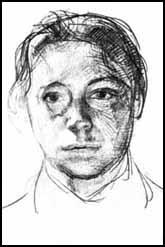
The worn-out older woman, lines of age etched deeper by profound grief:

She's Kathe Kollwitz, one of the greatest graphic artists of all time, in two of her extraordinary self-portraits. Born in Germany in 1867, she had the sorrowful distinction of living long enough to see her beloved son Peter die at age nineteen in one of the earliest battles of World War I, and her beloved grandson die fighting in WWII. She never got over her grief at either event, but transmuted it--at least partially--into art.
Kollwitz was a socialist and a pacifist. As such, she supported neither war waged by Germany, and so she didn't even have the solace available to those who did.
I first encountered Kollwitz's spare and haunting work about three decades ago, at an exhibit devoted to women artists, and was immediately struck by its power and uncompromising sorrow. Here was a woman who had no need to prettify things. Take a look at some of her graphics, which focus mainly on loss and grieving, particularly in war.
There is little prettiness in her art, but there is much beauty. Although Kollwitz herself had strong political viewpoints, they are a very distant subtext to the main themes of her work, which are universal and human. One cannot read about her life or look at her art without a feeling of deep respect, even if one disagrees with pacifism or socialism itself.
Kollwitz worked for many years on one of her major compositions, a large memorial sculpture in honor of her son Peter. She worked through many prototypes, and in the end decided on two simple but monumental figures of grieving parents, the models for which were Kollwitz herself and her husband Karl. The sculptures are installed permanently at the Vladslo cemetery for German soldiers from World War I at her son's grave, and their restraint and dignity only adds to the intensity of their grief (please click on the link if you'd like to read even more about Kollwitz's reaction to the wars and her losses):
Among the graves [at Vladso, in Belgium] is that of Peter Kollwitz, a student from Berlin who volunteered as soon as the war broke out. Two months later, in October 1914, he was killed, aged nineteen, in one of the war's first major campaigns.
Kathe Kollwitz was informed of her son's death in action on 30 October. 'Your pretty shawl will no longer be able to warm our boy,' was the touching way she broke the news to a close friend. To another friend she admitted, 'There is in our lives a wound which will never heal. Nor should it.'
By December 1914 Kollwitz, one of the foremost artists of her day, had formed the idea of creating a memorial to her son, with his body outstretched, 'the father at the head, the mother at the feet', to commemorate 'the sacrifice of all the young volunteers'. As time went on she attempted various other designs, but was dissatisfied with them all. Kollwitz put the project aside temporarily in 1919, but her commitment to see it through when it was right was unequivocal. 'I will come back, I shall do this work for you, for you and the others,' she noted in her diary in June 1919.
Twelve years later, she kept her word: in April 1931 she was at last able to complete the sculpture. 'In the autumn - Peter, - I shall bring it to you,' she wrote in her diary. Her work was exhibited in the National Gallery in Berlin and then transported to Belgium, where it was placed, as she had promised, adjacent to her son's grave. There it rests to this day.

This entire meditation on Kollwitz's life and work was occasioned by the media circus around Cindy Sheehan, grieving but activist mother of a soldier son killed in Iraq. Whether you think Sheehan is being exploited herself or exploitating others tends to depend on what side of the fence you are on the war, but sympathy for her grief is near-universal.
Grief-striken parents are a tragic given in war. Whether they consider the sacrifice worthwhile or not, the tragedy, as Kollwitz herself said, leaves a wound which will never really heal--nor should it.
But this sort of angry activism on the part of a mourning parent such as Cindy Sheehan seems to be a relatively recent phenomenon. What is driving it? Why are we seeing it and hearing about it now, as opposed to previous wars? My attempt to answer these questions will be the subject of Part II. For background reading, though, you would do well to read this excellent post from Varifrank.
(Trackback to Mudville Gazette open post. Also, I've started a new post on the topic of the discussion in the comments section of this thread here.)
The serene young artist, glowing with life:

The worn-out older woman, lines of age etched deeper by profound grief:

She's Kathe Kollwitz, one of the greatest graphic artists of all time, in two of her extraordinary self-portraits. Born in Germany in 1867, she had the sorrowful distinction of living long enough to see her beloved son Peter die at age nineteen in one of the earliest battles of World War I, and her beloved grandson die fighting in WWII. She never got over her grief at either event, but transmuted it--at least partially--into art.
Kollwitz was a socialist and a pacifist. As such, she supported neither war waged by Germany, and so she didn't even have the solace available to those who did.
I first encountered Kollwitz's spare and haunting work about three decades ago, at an exhibit devoted to women artists, and was immediately struck by its power and uncompromising sorrow. Here was a woman who had no need to prettify things. Take a look at some of her graphics, which focus mainly on loss and grieving, particularly in war.
There is little prettiness in her art, but there is much beauty. Although Kollwitz herself had strong political viewpoints, they are a very distant subtext to the main themes of her work, which are universal and human. One cannot read about her life or look at her art without a feeling of deep respect, even if one disagrees with pacifism or socialism itself.
Kollwitz worked for many years on one of her major compositions, a large memorial sculpture in honor of her son Peter. She worked through many prototypes, and in the end decided on two simple but monumental figures of grieving parents, the models for which were Kollwitz herself and her husband Karl. The sculptures are installed permanently at the Vladslo cemetery for German soldiers from World War I at her son's grave, and their restraint and dignity only adds to the intensity of their grief (please click on the link if you'd like to read even more about Kollwitz's reaction to the wars and her losses):
Among the graves [at Vladso, in Belgium] is that of Peter Kollwitz, a student from Berlin who volunteered as soon as the war broke out. Two months later, in October 1914, he was killed, aged nineteen, in one of the war's first major campaigns.
Kathe Kollwitz was informed of her son's death in action on 30 October. 'Your pretty shawl will no longer be able to warm our boy,' was the touching way she broke the news to a close friend. To another friend she admitted, 'There is in our lives a wound which will never heal. Nor should it.'
By December 1914 Kollwitz, one of the foremost artists of her day, had formed the idea of creating a memorial to her son, with his body outstretched, 'the father at the head, the mother at the feet', to commemorate 'the sacrifice of all the young volunteers'. As time went on she attempted various other designs, but was dissatisfied with them all. Kollwitz put the project aside temporarily in 1919, but her commitment to see it through when it was right was unequivocal. 'I will come back, I shall do this work for you, for you and the others,' she noted in her diary in June 1919.
Twelve years later, she kept her word: in April 1931 she was at last able to complete the sculpture. 'In the autumn - Peter, - I shall bring it to you,' she wrote in her diary. Her work was exhibited in the National Gallery in Berlin and then transported to Belgium, where it was placed, as she had promised, adjacent to her son's grave. There it rests to this day.

This entire meditation on Kollwitz's life and work was occasioned by the media circus around Cindy Sheehan, grieving but activist mother of a soldier son killed in Iraq. Whether you think Sheehan is being exploited herself or exploitating others tends to depend on what side of the fence you are on the war, but sympathy for her grief is near-universal.
Grief-striken parents are a tragic given in war. Whether they consider the sacrifice worthwhile or not, the tragedy, as Kollwitz herself said, leaves a wound which will never really heal--nor should it.
But this sort of angry activism on the part of a mourning parent such as Cindy Sheehan seems to be a relatively recent phenomenon. What is driving it? Why are we seeing it and hearing about it now, as opposed to previous wars? My attempt to answer these questions will be the subject of Part II. For background reading, though, you would do well to read this excellent post from Varifrank.
(Trackback to Mudville Gazette open post. Also, I've started a new post on the topic of the discussion in the comments section of this thread here.)
Saturday, August 13, 2005
Hendrick Hertzberg: writer
I've mentioned quite a few times that I'm a long-time reader of the New Yorker. That's "long-time" as in long-time--my estimate is close to forty years or so. I still get the magazine delivered to my home, and I still enjoy about half of what's in it, which isn't a bad percentage.
But much of the other half drives me nuts, and has been doing so for a couple of years now. I recently went on a cleaning spree and threw out most of the copies that have been hanging around the house, the ones in which I'd taken to underlining offending passages with red pens, and writing little notes to myself in the margins. That's why I don't have any specific examples of the sort of thing I'm talking about at the moment. But, generally, it takes the form of a gratuitous, reflexive "we don't have to explain anything we say because of course all of our readers agree with us" Bush-bashing, as well as a number of distortions and strategic omissions.
One of their most highly-respected writers is Hendrick Hertzberg, the magazine's political specialist and frequent contributor to its "Talk of the Town" feature. Hertzberg never seems to miss a Bush-bashing opportunity, and is known for writing an especially fluid line of prose. I've wondered for some time whether Hertzberg might not be a good example of the sort of journalist I wrote about yesterday, one who is a writer above all else; whose experience and expertise are mostly, if not wholly, confined to that one endeavor.
There's nothing wrong with being a writer. I admire and enjoy writers who are good at their craft. I like writers (some of my best friends are...). But if a writer is influencing the viewpoints of an audience as vast as that of the New Yorker, it's nice to know a little bit about his/her expertise and experience in addition to reading the words.
Of course, the words and the thought process of a writer stand on their own--after all, isn't that what blogging is about? I write; you read (or not, as the case may be). But bloggers don't have the reputation, clout, and circulation of a magazine such as the New Yorker--or, for that matter, any periodical or newspaper of large readership--behind them. The words of a blogger, by definition, are taken with a grain of salt, or even a hefty block of it. The words of an editor of the New Yorker are often swallowed whole, I'm afraid.
So, who is Hertzberg? A lengthy profile of him appeared in the Jan-Feb 2003 issue of Harvard Magazine, chock-full of illuminating information. Reading it, I got the distinct impression that, from very early on, Hertzberg never really evinced an interest in much of anything except political writing and in politics. But the accent seems to have been on the "writing" part.
That's not exactly a crime, nor is Hertzberg a bad person. Not at all. For starters he is an excellent writer, something I admire. He's an Orwell fan as well, thus proving to me once again that Orwell appeals to people from an usually wide variety of political persuasions.
I happen to disagree with many of Hertzberg's conclusions, particularly about the greater war in which we are currently engaged (not just the Iraqi one), and on Bush's role in it (see this lengthy interview with Hertzberg for a taste of his Bush Drangement syndrome, for example).
But Hertzberg is no Chomsky or Michael Moore. He sounds like he'd be a great person to hang out with--funny, witty, friendly, charming, athletic, even modest (he also happens to resemble Warren Beatty, which isn't too shabby). And I don't think he's unique in his dedication to writing above all else, nor do I suspect this pattern exists only on the liberal/left end of things--I wouldn't be surprised if I found a parallel sort of story among some conservative writers, and if anyone wants to do some research and offer one, it would be of interest. I believe the phenomenon is mostly a journalism thing, not a Hertzberg thing. But Hertzberg himself does seems to be a rather extreme example of the genre.
So I think it's instructive to study Hertzberg's training and experience, particularly in light of yesterday's post of mine on the subject, and to marvel at the swiftness of his rise to the pinnacle of the profession.
Child of liberal socialist (although staunchly anti-Communist) parents, Hertzberg almost seems to have been fated to be a journalist. His father was a sometime contributor to the NY Times and Commentary; his mother a teacher at Columbia and great-grandniece of Walt Whitman (those writer genes!). Hertzberg went to Harvard, Class of '65 (and, by the way, until I researched this post, I had no idea how dominant Harvard was in the world of the New Yorker and the New Republic), where he studied under the ever-so-slightly older teaching assistant Martin Peretz, later editor of the New Republic. But, according to the article, "Hertzberg's real field of concentration was the Crimson, where he was managing editor."
The article paints a picture of a man with a mission:
Even as a boy Hertzberg had been obsessed with newspapers. He recalls a family trip by car from New York to Aspen, Colorado, when he was 9, before the interstate highways had been built. It was "a wonderful trip, on two-lane roads," he recalls. "I got the newspaper in every town where we stopped. Somewhere, I still have a huge pile of 1953 papers, like the Toledo Blade. I was fascinated by the way they looked—layout, typography. When I got to Harvard, this was a real icebreaker—whenever I met somebody I'd rattle off the name of their hometown paper and mention a few details."
The Crimson was such an all-consuming passion that Hertzberg was a stranger to his professors during his last two years. This wasn't unusual for a managing editor, but in Hertzberg's case it landed him on academic probation for a semester, which required him to withdraw from extracurricular activities.
So Hertzberg had a sort of tunnel vision early on--even compared to other Crimson editors known for a similar tunnel vision--to the detriment of his getting an education in much of anything else. That tunnel vision was soon rewarded. While still an undergraduate, he got a call from New Yorker editor Bill Shawn (father of Hertzberg's Harvard classmate Wallace Shawn) to talk about writing for the magazine. Pretty heady stuff indeed. Harvard's Class of 1965, by the way, seems to have been a sort of feeder school for the magazine; the article lists four more members of that class alone who ended up writing for the New Yorker, a fairly astounding percentage.
For various reasons, Hertzberg refused Shawn's offer. One reason was a charming and endearing modesty; another was more practical:
"My whole career has been so marked by advantages gained from Harvard's old-boy network that only in the last couple of years have I been getting over the debilitating sense of not deserving anything." Though he did meet with Shawn, he did not accept a New Yorker job in 1965, feeling on the one hand "too green," and on the other, highly susceptible to the draft
His draft-deferred job was as editorial assistant for the National Student Association. A year later he was writing for Newsweek. Then, feeling he could avoid the draft no longer, he took what was probably the only non-writing job of his entire lifetime and enlisted in the Navy, a la John Kerry. However, his Navy trajectory was different than Kerry's; he stayed in the US and saw no action, applied for CO status the next year but was refused. His entire tour lasted two years. On leaving the Navy in 1969, Hertzberg went straight to the New Yorker, and wrote his first "Talk" shortly thereafter. By my calculations, he would have been about twenty-five years old.
Hertzberg stayed for seven years, and left to become a political speechwriter, writing mainly for Jimmy Carter. He left that gig when Carter left office, at which point Hertzberg went on to the New Republic, hired by editor-in-chief and former Harvard teacher Peretz. Hertzberg held the post of editor, and alternated with another Harvard graduate Michael Kinsley in that role for the next ten years.
While at the New Republic, which was starting to have a neocon wing, Hertzberg and Peretz found themselves disagreeing quite often, with Hertzberg heading up the more traditional liberal point of view. Here's Peretz's take on Hertzberg:
...when Rick was editor, I was more involved with the magazine than I was with anybody else. I never quite trusted that he wouldn't slip something in that would truly and deeply offend me."
Rick thinks everyone in the world is at least potentially as civilized as he is. He has not been mugged by reality," Peretz continues. "I think he is just extremely squishy on foreign policy. He thinks foreign policy should aim at bringing out the best in your adversary; I think that's possible with very few adversaries."
Hertzberg finally tired of the arguments, and did a couple of years at the Kennedy School (Harvard again), writing all the while for various magazines. Then, back to the New Yorker, where he's been ensconced ever since.
In the Harvard article, those who speak about Hertzberg in laudable terms seem to be praising his writing style more than anything else:
"He's the political voice of the magazine," says David Remnick, the New Yorker's editor since 1998. "Rick's writing has a kind of moral tone that is irreplaceable—he has tone control the way Billie Holiday had tone control, and his sentences are as well-timed as the most brilliant joke or song phrasing. Attached to this is his way of thinking, his lack of cruelty or cheapness. 'Comment' is the first thing people read when they open the magazine; it has to be just right, and it invariably is." To author James Fallows '70, who hired him for the Carter speechwriting team, Hertzberg's "distinctive gift is his nearly unparalleled grace as a writer. Rick is the classic tormented scribe—up all night, pacing—but when they come out, his words fall in a seemingly inevitable order, as if they came to him in a dream. He's a master of the mot juste. When I read him, I think, 'Godspeed.' Rick is probably the most consistent and effective liberal voice in the media now."...
It seems to be mostly about Hertzberg's voice, his style and his tone. Even Hertzberg himself speaks in these terms:
New Yorker readers are drawn to the magazine for aesthetic reasons; you can assume a subtlety of taste and sensibility. It's a common ground you share, one that lets you address issues in a way you hope readers will find congenial. They might hold still long enough to hear out your argument, and if you can express it in fresh enough language, may even reconsider their views....
So, according to Hertzberg, it seems that language is the best way to convince people of the solidity of your point of view. Of course, language is always part of the picture, but it has a certain primacy for Hertzberg and for others in the article, so much so that the ideas seem at times to be secondary.
In the article, even Hertzberg's discussion of the Bush administration's declaration of a "war on terror" demonstrates this tendency. The Harvard Magazine article quotes Hertzberg as criticizing the "war" metaphor and suggesting the substitution of a "crime" metaphor:
The metaphor of war—and it is more metaphor than description—ascribes to the perpetrators a dignity they do not merit, a status they cannot claim, and a strength they do not possess." Instead, he recommended the rubric of international crime as the most useful way to deal with global terrorism.
As so often happens, however, the Bush administration disregarded Hertzberg's advice. "The president and the country instead went for a war metaphor, which has many pitfalls," he says now. "The crime metaphor has pitfalls, too—it lacks the feeling of urgency and enormity—but it also has advantages. Crime is something that can never be annihilated, but can be reduced, controlled, and discouraged; it takes place within a large framework of order and civilization. Crime is not committed by sovereign entities—it's committed by outlaws."...
I'm not above criticizing people for their use of words--for example, I also think that "war on terror" is not the best name for this struggle. But it's not the "war" part that bothers me; I happen to think it should have been called the "war on Islamofascism," although I think I understand why that name wasn't chosen--the "Islamo" part would have offended too many people.
But the word "war" in the phrase "war on terror" is not just a metaphor. In fact, it's not a metaphor at all; we're not talking about a "war on drugs" here, for example. The word "war" is in there because this is a war, and it was a war before Bush ever called it that. And calling it a mere "crime" instead doesn't make it so, nor does it make it any more controllable or manageable. Writers deal in words, and words have power. But not that much power.
But much of the other half drives me nuts, and has been doing so for a couple of years now. I recently went on a cleaning spree and threw out most of the copies that have been hanging around the house, the ones in which I'd taken to underlining offending passages with red pens, and writing little notes to myself in the margins. That's why I don't have any specific examples of the sort of thing I'm talking about at the moment. But, generally, it takes the form of a gratuitous, reflexive "we don't have to explain anything we say because of course all of our readers agree with us" Bush-bashing, as well as a number of distortions and strategic omissions.
One of their most highly-respected writers is Hendrick Hertzberg, the magazine's political specialist and frequent contributor to its "Talk of the Town" feature. Hertzberg never seems to miss a Bush-bashing opportunity, and is known for writing an especially fluid line of prose. I've wondered for some time whether Hertzberg might not be a good example of the sort of journalist I wrote about yesterday, one who is a writer above all else; whose experience and expertise are mostly, if not wholly, confined to that one endeavor.
There's nothing wrong with being a writer. I admire and enjoy writers who are good at their craft. I like writers (some of my best friends are...). But if a writer is influencing the viewpoints of an audience as vast as that of the New Yorker, it's nice to know a little bit about his/her expertise and experience in addition to reading the words.
Of course, the words and the thought process of a writer stand on their own--after all, isn't that what blogging is about? I write; you read (or not, as the case may be). But bloggers don't have the reputation, clout, and circulation of a magazine such as the New Yorker--or, for that matter, any periodical or newspaper of large readership--behind them. The words of a blogger, by definition, are taken with a grain of salt, or even a hefty block of it. The words of an editor of the New Yorker are often swallowed whole, I'm afraid.
So, who is Hertzberg? A lengthy profile of him appeared in the Jan-Feb 2003 issue of Harvard Magazine, chock-full of illuminating information. Reading it, I got the distinct impression that, from very early on, Hertzberg never really evinced an interest in much of anything except political writing and in politics. But the accent seems to have been on the "writing" part.
That's not exactly a crime, nor is Hertzberg a bad person. Not at all. For starters he is an excellent writer, something I admire. He's an Orwell fan as well, thus proving to me once again that Orwell appeals to people from an usually wide variety of political persuasions.
I happen to disagree with many of Hertzberg's conclusions, particularly about the greater war in which we are currently engaged (not just the Iraqi one), and on Bush's role in it (see this lengthy interview with Hertzberg for a taste of his Bush Drangement syndrome, for example).
But Hertzberg is no Chomsky or Michael Moore. He sounds like he'd be a great person to hang out with--funny, witty, friendly, charming, athletic, even modest (he also happens to resemble Warren Beatty, which isn't too shabby). And I don't think he's unique in his dedication to writing above all else, nor do I suspect this pattern exists only on the liberal/left end of things--I wouldn't be surprised if I found a parallel sort of story among some conservative writers, and if anyone wants to do some research and offer one, it would be of interest. I believe the phenomenon is mostly a journalism thing, not a Hertzberg thing. But Hertzberg himself does seems to be a rather extreme example of the genre.
So I think it's instructive to study Hertzberg's training and experience, particularly in light of yesterday's post of mine on the subject, and to marvel at the swiftness of his rise to the pinnacle of the profession.
Child of liberal socialist (although staunchly anti-Communist) parents, Hertzberg almost seems to have been fated to be a journalist. His father was a sometime contributor to the NY Times and Commentary; his mother a teacher at Columbia and great-grandniece of Walt Whitman (those writer genes!). Hertzberg went to Harvard, Class of '65 (and, by the way, until I researched this post, I had no idea how dominant Harvard was in the world of the New Yorker and the New Republic), where he studied under the ever-so-slightly older teaching assistant Martin Peretz, later editor of the New Republic. But, according to the article, "Hertzberg's real field of concentration was the Crimson, where he was managing editor."
The article paints a picture of a man with a mission:
Even as a boy Hertzberg had been obsessed with newspapers. He recalls a family trip by car from New York to Aspen, Colorado, when he was 9, before the interstate highways had been built. It was "a wonderful trip, on two-lane roads," he recalls. "I got the newspaper in every town where we stopped. Somewhere, I still have a huge pile of 1953 papers, like the Toledo Blade. I was fascinated by the way they looked—layout, typography. When I got to Harvard, this was a real icebreaker—whenever I met somebody I'd rattle off the name of their hometown paper and mention a few details."
The Crimson was such an all-consuming passion that Hertzberg was a stranger to his professors during his last two years. This wasn't unusual for a managing editor, but in Hertzberg's case it landed him on academic probation for a semester, which required him to withdraw from extracurricular activities.
So Hertzberg had a sort of tunnel vision early on--even compared to other Crimson editors known for a similar tunnel vision--to the detriment of his getting an education in much of anything else. That tunnel vision was soon rewarded. While still an undergraduate, he got a call from New Yorker editor Bill Shawn (father of Hertzberg's Harvard classmate Wallace Shawn) to talk about writing for the magazine. Pretty heady stuff indeed. Harvard's Class of 1965, by the way, seems to have been a sort of feeder school for the magazine; the article lists four more members of that class alone who ended up writing for the New Yorker, a fairly astounding percentage.
For various reasons, Hertzberg refused Shawn's offer. One reason was a charming and endearing modesty; another was more practical:
"My whole career has been so marked by advantages gained from Harvard's old-boy network that only in the last couple of years have I been getting over the debilitating sense of not deserving anything." Though he did meet with Shawn, he did not accept a New Yorker job in 1965, feeling on the one hand "too green," and on the other, highly susceptible to the draft
His draft-deferred job was as editorial assistant for the National Student Association. A year later he was writing for Newsweek. Then, feeling he could avoid the draft no longer, he took what was probably the only non-writing job of his entire lifetime and enlisted in the Navy, a la John Kerry. However, his Navy trajectory was different than Kerry's; he stayed in the US and saw no action, applied for CO status the next year but was refused. His entire tour lasted two years. On leaving the Navy in 1969, Hertzberg went straight to the New Yorker, and wrote his first "Talk" shortly thereafter. By my calculations, he would have been about twenty-five years old.
Hertzberg stayed for seven years, and left to become a political speechwriter, writing mainly for Jimmy Carter. He left that gig when Carter left office, at which point Hertzberg went on to the New Republic, hired by editor-in-chief and former Harvard teacher Peretz. Hertzberg held the post of editor, and alternated with another Harvard graduate Michael Kinsley in that role for the next ten years.
While at the New Republic, which was starting to have a neocon wing, Hertzberg and Peretz found themselves disagreeing quite often, with Hertzberg heading up the more traditional liberal point of view. Here's Peretz's take on Hertzberg:
...when Rick was editor, I was more involved with the magazine than I was with anybody else. I never quite trusted that he wouldn't slip something in that would truly and deeply offend me."
Rick thinks everyone in the world is at least potentially as civilized as he is. He has not been mugged by reality," Peretz continues. "I think he is just extremely squishy on foreign policy. He thinks foreign policy should aim at bringing out the best in your adversary; I think that's possible with very few adversaries."
Hertzberg finally tired of the arguments, and did a couple of years at the Kennedy School (Harvard again), writing all the while for various magazines. Then, back to the New Yorker, where he's been ensconced ever since.
In the Harvard article, those who speak about Hertzberg in laudable terms seem to be praising his writing style more than anything else:
"He's the political voice of the magazine," says David Remnick, the New Yorker's editor since 1998. "Rick's writing has a kind of moral tone that is irreplaceable—he has tone control the way Billie Holiday had tone control, and his sentences are as well-timed as the most brilliant joke or song phrasing. Attached to this is his way of thinking, his lack of cruelty or cheapness. 'Comment' is the first thing people read when they open the magazine; it has to be just right, and it invariably is." To author James Fallows '70, who hired him for the Carter speechwriting team, Hertzberg's "distinctive gift is his nearly unparalleled grace as a writer. Rick is the classic tormented scribe—up all night, pacing—but when they come out, his words fall in a seemingly inevitable order, as if they came to him in a dream. He's a master of the mot juste. When I read him, I think, 'Godspeed.' Rick is probably the most consistent and effective liberal voice in the media now."...
It seems to be mostly about Hertzberg's voice, his style and his tone. Even Hertzberg himself speaks in these terms:
New Yorker readers are drawn to the magazine for aesthetic reasons; you can assume a subtlety of taste and sensibility. It's a common ground you share, one that lets you address issues in a way you hope readers will find congenial. They might hold still long enough to hear out your argument, and if you can express it in fresh enough language, may even reconsider their views....
So, according to Hertzberg, it seems that language is the best way to convince people of the solidity of your point of view. Of course, language is always part of the picture, but it has a certain primacy for Hertzberg and for others in the article, so much so that the ideas seem at times to be secondary.
In the article, even Hertzberg's discussion of the Bush administration's declaration of a "war on terror" demonstrates this tendency. The Harvard Magazine article quotes Hertzberg as criticizing the "war" metaphor and suggesting the substitution of a "crime" metaphor:
The metaphor of war—and it is more metaphor than description—ascribes to the perpetrators a dignity they do not merit, a status they cannot claim, and a strength they do not possess." Instead, he recommended the rubric of international crime as the most useful way to deal with global terrorism.
As so often happens, however, the Bush administration disregarded Hertzberg's advice. "The president and the country instead went for a war metaphor, which has many pitfalls," he says now. "The crime metaphor has pitfalls, too—it lacks the feeling of urgency and enormity—but it also has advantages. Crime is something that can never be annihilated, but can be reduced, controlled, and discouraged; it takes place within a large framework of order and civilization. Crime is not committed by sovereign entities—it's committed by outlaws."...
I'm not above criticizing people for their use of words--for example, I also think that "war on terror" is not the best name for this struggle. But it's not the "war" part that bothers me; I happen to think it should have been called the "war on Islamofascism," although I think I understand why that name wasn't chosen--the "Islamo" part would have offended too many people.
But the word "war" in the phrase "war on terror" is not just a metaphor. In fact, it's not a metaphor at all; we're not talking about a "war on drugs" here, for example. The word "war" is in there because this is a war, and it was a war before Bush ever called it that. And calling it a mere "crime" instead doesn't make it so, nor does it make it any more controllable or manageable. Writers deal in words, and words have power. But not that much power.
Totten: not all about us
In his new Tech Central Station article, Michael Totten points out some facts about the internal strife in the Islamic world, and how the west tends to ignore it and only notice the war the terrorists are waging against us.
Totten's point, if I may be so bold as to summarize it, is this:
Islam doesn't just have bloody borders; it has bloody centers, as well. And it appears that those bloody borders and centers are not about Islam itself so much as the ascendance and growth of its totalitarian, nihilist, fundamentalist sects.
Totten's point, if I may be so bold as to summarize it, is this:
Islam doesn't just have bloody borders; it has bloody centers, as well. And it appears that those bloody borders and centers are not about Islam itself so much as the ascendance and growth of its totalitarian, nihilist, fundamentalist sects.
Friday, August 12, 2005
Journalism: "It's the good ones who need watching"
Who are journalists, and what do they do?
The old-fashioned idea that a journalist is a mere reporter (or recorder) of the news has been replaced in recent years by the idea of a journalist as a writer first and foremost, and secondarily as an interpreter of the news and an exposer of truth. But why should we trust journalists with such a huge task, and how are we to judge whether they are doing their job well?
One notion is that journalism is a competitive meritocracy and that the best will naturally rise to the top. Another is that it is a near-sacred calling, an elevated profession with a dedication to principle. Still another is that journalists are experts on the topics they write about, and should be trusted as such. Another is that they are liars extraordinaire, all of them (except, of course, the ones with whom we happen to agree).
So, what is it? A little bit of each? Or something else entirely?
I used to read the news with a great deal of naive trust. I suppose I subscribed primarily to the meritocracy theory, with the editors as gatekeepers with excellent judgment. I trusted the New York Times, for example, to choose writers who knew their stuff, and to make sure what was printed in the paper was the closest humans could come to the truth.
It was only post-9/11 that I began to read widely and compare and contrast, and to notice which journalists were writing what, and how reliable (or unreliable) their articles turned out to be over time in predicting, describing, or analyzing. This could not have been done without the Internet. But that's another story for another time, and will be part of the rest of my "A mind is a difficult thing to change" series. For now, I want to focus on questions about the training and background of journalists in general.
In my reading, I keep coming across a particular type of journalist--one who is an expert on nothing so much as writing itself (not all journalists fit this description, but a surprising number seem to).
Now, good writing and sharp thinking (and honesty) are certainly not mutually exclusive. But neither are they necessarily linked. A person can write in such a smooth way as to mask the fact that the thinking behind what is being said is illogical or misleading, or the facts are false. In fact, the smoother the writing, the more it can cover a multitude of sins.
That may have been what was going on with the fabled Stephen Glass, an extreme example of a lying journalist. As writer and Slate editor Jack Schafer, who was fooled by Glass, says:
One final clue should have alerted us--readers and editors--to Glass' deception: Life is not so good that it places reporters at the center of action as frequently as it did the young Glass. And he wrote so well. Anyone can doubt a bad writer. It's the good ones who need watching.
"And he wrote so well." Yes, indeed.
The Glass story, although unusual in its excesses, illustrates some general journalistic trends. For example, it's clear there are flaws in the fact-checking system, especially where "the good ones" are concerned. And, although their fact-checking system may be flawed, at least magazines have fact-checking. Newspapers don't, at least not formally; the pressure to get the copy out quickly is much too great.
Perhaps part of the problem is the practice of hiring promising journalists right out of college or journalism graduate school. Glass, for example, went straight to the top while still in his early twenties, after being editor of the University of Pennsylvania college newspaper. Why so far, so fast? Whatever happened to apprenticeships in the boonies, the time-honored way to hone a reporter's craft?
Again, it seems that "the good ones" are now rushed along with extraordinary speed, before they are seasoned by much experience at all (except college or grad school writing experience, which is a different sort of experience than life experience or even experience covering the beat on a local newspaper). According to writer Rick McGinnis, this is a growing and lamentable trend:
The only unusual thing about Stephen Glass' fall from grace, as far as I can see, is that he was caught. Fabrication, in small or large part, will always be common in a profession that, too often, values sensation over substance, and where older editors increasingly turn to younger writers to provide them with "buzz", or a window on trends, real or spurious. Freelance writers and junior editorial staff, like Glass, are the disposable shock troops of this regrettable but seemingly ineradicable side of the business.
Why is this trend so troubling? According to another journalist who graduated from the University of Pennsylvania:
"I've spent 20 years as a journalist," says Bissinger, "and I've spent those years in places that were not very sexy, like Norfolk, Virginia or St. Paul, Minnesota. But they taught me a hell of a lot about journalism. Regardless of how good or how bad a reporter or journalist Stephen was, how did he get to this level so quickly? When I was 24 or 25 years old, I was covering cops. And I'm glad that I did it, because Stephen never knew what it was like for someone to get in his face and say, 'You know what, that story was wrong, that story was inaccurate.' When you work at a relatively small newspaper, if you print one fact wrong, they are all over you, and they are all over your editor. It's an incredibly unpleasant experience, and for no other reason, you never want to go through it again."
So Glass--and other young journalists who aren't con artists as Glass was--miss out on a valuable training ground for their own profession, and can get by on the flashiness of their writing style.
I don't know how common this is in the journalism profession--my guess is that it's most common in the world of elite magazines, but that's only a guess.
Another question that affects the field in general is whether journalists should be trained in some substantive discipline such as economics and/or history. I have found that there's a growing clamor in journalism education to actually insist that young journalists develop such a body of knowledge and an expertise in something other than the craft of writing itself. To me, this seems obvious--and apparently some schools (such as Northwestern) have had this approach, at least on paper, for quite some time. But even a journalism school as prestigious as Columbia, from which many of our most successful young journalists emerge, is only now getting around to instituting such a program:
Columbia President Lee Bollinger is saying the school's traditional emphasis on teaching the craft of journalism needs to be balanced with courses full of intellectual and theoretical rigor. Without this, students will be trained as little more than scribes.....
Journalism training is a bit like playing the piano. A pianist who only hits the notes seldom "makes music" of the same caliber as a person who also knows composition, musicology, theory, and music history. In journalism, it's a given that a reporter can write about, report, and edit the news. But to approach the craft with an informed professional perspective – to "make journalism" – aspiring journalists need to study media ethics, law, history, global communications, and theory.
Especially "the good ones."
The old-fashioned idea that a journalist is a mere reporter (or recorder) of the news has been replaced in recent years by the idea of a journalist as a writer first and foremost, and secondarily as an interpreter of the news and an exposer of truth. But why should we trust journalists with such a huge task, and how are we to judge whether they are doing their job well?
One notion is that journalism is a competitive meritocracy and that the best will naturally rise to the top. Another is that it is a near-sacred calling, an elevated profession with a dedication to principle. Still another is that journalists are experts on the topics they write about, and should be trusted as such. Another is that they are liars extraordinaire, all of them (except, of course, the ones with whom we happen to agree).
So, what is it? A little bit of each? Or something else entirely?
I used to read the news with a great deal of naive trust. I suppose I subscribed primarily to the meritocracy theory, with the editors as gatekeepers with excellent judgment. I trusted the New York Times, for example, to choose writers who knew their stuff, and to make sure what was printed in the paper was the closest humans could come to the truth.
It was only post-9/11 that I began to read widely and compare and contrast, and to notice which journalists were writing what, and how reliable (or unreliable) their articles turned out to be over time in predicting, describing, or analyzing. This could not have been done without the Internet. But that's another story for another time, and will be part of the rest of my "A mind is a difficult thing to change" series. For now, I want to focus on questions about the training and background of journalists in general.
In my reading, I keep coming across a particular type of journalist--one who is an expert on nothing so much as writing itself (not all journalists fit this description, but a surprising number seem to).
Now, good writing and sharp thinking (and honesty) are certainly not mutually exclusive. But neither are they necessarily linked. A person can write in such a smooth way as to mask the fact that the thinking behind what is being said is illogical or misleading, or the facts are false. In fact, the smoother the writing, the more it can cover a multitude of sins.
That may have been what was going on with the fabled Stephen Glass, an extreme example of a lying journalist. As writer and Slate editor Jack Schafer, who was fooled by Glass, says:
One final clue should have alerted us--readers and editors--to Glass' deception: Life is not so good that it places reporters at the center of action as frequently as it did the young Glass. And he wrote so well. Anyone can doubt a bad writer. It's the good ones who need watching.
"And he wrote so well." Yes, indeed.
The Glass story, although unusual in its excesses, illustrates some general journalistic trends. For example, it's clear there are flaws in the fact-checking system, especially where "the good ones" are concerned. And, although their fact-checking system may be flawed, at least magazines have fact-checking. Newspapers don't, at least not formally; the pressure to get the copy out quickly is much too great.
Perhaps part of the problem is the practice of hiring promising journalists right out of college or journalism graduate school. Glass, for example, went straight to the top while still in his early twenties, after being editor of the University of Pennsylvania college newspaper. Why so far, so fast? Whatever happened to apprenticeships in the boonies, the time-honored way to hone a reporter's craft?
Again, it seems that "the good ones" are now rushed along with extraordinary speed, before they are seasoned by much experience at all (except college or grad school writing experience, which is a different sort of experience than life experience or even experience covering the beat on a local newspaper). According to writer Rick McGinnis, this is a growing and lamentable trend:
The only unusual thing about Stephen Glass' fall from grace, as far as I can see, is that he was caught. Fabrication, in small or large part, will always be common in a profession that, too often, values sensation over substance, and where older editors increasingly turn to younger writers to provide them with "buzz", or a window on trends, real or spurious. Freelance writers and junior editorial staff, like Glass, are the disposable shock troops of this regrettable but seemingly ineradicable side of the business.
Why is this trend so troubling? According to another journalist who graduated from the University of Pennsylvania:
"I've spent 20 years as a journalist," says Bissinger, "and I've spent those years in places that were not very sexy, like Norfolk, Virginia or St. Paul, Minnesota. But they taught me a hell of a lot about journalism. Regardless of how good or how bad a reporter or journalist Stephen was, how did he get to this level so quickly? When I was 24 or 25 years old, I was covering cops. And I'm glad that I did it, because Stephen never knew what it was like for someone to get in his face and say, 'You know what, that story was wrong, that story was inaccurate.' When you work at a relatively small newspaper, if you print one fact wrong, they are all over you, and they are all over your editor. It's an incredibly unpleasant experience, and for no other reason, you never want to go through it again."
So Glass--and other young journalists who aren't con artists as Glass was--miss out on a valuable training ground for their own profession, and can get by on the flashiness of their writing style.
I don't know how common this is in the journalism profession--my guess is that it's most common in the world of elite magazines, but that's only a guess.
Another question that affects the field in general is whether journalists should be trained in some substantive discipline such as economics and/or history. I have found that there's a growing clamor in journalism education to actually insist that young journalists develop such a body of knowledge and an expertise in something other than the craft of writing itself. To me, this seems obvious--and apparently some schools (such as Northwestern) have had this approach, at least on paper, for quite some time. But even a journalism school as prestigious as Columbia, from which many of our most successful young journalists emerge, is only now getting around to instituting such a program:
Columbia President Lee Bollinger is saying the school's traditional emphasis on teaching the craft of journalism needs to be balanced with courses full of intellectual and theoretical rigor. Without this, students will be trained as little more than scribes.....
Journalism training is a bit like playing the piano. A pianist who only hits the notes seldom "makes music" of the same caliber as a person who also knows composition, musicology, theory, and music history. In journalism, it's a given that a reporter can write about, report, and edit the news. But to approach the craft with an informed professional perspective – to "make journalism" – aspiring journalists need to study media ethics, law, history, global communications, and theory.
Especially "the good ones."
Thursday, August 11, 2005
More circle dancing
Michael Totten has drawn our attention in this post to an article by James Wolcott. Totten writes that Wolcott is beating up on liberal hawks (he singles out Roger L. Simon in particular) for making common cause with conservatives by supporting the Terror War.
Not a surprise, not in the least. Nor is the particularly vicious tone of the Wolcott article. I've written many times before about the phenomenon of the left turning on its apostates with a vengeance, both
here as well as in most of my posts about David Horowitz's Radical Son.
As I wrote in Totten's comments, there's something extraordinarily mean-spirited and small in Wolcott's article. Instead of just saying that he himself thinks the liberal social and domestic agenda that people such as Roger may still aspire to is being compromised by their supporting Bush, Wolcott is especially snide and supercilious.
Wolcott seems to think that Simon and others of his ilk are clinging desperately to the notion of themselves as social liberals because, clearly, that's the only way to keep their self-respect. He wants to take them down a peg or two--or three or four or more. He seems to think the only shreds of self-respect they have left are the remnants of the liberalism they retain, and he wants to tear even those last shreds from them.
I don't think Wolcott can even conceive of a sane person being proud of a conservative point of view--to him, the only good people are liberals, and if Simon and others are no longer totally liberal, then they no longer can stake any claim to being at all good. Liberalism is an all-or-nothing proposition for Wolcott, and he is intent on drumming out of the fold those who don't buy the entire package as Wolcott defines it.
This is the type of thing I'm talking about, from Wolcott's article:
...no doubt futile effort to educate Roger L. Simon in the finer points of not making a fool of himself in the future....
...with every corpuscle of your tired body you've made common cause with Republican conservatives, neoconservatives, and Christian fundamentalists who are dedicated to destroying those parcels of liberalism on which you stake your tiny claims of pride.
Once again, I'll let one of my favorite writers, Milan Kundera, have the last word. Here's a relevant excerpt from his wonderful Book of Laughter and Forgetting (1978), about that circle dance which Wolcott is currently so angry at the Roger Simons of the world for leaving:
I too once danced in a ring. It was in the spring of 1948, the Communists had just taken power in my country, the Socialist and Christian Democrat ministers had fled abroad, and I took other Communist students by the hand, I put my arms around their shoulders...
...just about every month there [was] something to celebrate, an anniversary here, a special event there, old wrongs were righted, new wrongs perpetrated, factories were being nationalized, thousands of people went to jail, medical care became free of charge, small shopkeepers lost their shops, aged workers took their first vacations ever in confiscated country houses, and we smiled the smile of happiness. Then one day I said something I would better have left unsaid. I was expelled from the Party and had to leave the circle.
That was when I became aware of the magic properties of a circle. Leave a row and you can always go back to it. But once a circle closes, there is no return. It is no accident that the planets move in a circle and when a stone breaks loose from one of them it is drawn inexorably away by centrifugal force. Like a meteorite broken loose from a planet, I too fell from the circle and have been falling ever since.
Not a surprise, not in the least. Nor is the particularly vicious tone of the Wolcott article. I've written many times before about the phenomenon of the left turning on its apostates with a vengeance, both
here as well as in most of my posts about David Horowitz's Radical Son.
As I wrote in Totten's comments, there's something extraordinarily mean-spirited and small in Wolcott's article. Instead of just saying that he himself thinks the liberal social and domestic agenda that people such as Roger may still aspire to is being compromised by their supporting Bush, Wolcott is especially snide and supercilious.
Wolcott seems to think that Simon and others of his ilk are clinging desperately to the notion of themselves as social liberals because, clearly, that's the only way to keep their self-respect. He wants to take them down a peg or two--or three or four or more. He seems to think the only shreds of self-respect they have left are the remnants of the liberalism they retain, and he wants to tear even those last shreds from them.
I don't think Wolcott can even conceive of a sane person being proud of a conservative point of view--to him, the only good people are liberals, and if Simon and others are no longer totally liberal, then they no longer can stake any claim to being at all good. Liberalism is an all-or-nothing proposition for Wolcott, and he is intent on drumming out of the fold those who don't buy the entire package as Wolcott defines it.
This is the type of thing I'm talking about, from Wolcott's article:
...no doubt futile effort to educate Roger L. Simon in the finer points of not making a fool of himself in the future....
...with every corpuscle of your tired body you've made common cause with Republican conservatives, neoconservatives, and Christian fundamentalists who are dedicated to destroying those parcels of liberalism on which you stake your tiny claims of pride.
Once again, I'll let one of my favorite writers, Milan Kundera, have the last word. Here's a relevant excerpt from his wonderful Book of Laughter and Forgetting (1978), about that circle dance which Wolcott is currently so angry at the Roger Simons of the world for leaving:
I too once danced in a ring. It was in the spring of 1948, the Communists had just taken power in my country, the Socialist and Christian Democrat ministers had fled abroad, and I took other Communist students by the hand, I put my arms around their shoulders...
...just about every month there [was] something to celebrate, an anniversary here, a special event there, old wrongs were righted, new wrongs perpetrated, factories were being nationalized, thousands of people went to jail, medical care became free of charge, small shopkeepers lost their shops, aged workers took their first vacations ever in confiscated country houses, and we smiled the smile of happiness. Then one day I said something I would better have left unsaid. I was expelled from the Party and had to leave the circle.
That was when I became aware of the magic properties of a circle. Leave a row and you can always go back to it. But once a circle closes, there is no return. It is no accident that the planets move in a circle and when a stone breaks loose from one of them it is drawn inexorably away by centrifugal force. Like a meteorite broken loose from a planet, I too fell from the circle and have been falling ever since.
Calling all Japanese translators
Before I became a blogger, I had no idea how sitemeter or statcounter or any of the other traffic-counting devices worked.
When I first installed my sitemeter, I was enthralled to see all the little things it could tell me about my traffic, or lack thereof. Number of visits per hour, per day--that, I expected. What I didn't expect was all the information about referral pages, page views, and in particular the cute little bar graph maps of the world showing what percentage of my traffic was emanating from which time zone. The first time I saw that there were readers in New Zealand, Australia, Europe, and Hawaii, it gave me a real thrill.
Now I'm a little bit more jaded--but just a little. Recently I noticed a bunch of referrals coming from a mysterious website that appears to be Japanese, although the title seems to be in German. Quite a bit of traffic has come my way from that website recently, with the bar graph map making a surprisingly strong showing in the Japanese time zone.
The only problem is: I don't speak Japanese. It's tantalizing to know that someone is saying something about me that is driving a fair number of readers over here, but I don't know what it is that this person is saying; don't even know whether it's on the order of "what an idiot!" or "read her, she's good."
I tried using one of the automatic online translators, but the results might just as well have stayed in Japanese or German, they remained so unintelligable to me.
So I thought I'd appeal to my readers. Here's the site. What's it all about? Inquiring minds (mine, anyway) want to know.
When I first installed my sitemeter, I was enthralled to see all the little things it could tell me about my traffic, or lack thereof. Number of visits per hour, per day--that, I expected. What I didn't expect was all the information about referral pages, page views, and in particular the cute little bar graph maps of the world showing what percentage of my traffic was emanating from which time zone. The first time I saw that there were readers in New Zealand, Australia, Europe, and Hawaii, it gave me a real thrill.
Now I'm a little bit more jaded--but just a little. Recently I noticed a bunch of referrals coming from a mysterious website that appears to be Japanese, although the title seems to be in German. Quite a bit of traffic has come my way from that website recently, with the bar graph map making a surprisingly strong showing in the Japanese time zone.
The only problem is: I don't speak Japanese. It's tantalizing to know that someone is saying something about me that is driving a fair number of readers over here, but I don't know what it is that this person is saying; don't even know whether it's on the order of "what an idiot!" or "read her, she's good."
I tried using one of the automatic online translators, but the results might just as well have stayed in Japanese or German, they remained so unintelligable to me.
So I thought I'd appeal to my readers. Here's the site. What's it all about? Inquiring minds (mine, anyway) want to know.
Wednesday, August 10, 2005
Why bloggers love Orwell
A lot of people think George Orwell is special. I'm one of them.
I first read Orwell's books Animal Farm and 1984 when I was about twelve years old. The latter was good for many nightmares--I don't recommend giving the book to twelve-year-olds, but nobody was paying much attention to my reading matter at the time. 1984 seemed to weave a spell over me--so much that, for a week or so, it seemed more real than what was going on around me, and far more frightening. Winston Smith's travails seemed so terrifying and, in the end, so utterly devoid of hope, that it took me a while to come back again to my own world.
The most memorable part of the book to me, aside from Room 101 and the rats, was the section (an Appendix, I believe) about Newspeak. That words could be twisted into their opposites and used as propaganda ploys was a new thought to me at the time, but it made intuitive sense.
Later, it was the Orwell of the pithy epigram who appealed. He was an acknowledged master of the form, as evidenced here.
But I confess that I haven't done any serious reading of Orwell's other works. But having recently read this piece on Orwell written by Timothy Garton Ash and appearing in the New York Review of Books back in 1998, it seems that I must add Orwell's Homage to Catalonia, at the very least, to my ever-growing "required reading" list.
In his article, Ash poses a question that others have also tried to answer recently: what is it about Orwell that makes him so fascinating and important a writer even today? Ash writes:
The answer is both complicated and simple. It really starts in the Spanish Civil War. Because [Orwell] had joined the heterodox Marxist POUM militia rather than the communist-run International Brigade, he and his wife then got caught up in the violent suppression of the POUM in Barcelona. Friends with whom he had fought at the front were thrown into prison or killed by the Russian-directed communists—supposedly their republican allies. Orwell became a fugitive on the streets. This edition prints a secret report to the Tribunal for Espionage and High Treason in which Eric and Eileen Blair are described as "rabid Trotskyists" and "agents of the POUM." Had they not slipped out of Spain a few days earlier, they could have found themselves, like Georges Kopp, incarcerated, tortured, and thrown into a coal bin with giant rats. [Note the possible origins of the particularities of Winston Smith's dread Room 101.]
This direct experience of communist terror, betrayal, and lies is a key to understanding all his subsequent work. Of the Russian agent in Barcelona charged with defaming the POUM as Trotskyist Francoist traitors he writes, in Homage to Catalonia, "It was the first time that I had seen a person whose profession was telling lies—unless one counts journalists." The tail sting is typical black humor, but also reflects a further, bitter discovery. On returning to England he found that virtually the whole left-wing press was suppressing or falsifying the facts about the Barcelona events. This was the second part of his Spanish experience, and it shocked him even more because it was happening in his own country. Here begins his fascination with what he describes in Nineteen Eighty-Four as a basic principle of Oceania's ruling ideology: "the mutability of the past." Falsification, airbrushing, rewriting history: in short, the memory hole.
There, in a nutshell, is the fascination Orwell holds for me now: his sense of betrayal leading to bitterness and skepticism, and his realization of how easy it is for the press and others to lie about what had happened and how difficult it can be to combat those lies. Although Orwell remained a socialist all the days of his life (in his case, guilt about the British class system seemed to have been part of the reason), he was a socialist who hated--positively hated--Communism. His most basic dedication was to the cause of trying to ferret out the truth, and to describe the ways in which truth can be perverted and twisted. That mission transcended politics.
In my own humble way, I feel a small kinship. In preparation for my next "A mind is a difficult thing to change" essay, I've been thinking about my own bitterness, sense of betrayal (particularly by the press), and attempts at finding the truth.
For me, most of this has occurred in a long and complex post-9/11 process which will be the subject of the rest of my essays in the series. For Orwell, it was a bitter and dramatic experience that was directly personal. For me and most others, it is a more cerebral process, mediated mostly by reading, listening, and watching. But it has been a life- and mind-changing process nevertheless.
In Ash's article, he also makes some points about Orwell that made me suddenly see Orwell in a new light, which is that he bore some resemblance to bloggers--or, at least, to the goals of many bloggers, or to bloggers as they like to imagine themselves to be: truth-seekers who are honest about their own biases, and who are not above admitting and correcting their own mistakes. Perhaps that's one of the reasons bloggers, as a whole, seem especially attracted to him. Here's the quote:
[Orwell] writes about [the Spanish Civil War] in the first person, not in the self-indulgent spirit of "look at me, what a brave little Hemingway am I," but because it really is more honest. That "I" makes explicit the partiality of his view. To rub it in he tells the reader at the end of the book: "Beware of my partisanship, my mistakes of fact, and the distortion inevitably caused by my having seen only one corner of events."
He uses all his hard-learned writer's craft, chisels away at clean, vivid prose, deploys metaphor, artifice, and characteristic overstatement; but all the facts are as accurate as he can make them. It is, as he wrote in praise of Henry Miller, "a definite attempt to get at real facts." For all the question marks about the factual basis of some of Orwell's earlier work, his public and private writing after 1937 shows him striving for an old-fashioned, empirical truth, light-years removed from the postmodern. This includes, crucially, the unpleasant truths about his own side. These he makes a special point of exposing most bluntly...
His great essays straddle politics and literature. They explore Dickens, Kipling, and Tolstoy, nationalism, anti-Semitism, Gandhi, and boys' weeklies. In "Politics and the English Language" he shows how the corruption of language is crucial to the making and defending of bad, oppressive politics. But he also shows how we can get back at the abusers of power, because they are using our weapons: words. Freedom depends on writers keeping the word-mirrors clean. In an age of sophisticated media manipulation, this is more vital than ever.
In his best articles and letters, he gives us a gritty, personal example of how to engage as a writer in politics. He takes sides, but remains his own man. He will not put himself at the service of political parties exercising or pursuing power, since that means using half-truths, in a democracy, or whole lies in a dictatorship. He gets things wrong, but then corrects them. Sometimes he joins with others in volunteer brigades or boring committee work, to defend freedom. But if need be, he stands alone, against all the "smelly little orthodoxies which are now contending for our souls."
I first read Orwell's books Animal Farm and 1984 when I was about twelve years old. The latter was good for many nightmares--I don't recommend giving the book to twelve-year-olds, but nobody was paying much attention to my reading matter at the time. 1984 seemed to weave a spell over me--so much that, for a week or so, it seemed more real than what was going on around me, and far more frightening. Winston Smith's travails seemed so terrifying and, in the end, so utterly devoid of hope, that it took me a while to come back again to my own world.
The most memorable part of the book to me, aside from Room 101 and the rats, was the section (an Appendix, I believe) about Newspeak. That words could be twisted into their opposites and used as propaganda ploys was a new thought to me at the time, but it made intuitive sense.
Later, it was the Orwell of the pithy epigram who appealed. He was an acknowledged master of the form, as evidenced here.
But I confess that I haven't done any serious reading of Orwell's other works. But having recently read this piece on Orwell written by Timothy Garton Ash and appearing in the New York Review of Books back in 1998, it seems that I must add Orwell's Homage to Catalonia, at the very least, to my ever-growing "required reading" list.
In his article, Ash poses a question that others have also tried to answer recently: what is it about Orwell that makes him so fascinating and important a writer even today? Ash writes:
The answer is both complicated and simple. It really starts in the Spanish Civil War. Because [Orwell] had joined the heterodox Marxist POUM militia rather than the communist-run International Brigade, he and his wife then got caught up in the violent suppression of the POUM in Barcelona. Friends with whom he had fought at the front were thrown into prison or killed by the Russian-directed communists—supposedly their republican allies. Orwell became a fugitive on the streets. This edition prints a secret report to the Tribunal for Espionage and High Treason in which Eric and Eileen Blair are described as "rabid Trotskyists" and "agents of the POUM." Had they not slipped out of Spain a few days earlier, they could have found themselves, like Georges Kopp, incarcerated, tortured, and thrown into a coal bin with giant rats. [Note the possible origins of the particularities of Winston Smith's dread Room 101.]
This direct experience of communist terror, betrayal, and lies is a key to understanding all his subsequent work. Of the Russian agent in Barcelona charged with defaming the POUM as Trotskyist Francoist traitors he writes, in Homage to Catalonia, "It was the first time that I had seen a person whose profession was telling lies—unless one counts journalists." The tail sting is typical black humor, but also reflects a further, bitter discovery. On returning to England he found that virtually the whole left-wing press was suppressing or falsifying the facts about the Barcelona events. This was the second part of his Spanish experience, and it shocked him even more because it was happening in his own country. Here begins his fascination with what he describes in Nineteen Eighty-Four as a basic principle of Oceania's ruling ideology: "the mutability of the past." Falsification, airbrushing, rewriting history: in short, the memory hole.
There, in a nutshell, is the fascination Orwell holds for me now: his sense of betrayal leading to bitterness and skepticism, and his realization of how easy it is for the press and others to lie about what had happened and how difficult it can be to combat those lies. Although Orwell remained a socialist all the days of his life (in his case, guilt about the British class system seemed to have been part of the reason), he was a socialist who hated--positively hated--Communism. His most basic dedication was to the cause of trying to ferret out the truth, and to describe the ways in which truth can be perverted and twisted. That mission transcended politics.
In my own humble way, I feel a small kinship. In preparation for my next "A mind is a difficult thing to change" essay, I've been thinking about my own bitterness, sense of betrayal (particularly by the press), and attempts at finding the truth.
For me, most of this has occurred in a long and complex post-9/11 process which will be the subject of the rest of my essays in the series. For Orwell, it was a bitter and dramatic experience that was directly personal. For me and most others, it is a more cerebral process, mediated mostly by reading, listening, and watching. But it has been a life- and mind-changing process nevertheless.
In Ash's article, he also makes some points about Orwell that made me suddenly see Orwell in a new light, which is that he bore some resemblance to bloggers--or, at least, to the goals of many bloggers, or to bloggers as they like to imagine themselves to be: truth-seekers who are honest about their own biases, and who are not above admitting and correcting their own mistakes. Perhaps that's one of the reasons bloggers, as a whole, seem especially attracted to him. Here's the quote:
[Orwell] writes about [the Spanish Civil War] in the first person, not in the self-indulgent spirit of "look at me, what a brave little Hemingway am I," but because it really is more honest. That "I" makes explicit the partiality of his view. To rub it in he tells the reader at the end of the book: "Beware of my partisanship, my mistakes of fact, and the distortion inevitably caused by my having seen only one corner of events."
He uses all his hard-learned writer's craft, chisels away at clean, vivid prose, deploys metaphor, artifice, and characteristic overstatement; but all the facts are as accurate as he can make them. It is, as he wrote in praise of Henry Miller, "a definite attempt to get at real facts." For all the question marks about the factual basis of some of Orwell's earlier work, his public and private writing after 1937 shows him striving for an old-fashioned, empirical truth, light-years removed from the postmodern. This includes, crucially, the unpleasant truths about his own side. These he makes a special point of exposing most bluntly...
His great essays straddle politics and literature. They explore Dickens, Kipling, and Tolstoy, nationalism, anti-Semitism, Gandhi, and boys' weeklies. In "Politics and the English Language" he shows how the corruption of language is crucial to the making and defending of bad, oppressive politics. But he also shows how we can get back at the abusers of power, because they are using our weapons: words. Freedom depends on writers keeping the word-mirrors clean. In an age of sophisticated media manipulation, this is more vital than ever.
In his best articles and letters, he gives us a gritty, personal example of how to engage as a writer in politics. He takes sides, but remains his own man. He will not put himself at the service of political parties exercising or pursuing power, since that means using half-truths, in a democracy, or whole lies in a dictatorship. He gets things wrong, but then corrects them. Sometimes he joins with others in volunteer brigades or boring committee work, to defend freedom. But if need be, he stands alone, against all the "smelly little orthodoxies which are now contending for our souls."
Tuesday, August 09, 2005
Lobster Lib comes to Maine--and Italy
Yesterday and today, PETA comes to New England with its Lobster Lib campaign. By campaigning in Portland and Bar Harbor Maine, PETA has come to the belly of the beast, as it were.
Apparently, according to today's NY Times, the lobster catch in the Gulf of Maine has been inexplicably plentiful recently--record-breaking, in fact--while the lobster population in Cape Cod and to the south of Massachusetts south languishes. So PETA must think, what better place to come to in order to discourage people from eating lobster than Maine? But people here are pretty hard-nosed (have a tough shell?) about their lobster. As long as they can't hear them scream when they die, into the pot they go.
But this doesn't stop the indefatigable PETA. I can't say I understand their need to champion the rights of invertebrates, but obviously PETA has a soft heart even for the lobster. Its "lobster lib" site makes it clear that PETA members are extremely unhappy about boiling lobsters alive--that's no surprise, really. But PETA is even sad about keeping them in tanks.
The site is filled with suggestions for PETA members and their sympathizers to try talk those in charge of lobster tanks into releasing them back to the wild, a plan which seems to have little to no chance of succeeding in New England, where lobster is exceedingly big business and traditional celebratory eating. As far as I can determine, the campaign for tank releases had its origins in an episode of the Ellen De Generes show. I can't imagine that many of the New Englanders I know will be signing up.
But residents of toney Reggio, Italy, seem to feel differently. They've even passed an ordinance banning the practice of boiling lobsters alive. This intrigued me--do the good people of Reggio even have access to lobsters? I looked it up on the map, and Reggio is not a coastal town.
So, what gives with Reggio? Is it the Italian headquarters of PETA? Well, sort of. According to this absolutely riveting article from the Telegraph, it's the town council, not the inhabitants of Reggio, who are the lobster protectors.
And it's not just lobster, either. About a year ago, according to the article, the town council passed, almost unanimously, an ordinance that just might qualify as the most PETA-friendly law on earth, and certainly one of the most absurd.
A few excerpts (but read the whole thing, as Glenn would say):
Under the bylaw, "sociable" birds such as budgerigars and parrots must be kept in pairs. Birdcages must be at least five times the bird's wingspan in width, and three times in height. It also makes it illegal to keep a goldfish in a round glass bowl.
But somehow, this is my favorite part:
Another clause requires owners to ensure that each pet sharing a meal gets an equal portion.
I can envision a certain problem with enforcement. But the councilors of Reggio certainly get the PETA golden leash award for effort.
So, what about it? Do lobsters feel pain in that pot? Unfortunately for the PETA folks (not that they care in the least), the best evidence from scientists indicates that the answer is "no." The study was done in Norway, but scientists in Maine were in agreeement:
The Norwegian report backs up a study in the early 1990s at the University of Maine and reinforces what people in the lobster industry have always contended, said Bob Bayer, executive director of the Lobster Institute, a research and education organization in Orono. "We've maintained all along that the lobster doesn't have the ability to process pain,'' Bayer said.
PETA claims Norwegian bias. What a surprise!
I think the final word on the question is this, from the same article: It's debatable whether the debate will ever be resolved.
Indeed. Until lobsters manage to speak to us in their death throes (or pet psychics channel them from beyond the grave), scientists will claim one thing and PETA folk the other.
Apparently, according to today's NY Times, the lobster catch in the Gulf of Maine has been inexplicably plentiful recently--record-breaking, in fact--while the lobster population in Cape Cod and to the south of Massachusetts south languishes. So PETA must think, what better place to come to in order to discourage people from eating lobster than Maine? But people here are pretty hard-nosed (have a tough shell?) about their lobster. As long as they can't hear them scream when they die, into the pot they go.
But this doesn't stop the indefatigable PETA. I can't say I understand their need to champion the rights of invertebrates, but obviously PETA has a soft heart even for the lobster. Its "lobster lib" site makes it clear that PETA members are extremely unhappy about boiling lobsters alive--that's no surprise, really. But PETA is even sad about keeping them in tanks.
The site is filled with suggestions for PETA members and their sympathizers to try talk those in charge of lobster tanks into releasing them back to the wild, a plan which seems to have little to no chance of succeeding in New England, where lobster is exceedingly big business and traditional celebratory eating. As far as I can determine, the campaign for tank releases had its origins in an episode of the Ellen De Generes show. I can't imagine that many of the New Englanders I know will be signing up.
But residents of toney Reggio, Italy, seem to feel differently. They've even passed an ordinance banning the practice of boiling lobsters alive. This intrigued me--do the good people of Reggio even have access to lobsters? I looked it up on the map, and Reggio is not a coastal town.
So, what gives with Reggio? Is it the Italian headquarters of PETA? Well, sort of. According to this absolutely riveting article from the Telegraph, it's the town council, not the inhabitants of Reggio, who are the lobster protectors.
And it's not just lobster, either. About a year ago, according to the article, the town council passed, almost unanimously, an ordinance that just might qualify as the most PETA-friendly law on earth, and certainly one of the most absurd.
A few excerpts (but read the whole thing, as Glenn would say):
Under the bylaw, "sociable" birds such as budgerigars and parrots must be kept in pairs. Birdcages must be at least five times the bird's wingspan in width, and three times in height. It also makes it illegal to keep a goldfish in a round glass bowl.
But somehow, this is my favorite part:
Another clause requires owners to ensure that each pet sharing a meal gets an equal portion.
I can envision a certain problem with enforcement. But the councilors of Reggio certainly get the PETA golden leash award for effort.
So, what about it? Do lobsters feel pain in that pot? Unfortunately for the PETA folks (not that they care in the least), the best evidence from scientists indicates that the answer is "no." The study was done in Norway, but scientists in Maine were in agreeement:
The Norwegian report backs up a study in the early 1990s at the University of Maine and reinforces what people in the lobster industry have always contended, said Bob Bayer, executive director of the Lobster Institute, a research and education organization in Orono. "We've maintained all along that the lobster doesn't have the ability to process pain,'' Bayer said.
PETA claims Norwegian bias. What a surprise!
I think the final word on the question is this, from the same article: It's debatable whether the debate will ever be resolved.
Indeed. Until lobsters manage to speak to us in their death throes (or pet psychics channel them from beyond the grave), scientists will claim one thing and PETA folk the other.
And the techie award of the month (or perhaps the year) goes to: Mike's America
Mike's America gets a gold star, for fixing my sitemeter from afar. The world of computers is somewhat of a mystery to me, but not to Mike's America (see this.)
Thanks, Mike!
Thanks, Mike!
Monday, August 08, 2005
The new Al Qaeda: causes and consequences
According to this AP article, terrorism experts have declared that the old Al Qaeda is morphing into a new entity, one that is less centralized and relies on homegrown malcontents:
These experts, who include a pioneer in personality profiling, say al-Qaida, always loosely knit, is mutating into satellites that attract local operatives bound by disenchantment with the Western societies in which they grew up. It is no longer a hierarchy with Osama bin Laden calling the shots, they say.
"Al-Qaida version 1.0 is functionally dead," said Jerrold Post, a founding director of the CIA's Center for the Analysis of Personality and Political Behavior. "Al-Qaida version 2.0 is almost more an ideology. ... It's an adaptive organization responding to a crisis."...
With its founding fathers in hiding, and dozens of key operatives under watch, al-Qaida has changed. No longer considered capable of large transnational attacks, it is taking advantage of people who don't have to cross borders, receive cash from abroad or engage in other international transactions that might alert authorities, said Brian Jenkins, a senior adviser to the president of the Rand Corp.
"We are now dealing with many little al-Qaidas with the potential of neighborhood al-Qaidas," Jenkins said. "They may not be able to carry out specialized operations ... but they can still operate at a lethal level."...
Somehow the image of the broomsticks in "Fantasia" comes to mind.
But here is the part that really caught my eye:
The new al-Qaida is finding fertile ground for recruits, particularly among the children of Europe's immigrants, Post said.
"Diaspora communities are the main resources for this global jihad," Post told The Associated Press. "(Their families) left for a better life, but they really have not been able to fully integrate with the recipient societies that they have immigrated to."
Unlike the United States, where immigrants usually come to stay, many of Europe's Muslims came to make money, then return home, said Olivier Roy, the French author of "Globalized Islam." Because of this and other factors, it has taken them longer to assimilate — adding to their sense of alienation.
"The second generation in America has been taken into the American mainstream, while in Europe there is a tendency to lag behind in social mobility," Roy said.
So, the US is doing something right compared to Europe? The promise of America is not an empty one, after all? Our relative openness and tolerance may mean that we will reap the benefit in practical ways, too, by having a smaller pool of angry Moslem residents and citizens from which the terrorists can draw their new footsoldiers.
This is not to say that it can't happen here. Of course it can; that much is obvious. But this news still seems to be a marginally encouraging sign in terms of the US, and an extremely discouraging and troubling one in terms of Europe.
A personal note: I traveled to England for the first time in 1978. I was looking forward to it, and mostly it was a great trip. But over and over while I was there I noticed a level of racial and ethnic anger that was extraordinary.
Up until that time, I had lived almost all of my life in large cities that were racially and ethnically mixed--mostly New York, but with lengthy stints in Los Angeles, Boston, and Chicago. But never in all those years had I seen anything remotely approaching the ethnic strife I noticed almost immediately during my English stay. Almost every day I was there I witnessed some racially charged incident/altercation--on the streets, in shops, and particularly on the underground. A great deal of screaming, carrying on, and just plain rudeness was glimpsed almost every time I went out, and these didn't seem to be minor incidents, either.
The level of anger felt almost dangerously high. It was a tremendous contrast to the image I had held of England prior to my visit, and I didn't know what to make of it at the time. But I noted it. In retrospect, I think it was the result of this relative lack of assimilation and opportunity, both in England and elsewhere in Europe (I don't have any personal experience of what it's been like there more recently, since I haven't been back to England since).
So, perhaps (note my caution) this explains at least part of the reason that the US has not experienced a major terror attack since 9/11. If Al Qaeda is no longer a hierarchical global organization intent on spectacular attacks, and Europe is now the place where members are best recruited, and the international cooperation of authorities to curb the free international movement of terrorist suspects has improved to the point where such mobility is impeded--well then, it would stand to reason attacks in Europe would be easier at the moment than attacks here.
Note also that, in the quotes I cited, terrorism expert Jerrold Post mentions that the families of these new recruits left their original countries "for a better life." That certainly is true economically speaking. But it's clear from the next paragraph, which states they come to make money and then go home, that part of the assimilation problem is that the immigrants in question are not looking to assimilate, or even to stay for long. They are looking to get what they can, keep their culture and belief system intact, and then leave with their earnings and return to their original countries.
People who emigrate with that sort of attitude assimilate only in spite of themselves, not because they are trying to. Of course, if their children are well integrated into the mainstream of society, it's the children who usually end up assimilating, whether the parents like it or not. But in this case, sometimes it's the children who are failing to assimilate and are becoming the new "neighborhood" Al Qaeda members.
One more thing: Post is quoted as saying, "Diaspora communities are the main resources for this global jihad." An ironic, although common, use of the word "diaspora;" here is the actual derivation and definition of the term.
These experts, who include a pioneer in personality profiling, say al-Qaida, always loosely knit, is mutating into satellites that attract local operatives bound by disenchantment with the Western societies in which they grew up. It is no longer a hierarchy with Osama bin Laden calling the shots, they say.
"Al-Qaida version 1.0 is functionally dead," said Jerrold Post, a founding director of the CIA's Center for the Analysis of Personality and Political Behavior. "Al-Qaida version 2.0 is almost more an ideology. ... It's an adaptive organization responding to a crisis."...
With its founding fathers in hiding, and dozens of key operatives under watch, al-Qaida has changed. No longer considered capable of large transnational attacks, it is taking advantage of people who don't have to cross borders, receive cash from abroad or engage in other international transactions that might alert authorities, said Brian Jenkins, a senior adviser to the president of the Rand Corp.
"We are now dealing with many little al-Qaidas with the potential of neighborhood al-Qaidas," Jenkins said. "They may not be able to carry out specialized operations ... but they can still operate at a lethal level."...
Somehow the image of the broomsticks in "Fantasia" comes to mind.
But here is the part that really caught my eye:
The new al-Qaida is finding fertile ground for recruits, particularly among the children of Europe's immigrants, Post said.
"Diaspora communities are the main resources for this global jihad," Post told The Associated Press. "(Their families) left for a better life, but they really have not been able to fully integrate with the recipient societies that they have immigrated to."
Unlike the United States, where immigrants usually come to stay, many of Europe's Muslims came to make money, then return home, said Olivier Roy, the French author of "Globalized Islam." Because of this and other factors, it has taken them longer to assimilate — adding to their sense of alienation.
"The second generation in America has been taken into the American mainstream, while in Europe there is a tendency to lag behind in social mobility," Roy said.
So, the US is doing something right compared to Europe? The promise of America is not an empty one, after all? Our relative openness and tolerance may mean that we will reap the benefit in practical ways, too, by having a smaller pool of angry Moslem residents and citizens from which the terrorists can draw their new footsoldiers.
This is not to say that it can't happen here. Of course it can; that much is obvious. But this news still seems to be a marginally encouraging sign in terms of the US, and an extremely discouraging and troubling one in terms of Europe.
A personal note: I traveled to England for the first time in 1978. I was looking forward to it, and mostly it was a great trip. But over and over while I was there I noticed a level of racial and ethnic anger that was extraordinary.
Up until that time, I had lived almost all of my life in large cities that were racially and ethnically mixed--mostly New York, but with lengthy stints in Los Angeles, Boston, and Chicago. But never in all those years had I seen anything remotely approaching the ethnic strife I noticed almost immediately during my English stay. Almost every day I was there I witnessed some racially charged incident/altercation--on the streets, in shops, and particularly on the underground. A great deal of screaming, carrying on, and just plain rudeness was glimpsed almost every time I went out, and these didn't seem to be minor incidents, either.
The level of anger felt almost dangerously high. It was a tremendous contrast to the image I had held of England prior to my visit, and I didn't know what to make of it at the time. But I noted it. In retrospect, I think it was the result of this relative lack of assimilation and opportunity, both in England and elsewhere in Europe (I don't have any personal experience of what it's been like there more recently, since I haven't been back to England since).
So, perhaps (note my caution) this explains at least part of the reason that the US has not experienced a major terror attack since 9/11. If Al Qaeda is no longer a hierarchical global organization intent on spectacular attacks, and Europe is now the place where members are best recruited, and the international cooperation of authorities to curb the free international movement of terrorist suspects has improved to the point where such mobility is impeded--well then, it would stand to reason attacks in Europe would be easier at the moment than attacks here.
Note also that, in the quotes I cited, terrorism expert Jerrold Post mentions that the families of these new recruits left their original countries "for a better life." That certainly is true economically speaking. But it's clear from the next paragraph, which states they come to make money and then go home, that part of the assimilation problem is that the immigrants in question are not looking to assimilate, or even to stay for long. They are looking to get what they can, keep their culture and belief system intact, and then leave with their earnings and return to their original countries.
People who emigrate with that sort of attitude assimilate only in spite of themselves, not because they are trying to. Of course, if their children are well integrated into the mainstream of society, it's the children who usually end up assimilating, whether the parents like it or not. But in this case, sometimes it's the children who are failing to assimilate and are becoming the new "neighborhood" Al Qaeda members.
One more thing: Post is quoted as saying, "Diaspora communities are the main resources for this global jihad." An ironic, although common, use of the word "diaspora;" here is the actual derivation and definition of the term.
Sunday, August 07, 2005
Why pick on "anon?"
It may seem as though I've been picking on "anonymous" lately, by featuring his/her comments in a serious of posts, answering them or dealing with some aspect of them. And you might ask why I'm doing this.
I don't usually respond to trolls, since I think they thrive on the attention and I have no desire to give them what they crave. Besides, it's a waste of time to answer a troll, since trolls aren't interested in the exchange of ideas, they are interested in annoying people and getting them to waste their time posting long exhaustive answers filled with points that can never convince the troll, no matter how persuasive they might be.
But a poster such as "anonymous" is not a troll. I'm not sure what his/her motivation is in posting (or even if it's always the same person, since he/she is anonymous). But "anonymous" often raises some interesting questions, and whether or not he/she (boy, that formulation gets tiring!) is interested in my answers, I am interested in many of his/her questions or points. They can be used as a springboard to do some research and to air some ideas of my own.
But it occurred to me that part of the reason I'm interested in some of what "anonymous" has to say is that he/she sometimes speaks for my liberal self. Now, my liberal self was never rude or abrasive, as "anonymous" sometimes is (or, as one of them sometimes is?). I was a kinder, gentler version of "anonymous." Nor was I ever a leftist, so I would never ascribe to some of the more extreme opinions some of the "anonymi" (I'm having trouble finding the plural of the word--help, anyone?) might proffer.
But a question such as the one anonymous posed about why the US didn't drop the atom bomb in some unpopulated area as a demonstration of its power to see whether Japan would surrender is the sort of question I myself might easily have asked, in all seriousness and with good intentions, just a few short years ago. The difference between then and now is that now I have more information with which to answer it, and more tools such as the internet to research it--and probably, because of 9/11 and its aftermath, more interest in the question itself.
I don't usually respond to trolls, since I think they thrive on the attention and I have no desire to give them what they crave. Besides, it's a waste of time to answer a troll, since trolls aren't interested in the exchange of ideas, they are interested in annoying people and getting them to waste their time posting long exhaustive answers filled with points that can never convince the troll, no matter how persuasive they might be.
But a poster such as "anonymous" is not a troll. I'm not sure what his/her motivation is in posting (or even if it's always the same person, since he/she is anonymous). But "anonymous" often raises some interesting questions, and whether or not he/she (boy, that formulation gets tiring!) is interested in my answers, I am interested in many of his/her questions or points. They can be used as a springboard to do some research and to air some ideas of my own.
But it occurred to me that part of the reason I'm interested in some of what "anonymous" has to say is that he/she sometimes speaks for my liberal self. Now, my liberal self was never rude or abrasive, as "anonymous" sometimes is (or, as one of them sometimes is?). I was a kinder, gentler version of "anonymous." Nor was I ever a leftist, so I would never ascribe to some of the more extreme opinions some of the "anonymi" (I'm having trouble finding the plural of the word--help, anyone?) might proffer.
But a question such as the one anonymous posed about why the US didn't drop the atom bomb in some unpopulated area as a demonstration of its power to see whether Japan would surrender is the sort of question I myself might easily have asked, in all seriousness and with good intentions, just a few short years ago. The difference between then and now is that now I have more information with which to answer it, and more tools such as the internet to research it--and probably, because of 9/11 and its aftermath, more interest in the question itself.
Saturday, August 06, 2005
Alternatives to Hiroshima and Nagasaki?
In this thread about the decision to drop the atomic bomb, anonymous asks:
Why didn't they drop a nuke on an unpopulated area and say, 'See that goddamn horror? We'll drop another one on your heads in two days if you don't surrender.'
My post had ended with this quote from Fussell's article about the atomic bomb, which I think is especially relevant to anonymous' question:
The past, which as always did not know the future, acted in ways that ask to be imagined before they are condemned. Or even simplified.
Many of those who are critical of the dropping of the Hiroshima and Nagasaki bombs seem to lack the capacity to understand that those who made the decision were given a certain set of circumstances with which to work. One of those circumstances was a fairly basic one: the US only had two atomic bombs at the time.
Somewhere along the line I had come across this fact, and I wanted to check to see whether my memory was correct. The second article that came up when I Googled "Hiroshima only 2 bombs available" was written by Jamie Glazov, and appeared on August 7, 2001 here, at frontpagemag.com. It contains the answer to anonymous' question, and more. The article sheds much light on the complex dilemmas facing those who were actually making the decision in real time, and what the obstacles were to alternatives such as the one suggested by anonymous.
I am taking the liberty of printing some longish excerpts from this important article by Glazov:
Many critics, however, have insisted that the U.S. could have devised a way to "demonstrate" the awesome power of the bomb to make the Japanese surrender. For instance, it has been argued that the Americans could have dropped the bomb on some built-up area, after giving notice to the inhabitants to evacuate.
No.
A failure under those crucial circumstances could have done enormous, if not fatal, damage to American credibility. There were only two bombs available at the time, and the actual bomb devices were new and scarcely tested. Americans could not ignore the psychological effect on Japanese leaders if the bomb did not work.
To broadcast a "warning" was to risk the operation in other ways. It would have been child's play for the Japanese to intercept an incoming airplane, especially if they knew where and when it was expected.
Truman and his officials agonized over the fact that the Japanese could end such an endeavor altogether by placing American POWs into the "announced" target area. The Japanese had, after all, given the order to kill all POWs once an invasion of the islands began.
In pursuit of their anti-American odyssey, critics have also alleged that a "tactical strike" could have been carried through. In other words, the bomb could have been dropped on a purely military target, an arsenal or a harbor, and without advance notice. They have also theorized that the bomb could have been dropped, without advance warning, over a relatively uninhabited stretch of Japanese territory where the Japanese high command could witness it first hand, and would, therefore, finally accept the futility of their struggle.
There were, even at that time, many suggestions that advocated an explosion at night over Tokyo Bay, which might have served as a satisfactory example. Still another alternative proposed that the bomb could be detonated not on Japan but in some remote corner of the world, and that this would have been enough to scare the Japanese.
First, all of these scenarios imply that the Americans were dealing with a sane Japanese leadership. That was not the case.
Second, no known military target had a wide enough compass to contain the total destructive capacity of the bomb – and to allow it to show what it was capable of doing.
No one could suggest, or even be sure, of a way in which the bomb could be used in so convincing a manner that it would frighten a leadership that worshiped "death before dishonor." The very idea of "demonstrating" the bomb ran counter to its very purpose: to shock the Japanese out of their faith that dying in war was a noble enterprise.
Not even the scientists who made the atomic bombs were fully certain about the destructive potential of the bomb and its radioactive fall-outs. A test in a remote area, therefore, even if successful, could prove useless. It would be done on neutral soil and the Japanese could think it was a fake, accomplished with a massive amount of ordinary TNT. In addition, the Truman administration feared that advance notice of this kind of demonstration would simply give the Japanese too much useful information.
In May 1945, four distinguished physicists who served as advisers to the interim committee met in Los Alamos to consider the proposed "demonstration" theories. They were Arthur H. Compton, Enrico Fermi, Ernest Lawrence and Robert Oppenheimer. After the meeting they concluded: "We can propose no technical demonstration likely to bring an end to the war; we see no acceptable alternative to direct military use."
Why didn't they drop a nuke on an unpopulated area and say, 'See that goddamn horror? We'll drop another one on your heads in two days if you don't surrender.'
My post had ended with this quote from Fussell's article about the atomic bomb, which I think is especially relevant to anonymous' question:
The past, which as always did not know the future, acted in ways that ask to be imagined before they are condemned. Or even simplified.
Many of those who are critical of the dropping of the Hiroshima and Nagasaki bombs seem to lack the capacity to understand that those who made the decision were given a certain set of circumstances with which to work. One of those circumstances was a fairly basic one: the US only had two atomic bombs at the time.
Somewhere along the line I had come across this fact, and I wanted to check to see whether my memory was correct. The second article that came up when I Googled "Hiroshima only 2 bombs available" was written by Jamie Glazov, and appeared on August 7, 2001 here, at frontpagemag.com. It contains the answer to anonymous' question, and more. The article sheds much light on the complex dilemmas facing those who were actually making the decision in real time, and what the obstacles were to alternatives such as the one suggested by anonymous.
I am taking the liberty of printing some longish excerpts from this important article by Glazov:
Many critics, however, have insisted that the U.S. could have devised a way to "demonstrate" the awesome power of the bomb to make the Japanese surrender. For instance, it has been argued that the Americans could have dropped the bomb on some built-up area, after giving notice to the inhabitants to evacuate.
No.
A failure under those crucial circumstances could have done enormous, if not fatal, damage to American credibility. There were only two bombs available at the time, and the actual bomb devices were new and scarcely tested. Americans could not ignore the psychological effect on Japanese leaders if the bomb did not work.
To broadcast a "warning" was to risk the operation in other ways. It would have been child's play for the Japanese to intercept an incoming airplane, especially if they knew where and when it was expected.
Truman and his officials agonized over the fact that the Japanese could end such an endeavor altogether by placing American POWs into the "announced" target area. The Japanese had, after all, given the order to kill all POWs once an invasion of the islands began.
In pursuit of their anti-American odyssey, critics have also alleged that a "tactical strike" could have been carried through. In other words, the bomb could have been dropped on a purely military target, an arsenal or a harbor, and without advance notice. They have also theorized that the bomb could have been dropped, without advance warning, over a relatively uninhabited stretch of Japanese territory where the Japanese high command could witness it first hand, and would, therefore, finally accept the futility of their struggle.
There were, even at that time, many suggestions that advocated an explosion at night over Tokyo Bay, which might have served as a satisfactory example. Still another alternative proposed that the bomb could be detonated not on Japan but in some remote corner of the world, and that this would have been enough to scare the Japanese.
First, all of these scenarios imply that the Americans were dealing with a sane Japanese leadership. That was not the case.
Second, no known military target had a wide enough compass to contain the total destructive capacity of the bomb – and to allow it to show what it was capable of doing.
No one could suggest, or even be sure, of a way in which the bomb could be used in so convincing a manner that it would frighten a leadership that worshiped "death before dishonor." The very idea of "demonstrating" the bomb ran counter to its very purpose: to shock the Japanese out of their faith that dying in war was a noble enterprise.
Not even the scientists who made the atomic bombs were fully certain about the destructive potential of the bomb and its radioactive fall-outs. A test in a remote area, therefore, even if successful, could prove useless. It would be done on neutral soil and the Japanese could think it was a fake, accomplished with a massive amount of ordinary TNT. In addition, the Truman administration feared that advance notice of this kind of demonstration would simply give the Japanese too much useful information.
In May 1945, four distinguished physicists who served as advisers to the interim committee met in Los Alamos to consider the proposed "demonstration" theories. They were Arthur H. Compton, Enrico Fermi, Ernest Lawrence and Robert Oppenheimer. After the meeting they concluded: "We can propose no technical demonstration likely to bring an end to the war; we see no acceptable alternative to direct military use."
Terrorists and their Western apologists--therapists hatch some theories
Roger Simon recently linked to this essay by Dr. Robert Harman, which attempts to analyze terrorists and our reaction to them, and in particular the symbiotic psychological connection between terrorists and their Western apologists.
Dr Harman is an orgonomist. Huh, you say? What's an orgonomist? "Orgonomist," as in Reich's "orgone box," one of those branches of psychoanalysis that seems to have made a sharp turn and plunged into extreme eccentricity quite some time ago.
But orgonomy is apparently alive and well and living in Princeton, New Jersey. I can't quite figure out what orgonomists really do at this point, or whether they've jettisoned the orgone box (as far as I can decipher from the website, they have, thankfully). I'd never even heard of the American College of Orgonomy before, but its members appear to be bona fide psychiatrists who attempt to integrate some aspects of body dynamics into their practice of psychotherapy. For some reason, part of orgonomic theory seems to be to delve rather deeply into the political, which is extremely unusual for a psychotherapeutic discipline. (See, for example, this article analyzing the phenomenon of liberalism, written almost half a century ago by a leading orgonomist.)
In light of this history of a political focus on the part of orgonomists, it's not so strange after all that Dr. Harman was able to write his article only a month and a half after the events of 9/11. Apparently he'd already been thinking about these sorts of questions for quite a while.
Harman doesn't really pick up steam until the second half of the essay, the part that is subtitled "Who Are They?" and the sections that follow it. He sees the relationship between terrorists and their liberal apologists as an almost-perfect sadomasochistic symbiosis. The following excerpt contains the heart of his message on the subject:
...when his nation is attacked, the normally decent, true liberal is at risk for having the following masochistic reaction, particularly under the influence of vocal pseudo-liberals who occupy opinion-making positions (academia, the clergy, the media, etc.):
He will criticize and may even blame his own nation.
He will develop a guilt-ridden or anxious desire to "solve" the problem by being nicer to those who might hate or dislike his country.
He will elaborate various disaster scenarios which he fears will occur if force is used aggressively. Usually the imagined disaster is a variation of "it will only make them hate us even more" or a feared dramatic escalation of violence which we will not have the will or the strength (so the liberal believes) to handle.
He fears that his nation and its leaders (especially if they are not liberals) are stupid and clumsy, and he may insist on replacing a directly aggressive defense with half-hearted responses which actually would be clumsy and ineffective.
This type of masochistic reaction only increases the sadism of the terrorist, leading to new attacks which further increase the masochistic response, and so on in a vicious cycle. The September 11th attacks were the culmination of a decade of such a cycle of sadomasochistic interaction.
I think the most remarkable thing about this passage (other than the fact that it was written by an orgonomist), is that it was delivered at a conference on Oct. 21, 2001. At that relatively early date, Harman seems to have understood exactly what would be the ensuing liberal/leftist reaction, although it really hadn't developed yet.
Another fascinating observation by Harman is his discussion of the linkage between fanatics on the far left and those on the far right (what he refers to as "red" and "black" fascists, respectively):
...there is often a synergistic relationship between black and red fascism...The red fascist is incapable of expressing his aggression in a gut level way and of communicating a high, sustained emotional charge, thus he admires the black fascist's ability to do these things...the black fascist expresses himself emotionally, sometimes in a nearly incoherent way. This can be seen in some of Osama Bin Ladin's speeches and in Hitler's diplomatic communiqués, which are emotionally charged, but don't hold together logically. Thus the black fascist benefits from the red fascist's ability to use logical arguments to persuade liberals into immobilizing any nation's effort to forcefully oppose the black fascist's aggression. Eventually the red fascist and the black fascist will turn on each other and one or the other will prevail, but they are temporarily united as one in their hatred of life. This is seen today in the synergistic action of the covert hatred of America on the part of the pseudo-liberal and the overt hatred of America on the part of the Islamic fanatic...
Since this was written in October of 2001, I would say that Harman ought to get some sort award for prescience, although of course his prescience is based on the study of history. This cooperation between far right and far left is precisely what has come to pass; the two work as a sort of tag team. The Islamofascists provide the emotionally aggressive "juice" and the leftist apologists supply the "logical" arguments designed to lead Western nations to appeasement, attempting to cause effective action against the Islamofascists to be blocked and immobilized.
The fact that Islamofascists stand for everything the far left is ostensibly against--persecution of women and gays, just to take two obvious examples--has been a puzzlement in endeavoring to understand why it is that leftists seem nevertheless to ally with them. But Harman doesn't look at this alliance in political terms, so he sees no contradiction in it. Instead, he sees the politics as a sort of nearly-irrelevant screen, an excuse for the deeper emotional interactions that drive the whole engine. The sadist and the masochist are pulled together by ties stronger than logic or politics, and the wimpy intellectual worships the angry thug who acts as his/her bold and rageful surrogate.
To find a good example, one can see this dynamic working most clearly and nakedly in the writings of British leftist journalist Robert Fisk. In his famous Afghan beating article, (dating from December, 2001, months after Harman's observations) Fisk writes:
They started by shaking hands. We said "Salaam aleikum" – peace be upon you – then the first pebbles flew past my face. A small boy tried to grab my bag. Then another. Then someone punched me in the back. Then young men broke my glasses, began smashing stones into my face and head. I couldn't see for the blood pouring down my forehead and swamping my eyes. And even then, I understood. I couldn't blame them for what they were doing. In fact, if I were the Afghan refugees of Kila Abdullah, close to the Afghan-Pakistan border, I would have done just the same to Robert Fisk. Or any other Westerner I could find.
As a psychiatrist, Harman thinks in terms of individual psychology. As a family therapist, I don't ordinarily think that way, although I do understand such terms and believe his analysis to be a good one. But if I had to come up with a simple explanation for the behavior of so many liberals or leftists who make excuses for terrorists, I would describe it differently.
I think there is a similarity to the attitude of many abused children who blame themselves for the abusive actions of their parents. Children believe in an ordered and just world. It may seem paradoxical, but for most abused children it is less threatening and terrifying to see themselves as the guilty ones, and to believe that their abusive parents are punishing them for a good reason, than to know that the world is a place in which parents can be irrationally abusive towards their own innocent children. Part of the work of therapy with such children (even after they've grown up) is to convince them that they themselves were/are not evil and deserving of the abuse.
I think that, in a similar way, most liberals and even some leftists like to believe that the world is a just and sane place, and that people are rational actors--particularly people in third-world countries (the actions of the "evil" US and Israel are often excluded from this benign formulation). If such people are out to get us, it's merely because we have done something to them that has made us deserve it. The reasoning is similar to that of the aforementioned abused child.
There is a tremendous power inherent in such a formulation, although it is a hidden sort of power. For the child, it means that he/she is in some sort of control, rather than at the mercy of a powerful, irrational, and cruel person--his abusing parent. After all, if the child's behavior is the reason for the abuse, than the child can stop the abuse, if only he/she can identify that key behavior and change it. It resets the locus of control and puts it back in the child--although only theoretically (in fact, it is an impossible dream of the child, and cannot be accomplished).
A similar dynamic is true of many of the liberals and leftists who blame our actions for the behavior of terrorists. Terrorists are frightening, cruel, violent, unpredictable. Anyone could be a target at any time. But if we say that they are only reacting to things that we ourselves are doing, things we could easily change if we wanted to, then the locus of control goes back to us, and the world is a far less scary and far more ordered place.
(ADDENDUM 8/8/05, 9:15 PM: Welcome, Instapundit and Roger Simon readers! If you're a glutton for punishment and interested in reading a few more of my long-winded tomes, go to the heart of this blog--its raison d'etre, as it were. Scroll down on the right sidebar to find the links under the title, "A mind is a difficult thing to change." It's a series about the formation of a political identity, and the process of changing one's mind politically.)
Dr Harman is an orgonomist. Huh, you say? What's an orgonomist? "Orgonomist," as in Reich's "orgone box," one of those branches of psychoanalysis that seems to have made a sharp turn and plunged into extreme eccentricity quite some time ago.
But orgonomy is apparently alive and well and living in Princeton, New Jersey. I can't quite figure out what orgonomists really do at this point, or whether they've jettisoned the orgone box (as far as I can decipher from the website, they have, thankfully). I'd never even heard of the American College of Orgonomy before, but its members appear to be bona fide psychiatrists who attempt to integrate some aspects of body dynamics into their practice of psychotherapy. For some reason, part of orgonomic theory seems to be to delve rather deeply into the political, which is extremely unusual for a psychotherapeutic discipline. (See, for example, this article analyzing the phenomenon of liberalism, written almost half a century ago by a leading orgonomist.)
In light of this history of a political focus on the part of orgonomists, it's not so strange after all that Dr. Harman was able to write his article only a month and a half after the events of 9/11. Apparently he'd already been thinking about these sorts of questions for quite a while.
Harman doesn't really pick up steam until the second half of the essay, the part that is subtitled "Who Are They?" and the sections that follow it. He sees the relationship between terrorists and their liberal apologists as an almost-perfect sadomasochistic symbiosis. The following excerpt contains the heart of his message on the subject:
...when his nation is attacked, the normally decent, true liberal is at risk for having the following masochistic reaction, particularly under the influence of vocal pseudo-liberals who occupy opinion-making positions (academia, the clergy, the media, etc.):
He will criticize and may even blame his own nation.
He will develop a guilt-ridden or anxious desire to "solve" the problem by being nicer to those who might hate or dislike his country.
He will elaborate various disaster scenarios which he fears will occur if force is used aggressively. Usually the imagined disaster is a variation of "it will only make them hate us even more" or a feared dramatic escalation of violence which we will not have the will or the strength (so the liberal believes) to handle.
He fears that his nation and its leaders (especially if they are not liberals) are stupid and clumsy, and he may insist on replacing a directly aggressive defense with half-hearted responses which actually would be clumsy and ineffective.
This type of masochistic reaction only increases the sadism of the terrorist, leading to new attacks which further increase the masochistic response, and so on in a vicious cycle. The September 11th attacks were the culmination of a decade of such a cycle of sadomasochistic interaction.
I think the most remarkable thing about this passage (other than the fact that it was written by an orgonomist), is that it was delivered at a conference on Oct. 21, 2001. At that relatively early date, Harman seems to have understood exactly what would be the ensuing liberal/leftist reaction, although it really hadn't developed yet.
Another fascinating observation by Harman is his discussion of the linkage between fanatics on the far left and those on the far right (what he refers to as "red" and "black" fascists, respectively):
...there is often a synergistic relationship between black and red fascism...The red fascist is incapable of expressing his aggression in a gut level way and of communicating a high, sustained emotional charge, thus he admires the black fascist's ability to do these things...the black fascist expresses himself emotionally, sometimes in a nearly incoherent way. This can be seen in some of Osama Bin Ladin's speeches and in Hitler's diplomatic communiqués, which are emotionally charged, but don't hold together logically. Thus the black fascist benefits from the red fascist's ability to use logical arguments to persuade liberals into immobilizing any nation's effort to forcefully oppose the black fascist's aggression. Eventually the red fascist and the black fascist will turn on each other and one or the other will prevail, but they are temporarily united as one in their hatred of life. This is seen today in the synergistic action of the covert hatred of America on the part of the pseudo-liberal and the overt hatred of America on the part of the Islamic fanatic...
Since this was written in October of 2001, I would say that Harman ought to get some sort award for prescience, although of course his prescience is based on the study of history. This cooperation between far right and far left is precisely what has come to pass; the two work as a sort of tag team. The Islamofascists provide the emotionally aggressive "juice" and the leftist apologists supply the "logical" arguments designed to lead Western nations to appeasement, attempting to cause effective action against the Islamofascists to be blocked and immobilized.
The fact that Islamofascists stand for everything the far left is ostensibly against--persecution of women and gays, just to take two obvious examples--has been a puzzlement in endeavoring to understand why it is that leftists seem nevertheless to ally with them. But Harman doesn't look at this alliance in political terms, so he sees no contradiction in it. Instead, he sees the politics as a sort of nearly-irrelevant screen, an excuse for the deeper emotional interactions that drive the whole engine. The sadist and the masochist are pulled together by ties stronger than logic or politics, and the wimpy intellectual worships the angry thug who acts as his/her bold and rageful surrogate.
To find a good example, one can see this dynamic working most clearly and nakedly in the writings of British leftist journalist Robert Fisk. In his famous Afghan beating article, (dating from December, 2001, months after Harman's observations) Fisk writes:
They started by shaking hands. We said "Salaam aleikum" – peace be upon you – then the first pebbles flew past my face. A small boy tried to grab my bag. Then another. Then someone punched me in the back. Then young men broke my glasses, began smashing stones into my face and head. I couldn't see for the blood pouring down my forehead and swamping my eyes. And even then, I understood. I couldn't blame them for what they were doing. In fact, if I were the Afghan refugees of Kila Abdullah, close to the Afghan-Pakistan border, I would have done just the same to Robert Fisk. Or any other Westerner I could find.
As a psychiatrist, Harman thinks in terms of individual psychology. As a family therapist, I don't ordinarily think that way, although I do understand such terms and believe his analysis to be a good one. But if I had to come up with a simple explanation for the behavior of so many liberals or leftists who make excuses for terrorists, I would describe it differently.
I think there is a similarity to the attitude of many abused children who blame themselves for the abusive actions of their parents. Children believe in an ordered and just world. It may seem paradoxical, but for most abused children it is less threatening and terrifying to see themselves as the guilty ones, and to believe that their abusive parents are punishing them for a good reason, than to know that the world is a place in which parents can be irrationally abusive towards their own innocent children. Part of the work of therapy with such children (even after they've grown up) is to convince them that they themselves were/are not evil and deserving of the abuse.
I think that, in a similar way, most liberals and even some leftists like to believe that the world is a just and sane place, and that people are rational actors--particularly people in third-world countries (the actions of the "evil" US and Israel are often excluded from this benign formulation). If such people are out to get us, it's merely because we have done something to them that has made us deserve it. The reasoning is similar to that of the aforementioned abused child.
There is a tremendous power inherent in such a formulation, although it is a hidden sort of power. For the child, it means that he/she is in some sort of control, rather than at the mercy of a powerful, irrational, and cruel person--his abusing parent. After all, if the child's behavior is the reason for the abuse, than the child can stop the abuse, if only he/she can identify that key behavior and change it. It resets the locus of control and puts it back in the child--although only theoretically (in fact, it is an impossible dream of the child, and cannot be accomplished).
A similar dynamic is true of many of the liberals and leftists who blame our actions for the behavior of terrorists. Terrorists are frightening, cruel, violent, unpredictable. Anyone could be a target at any time. But if we say that they are only reacting to things that we ourselves are doing, things we could easily change if we wanted to, then the locus of control goes back to us, and the world is a far less scary and far more ordered place.
(ADDENDUM 8/8/05, 9:15 PM: Welcome, Instapundit and Roger Simon readers! If you're a glutton for punishment and interested in reading a few more of my long-winded tomes, go to the heart of this blog--its raison d'etre, as it were. Scroll down on the right sidebar to find the links under the title, "A mind is a difficult thing to change." It's a series about the formation of a political identity, and the process of changing one's mind politically.)
Subscribe to:
Posts (Atom)