[On this fifth anniversary of 9/11, I am reposting the following. It is part of my "A mind is a difficult thing to change" series, and deals with the events of 9/11 and my reaction to them.]
INTRODUCTION
Although I've written in my "About Me" section that I was "mugged by reality on 9/11," that's really just a convenient and probably misleading shorthand description of a much more complex reaction, one that began that instant but emerged only slowly, over a period of several years. It's probably still in the process of evolving and changing.
But the beginning wasn't slow. Not at all.
It began in an instant, the instant I heard about the 9/11 attacks. Like most of you, I remember exactly where I was at the time and how I learned the news. My story isn't a particularly dramatic one. I don't tell it for that reason. I tell it to learn more about the process by which a mind is changed--sometimes, as in this case, through a sudden and dramatic event that sparks intense feelings and begins a cognitive process by which a person tries to make some sort of sense of that overwhelming event and those chaotic feelings.
9/11
I was having trouble sleeping that night. I don't know why--I wasn't in pain, I didn't have a stomach ache, nor was I anxious about anything in particular. But I lay awake in bed for hours in a sort of unfocused but nevertheless unpleasant and restless agitation, until I finally fell into a fitful sleep from about 5 AM to 8 AM, and then woke up again.
I was visiting with friends, so I wasn't in my regular bed. My work didn't force me to get up early, so I tried to relax and sleep a bit more. But the strange wakefulness continued, and at about 10:15 I finally gave up and went downstairs.
My friend was at her job, but her husband John works at home in a basement office. Since he was nowhere to be seen, I figured he was down there working at his computer. I grabbed a yogurt for breakfast, and I was engaged in eating it a few minutes later when John appeared in the kitchen.
John is one of the calmest people I know, almost preternaturally so. I've never heard him raise his voice, and never even seen him look agitated, despite the vagaries of raising two teenagers and assorted pets. Nor did he appear particularly distressed that day. He seemed to be looking through some piles on the countertops for something--a pen? some notepaper?--when I caught his attention and started to ask some casual question.
John stopped shuffling through the stacks, and gave me a look I can only characterize as quizzical. He seemed to be studying me. And what he said next are words that are burned into my brain, a phrase I never want to hear again, not ever: "You don't know what happened, do you?"
I write it as a question, but it didn't really have a rising inflection at the end. It was more of a statement, an expression of intense wonderment that anyone could be so ignorant of something so obvious. It was as though he'd said "You don't know the sky is blue, do you?"
No, I guess I didn't know what had happened, I said, and waited for him to tell me.
What did I suppose it might be? I had already sensed, somehow, that it was nothing good. But in the split second of innocence I had left to think about it, I might have thought John was about to say that there had been an auto accident, a bus collision, or a fire, an upsetting but ordinary and generic tragedy of some sort or another.
But instead, John's calm words came out in one long run-on sentence, although their content was anything but calm, or calming.
"Two planes just crashed into the World Trade Center, and the towers have fallen, and then another plane crashed into the Pentagon, and a fourth one is missing, and a few others are missing, too" (the final destination of Flight 93 was unknown as yet, and a mistaken report had been issued that there were further planes still unaccounted for).
If John had told me that Martians had landed in Central Park, or that an asteroid was on a doomsday course towards earth and we had only a few hours to live, I could not have been more surprised. My body reacted instantly, before my mind did--my legs felt shaky, my mouth went dry, and something inside my gut was shaking, also.
I knew immediately and intuitively that a watershed event had occurred. I didn't know the exact parameters of it, nor any details of the direction in which we were headed, but I knew that this moment felt like a break with everything that had gone before. Assumptions I hadn't even known I'd held were dead in a single instant, as though their life supports had been cut. I didn't know what would replace them.
What were the main assumptions that had died in that instant for me? They had to do with a sense of basic long-term safety. Some utterly fearful thing that had seemed contained before, although vaguely threatening, had now burst from its constraints. It was like being plunged into something dark and ancient that had also suddenly been grafted onto modern technology and jet planes--Huns or Mongols or Genghis Khan or Vlad the Impaler or Hector being dragged behind Achilles' chariot--a thousand swirling vague but horrific impressions from an ancient history I'd never paid all that much attention to before.
I remembered having read articles within the last couple of years that had told of terrorist plans and threats, but managing to successfully surpress my rising fear and reassuring myself that no, it wouldn't actually happen; it was just talk and boasting bravado. The nuclear nightmares of my youth now came to mind: the fallout shelters, the bomb drills, the suspicion that I wouldn't live to grow up. I had suppressed those, too, especially in recent years when the fall of the Soviet Union had removed what had once been the likeliest source of the conflagration. It now felt like one of those horror movies where the heroine is chased by someone out to do her harm and then she gets home, feels safe, closes the door and breathes a sigh of relief--and then the murderer leaps out of the closet, where he'd been hiding all the time.
But all these thoughts and images weren't fully formed, they were a jumbled set of apprehensions that hit me almost simultaneously with John's news. In the next instant, I had a sudden vision of the two WTC towers toppling over and falling into the other buildings in downtown New York, crushing them as in some ghastly game of giant dominos. So the first question I asked John when I could get my suddenly dry mouth to function was, "How did the towers fall? Did they fall over and smash other buildings?
John didn't know the answer. The reason he didn't know was that the family television set had recently been unplugged and stored away, deemed too distracting for the kids, who'd been having some trouble in school lately. This meant that John had no visuals, and so he couldn't answer my question.
And then John left to get his daughter, and I was left alone with my thoughts.
I had always been glad I'd been born after World War II because I had a sense that the stress of those horrific war years would have taken a terrible toll on me. I had often wondered whether I could have handled such a lengthy time of deep uncertainty about whether the forces of good or evil (not that I really thought in those terms ordinarily, but WWII did seem to present a stark choice of that type) would triumph. I wondered about the sense of impending doom and personal danger that a worldwide war with so many casualties would have entailed, especially in those early years when it wasn't going very well for the Allies.
I'd known war, of course--most particularly, Vietnam. But as much as that war had affected me personally by affecting those I loved, and as much as I'd been upset by all the killing and struggle, the actual fighting had been far away "over there," and in a relatively small area of the globe.
From the very first moment that John had told me the news of 9/11, there had been no real doubt in my mind that the attacks had been the work of terrorists. There had also been no doubt that this was something very different from what had gone before.
But why was that difference so clear? After all, there had been terrorist attacks before that had killed hundreds of people at a time. There had even been a previous attack on the World Trade Center, and I had known that the intent of the terrorists back then had been to bring the building down. So, why this feeling of something utterly new?
Each prior terrorist attack had contained elements that had allowed me to soothe and distance myself from it, and to minimize the terrorists' intent. Most of the attacks had been overseas, or on military personnel, or both. Or, if the attack had been in this country and on civilians (both were certainly true of the previous WTC bombing), the terrorists had seemed almost comically inept and bumbling. Each attack had been horrible, but the presence of one or more of these elements had kept knowledge of what was really going on at bay.
Those planes that had crashed into the towers and toppled them on 9/11 also had smashed the nearly impenetrable wall of my previous denial. These attacks had been audacious. I could not ignore the fact that the intent of the terrorists was to be as lethal and malicious as humanly possible. The change in the scope and scale of the project made it seem as though they did indeed want to kill us all, indiscriminately, and it gave their motives even less grounding in any sort of rational thought that I could fathom, or any real strategic end. The creativity of the attacks (and I do not use that word admiringly, but the attacks were indeed an instance of thinking outside the box) made it seem that anything was possible, and that the form of future attacks could not be anticipated or even guessed at. The attacks had imitated an action/adventure movie far too well, the type of thing that had always seemed way too improbable to be true. But now it had actually happened, and the terrorists seemed to have become almost slickly competent in the split-second timing and execution of the attacks.
After John had left the house, I did a few practical things. I called my family in New York, who were all safe, though very shaken (my sister-in-law had witnessed the second crash from her balcony, and their small yard was covered with ash and papers). I managed to get to a television set and watch the videotapes, and it was then that I learned that the towers had fallen neatly, collapsing onto themselves like a planned demolition.
And then I did something impractical. I went to the ocean and sat on the rocks. It was the loveliest day imaginable. I had been alive for over fifty years at the time, and I cannot recall weather and a sky quite like that before. It added to the utter unreality of the day and my feelings. The sky was so blue as to be almost piercing, with a clarity and sharpness that seemed other-worldly. It made it feel as though the heavens themselves were speaking to us; but what were they saying?
All this clarity and purity was enhanced by the fact that there wasn't an airplane in the sky. There were boats of all types on the bluest of oceans, the sun beamed down and made the waves sparkle, and it all seemed to have a preciousness and a beauty that came with something that might soon be irretrievably lost.
I thought there might be more attacks, bigger attacks, and soon. So I might as well enjoy the sky. I wondered whether I should go ahead with a house purchase I was about to make. I wondered whether it mattered. But most of all, I wondered why the attacks had happened.
I'd studied human behavior for a good many years, but I can honestly say there was a tremendous and unfathomable mystery here. I had always been a curious person, but the amount of time and effort I had spent studying world history or political movements had been relatively minor. I'd been more interested in literature and art, psychology and science.
Now, and quite suddenly, I wanted to learn what had happened, why, and what we might need to do about it. In fact, I felt driven to study these things, in the way that a person suddenly faced with the diagnosis of a terminal illness might want to learn everything possible about that disease, even if they'd had no interest whatsoever in it before. Samuel Johnson has written that the prospect of being hanged focuses the mind wonderfully. A terrorist attack on this scale had focused the mind wonderfully, too. That was, perhaps, its only benefit.
Even on that very first day, as I sat on the rocks overlooking the beautiful ocean that I loved so much, I thought we had entered a new era, one which would probably go on for most of my lifetime however much longer I might live. The fight would be long and hard, and there would be many many deaths before it was over. Perhaps it would result in the end of civilization as we knew it--yes, my thoughts went that far on that day. This war would encompass most of the globe. I had no idea how it would work out, but I knew that we were in for the fight of our lives.
The legal actions of the past--the puny trial after the first World Trade Center attack, for example--no longer seemed like an effective response. It seemed, in retrospect, to have been almost laughably naive. The situation didn't even seem amenable to a conventional war. Something new would have to be invented, and fast. And it would have to be global. It would have to have great depth and breadth, and it would probably last for decades or even longer.
So for me the day began with an emotional intensity--a stunning shock that very quickly was matched by a cognitive intensity as well. It now seemed to be no less than a matter of life and death to learn, as best I could, what was going on. I knew it wasn't up to me to solve this; I had no power and no influence in the world. But still something drove me, with a force that was almost relentless, to pursue knowledge and understanding about this event. The pursuit of this knowledge no longer seemed discretionary or abstract, it seemed both necessary and deeply, newly personal.
Monday, September 11, 2006
Saturday, September 09, 2006
Chemistry lessons: a thing of beauty is a joy forever
When I was in junior high school there was a huge poster of the Periodic Table of the Elements that hung in the science classroom in front of a little-used blackboard spanning the right side of the room, next to where I sat.
I'm not sure whether anybody in the junior high learned what the chart was about--we certainly didn't. But it was a grim reminder of what awaited us in high school, when we'd be required to take Chemistry and Physics and Geometry and Trigonometry and a bunch of other subjects that sounded Hard, and sounded like An Awful Lot of Work.
I wasn't looking forward to the experience. In my more bored moments in class (and I had quite a few of them), I would glance at that chart on the wall and idly ponder its arcane mysteries. It looked like a more old-fashioned and slightly yellowing version of this:

That chart was the sort of thing that made me nearly sick to my stomach whenever I looked at it, something like slide rules and drawings of the innards of the internal combustion engine, and the long rows of monotonous monochromatic law books in my father's office.
But then time passed--as time often does--and I found myself a junior in high school, sitting in chemistry class, finally and reluctantly about to penetrate the secrets of the Periodic Table. The teacher, a small, elderly (oh, he must have been at least fifty), enthusiastic, spry man, explained it to us.
I sat in awe as I took in what he was saying. That chart may have looked boring, but it demonstrated something so absolutely astounding that I could hardly believe it was true. The world of the elements at the atomic level was spectacularly orderly, with such grandeur, power, and rightness that I could only think of one term for it, and that was "beautiful."
I did very well in chemistry, and even thought of majoring in it in college, although in the end I stuck to psychology and anthropology. But I never forgot the lesson of the Periodic Table (actually, it taught many lessons, although some of them I did forget). But the one I remembered was that appearances can be deceptive, and that what lies beneath a bland and stark exterior can be a world of magic.
And now (via Pajamas Media), I've finally discovered a Periodic Table worth its salt--or, rather, its sodium chloride. Take a look at this, a Periodic Table nearly as lovely as the elemental wonders it illustrates:

If you follow the link to the poster at its source, you can click on parts of it to enlarge them and see more of the detail. And then you might say with Keats:
When old age shall this generation waste,
Thou shalt remain, in midst of other woe
Than ours, a friend to man, to whom thou say'st,
'Beauty is truth, truth beauty,—that is all
Ye know on earth, and all ye need to know.'
I'm not sure whether anybody in the junior high learned what the chart was about--we certainly didn't. But it was a grim reminder of what awaited us in high school, when we'd be required to take Chemistry and Physics and Geometry and Trigonometry and a bunch of other subjects that sounded Hard, and sounded like An Awful Lot of Work.
I wasn't looking forward to the experience. In my more bored moments in class (and I had quite a few of them), I would glance at that chart on the wall and idly ponder its arcane mysteries. It looked like a more old-fashioned and slightly yellowing version of this:
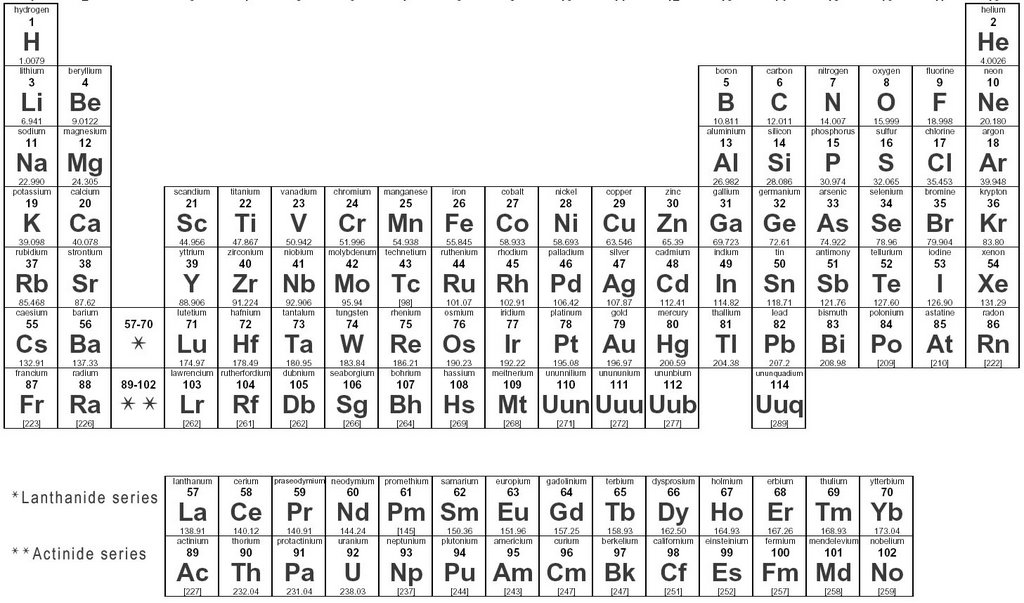
That chart was the sort of thing that made me nearly sick to my stomach whenever I looked at it, something like slide rules and drawings of the innards of the internal combustion engine, and the long rows of monotonous monochromatic law books in my father's office.
But then time passed--as time often does--and I found myself a junior in high school, sitting in chemistry class, finally and reluctantly about to penetrate the secrets of the Periodic Table. The teacher, a small, elderly (oh, he must have been at least fifty), enthusiastic, spry man, explained it to us.
I sat in awe as I took in what he was saying. That chart may have looked boring, but it demonstrated something so absolutely astounding that I could hardly believe it was true. The world of the elements at the atomic level was spectacularly orderly, with such grandeur, power, and rightness that I could only think of one term for it, and that was "beautiful."
I did very well in chemistry, and even thought of majoring in it in college, although in the end I stuck to psychology and anthropology. But I never forgot the lesson of the Periodic Table (actually, it taught many lessons, although some of them I did forget). But the one I remembered was that appearances can be deceptive, and that what lies beneath a bland and stark exterior can be a world of magic.
And now (via Pajamas Media), I've finally discovered a Periodic Table worth its salt--or, rather, its sodium chloride. Take a look at this, a Periodic Table nearly as lovely as the elemental wonders it illustrates:

If you follow the link to the poster at its source, you can click on parts of it to enlarge them and see more of the detail. And then you might say with Keats:
When old age shall this generation waste,
Thou shalt remain, in midst of other woe
Than ours, a friend to man, to whom thou say'st,
'Beauty is truth, truth beauty,—that is all
Ye know on earth, and all ye need to know.'

The Rover Conventions
Commenter "Sergey" has contributed a wonderful piece of folk wisdom about international law and its enforceability:
In old Russia there was a proverbial Yiddish saying on usefulness of formalities of law in dealing with those who do not respect law: "Scribe mit a Hund a Dogovor" (sign a treaty with a dog so it would not bite you).
Yes, indeed. Dip Rover's paw in the ink and have him sign on the dotted line, and I'm sure everything will be just fine.
In old Russia there was a proverbial Yiddish saying on usefulness of formalities of law in dealing with those who do not respect law: "Scribe mit a Hund a Dogovor" (sign a treaty with a dog so it would not bite you).
Yes, indeed. Dip Rover's paw in the ink and have him sign on the dotted line, and I'm sure everything will be just fine.
Friday, September 08, 2006
For those of you who like to follow the sport of troll morphing...
...it turns out that our new friend "Stephen Britton," a far more polite version of his predecessors Stevie/Yahmir/Suzy/anon, is almost certainly one and the same.
J'accuse: a case of libel, the blood libel, and the French press
There's a case about to begin in France that--according to blogger Richard Landes--could rival the Dreyfus case in importance.
I've written previously about the underpinnings of the present case: the misleading media coverage of the alleged death of 12-year old Mohammed al Durah. Those of you who read Augean Stables and Second Draft are probably quite familiar with the fact that a deception was most likely perpetrated by the French media in broadcasting the story to the world.
But now there are new wrinkles to the tale.
If anyone isn't familiar with the original incident, here's a quick summary: in late September of 2000, the boy Mohammed al Durah and his father were taking cover from an exchange of gunfire between Palestinian and Israeli forces in Gaza. Mohammed was either (take your pick, depending on the source) purposely gunned downed by the Israelis, or "caught in the crossfire" and accidently killed by them, according to Talal abu Rahmeh, a Palestinian cameraman who filmed the only video that exists of the supposed death scene; French correspondent Charles Enderlin; and the TV station for which they both worked, France2.
The incendiary footage of al Durah and his father was beamed all over the world. It was viewed with rage and condemnation of Israel, especially in predominantly Moslem and Arab countries as well as in Europe. The al Durah incident and photos of it were prominently visible in propaganda justifying the bloody and horrific Second Intifada against Israel, with its repeated terrorist attacks against Israeli civilians, including many children.
But subsequent research and revelations have led those who have investigated the incident to the almost inescapable conclusion that the facts were not only not quite as reported (for example, the direction of the shots were such that Israeli forces could not have been responsible for hitting al Durah), but what is far worse--that it was bogus from start to finish. That is, that it was staged. The Second Draft site has a great deal of information on this subject; take a look for yourself.
Why am I bringing this up now? The first reason is that media misrepresentation in the recent war in Lebanon has highlighted possibly widespread media complicity in promulgating misinformation and propaganda favoring the Arab/Palestinian position in the Middle East. The al Durah case is an example from six years ago that makes one wonder just how long this has been going on, and how successful it has been in shaping anti-Israel opinions (the answer to both questions appears to be: very).
The second is the aforementioned trial about to begin in France over the al Durah case. The operative French law is one that was passed in 1881, aimed at protecting the press from defamation that "strikes at the honor and consideration (reputation) of 'the individual or institution in question.'"
And who is France2 suing for defamation? Three French citizens who used their websites to publish internet critiques of the station's coverage of the al Durah affair. As far as I can tell, this is the equivalent of the television station suing a blogger such as myself (who, fortunately, lives in the US rather than France) for pointing out that the France2 emperor has no clothes in this matter.
The hubris of France2 is astounding. What's more, they might actually win, according to Landes, despite the fact that anyone viewing the video on which they based the al Durah story can only conclude that France2's journalistic standards in airing the footage were abysmal and deplorable.
If one reviews the history of the coverage of al Durah by France2 with an open mind, it becomes clear that the TV station should be the defendant in a defamation trial, not the plaintiff. The truth appears to be that France2 has not just been duped, but that it has lied, especially in the persons of cameraman Tamal and Charles Enderlin, who asserted that they had respectively taken (Tamal) and personally viewed (Enderlin) twenty-seven minutes of corraboratory video showing the death throes of al Durah, footage that cannot be produced and that in fact never existed.
What does exist? A mere fifty-nine seconds of video, embedded in more minutes of other obviously staged material, filmed by a single Palestinian stringer (Tamal), and showing not al Durah's death throes, but his voluntary movements after he had supposedly been killed by a strangely bloodless shot in the stomach. Take a look at the footage (click to download "Death of an Icon") and see what you think. The egregiousness of the Big Lie must really be seen to be believed (or, rather, disbelieved).
Why does this matter? Al Durah has become both an icon and a rallying cry, a modern and non-Christian twist on an ancient deception, the blood libel. Both the old stories and the new are propaganda used for the same purposes, to ignite anti-Jewish feeling--or its modern-day incarnations, anti-Israeli and anti-Jewish feeling. The repercussions have been vast, especially in Europe, in which both anti-Israeli and anti-Jewish sentiment has risen since 2000, the year of the al Durah incident.
I find the very existence of the French law under which this lawsuit is being brought to be astounding. Why would the media, of all things, need a special stature to protect itself against criticism? Moreover, why is the media so accepting of evidence that anyone with a grain of critical thought would view as suspicious? And why are these fakes so badly done?
The latter question gnaws at me, as it did when the Rathergate memos were exposed as fakes. It wasn't just that they were fakes, it's that they were patently obvious fakes. The inescapable conclusion is that the media on which we rely so heavily to shape our view of the world is either stupid or lying. There's no other possibility, and both alternatives are almost equally horrendous in their consequences.
My other supposition is that we only have uncovered these particular fakes because they are so very obvious. But we can't assume that all the fakes that have been perpetrated on us over the years have been so poorly executed. Are there in fact many others that have passed muster because they are technically far more competently done?
For example, in the case of Rathergate, what if the forgers had actually gotten hold of an old typewriter from the proper era (duh--not so difficult to do, after all)? Would we have ever known such a document was fake? And, with al Durah, what if they'd actually staged these scenes more carefully? It seems to me that it wouldn't have been so very difficult to have done so; moviemakers do it all the time, do they not?
Even so--even with the amateurish and slipshod nature of these forgeries--they still worked, for a while, and still work for many viewers. Al Durah has worked much better and longer than the memos. I fear that, in the future, the perpetrators of such fictions will become more skillful, having learned their lesson from these cases.
There is some cause for cautious--very cautious--optimism, however. I agree with Landes that if the present case in France receives wide coverage, and if the video of al Durah is ever released to the public and receives wide dissemination, it could be a turning point. I like to think that, with repetition (including new incidents such as Reutergate), distrust of media coverage in the area will reach some sort of critical mass. Then, if that happens, even if a lie continues to get halfway round the world before the truth has a chance to get its pants on, maybe that lie won't be so easily believed.
I've written previously about the underpinnings of the present case: the misleading media coverage of the alleged death of 12-year old Mohammed al Durah. Those of you who read Augean Stables and Second Draft are probably quite familiar with the fact that a deception was most likely perpetrated by the French media in broadcasting the story to the world.
But now there are new wrinkles to the tale.
If anyone isn't familiar with the original incident, here's a quick summary: in late September of 2000, the boy Mohammed al Durah and his father were taking cover from an exchange of gunfire between Palestinian and Israeli forces in Gaza. Mohammed was either (take your pick, depending on the source) purposely gunned downed by the Israelis, or "caught in the crossfire" and accidently killed by them, according to Talal abu Rahmeh, a Palestinian cameraman who filmed the only video that exists of the supposed death scene; French correspondent Charles Enderlin; and the TV station for which they both worked, France2.
The incendiary footage of al Durah and his father was beamed all over the world. It was viewed with rage and condemnation of Israel, especially in predominantly Moslem and Arab countries as well as in Europe. The al Durah incident and photos of it were prominently visible in propaganda justifying the bloody and horrific Second Intifada against Israel, with its repeated terrorist attacks against Israeli civilians, including many children.
But subsequent research and revelations have led those who have investigated the incident to the almost inescapable conclusion that the facts were not only not quite as reported (for example, the direction of the shots were such that Israeli forces could not have been responsible for hitting al Durah), but what is far worse--that it was bogus from start to finish. That is, that it was staged. The Second Draft site has a great deal of information on this subject; take a look for yourself.
Why am I bringing this up now? The first reason is that media misrepresentation in the recent war in Lebanon has highlighted possibly widespread media complicity in promulgating misinformation and propaganda favoring the Arab/Palestinian position in the Middle East. The al Durah case is an example from six years ago that makes one wonder just how long this has been going on, and how successful it has been in shaping anti-Israel opinions (the answer to both questions appears to be: very).
The second is the aforementioned trial about to begin in France over the al Durah case. The operative French law is one that was passed in 1881, aimed at protecting the press from defamation that "strikes at the honor and consideration (reputation) of 'the individual or institution in question.'"
And who is France2 suing for defamation? Three French citizens who used their websites to publish internet critiques of the station's coverage of the al Durah affair. As far as I can tell, this is the equivalent of the television station suing a blogger such as myself (who, fortunately, lives in the US rather than France) for pointing out that the France2 emperor has no clothes in this matter.
The hubris of France2 is astounding. What's more, they might actually win, according to Landes, despite the fact that anyone viewing the video on which they based the al Durah story can only conclude that France2's journalistic standards in airing the footage were abysmal and deplorable.
If one reviews the history of the coverage of al Durah by France2 with an open mind, it becomes clear that the TV station should be the defendant in a defamation trial, not the plaintiff. The truth appears to be that France2 has not just been duped, but that it has lied, especially in the persons of cameraman Tamal and Charles Enderlin, who asserted that they had respectively taken (Tamal) and personally viewed (Enderlin) twenty-seven minutes of corraboratory video showing the death throes of al Durah, footage that cannot be produced and that in fact never existed.
What does exist? A mere fifty-nine seconds of video, embedded in more minutes of other obviously staged material, filmed by a single Palestinian stringer (Tamal), and showing not al Durah's death throes, but his voluntary movements after he had supposedly been killed by a strangely bloodless shot in the stomach. Take a look at the footage (click to download "Death of an Icon") and see what you think. The egregiousness of the Big Lie must really be seen to be believed (or, rather, disbelieved).
Why does this matter? Al Durah has become both an icon and a rallying cry, a modern and non-Christian twist on an ancient deception, the blood libel. Both the old stories and the new are propaganda used for the same purposes, to ignite anti-Jewish feeling--or its modern-day incarnations, anti-Israeli and anti-Jewish feeling. The repercussions have been vast, especially in Europe, in which both anti-Israeli and anti-Jewish sentiment has risen since 2000, the year of the al Durah incident.
I find the very existence of the French law under which this lawsuit is being brought to be astounding. Why would the media, of all things, need a special stature to protect itself against criticism? Moreover, why is the media so accepting of evidence that anyone with a grain of critical thought would view as suspicious? And why are these fakes so badly done?
The latter question gnaws at me, as it did when the Rathergate memos were exposed as fakes. It wasn't just that they were fakes, it's that they were patently obvious fakes. The inescapable conclusion is that the media on which we rely so heavily to shape our view of the world is either stupid or lying. There's no other possibility, and both alternatives are almost equally horrendous in their consequences.
My other supposition is that we only have uncovered these particular fakes because they are so very obvious. But we can't assume that all the fakes that have been perpetrated on us over the years have been so poorly executed. Are there in fact many others that have passed muster because they are technically far more competently done?
For example, in the case of Rathergate, what if the forgers had actually gotten hold of an old typewriter from the proper era (duh--not so difficult to do, after all)? Would we have ever known such a document was fake? And, with al Durah, what if they'd actually staged these scenes more carefully? It seems to me that it wouldn't have been so very difficult to have done so; moviemakers do it all the time, do they not?
Even so--even with the amateurish and slipshod nature of these forgeries--they still worked, for a while, and still work for many viewers. Al Durah has worked much better and longer than the memos. I fear that, in the future, the perpetrators of such fictions will become more skillful, having learned their lesson from these cases.
There is some cause for cautious--very cautious--optimism, however. I agree with Landes that if the present case in France receives wide coverage, and if the video of al Durah is ever released to the public and receives wide dissemination, it could be a turning point. I like to think that, with repetition (including new incidents such as Reutergate), distrust of media coverage in the area will reach some sort of critical mass. Then, if that happens, even if a lie continues to get halfway round the world before the truth has a chance to get its pants on, maybe that lie won't be so easily believed.
Thursday, September 07, 2006
The Dread Pirate Bin Laden
More on the subject of fear:
Dean Esmay, a fan of "The Princess Bride," points out that the Dread Pirate Roberts of that movie was an actual historical figure.
Pirates have become almost comical these days, good for a laugh in a children's movie, not to mention a classic costume for Halloween. That's about it.
But in their day they were much-feared, and rightly so. This piece (also reached through a post linked by Dean) offers a discussion of the history of piracy and of laws against it, and suggests applying the concept to terrorists.
Pirates were once state-sponsored, hidden agents for nations to wage war against each other. Then piracy degenerated still further, into free-form nihilism:
...[latter-day pirates] struck indiscriminately in ferocious revenge against the societies that they felt had condemned them. Often these disenchanted sailors cast their piratical careers in revolutionary terms. The 18th-century English legal scholar William Blackstone defined a pirate as someone who has "reduced himself afresh to the savage state of nature by declaring war against all mankind,"...Perhaps the most telling statement of the pirates' motives comes from a pirate named Black Sam Bellamy. To a captured merchant captain, he boasted, "I am a free prince, and have as much authority to make war on the whole world as he who has a 100 sail of ships and an army of 100,000 men in the field."
The laws against piracy rest on:
...the concept of universal jurisdiction. The crime of piracy is considered a breach of jus cogens, a conventional peremptory international norm from which states may not derogate. Those committing thefts on the high seas, inhibiting trade, and endangering maritime communication are considered by sovereign states to be hostis humani generis (enemies of humanity).
In the mid-19th century, the nations of Europe had finally stopped using piracy to further their own ends and got together to help weaken its hold on the world. A similar unity among the world's nations right now against the current enemies of humanity might relegate terrorists of the future to characters in children's movies, and to colorful costumes at Halloween. Unfortunately, that's not likely to happen: terrorists still serve the interests of many countries, who use them as convenient surrogates and hidden agents.
Dean Esmay, a fan of "The Princess Bride," points out that the Dread Pirate Roberts of that movie was an actual historical figure.
Pirates have become almost comical these days, good for a laugh in a children's movie, not to mention a classic costume for Halloween. That's about it.
But in their day they were much-feared, and rightly so. This piece (also reached through a post linked by Dean) offers a discussion of the history of piracy and of laws against it, and suggests applying the concept to terrorists.
Pirates were once state-sponsored, hidden agents for nations to wage war against each other. Then piracy degenerated still further, into free-form nihilism:
...[latter-day pirates] struck indiscriminately in ferocious revenge against the societies that they felt had condemned them. Often these disenchanted sailors cast their piratical careers in revolutionary terms. The 18th-century English legal scholar William Blackstone defined a pirate as someone who has "reduced himself afresh to the savage state of nature by declaring war against all mankind,"...Perhaps the most telling statement of the pirates' motives comes from a pirate named Black Sam Bellamy. To a captured merchant captain, he boasted, "I am a free prince, and have as much authority to make war on the whole world as he who has a 100 sail of ships and an army of 100,000 men in the field."
The laws against piracy rest on:
...the concept of universal jurisdiction. The crime of piracy is considered a breach of jus cogens, a conventional peremptory international norm from which states may not derogate. Those committing thefts on the high seas, inhibiting trade, and endangering maritime communication are considered by sovereign states to be hostis humani generis (enemies of humanity).
In the mid-19th century, the nations of Europe had finally stopped using piracy to further their own ends and got together to help weaken its hold on the world. A similar unity among the world's nations right now against the current enemies of humanity might relegate terrorists of the future to characters in children's movies, and to colorful costumes at Halloween. Unfortunately, that's not likely to happen: terrorists still serve the interests of many countries, who use them as convenient surrogates and hidden agents.
Fraidy cats and fear itself: Left and Right
There's been a longstanding meme on the Left about the Right, one I've written about before. It's a twist on the old schoolyard taunt, "Fraidy, cat, fraidy cat!"
The allegation is that the Right is motivated by fear--and unrealistic and wildly exaggerated fear, at that. My esteemed colleague Shrinkwrapped has written a recent and excellent piece on the subject.
Funny; when I look about me on the Right, I don't see a whole lot of fear. Anger, perhaps, both at the Left and at the Islamist totalitarian enemy. But on the whole, the Right seems to me to be realistically facing and evaluating the threat before us, taking the enemy at its word about what it intends to do, and trying to learn the lessons of history. The Right wishes to take action against that enemy rather than wait in passive denial, wring its hands in fear, or pursue the false hope of appeasement.
One can disagree with the methods and approach of the Right without disagreeing about the degree of threat represented by the enemy. The Left, however, in choosing the "fraidy cat" argument, appears to be thinking along the following lines (excerpt from that previous post of mine about fear):
The legacy of Vietnam is that the left has a lingering mindset that considers national security concerns to almost always be mere excuses for government spying...The left, and many liberals, seem to feel that the raising of security issues in these situations is almost always bogus--a sort of screen, used by a proto-totalitarian government to cover its own misuse of power, with the goal of getting away with domestic spying on its enemies, and the further consolidation of its own power. If this is the conception, then national security concerns must be downplayed in almost all cases, and the role of fear as motivation for those concerns exaggerated instead.
I see the Right as motivated by realism about the goals of Islamist totalitarianism, and this leads to calls for action to block the enemy before the threat it represents becomes even greater, and the possibility of even more devastation looms larger.
But even if we are willing to grant, for the sake of argument, the Left's charge that the main motivation on the Right is fear, we can say two things. The first is that in facing an enemy bent on one's destruction and willing to purposely kill as many innocents as possible with all the weapons at its disposal, some element of fear (as in "apprehension of a danger") is certainly warranted. The real question is whether the fear is realistic or whether it is exaggerated, and whether the person is paralyzed by that fear, or whether he/she takes appropriate action to forestall the feared consequences.
The left has its own fears, of course, and they are potent motivators, as well. As previously stated, they fear abuse of power by our own government in the pursuit of national security more than any foreign threat. To parse it even more finely, sometimes it seems that they fear abuse of power by a Republican executive branch more than anything; back in the days of FDR they liked a powerful federal government well enough, when it was run by a Democrat.
Speaking of FDR, it was he who famously said, "The only thing we have to fear is fear itself." The context in which he made that statement is interesting; take a look at his First Inaugural Address, delivered in March of 1933, when the nation faced the Great Depression, the subject matter of FDR's speech.
FDR does indeed say, "The only think we have to fear is fear itself" (and, by the way, listen to the audio; what a speaker he was!). But this is the message in which his quote was embedded:
...the only thing we have to fear is fear itself—-nameless, unreasoning, unjustified terror which paralyzes needed efforts to convert retreat into advance. In every dark hour of our national life a leadership of frankness and vigor has met with that understanding and support of the people themselves which is essential to victory...In such a spirit on my part and on yours we face our common difficulties [he follows with a long list of the problems the nation faced at the time]...Only a foolish optimist can deny the dark realities of the moment.
Then, as now, the danger of fear is not really fear itself. It is, as FDR stated [emphasis mine], "nameless, unreasoning, unjustified terror which paralyzes needed efforts."
I submit that those words define the stance of the Left today far more than that of the Right--in fearing, for example, warrantless NSA wiretapping of calls with terrorist foreign nationals more than the consequences of not using reasonable tools in our arsenal in order to fight an implacable and vicious enemy (and see here if you wish to revisit the complexities of the legal arguments concerning these wiretappings).
And I agree, along with FDR, that "only a foolish optimist can deny the dark realities of the moment." I happen to think the Left fits the definition of "foolish optimist" in denying the dark realities of the present-day Islamist totalitarian threat. The Left, of course, thinks people such as myself to be foolish optimists in denying the dark realities of the threats posed by the would-be dictators Bush and Rove, and that we are timid and cowering fraidy cats in assuming that people such as Ahmadinejad mean exactly and precisely what they say.
[NOTE: And speaking of fear...]
The allegation is that the Right is motivated by fear--and unrealistic and wildly exaggerated fear, at that. My esteemed colleague Shrinkwrapped has written a recent and excellent piece on the subject.
Funny; when I look about me on the Right, I don't see a whole lot of fear. Anger, perhaps, both at the Left and at the Islamist totalitarian enemy. But on the whole, the Right seems to me to be realistically facing and evaluating the threat before us, taking the enemy at its word about what it intends to do, and trying to learn the lessons of history. The Right wishes to take action against that enemy rather than wait in passive denial, wring its hands in fear, or pursue the false hope of appeasement.
One can disagree with the methods and approach of the Right without disagreeing about the degree of threat represented by the enemy. The Left, however, in choosing the "fraidy cat" argument, appears to be thinking along the following lines (excerpt from that previous post of mine about fear):
The legacy of Vietnam is that the left has a lingering mindset that considers national security concerns to almost always be mere excuses for government spying...The left, and many liberals, seem to feel that the raising of security issues in these situations is almost always bogus--a sort of screen, used by a proto-totalitarian government to cover its own misuse of power, with the goal of getting away with domestic spying on its enemies, and the further consolidation of its own power. If this is the conception, then national security concerns must be downplayed in almost all cases, and the role of fear as motivation for those concerns exaggerated instead.
I see the Right as motivated by realism about the goals of Islamist totalitarianism, and this leads to calls for action to block the enemy before the threat it represents becomes even greater, and the possibility of even more devastation looms larger.
But even if we are willing to grant, for the sake of argument, the Left's charge that the main motivation on the Right is fear, we can say two things. The first is that in facing an enemy bent on one's destruction and willing to purposely kill as many innocents as possible with all the weapons at its disposal, some element of fear (as in "apprehension of a danger") is certainly warranted. The real question is whether the fear is realistic or whether it is exaggerated, and whether the person is paralyzed by that fear, or whether he/she takes appropriate action to forestall the feared consequences.
The left has its own fears, of course, and they are potent motivators, as well. As previously stated, they fear abuse of power by our own government in the pursuit of national security more than any foreign threat. To parse it even more finely, sometimes it seems that they fear abuse of power by a Republican executive branch more than anything; back in the days of FDR they liked a powerful federal government well enough, when it was run by a Democrat.
Speaking of FDR, it was he who famously said, "The only thing we have to fear is fear itself." The context in which he made that statement is interesting; take a look at his First Inaugural Address, delivered in March of 1933, when the nation faced the Great Depression, the subject matter of FDR's speech.
FDR does indeed say, "The only think we have to fear is fear itself" (and, by the way, listen to the audio; what a speaker he was!). But this is the message in which his quote was embedded:
...the only thing we have to fear is fear itself—-nameless, unreasoning, unjustified terror which paralyzes needed efforts to convert retreat into advance. In every dark hour of our national life a leadership of frankness and vigor has met with that understanding and support of the people themselves which is essential to victory...In such a spirit on my part and on yours we face our common difficulties [he follows with a long list of the problems the nation faced at the time]...Only a foolish optimist can deny the dark realities of the moment.
Then, as now, the danger of fear is not really fear itself. It is, as FDR stated [emphasis mine], "nameless, unreasoning, unjustified terror which paralyzes needed efforts."
I submit that those words define the stance of the Left today far more than that of the Right--in fearing, for example, warrantless NSA wiretapping of calls with terrorist foreign nationals more than the consequences of not using reasonable tools in our arsenal in order to fight an implacable and vicious enemy (and see here if you wish to revisit the complexities of the legal arguments concerning these wiretappings).
And I agree, along with FDR, that "only a foolish optimist can deny the dark realities of the moment." I happen to think the Left fits the definition of "foolish optimist" in denying the dark realities of the present-day Islamist totalitarian threat. The Left, of course, thinks people such as myself to be foolish optimists in denying the dark realities of the threats posed by the would-be dictators Bush and Rove, and that we are timid and cowering fraidy cats in assuming that people such as Ahmadinejad mean exactly and precisely what they say.
[NOTE: And speaking of fear...]
Wednesday, September 06, 2006
Bloggers and vacations
The Wall Street Journal is on to the not-so-well-kept secret of bloggers, which is that is that they tend to have some degree of obsessive-compulsive disorder.
The ubiquity of the internet, laptops, and the like means that bloggers need never be very far away from their connections. Now, "connection" is a word with a double meaning, of course: it can refer to being hooked up to the Web, or simply to being hooked, as in "addicted."
Yes, some would argue that blogging is an addiction--perhaps what's referred to as a Positive Addiction, but an addiction nonetheless.
The WSJ article highlights the very special dilemma facing bloggers who want to take some time off:
In the height of summer-holiday season, bloggers face the inevitable question: to blog on break or put the blog on a break? Fearing a decline in readership, some writers opt not to take vacations. Others keep posting while on location, to the chagrin of their families. Those brave enough to detach themselves from their keyboards for a few days must choose between leaving the site dormant or having someone blog-sit.
According to the WSJ, even the biggest bloggers seem to mull over--or perhaps obsess over--the problem.
But me? No. Not moi. Not addicted, not at all. No siree. I have no difficulty whatsoever in resolving this issue. When I'm on vacation--and I've taken rather lengthy ones each of the two summers I've been blogging--I continue to post. But I take a middle road and lighten my load considerably. I won't bore you with the secrets of how I do it, but I've managed to keep up the blog without ruining my vacations. At least so far.
The truth is that bloggers depend on addictions, both in themselves and in others. After all, aren't we trying to form an addiction in our readers--an addiction to reading our blogs? Maybe a better word would be "habit"--makes us all feel better.
And, just to show how very unaddicted I am, I'm now going out to enjoy some of that thing known as "real life." Till later...
The ubiquity of the internet, laptops, and the like means that bloggers need never be very far away from their connections. Now, "connection" is a word with a double meaning, of course: it can refer to being hooked up to the Web, or simply to being hooked, as in "addicted."
Yes, some would argue that blogging is an addiction--perhaps what's referred to as a Positive Addiction, but an addiction nonetheless.
The WSJ article highlights the very special dilemma facing bloggers who want to take some time off:
In the height of summer-holiday season, bloggers face the inevitable question: to blog on break or put the blog on a break? Fearing a decline in readership, some writers opt not to take vacations. Others keep posting while on location, to the chagrin of their families. Those brave enough to detach themselves from their keyboards for a few days must choose between leaving the site dormant or having someone blog-sit.
According to the WSJ, even the biggest bloggers seem to mull over--or perhaps obsess over--the problem.
But me? No. Not moi. Not addicted, not at all. No siree. I have no difficulty whatsoever in resolving this issue. When I'm on vacation--and I've taken rather lengthy ones each of the two summers I've been blogging--I continue to post. But I take a middle road and lighten my load considerably. I won't bore you with the secrets of how I do it, but I've managed to keep up the blog without ruining my vacations. At least so far.
The truth is that bloggers depend on addictions, both in themselves and in others. After all, aren't we trying to form an addiction in our readers--an addiction to reading our blogs? Maybe a better word would be "habit"--makes us all feel better.
And, just to show how very unaddicted I am, I'm now going out to enjoy some of that thing known as "real life." Till later...
More shameless self-promotion: Sanity Squad podcast
The latest Sanity Squad podcast is up at the Politics Central site at Pajamas Media.
There are still a few technical kinks--every now and then, Shrinkwrapped's voice goes all metallic and he gets stuck in a strange time warp. But I think you'll find the group interesting and entertaining--although not as entertaining as you might have found them had the technical guy not decided that my joke about France was way lame, and edited it out.
What joke about France? Well, after Siggy challenges us all to name a nation under the sway of tyranny that isn't a third-world country, I respond with, "France?"
Come to think of it, maybe the technical guy was right.
There are still a few technical kinks--every now and then, Shrinkwrapped's voice goes all metallic and he gets stuck in a strange time warp. But I think you'll find the group interesting and entertaining--although not as entertaining as you might have found them had the technical guy not decided that my joke about France was way lame, and edited it out.
What joke about France? Well, after Siggy challenges us all to name a nation under the sway of tyranny that isn't a third-world country, I respond with, "France?"
Come to think of it, maybe the technical guy was right.
Tuesday, September 05, 2006
Conversations on conversion
Alexandra is incensed at Bill Maher for making light of forced conversion to Islam.
Maher isn't one of my favorites (surprise, surprise, you say), and I don't really tend to follow his shows. But in a comedy routine (video here; starts at minute two), Maher said:
New rule: If converting to Islam is all it takes to get the terrorists off our backs, then all I have to say is, “Lalalalalalala! [ulalates loudly]”...Now, I know what you’re thinking: “Bill, if we convert to Islam, doesn’t that mean the terrorists have won?” Well, sort of, but it’s a win-win, because they get to declare victory, and we get to take hair gel on the plane. Plus, we’re not really converting to Islam. We’re just telling our enemies what they want to hear, and trying to convince them we’re something we’re really not...And, it’s so simple to convert this way. You know, if you want to convert to Judaism, it’s a huge hassle. You’ve got to find a Rabbi, study the Torah, get circumcised, go to dental school. But, Mohammed made joining his team easy: two line pledge, and you’re in.
Maher loves to be controversial, and this rant is no exception. He goes on to add that conversion doesn't matter because Americans are Christians in name only and don't fulfill most of the obligations of Christianity, and that one religious fanatic is much the same as another.
To treat Maher's charges with a seriousness they perhaps don't deserve, he ignores the fact that imperfection in religious observance (charity, for example, and other kindly acts) is the rule for humanity across the board, not just in the case of Americans. He also ignores the major differences between fanatical Christians and fanatical Moslems and fanatical Jews, especially in their attitudes towards conversion, but in many other respects, as well.
Most of us can agree with Maher, however, that allowing religious fanatics of any stripe to be in charge of government would be a bad thing. The disagreement arises in the definition of "fanatic." Some, no doubt, believe that all Zionists are by definition religious fanatics. Some, no doubt, feel that the entire anti-abortion crowd--not just those who murder abortionists--are religious fanatics.
I happen to believe that not all religious fanatics are the same. And I think the evidence is clear that present-day Islamist fanatics are louder, more numerous, more powerful in their own countries, more willing to use coercion to force beliefs and practices on others, and more intent on killing very large numbers of people in their desire for religious hegemony.
That attitude towards religious hegemony--and the best means to go about achieving it, if desired--is another huge distinction between the three Abrahamic religions. Even though he's not trying to be serious, Maher touches on a very fundamental and important difference among the religions as far as conversion goes, and it's not a tangential one. The distinction goes to the heart of what each religion is in modern times--how it sees itself, its message, and its mission in the world.
Judaism makes conversion difficult for a reason. Islam makes it extremely easy for a reason. Christianity occupies a middle ground for a reason (the issues and history are far more complex than can be dealt with in this post, so the following is, quite naturally, a simplification).
Judaism has a "live and let live" attitude towards other religions. Here's a statement of the Jewish point of view:
Judaism, unlike say Christianity and Islam, is not a proselytising religion. Because it teaches that the righteous of all nations shall enter the gates of heaven, it does not have any compelling urge to rescue non-Jews from hell and damnation. There is a requirement in Jewish law to ensure the sincerity of a potential convert. Essentially, [the religious authorities] want to be sure that the convert knows what he is getting into, and that he is doing it for sincerely religious reasons.
Christianity is a proselytising religion. In modern times it does so through nonviolent means--persuasion, preaching, missionary work--although in the past coercion was sometimes involved. The idea behind both the nonviolent and the violent conversions was that Christianity was the only way to salvation, and thus it was incumbent on Christians to spread the faith.
The same is true of Islam. Islam's early tradition is one of jihad through martial conquest, giving defeated peoples "of the Book" (Christians, Jews) a choice: conversion, dhimmitude, or death. The choice for infidels was simpler: conversion or death. This was done despite verses in the Koran framing religious choice as something that should not be coerced. As in much of Islam, there are other contradictory hadiths--for example, the Verse of the Sword--that seem to prescribe forced conversion.
There is no question that Islam is a religion with a mainstream--not a fringe--belief that everyone on earth should ultimately become Moslem. In fact, it considers conversion to be a misnomer; the proper word might be reversion, since it is also believes that everyone on earth is actually born a Moslem. Islam is also the only religion of which I'm aware that considers death the punishment for renouncing the religion.
As a group that has been subjected to forced conversions for centuries--both at the hands of Christians and from Moslems--Jews have long pondered the dilemma of the reluctant potential convert. Should one resist to the death? Or is a far more serious version of Bill Maher's suggestion ("We're not really converting to Islam") acceptable: pretended conversion, allowing the convert to live and to practice Judaism in secret, hoping at some future date to become openly Jewish once again?
The great Jewish rabbi-philosopher Maimonides pondered the issue in the twelfth century, writing his "Epistle on Forced Conversion." Maimonides had an extremely personal interest in the topic, since he himself had been forced to convert to Islam in Spain in order to save his life, after which he fled that country, ending up in Egypt and returning to the practice of Judaism. His answer is that it is best to leave the area, if possible, rather than to convert, but that conversion is acceptable and forgivable in order to save one's life, especially if the intent is to practice secretly and/or to ultimately emigrate and practice the religion openly once again.
Some who are not religious may find it hard to understand what all the fuss about forced conversion is. But most probably realize that forced conversion is an affront to freedom of belief and practice, which includes the freedom to not believe and to not practice. And even Maher, in his lucid moments--and I'm sure he has a few--would agree that any religious group bent on forcibly and aggressively imposing both its belief system and its practices on others is one that must be vigorously fought against and defeated. Conversion at the point of a sword--or a gun--is the unmistakable marker of such a religious group. And such conversion seems to be the exclusive province of Islamist totalitarians these days.
Maher isn't one of my favorites (surprise, surprise, you say), and I don't really tend to follow his shows. But in a comedy routine (video here; starts at minute two), Maher said:
New rule: If converting to Islam is all it takes to get the terrorists off our backs, then all I have to say is, “Lalalalalalala! [ulalates loudly]”...Now, I know what you’re thinking: “Bill, if we convert to Islam, doesn’t that mean the terrorists have won?” Well, sort of, but it’s a win-win, because they get to declare victory, and we get to take hair gel on the plane. Plus, we’re not really converting to Islam. We’re just telling our enemies what they want to hear, and trying to convince them we’re something we’re really not...And, it’s so simple to convert this way. You know, if you want to convert to Judaism, it’s a huge hassle. You’ve got to find a Rabbi, study the Torah, get circumcised, go to dental school. But, Mohammed made joining his team easy: two line pledge, and you’re in.
Maher loves to be controversial, and this rant is no exception. He goes on to add that conversion doesn't matter because Americans are Christians in name only and don't fulfill most of the obligations of Christianity, and that one religious fanatic is much the same as another.
To treat Maher's charges with a seriousness they perhaps don't deserve, he ignores the fact that imperfection in religious observance (charity, for example, and other kindly acts) is the rule for humanity across the board, not just in the case of Americans. He also ignores the major differences between fanatical Christians and fanatical Moslems and fanatical Jews, especially in their attitudes towards conversion, but in many other respects, as well.
Most of us can agree with Maher, however, that allowing religious fanatics of any stripe to be in charge of government would be a bad thing. The disagreement arises in the definition of "fanatic." Some, no doubt, believe that all Zionists are by definition religious fanatics. Some, no doubt, feel that the entire anti-abortion crowd--not just those who murder abortionists--are religious fanatics.
I happen to believe that not all religious fanatics are the same. And I think the evidence is clear that present-day Islamist fanatics are louder, more numerous, more powerful in their own countries, more willing to use coercion to force beliefs and practices on others, and more intent on killing very large numbers of people in their desire for religious hegemony.
That attitude towards religious hegemony--and the best means to go about achieving it, if desired--is another huge distinction between the three Abrahamic religions. Even though he's not trying to be serious, Maher touches on a very fundamental and important difference among the religions as far as conversion goes, and it's not a tangential one. The distinction goes to the heart of what each religion is in modern times--how it sees itself, its message, and its mission in the world.
Judaism makes conversion difficult for a reason. Islam makes it extremely easy for a reason. Christianity occupies a middle ground for a reason (the issues and history are far more complex than can be dealt with in this post, so the following is, quite naturally, a simplification).
Judaism has a "live and let live" attitude towards other religions. Here's a statement of the Jewish point of view:
Judaism, unlike say Christianity and Islam, is not a proselytising religion. Because it teaches that the righteous of all nations shall enter the gates of heaven, it does not have any compelling urge to rescue non-Jews from hell and damnation. There is a requirement in Jewish law to ensure the sincerity of a potential convert. Essentially, [the religious authorities] want to be sure that the convert knows what he is getting into, and that he is doing it for sincerely religious reasons.
Christianity is a proselytising religion. In modern times it does so through nonviolent means--persuasion, preaching, missionary work--although in the past coercion was sometimes involved. The idea behind both the nonviolent and the violent conversions was that Christianity was the only way to salvation, and thus it was incumbent on Christians to spread the faith.
The same is true of Islam. Islam's early tradition is one of jihad through martial conquest, giving defeated peoples "of the Book" (Christians, Jews) a choice: conversion, dhimmitude, or death. The choice for infidels was simpler: conversion or death. This was done despite verses in the Koran framing religious choice as something that should not be coerced. As in much of Islam, there are other contradictory hadiths--for example, the Verse of the Sword--that seem to prescribe forced conversion.
There is no question that Islam is a religion with a mainstream--not a fringe--belief that everyone on earth should ultimately become Moslem. In fact, it considers conversion to be a misnomer; the proper word might be reversion, since it is also believes that everyone on earth is actually born a Moslem. Islam is also the only religion of which I'm aware that considers death the punishment for renouncing the religion.
As a group that has been subjected to forced conversions for centuries--both at the hands of Christians and from Moslems--Jews have long pondered the dilemma of the reluctant potential convert. Should one resist to the death? Or is a far more serious version of Bill Maher's suggestion ("We're not really converting to Islam") acceptable: pretended conversion, allowing the convert to live and to practice Judaism in secret, hoping at some future date to become openly Jewish once again?
The great Jewish rabbi-philosopher Maimonides pondered the issue in the twelfth century, writing his "Epistle on Forced Conversion." Maimonides had an extremely personal interest in the topic, since he himself had been forced to convert to Islam in Spain in order to save his life, after which he fled that country, ending up in Egypt and returning to the practice of Judaism. His answer is that it is best to leave the area, if possible, rather than to convert, but that conversion is acceptable and forgivable in order to save one's life, especially if the intent is to practice secretly and/or to ultimately emigrate and practice the religion openly once again.
Some who are not religious may find it hard to understand what all the fuss about forced conversion is. But most probably realize that forced conversion is an affront to freedom of belief and practice, which includes the freedom to not believe and to not practice. And even Maher, in his lucid moments--and I'm sure he has a few--would agree that any religious group bent on forcibly and aggressively imposing both its belief system and its practices on others is one that must be vigorously fought against and defeated. Conversion at the point of a sword--or a gun--is the unmistakable marker of such a religious group. And such conversion seems to be the exclusive province of Islamist totalitarians these days.
Watch for it
Airing this September 10-11, the five-year anniversary of 9/11, this ABC miniseries sounds awfully good.
[ADDENDUM: A caveat about the historical accuracy of a certain scene involving the Clinton administration. Perhaps there's a bit of Oliver Stonism creeping in?]
[ADDENDUM: A caveat about the historical accuracy of a certain scene involving the Clinton administration. Perhaps there's a bit of Oliver Stonism creeping in?]
Can't get enough of the voice of neo-neocon?: audio from down under
I'm the guest interviewee on this podcast from Shire Network News, found at Blogmatrix. You can download through iTunes, or just download it directly from the Blogmatrix site, here.
The interview with me starts about a third of the way into the podcast. My voice can't compete with the mellifluous British tones of Brian of London, who begins the podcast, nor can it measure up to the dulcet harmonies of Tom Paine, my Australian interviewer (love those accents, guys!). But on this podcast my voice comes the closest so far to sounding like my actual self. And the topic I'm talking about is one near and dear to my heart--my "change." And, if you want to hear me at least attempting to make a few jokes, there's a moment or two when I do just that.
Blogmatrix specializes in podcasts, and often injects humor into the proceedings. You might want to take a look at some of their previous efforts, as well.
The interview with me starts about a third of the way into the podcast. My voice can't compete with the mellifluous British tones of Brian of London, who begins the podcast, nor can it measure up to the dulcet harmonies of Tom Paine, my Australian interviewer (love those accents, guys!). But on this podcast my voice comes the closest so far to sounding like my actual self. And the topic I'm talking about is one near and dear to my heart--my "change." And, if you want to hear me at least attempting to make a few jokes, there's a moment or two when I do just that.
Blogmatrix specializes in podcasts, and often injects humor into the proceedings. You might want to take a look at some of their previous efforts, as well.
Monday, September 04, 2006
Traveling without divisions, you don't get no respect
Iran and Ahmadinejad have once again demonstrated the great and awesome power of the UN and their fear of its sanctions, in Iran's continued defiance of the UN's call for limitations on its nuclear program. Although Kofi Annan made a special trip to Iran to discuss these matters, the Iranian leader might very well have paraphrased Stalin (instead of the historical tyrant he usually prefers to channel, Hitler) and asked: how many divisions does Kofi Annan have?
The answer? Quite a few, but unfortunately they lack the ability to fight, being either unarmed or lightly armed and only allowed to fire in self-defense. And the UN's proposed sanctions, hardly frightening in and of themselves, are likely to be blocked by Iran's buddies Russia and China, as Iran is well aware.
As for Annan himself, he well might paraphrase Rodney Dangerfield and say: I don't get no respect, despite (or perhaps because) of Iran's praise for his visit as "good, suitable, and positive." In other words: powerless, meaningless, and suiting Iran's aims to place a cooperative face on its nuclear ambitions.
Annan made a small gesture of relative defiance by criticizing Iran's nose-thumbing announcement of a conference devoted to the fact that the Holocaust was an "exaggeration," as well as the mounting of an exhibit in Teheran of cartoons mocking said Holocaust (or, rather, un-Holocaust).
Annan's statement of the Holocaust's historical reality is okay as far as it goes, which isn't all that far. It illustrates the tepid nature of the UN response--or the diplomatic response in general--when faced with evil. Annan is typical of those groups in trying to reason with the unreasonable, and to plead with the inhumane. Such reasoning and pleas are doomed to fall on deaf ears.
The answer? Quite a few, but unfortunately they lack the ability to fight, being either unarmed or lightly armed and only allowed to fire in self-defense. And the UN's proposed sanctions, hardly frightening in and of themselves, are likely to be blocked by Iran's buddies Russia and China, as Iran is well aware.
As for Annan himself, he well might paraphrase Rodney Dangerfield and say: I don't get no respect, despite (or perhaps because) of Iran's praise for his visit as "good, suitable, and positive." In other words: powerless, meaningless, and suiting Iran's aims to place a cooperative face on its nuclear ambitions.
Annan made a small gesture of relative defiance by criticizing Iran's nose-thumbing announcement of a conference devoted to the fact that the Holocaust was an "exaggeration," as well as the mounting of an exhibit in Teheran of cartoons mocking said Holocaust (or, rather, un-Holocaust).
Annan's statement of the Holocaust's historical reality is okay as far as it goes, which isn't all that far. It illustrates the tepid nature of the UN response--or the diplomatic response in general--when faced with evil. Annan is typical of those groups in trying to reason with the unreasonable, and to plead with the inhumane. Such reasoning and pleas are doomed to fall on deaf ears.
Noah's eyes: still point in the turning world
If you're having a slow Labor Day, take a look at this (hat tip: Pajamas Media): a young man named Noah takes a photo of himself every day for six years (yes, count 'em--or rather, maybe you'd better just take his word for it).
Ah, Noah, despite your relative youth and my relative age, I can empathize. What am I talking about? Why, the hair, of course! Every day a different experience--every hour a different experience. Those of us with strongly wavy hair that has a mind of its own can understand; others probably cannot.
The variety of directions in which Noah's hair chooses to go is not matched by any variety in his own moods, however. Never I have seen so little change of expression in my life. And his eyes--how does he do that? They appear to remain focused on a single point throughout the over two thousand photos.
Ah, Noah, despite your relative youth and my relative age, I can empathize. What am I talking about? Why, the hair, of course! Every day a different experience--every hour a different experience. Those of us with strongly wavy hair that has a mind of its own can understand; others probably cannot.
The variety of directions in which Noah's hair chooses to go is not matched by any variety in his own moods, however. Never I have seen so little change of expression in my life. And his eyes--how does he do that? They appear to remain focused on a single point throughout the over two thousand photos.
Sunday, September 03, 2006
Almost-fall garden interlude
When I moved to my present house I inherited a perennial garden.
That wasn't my main concern. Just having a marginally affordable place to live was the important thing, because I managed to buy my house in a seller's market (and I bet that, whenever I move, it will be a buyer's market. Ah, well.)
The garden was an unintended responsibility, one I wasn't sure I could meet. Actually, although the house is fairly small, there were three gardens--one in front, the sun garden; a terraced rock one on the side and one in the back, both shade gardens. I had to do a lot of reading and learning about growing flowers to rise to the occasion and do right by those gardens, since I knew virtually nothing on the subject when I first moved here.
But I think, all things considering, I've done rather well. Some plants died and I replaced them with others. Some thrived. I moved things around. I learned that what looks good in June or July can look crummy and bloomless in August. I learned my favorite garden joke, which I've written before but will repeat once more, with feeling:
Q: What's the definition of a perennial?
A: It's a plant that comes back every year, if it had lived.
It's not always easy to get the garden to look good in September. But I will restrain my innate modesty to say that I think mine isn't all that shabby right now. And, getting an even tighter grip on that innate modesty, I'm going to post a couple of photos of the front garden, taken just yesterday, when it wasn't pouring rain, unlike today:



That wasn't my main concern. Just having a marginally affordable place to live was the important thing, because I managed to buy my house in a seller's market (and I bet that, whenever I move, it will be a buyer's market. Ah, well.)
The garden was an unintended responsibility, one I wasn't sure I could meet. Actually, although the house is fairly small, there were three gardens--one in front, the sun garden; a terraced rock one on the side and one in the back, both shade gardens. I had to do a lot of reading and learning about growing flowers to rise to the occasion and do right by those gardens, since I knew virtually nothing on the subject when I first moved here.
But I think, all things considering, I've done rather well. Some plants died and I replaced them with others. Some thrived. I moved things around. I learned that what looks good in June or July can look crummy and bloomless in August. I learned my favorite garden joke, which I've written before but will repeat once more, with feeling:
Q: What's the definition of a perennial?
A: It's a plant that comes back every year, if it had lived.
It's not always easy to get the garden to look good in September. But I will restrain my innate modesty to say that I think mine isn't all that shabby right now. And, getting an even tighter grip on that innate modesty, I'm going to post a couple of photos of the front garden, taken just yesterday, when it wasn't pouring rain, unlike today:



Saturday, September 02, 2006
Beslan: second anniversary
It's the second anniversary of one of the worst terrorist acts in history, the Beslan kidnapping and massacre.
I wrote this post one year ago, on the first anniversary. Nothing much has changed since then. The sorrow of the parents who lost children has probably not eased much, although it has gotten a little older.
The main thrust of most articles written on this second anniversary (and there are relatively few, especially outside of Russia) focus on the rage the families feel at the Russian authorities for what is perceived as their negligent handling of the incident. This feeling has been fueled by a new and controversial report by a member of the State Duma, Yury Savelyev, who disagrees with the official findings that the first shots fired in the final confrontation were set off by the terrorists. He writes that the initial blasts came from the Russian authorities.
It's impossible from this vantage point to even begin to evaluate who might be correct. Some accuse Savelyev of distorting the facts for political gain (sound familiar)? Whatever the truth might be, his report--and other articles about the anniversary--are definitely part of a trend that I've noticed before under similar circumstances, which is this: when terrorists attack, people often seem to direct the bulk of their anger at their own authorities, blaming them for failure to protect.
In this case, my guess is that the Russian authorities are indeed guilty of some sort of contributory negligence. Perhaps they didn't fire at the school first, despite what Savelyev has said. But they may indeed have messed up in some way or other, perhaps even in several different ways.
But any negligence on their part is contributory only. There's no question this was a terrorist attack of extreme and unusual coldbloodedness. The guilt and responsibility lie squarely with the terrorists themselves. They were the ones who chose a target with a predominance of children among the victims, they were the ones who subjected those children and others to great suffering both before and during their deaths, and they were the ones who had a chance to view that suffering and yet still did not relent (even shooting some of the children in the back as they fled the final conflagration).
But most of those terrorists--except one--are now dead. They are out of reach; the Russian authorities are not. It's a normal human reaction to blame those close at hand, especially if they are perceived as having had a duty to protect and as having failed that duty.
But history only plays once; we don't have an alternate universe in which the Russian military and police get another opportunity to do something different, something more effective, something that preserved more lives. Was there any chance of a more successful outcome, given the ferocity of the hostage-takers? I personally don't think so, but I have no way of knowing. Neither does anyone else.
Many people in Russia criticize the fact that the terrorists were not stopped somewhere on the way to their target. This is similar to criticisms mounted in this country towards the CIA and FBI for not noticing and stopping the 9/11 hijackers long before they did their nefarious business.
A group calling itself the Mothers of Beslan speaks out:
"We are convinced that the difficult last two years have not brought us to the truth about the Beslan tragedy but to the covering up of the truth."
That lack of trust means that even the trial of Nurpashi Kulayev, who officials say was the only hostage-taker not to die during the fighting, failed to bring closure to victims and their relatives.
"One person cannot be responsible for the deaths of more than 300. Those who allowed the fighters to travel unhindered to Beslan along federal roads should sit in his place. And those who allowed the bloody ending," said Valery Karlov, who lost his father.
That last quote says a great deal. There is only one person left alive from among the perpetrators, hardly enough to bear the brunt of all the rage and grief the families--and much of Russia--still feel. The authorities, however, are alive and kicking, as well as numerous.
And no doubt there are plenty of reasons to blame them, as their response was far from perfect, as are most human responses to an unforeseen and unprecedented crisis. The basic human need to believe that, if the police and military and government had done their job correctly, no one need have died, is compounded by a traditional (and probably justified) distrust of the Russian government. Any official report from that source is already seen as a whitewash.
But we can all agree that Beslan was one of the saddest episodes yet in the annals of terrorism, and that many of the rescuers distinguished themselves that day. There are some poignant photos, for remembrance at this website .
I wrote this post one year ago, on the first anniversary. Nothing much has changed since then. The sorrow of the parents who lost children has probably not eased much, although it has gotten a little older.
The main thrust of most articles written on this second anniversary (and there are relatively few, especially outside of Russia) focus on the rage the families feel at the Russian authorities for what is perceived as their negligent handling of the incident. This feeling has been fueled by a new and controversial report by a member of the State Duma, Yury Savelyev, who disagrees with the official findings that the first shots fired in the final confrontation were set off by the terrorists. He writes that the initial blasts came from the Russian authorities.
It's impossible from this vantage point to even begin to evaluate who might be correct. Some accuse Savelyev of distorting the facts for political gain (sound familiar)? Whatever the truth might be, his report--and other articles about the anniversary--are definitely part of a trend that I've noticed before under similar circumstances, which is this: when terrorists attack, people often seem to direct the bulk of their anger at their own authorities, blaming them for failure to protect.
In this case, my guess is that the Russian authorities are indeed guilty of some sort of contributory negligence. Perhaps they didn't fire at the school first, despite what Savelyev has said. But they may indeed have messed up in some way or other, perhaps even in several different ways.
But any negligence on their part is contributory only. There's no question this was a terrorist attack of extreme and unusual coldbloodedness. The guilt and responsibility lie squarely with the terrorists themselves. They were the ones who chose a target with a predominance of children among the victims, they were the ones who subjected those children and others to great suffering both before and during their deaths, and they were the ones who had a chance to view that suffering and yet still did not relent (even shooting some of the children in the back as they fled the final conflagration).
But most of those terrorists--except one--are now dead. They are out of reach; the Russian authorities are not. It's a normal human reaction to blame those close at hand, especially if they are perceived as having had a duty to protect and as having failed that duty.
But history only plays once; we don't have an alternate universe in which the Russian military and police get another opportunity to do something different, something more effective, something that preserved more lives. Was there any chance of a more successful outcome, given the ferocity of the hostage-takers? I personally don't think so, but I have no way of knowing. Neither does anyone else.
Many people in Russia criticize the fact that the terrorists were not stopped somewhere on the way to their target. This is similar to criticisms mounted in this country towards the CIA and FBI for not noticing and stopping the 9/11 hijackers long before they did their nefarious business.
A group calling itself the Mothers of Beslan speaks out:
"We are convinced that the difficult last two years have not brought us to the truth about the Beslan tragedy but to the covering up of the truth."
That lack of trust means that even the trial of Nurpashi Kulayev, who officials say was the only hostage-taker not to die during the fighting, failed to bring closure to victims and their relatives.
"One person cannot be responsible for the deaths of more than 300. Those who allowed the fighters to travel unhindered to Beslan along federal roads should sit in his place. And those who allowed the bloody ending," said Valery Karlov, who lost his father.
That last quote says a great deal. There is only one person left alive from among the perpetrators, hardly enough to bear the brunt of all the rage and grief the families--and much of Russia--still feel. The authorities, however, are alive and kicking, as well as numerous.
And no doubt there are plenty of reasons to blame them, as their response was far from perfect, as are most human responses to an unforeseen and unprecedented crisis. The basic human need to believe that, if the police and military and government had done their job correctly, no one need have died, is compounded by a traditional (and probably justified) distrust of the Russian government. Any official report from that source is already seen as a whitewash.
But we can all agree that Beslan was one of the saddest episodes yet in the annals of terrorism, and that many of the rescuers distinguished themselves that day. There are some poignant photos, for remembrance at this website .
Friday, September 01, 2006
A trip back in time: Jimmy Carter and the Iranian Revolution (Part III)
[Parts I and II.]
For anyone who was alive at the time and old enough to pay attention to the news, the first thing that comes to mind when thinking of Jimmy Carter and the Iranian Revolution is the hostage crisis that occurred less than a year after the installment of the Khomeini regime. We watched, impotently, as America was brought to its knees by a bunch of anti-American Iranian kidnappers and a US President who seemed powerless to do anything about them. And the incident wasn't a short one, either, lasting a Biblical-sounding 444 days.
Carter did do a few things about the crisis, it's true. He froze Iranian assets in the US and halted oil imports, as well as trying diplomacy. In desperation, about six months into the mess, he approved a half-baked and doomed rescue attempt that ended in tragedy and more humiliation for the US (see here for my post about this incident). In the final ignominy for Jimmy (but a relief for the nation), the hostages were freed on the day of Ronald Reagan's inauguration.
Here's more about Carter's reasoning and the strategies behind it during the hostage crisis:
As winter turned to spring, and negotiations failed to produce a deal, frustrated Americans demanded stronger action. "No one can know how much pressure there was on Jimmy to do something," Rosalynn Carter recalled. "I would go out and campaign and come back and say, 'Why don't you do something?' And he said, 'What would you want me to do?' I said, 'Mine the harbors.' He said, 'Okay, suppose I mine the harbors, and they decide to take one hostage out every day and kill him. What am I going to do then?'"
Based on that evidence, I'd prefer Rosalynn to have been in charge. Carter's mindset was zero tolerance for even the possibility of a hostage being killed. His basic orientation was pacifist, and the hostage crisis revealed him to the world as an ineffectual and timid leader. By extrapolation, his role implied that the United States was the same. And, for the moment at least, it was.
It's easy to pay attention to dramatic events such as the hostage crisis, which thrust themselves into nearly everyone's consciousness in a way that could hardly be ignored. It's much easier, however, to ignore the more subtle, far less widely-covered events that led up to the Shah's downfall and Khomeini's rise, events in which President Carter played a large role as well.
Perhaps, as I wrote yesterday, no policy of the Shah's in his final years in power could have stopped the steamroller of discontent with his policies and the increasing support for the mullahs. After all, the Iranians knew what they disliked about the Shah, and there was something with which everyone could find fault. The Shah was brought down by an unholy and bizarre alliance, a trio made of three groups with beliefs that utterly contradicted those of the other two-- civil libertarians, socialists, and totalitarian Islamists. Each group had reasons to dislike the Shah, and each of them calculated that they'd be the only ones left standing in the end. But there was room for only one winner, and that turned out to be the mullahs.
So maybe Carter's pre-Revolutionary policies towards the Shah weren't all that important in bringing about the latter's downfall. Or maybe they were. What were those policies?
First, a bit of background. The Shah had been a staunch ally of the US for his lengthy reign (see this for some background. Yes, it's Wikipedia, but it seems fairly straightforward and quite detailed). A particularly complex (and controversial) event in US-Iranian relations involved the Shah's cooperation with the Eisenhower administration in a 1953 coup (or, to be technical, a counter-coup) against Mossadegh, the elected Prime Minister of Iran who was suspected at the time of being a Communist sympathizer .
The Shah lived in what's known as a "rough neighborhood." This meant that, in order to implement the modernization of Iran, he felt he needed to be harsh in dealing with the opposition. Jimmy Carter was dedicated to the cause of spreading human rights throughout the world, and he decided to put pressure to bear on the Shah to expand civil liberties and relax his policies towards those in his country who were against him.
Carter threatened the Shah with cutting arms shipments, and in response:
The Shah...released 357 political prisoners in February, 1977. But lifting the lid of repression even slightly encouraged the Shah's opponents. An organization of writers and publishers called for freedom of thought, and 64 lawyers called for the abolition of military tribunals. Merchants wrote letters requesting more freedom from government controls. Some people took to the streets, perhaps less fearful of being shot to death, and they clashed with police. A group of 120 lawyers joined together to publicize SAVAK torture and to monitor prison conditions. Dissident academics formed a group called the National Organization of University Teachers, and they joined students in demanding academic freedom. Political dissidents started disseminating more openly their semi-clandestine publications.
As events spiraled out of control, there were demonstrations throughout Iran. Police reacted harshly, and many protestors were killed, which led to more demonstrations and more deaths, which led to--well, you get the idea.
A genie of dissent had been unleashed--a valid one, because there was much to protest. But as things escalated, and the Shah eventually lost the support of the army and the police (a turning point), few seemed to be prescient enough to predict what forces would replace his regime--not what was hoped for, but what was likely to do so. There were only three choices, and two of them--the mullahs and the Marxists--could reasonably be expected to be far more repressive than the Shah.
Jimmy Carter was probably sincere in wishing that his pressure on the Shah would lead to greater civil liberties, not fewer. But if so, it was one of the gravest miscalculations in history. Be careful what you wish for.
On New Years Eve of 1977:
President Carter toasted the Shah at a state dinner in Tehran, calling him "an island of stability' in the troubled Middle East....Did the Carter administration "lose" Iran, as some have suggested? Gaddis Smith might have put it best: "President Carter inherited an impossible situation -- and he and his advisers made the worst of it." Carter seemed to have a hard time deciding whether to heed the advice of his aggressive national security advisor, Zbigniew Brzezinski, who wanted to encourage the Shah to brutally suppress the revolution, or that of his more cautious State Department, which suggested Carter reach out to opposition elements in order to smooth the transition to a new government. In the end he did neither, and suffered the consequences.
Even after it became known that the Shah was suffering from cancer, President Carter was reluctant to allow him entry to the United States, for fear of reprisal against Americans still in Iran. But in October, when the severity of the Shah's illness became known, Carter relented on humanitarian grounds. "He went around the room, and most of us said, 'Let him in.'" recalls Vice President Walter Mondale. "And he said, 'And if [the Iranians] take our employees in our embassy hostage, then what would be your advice?' And the room just fell dead. No one had an answer to that. Turns out, we never did."...
No, they never did. And soon the whole world knew it.
[ADDENDUM: Here's an interesting--although perhaps biased from the Right--look at how Carter contributed to Khomeini's rise. Note something that caught my eye: the role of our old friend Ramsey Clark (second from last paragraph in the "Iranian Voice" piece). Note, also, the role of the State Department.]
For anyone who was alive at the time and old enough to pay attention to the news, the first thing that comes to mind when thinking of Jimmy Carter and the Iranian Revolution is the hostage crisis that occurred less than a year after the installment of the Khomeini regime. We watched, impotently, as America was brought to its knees by a bunch of anti-American Iranian kidnappers and a US President who seemed powerless to do anything about them. And the incident wasn't a short one, either, lasting a Biblical-sounding 444 days.
Carter did do a few things about the crisis, it's true. He froze Iranian assets in the US and halted oil imports, as well as trying diplomacy. In desperation, about six months into the mess, he approved a half-baked and doomed rescue attempt that ended in tragedy and more humiliation for the US (see here for my post about this incident). In the final ignominy for Jimmy (but a relief for the nation), the hostages were freed on the day of Ronald Reagan's inauguration.
Here's more about Carter's reasoning and the strategies behind it during the hostage crisis:
As winter turned to spring, and negotiations failed to produce a deal, frustrated Americans demanded stronger action. "No one can know how much pressure there was on Jimmy to do something," Rosalynn Carter recalled. "I would go out and campaign and come back and say, 'Why don't you do something?' And he said, 'What would you want me to do?' I said, 'Mine the harbors.' He said, 'Okay, suppose I mine the harbors, and they decide to take one hostage out every day and kill him. What am I going to do then?'"
Based on that evidence, I'd prefer Rosalynn to have been in charge. Carter's mindset was zero tolerance for even the possibility of a hostage being killed. His basic orientation was pacifist, and the hostage crisis revealed him to the world as an ineffectual and timid leader. By extrapolation, his role implied that the United States was the same. And, for the moment at least, it was.
It's easy to pay attention to dramatic events such as the hostage crisis, which thrust themselves into nearly everyone's consciousness in a way that could hardly be ignored. It's much easier, however, to ignore the more subtle, far less widely-covered events that led up to the Shah's downfall and Khomeini's rise, events in which President Carter played a large role as well.
Perhaps, as I wrote yesterday, no policy of the Shah's in his final years in power could have stopped the steamroller of discontent with his policies and the increasing support for the mullahs. After all, the Iranians knew what they disliked about the Shah, and there was something with which everyone could find fault. The Shah was brought down by an unholy and bizarre alliance, a trio made of three groups with beliefs that utterly contradicted those of the other two-- civil libertarians, socialists, and totalitarian Islamists. Each group had reasons to dislike the Shah, and each of them calculated that they'd be the only ones left standing in the end. But there was room for only one winner, and that turned out to be the mullahs.
So maybe Carter's pre-Revolutionary policies towards the Shah weren't all that important in bringing about the latter's downfall. Or maybe they were. What were those policies?
First, a bit of background. The Shah had been a staunch ally of the US for his lengthy reign (see this for some background. Yes, it's Wikipedia, but it seems fairly straightforward and quite detailed). A particularly complex (and controversial) event in US-Iranian relations involved the Shah's cooperation with the Eisenhower administration in a 1953 coup (or, to be technical, a counter-coup) against Mossadegh, the elected Prime Minister of Iran who was suspected at the time of being a Communist sympathizer .
The Shah lived in what's known as a "rough neighborhood." This meant that, in order to implement the modernization of Iran, he felt he needed to be harsh in dealing with the opposition. Jimmy Carter was dedicated to the cause of spreading human rights throughout the world, and he decided to put pressure to bear on the Shah to expand civil liberties and relax his policies towards those in his country who were against him.
Carter threatened the Shah with cutting arms shipments, and in response:
The Shah...released 357 political prisoners in February, 1977. But lifting the lid of repression even slightly encouraged the Shah's opponents. An organization of writers and publishers called for freedom of thought, and 64 lawyers called for the abolition of military tribunals. Merchants wrote letters requesting more freedom from government controls. Some people took to the streets, perhaps less fearful of being shot to death, and they clashed with police. A group of 120 lawyers joined together to publicize SAVAK torture and to monitor prison conditions. Dissident academics formed a group called the National Organization of University Teachers, and they joined students in demanding academic freedom. Political dissidents started disseminating more openly their semi-clandestine publications.
As events spiraled out of control, there were demonstrations throughout Iran. Police reacted harshly, and many protestors were killed, which led to more demonstrations and more deaths, which led to--well, you get the idea.
A genie of dissent had been unleashed--a valid one, because there was much to protest. But as things escalated, and the Shah eventually lost the support of the army and the police (a turning point), few seemed to be prescient enough to predict what forces would replace his regime--not what was hoped for, but what was likely to do so. There were only three choices, and two of them--the mullahs and the Marxists--could reasonably be expected to be far more repressive than the Shah.
Jimmy Carter was probably sincere in wishing that his pressure on the Shah would lead to greater civil liberties, not fewer. But if so, it was one of the gravest miscalculations in history. Be careful what you wish for.
On New Years Eve of 1977:
President Carter toasted the Shah at a state dinner in Tehran, calling him "an island of stability' in the troubled Middle East....Did the Carter administration "lose" Iran, as some have suggested? Gaddis Smith might have put it best: "President Carter inherited an impossible situation -- and he and his advisers made the worst of it." Carter seemed to have a hard time deciding whether to heed the advice of his aggressive national security advisor, Zbigniew Brzezinski, who wanted to encourage the Shah to brutally suppress the revolution, or that of his more cautious State Department, which suggested Carter reach out to opposition elements in order to smooth the transition to a new government. In the end he did neither, and suffered the consequences.
Even after it became known that the Shah was suffering from cancer, President Carter was reluctant to allow him entry to the United States, for fear of reprisal against Americans still in Iran. But in October, when the severity of the Shah's illness became known, Carter relented on humanitarian grounds. "He went around the room, and most of us said, 'Let him in.'" recalls Vice President Walter Mondale. "And he said, 'And if [the Iranians] take our employees in our embassy hostage, then what would be your advice?' And the room just fell dead. No one had an answer to that. Turns out, we never did."...
No, they never did. And soon the whole world knew it.
[ADDENDUM: Here's an interesting--although perhaps biased from the Right--look at how Carter contributed to Khomeini's rise. Note something that caught my eye: the role of our old friend Ramsey Clark (second from last paragraph in the "Iranian Voice" piece). Note, also, the role of the State Department.]
Thursday, August 31, 2006
A trip back in time: Bakhtiar and the Revolution (Part II)
[Part I of this series can be found here. Part III is here.]
Shapour Bakhtiar took office as Prime Minister of Iran on Jan 6, 1979. He was appointed by the Shah in one of the latter's final acts in Iran, a country from which the Shah departed on Jan 16.
But Bakhtiar was not the Shah's man. He was a well-known dissident who was appointed in an effort to show that the Shah was ready to reform in ways that would satisfy those who were proponents of greater freedom and civil liberties in Iran.
The Shah is one of those figures in history who, like Ataturk in Turkey, was faced with the dilemmas common to those who would modernize and Westernize a third-world country, and especially one with a strong traditional Islamic clerical tradition. It is beyond the scope of this post to discuss why Ataturk was able to successfully buck the fairly substantial opposition of religious leaders and the populace in Turkey, and why the Shah's effort ultimately failed in Iran. Some day I may attempt to tackle that one--but suffice to say for now that the Iranian Shah had the same goal of modernization as Ataturk, but the opposition to his rule was stronger, and his efforts to crush it far more Draconian.
The Shah's secret police--SAVAK, usually referred to with an adjective such as "dreaded" or "hated" before the acronym--was active in Iran to stifle those who would oppose him. There is a great deal of controversy over just how dreadful SAVAK actually was in the larger scheme of things. Was it a wide-ranging and indiscriminate effort to track down, torture, imprison, exile and/or murder all those who dissented, or who even were thought to dissent, much like the operations of the Soviet KGB? Or was it far more benign, only dealing with those who would violently overthrow the government (such as Khomeini and his henchmen), and using torture only sparingly? If history is written by the victors--and, in this case, the victors so far in Iran have been the Khomeinists--then how can we know the truth about SAVAK?
What we do know, however, is this: there were many protests against the Shah's modernizing changes, which especially threatened the religious establishment in Iran. For example, religious students demonstrated against land reforms that the Shah had instituted to try to offer the populace of Iran some economic benefits, with the goal (among other things) of increasing his popularity with them.
If that was the Shah's intent, it backfired, because the land reforms imposed hardships on the Shiite clerical establishment (which had owned some of the land). Khomeini, who was still in Iran at the time, issued a fatwa. Protests were organized, the Shah's government began to ridicule the clerics as old-fashioned, and more clerics took offense and joined the opposition. In addition, crackdowns on protesters became very brutal--for example, a group of theological students protesting against the opening of liquor stores were killed, and these deaths ultimately reached into the hundreds.
It appears that the Shah was already fighting the same extreme fanatics who were to take over the country in 1979. As often happens, his efforts to stop them had the paradoxical effect of making them martyrs, agitating their sympathizers, and ultimately making the movement against him grow stronger. Had his policies against his enemies--the enemies of modernization--been less heavy-handed, might the movement have died down? Or would it only have grown larger and more powerful more quickly? Unanswerable questions, I'm afraid.
History gave its own answer. I've written before about how the Shah had hesitated to have Khomeini executed in 1964 when the latter was imprisoned, because the Shah feared making the already popular and powerful cleric into a martyr. Perhaps if he'd done so others would have filled Khomeini's shoes and carried on in his name, and history would have taken more or less the same course as it ultimately did.
But perhaps not. Perhaps there was something especially charismatic about Khomeini that would have been lost to the clerics' cause without his particular presence. Once again, we'll never know; what we do know is that Khomeini's life was spared, he was ultimately exiled, and he lived to return to Iran in triumph and take over the government. As unrest and discontent with the Shah was brewing in the late 1970s, Khomeini became the de facto head of the opposition, which was a strange amalgam of restrictive clerics, liberals who supported human rights, and socialists--each with an agenda, each jockeying for position:
Anti-Shah intellectuals, secular and Islamic, moderate and leftist misread developments. They believed that they were using the popular Khomeini and that he could be shunted aside as democracy was established. It was believed that with the success of the revolution the ulama (official community of scholars of Islam) and Khomeini would return to their mosques and schools and perhaps advise the government on Islamic matters.
Such hubris is misplaced. The moral of the story is to never underestimate the power of a demagogue fully bent on acquiring it (the same mistake was made, by the way, by Franz von Papen and Hindenberg. In the waning days of the Weimar Republic, they thought they could "control" that silly-looking upstart, Hitler.)
Which brings us to Bakhtiar. On Bakhtiar's appointment as the new Prime Minister, Khomeini condemned him, of course, from his exile in France. But Khomeini continued to live his charmed life; Bakhtiar allowed him to return to Iran shortly thereafter. The reason? A combination of Bakhtiar's own devotion to freedom of speech, and the Shah's old conundrum: Khomeini was so popular that to try to ban him would cause such public unrest in Iran that it seemed counterproductive. In essence, Bakhtiar, although a far different ruler than the Shah, faced the same dilemma; he resolved it in favor of not suppressing the opposition.
So who was Bakhtiar? Like many Iranians, he'd spent many formative years in France, acquiring graduate degrees in political science, law, and philosophy. But he was also a man of action; residing in France during the Nazi occupation, he fought for the Resistance. Returning to Iran after WWII, he continued his resistance, becoming an opponent of the Shah, who imprisoned him for many years.
Thus Bakhtiar had his bona fides--no patsy of the Shah, he had been one of the leaders of those who were against the Shah's regime because of its human rights abuses, and he himself had suffered greatly for his bravery. But by the time Bakhtiar came to power it was most decidedly too late, both for him and for the Shah's modernization program, as well as for the civil rights that Bakhtiar championed. Perhaps the only beneficiary of that campaign for civil rights was Khomeini himself, ironically enough.
Bakhtiar's regime lasted about two weeks before Khomeini and the clerics took over, establishing the primacy of Sharia law, abolishing most of the rights women had enjoyed, banning alcohol and gambling and a host of other un-Islamic pursuits as well as newspapers, and instituting his own murderous crackdown to stifle all opposition. Khomeini didn't have to worry about making martyrs of his enemies, nor about whether to allow them to remain in Iran and exercise freedom of speech. Tyranny doesn't struggle with the same sort of philosophical questions about how much toughness is too much, questions with which its opponents wrestle mightily:
It was announced that any spreading of corruption would be punished by death. A variety of the Shah's former friends, colleagues and generals were seized, and after trials of a few minutes they were executed immediately - to prevent news spreading to the others who were detained - the executions lasting without stop for several weeks. The bodies of the prisoners were loaded into meat containers and dumped into mass graves. Khomeini dismissing international protests, saying that criminals did not need to be tried, just killed.
Bakhtiar, however, was not one of them--at least, not right away. He left Iran and settled in Paris again. From that venue he organized another resistance--a movement to fight the Islamic Republic of the mullahs. For his pains, he was almost assassinated in 1980; a policeman and a neighbor died, but Bakhtiar lived to fight another day.
In 1991, however, the number of this brave man was finally up. The assassins got their man; Bakhtiar and his secretary were murdered in his home. The assailant later was captured and tried in France. At his trial he admitted to having been sent by the Iranian government.
What lessons can we draw from the life of Bakhtiar? The first is that one can be both committed to freedom and personally courageous, and yet lose the battle against repression and tyranny. The second is more of a question: is it sometimes acceptable (or perhaps even necessary) to use greater ruthlessness, to be willing to use oppressive tools against an enemy that--if successful--would not hesitate to abolish all the civil liberties and the advances for which you are fighting?
This is the dilemma faced not just by Bakhtiar, but by all those who would oppose the likes of Khomeini. How much of a crackdown is too much? How little is too little? At what point do you compromise your own principles so much that you become too much like the enemy you are fighting?
There are no easy answers. Only the questions--and Khomeini's regime, in its present-day manifestation, Ahmadinejad-- remain.
Shapour Bakhtiar took office as Prime Minister of Iran on Jan 6, 1979. He was appointed by the Shah in one of the latter's final acts in Iran, a country from which the Shah departed on Jan 16.
But Bakhtiar was not the Shah's man. He was a well-known dissident who was appointed in an effort to show that the Shah was ready to reform in ways that would satisfy those who were proponents of greater freedom and civil liberties in Iran.
The Shah is one of those figures in history who, like Ataturk in Turkey, was faced with the dilemmas common to those who would modernize and Westernize a third-world country, and especially one with a strong traditional Islamic clerical tradition. It is beyond the scope of this post to discuss why Ataturk was able to successfully buck the fairly substantial opposition of religious leaders and the populace in Turkey, and why the Shah's effort ultimately failed in Iran. Some day I may attempt to tackle that one--but suffice to say for now that the Iranian Shah had the same goal of modernization as Ataturk, but the opposition to his rule was stronger, and his efforts to crush it far more Draconian.
The Shah's secret police--SAVAK, usually referred to with an adjective such as "dreaded" or "hated" before the acronym--was active in Iran to stifle those who would oppose him. There is a great deal of controversy over just how dreadful SAVAK actually was in the larger scheme of things. Was it a wide-ranging and indiscriminate effort to track down, torture, imprison, exile and/or murder all those who dissented, or who even were thought to dissent, much like the operations of the Soviet KGB? Or was it far more benign, only dealing with those who would violently overthrow the government (such as Khomeini and his henchmen), and using torture only sparingly? If history is written by the victors--and, in this case, the victors so far in Iran have been the Khomeinists--then how can we know the truth about SAVAK?
What we do know, however, is this: there were many protests against the Shah's modernizing changes, which especially threatened the religious establishment in Iran. For example, religious students demonstrated against land reforms that the Shah had instituted to try to offer the populace of Iran some economic benefits, with the goal (among other things) of increasing his popularity with them.
If that was the Shah's intent, it backfired, because the land reforms imposed hardships on the Shiite clerical establishment (which had owned some of the land). Khomeini, who was still in Iran at the time, issued a fatwa. Protests were organized, the Shah's government began to ridicule the clerics as old-fashioned, and more clerics took offense and joined the opposition. In addition, crackdowns on protesters became very brutal--for example, a group of theological students protesting against the opening of liquor stores were killed, and these deaths ultimately reached into the hundreds.
It appears that the Shah was already fighting the same extreme fanatics who were to take over the country in 1979. As often happens, his efforts to stop them had the paradoxical effect of making them martyrs, agitating their sympathizers, and ultimately making the movement against him grow stronger. Had his policies against his enemies--the enemies of modernization--been less heavy-handed, might the movement have died down? Or would it only have grown larger and more powerful more quickly? Unanswerable questions, I'm afraid.
History gave its own answer. I've written before about how the Shah had hesitated to have Khomeini executed in 1964 when the latter was imprisoned, because the Shah feared making the already popular and powerful cleric into a martyr. Perhaps if he'd done so others would have filled Khomeini's shoes and carried on in his name, and history would have taken more or less the same course as it ultimately did.
But perhaps not. Perhaps there was something especially charismatic about Khomeini that would have been lost to the clerics' cause without his particular presence. Once again, we'll never know; what we do know is that Khomeini's life was spared, he was ultimately exiled, and he lived to return to Iran in triumph and take over the government. As unrest and discontent with the Shah was brewing in the late 1970s, Khomeini became the de facto head of the opposition, which was a strange amalgam of restrictive clerics, liberals who supported human rights, and socialists--each with an agenda, each jockeying for position:
Anti-Shah intellectuals, secular and Islamic, moderate and leftist misread developments. They believed that they were using the popular Khomeini and that he could be shunted aside as democracy was established. It was believed that with the success of the revolution the ulama (official community of scholars of Islam) and Khomeini would return to their mosques and schools and perhaps advise the government on Islamic matters.
Such hubris is misplaced. The moral of the story is to never underestimate the power of a demagogue fully bent on acquiring it (the same mistake was made, by the way, by Franz von Papen and Hindenberg. In the waning days of the Weimar Republic, they thought they could "control" that silly-looking upstart, Hitler.)
Which brings us to Bakhtiar. On Bakhtiar's appointment as the new Prime Minister, Khomeini condemned him, of course, from his exile in France. But Khomeini continued to live his charmed life; Bakhtiar allowed him to return to Iran shortly thereafter. The reason? A combination of Bakhtiar's own devotion to freedom of speech, and the Shah's old conundrum: Khomeini was so popular that to try to ban him would cause such public unrest in Iran that it seemed counterproductive. In essence, Bakhtiar, although a far different ruler than the Shah, faced the same dilemma; he resolved it in favor of not suppressing the opposition.
So who was Bakhtiar? Like many Iranians, he'd spent many formative years in France, acquiring graduate degrees in political science, law, and philosophy. But he was also a man of action; residing in France during the Nazi occupation, he fought for the Resistance. Returning to Iran after WWII, he continued his resistance, becoming an opponent of the Shah, who imprisoned him for many years.
Thus Bakhtiar had his bona fides--no patsy of the Shah, he had been one of the leaders of those who were against the Shah's regime because of its human rights abuses, and he himself had suffered greatly for his bravery. But by the time Bakhtiar came to power it was most decidedly too late, both for him and for the Shah's modernization program, as well as for the civil rights that Bakhtiar championed. Perhaps the only beneficiary of that campaign for civil rights was Khomeini himself, ironically enough.
Bakhtiar's regime lasted about two weeks before Khomeini and the clerics took over, establishing the primacy of Sharia law, abolishing most of the rights women had enjoyed, banning alcohol and gambling and a host of other un-Islamic pursuits as well as newspapers, and instituting his own murderous crackdown to stifle all opposition. Khomeini didn't have to worry about making martyrs of his enemies, nor about whether to allow them to remain in Iran and exercise freedom of speech. Tyranny doesn't struggle with the same sort of philosophical questions about how much toughness is too much, questions with which its opponents wrestle mightily:
It was announced that any spreading of corruption would be punished by death. A variety of the Shah's former friends, colleagues and generals were seized, and after trials of a few minutes they were executed immediately - to prevent news spreading to the others who were detained - the executions lasting without stop for several weeks. The bodies of the prisoners were loaded into meat containers and dumped into mass graves. Khomeini dismissing international protests, saying that criminals did not need to be tried, just killed.
Bakhtiar, however, was not one of them--at least, not right away. He left Iran and settled in Paris again. From that venue he organized another resistance--a movement to fight the Islamic Republic of the mullahs. For his pains, he was almost assassinated in 1980; a policeman and a neighbor died, but Bakhtiar lived to fight another day.
In 1991, however, the number of this brave man was finally up. The assassins got their man; Bakhtiar and his secretary were murdered in his home. The assailant later was captured and tried in France. At his trial he admitted to having been sent by the Iranian government.
What lessons can we draw from the life of Bakhtiar? The first is that one can be both committed to freedom and personally courageous, and yet lose the battle against repression and tyranny. The second is more of a question: is it sometimes acceptable (or perhaps even necessary) to use greater ruthlessness, to be willing to use oppressive tools against an enemy that--if successful--would not hesitate to abolish all the civil liberties and the advances for which you are fighting?
This is the dilemma faced not just by Bakhtiar, but by all those who would oppose the likes of Khomeini. How much of a crackdown is too much? How little is too little? At what point do you compromise your own principles so much that you become too much like the enemy you are fighting?
There are no easy answers. Only the questions--and Khomeini's regime, in its present-day manifestation, Ahmadinejad-- remain.
Wednesday, August 30, 2006
A trip back in time: Khomeini and the Revolution (Part I)
One of my favorite verses from The Rubaiyat of Omar Khayyam (the Fitzgerald translation of the Persian original) is this:
The Moving Finger writes; and, having writ,
Moves on: nor all your Piety nor Wit
Shall lure it back to cancel half a Line,
Nor all your Tears wash out a Word of it.
Ah, but if only we could go back, to wash out a few of the most terrible words! That's the deep desire that propels most time travel fantasy: to undo some event that you know led to untold suffering.
The answer given by science fiction--and life--is that it just can't be done. Even if it could, doing so might cause a cascade of other unforeseen effects. But the wish remains, especially for those happenings that seem to have been unmitigated tragedies for humankind.
One of those events was the triumphal return of Ayatollah Khomeini to Iran from his long exile in Iraq and his short sojourn in France (and Khayyam is an especially apt source to quote for the occasion--since modern day Iran is, of course, ancient Persia).
I was around when Khomeini made his return trip, one that propelled Iran's own trip back in time to some horrific amalgam of the Dark Ages crossed with the tools of a modern totalitarian state. I noticed Khomeini's arrival in Iran, although I had no idea of its significance. Neither did most.
He seemed and dark and brooding figure from some stern and gloomy ancient past. Or the sorcerer from Disney's "Sorcerer's Apprentice:"
It was difficult to understand the veneration the Iranian people seemed to have for him. In this photo, taken on his return, he looks as though he's already become a statue.
Here's an article that chronicled the event. Reportedly, "up to" five million people lined the streets of the capital to witness it. The revolution he had helped orchestrate from Paris (how apropos!) was in motion; its Reign of Terror was about to begin.
The Iranian revolution took almost everyone by surprise, including many of its participants. It was an amalgam of several of the strangest bedfellows in the world--a religious movement to impose a theocracy of strictest Islamic law, a group dedicated to Westernization and classical liberal human rights, and an active Marxist contingent.
All in all, a heady concoction that couldn't fail to explode. The only question at the beginning was which faction would win out, because they certainly couldn't all coexist. Khomeini was pretty sure he had an answer to that question. While in exile he had carefully played to the crowd that believed in human rights, but he made it crystal clear once he had consolidated his power that he had no intention whatsoever of following through on that score. Au contraire.
Khomeini addressed the assembled crowd at the Cemetery of Martyrs a few miles south of Tehran on February 1, 1979:
I will strike with my fists at the mouths of [the current Iranian] government. From now on it is I who will name the government.
Khomeni had learned his French lessons well: L'etat, c'est moi.
Shapour Bakhtiar, the newly-minted and ineffectual Prime Minister of Iran at the time--he had less than two weeks to go in that position--replied as follows:
Don't worry about this kind of speech. That is Khomeini. He is free to speak but he is not free to act.
I almost wrote, "the ineffectual and clueless Bakhtiar." But I'm glad I didn't, because when I started to do some research on Bakhtiar himself, I found a man of rare courage and no small prescience, a tragic figure in history who made at least one fatal error.
[To be continued tomorrow, in Part II.]
The Moving Finger writes; and, having writ,
Moves on: nor all your Piety nor Wit
Shall lure it back to cancel half a Line,
Nor all your Tears wash out a Word of it.
Ah, but if only we could go back, to wash out a few of the most terrible words! That's the deep desire that propels most time travel fantasy: to undo some event that you know led to untold suffering.
The answer given by science fiction--and life--is that it just can't be done. Even if it could, doing so might cause a cascade of other unforeseen effects. But the wish remains, especially for those happenings that seem to have been unmitigated tragedies for humankind.
One of those events was the triumphal return of Ayatollah Khomeini to Iran from his long exile in Iraq and his short sojourn in France (and Khayyam is an especially apt source to quote for the occasion--since modern day Iran is, of course, ancient Persia).
I was around when Khomeini made his return trip, one that propelled Iran's own trip back in time to some horrific amalgam of the Dark Ages crossed with the tools of a modern totalitarian state. I noticed Khomeini's arrival in Iran, although I had no idea of its significance. Neither did most.
He seemed and dark and brooding figure from some stern and gloomy ancient past. Or the sorcerer from Disney's "Sorcerer's Apprentice:"
It was difficult to understand the veneration the Iranian people seemed to have for him. In this photo, taken on his return, he looks as though he's already become a statue.
Here's an article that chronicled the event. Reportedly, "up to" five million people lined the streets of the capital to witness it. The revolution he had helped orchestrate from Paris (how apropos!) was in motion; its Reign of Terror was about to begin.
The Iranian revolution took almost everyone by surprise, including many of its participants. It was an amalgam of several of the strangest bedfellows in the world--a religious movement to impose a theocracy of strictest Islamic law, a group dedicated to Westernization and classical liberal human rights, and an active Marxist contingent.
All in all, a heady concoction that couldn't fail to explode. The only question at the beginning was which faction would win out, because they certainly couldn't all coexist. Khomeini was pretty sure he had an answer to that question. While in exile he had carefully played to the crowd that believed in human rights, but he made it crystal clear once he had consolidated his power that he had no intention whatsoever of following through on that score. Au contraire.
Khomeini addressed the assembled crowd at the Cemetery of Martyrs a few miles south of Tehran on February 1, 1979:
I will strike with my fists at the mouths of [the current Iranian] government. From now on it is I who will name the government.
Khomeni had learned his French lessons well: L'etat, c'est moi.
Shapour Bakhtiar, the newly-minted and ineffectual Prime Minister of Iran at the time--he had less than two weeks to go in that position--replied as follows:
Don't worry about this kind of speech. That is Khomeini. He is free to speak but he is not free to act.
I almost wrote, "the ineffectual and clueless Bakhtiar." But I'm glad I didn't, because when I started to do some research on Bakhtiar himself, I found a man of rare courage and no small prescience, a tragic figure in history who made at least one fatal error.
[To be continued tomorrow, in Part II.]
Must-read: on Israel, chosenness, supercessionism
Richard Landes of Second Draft and Augean Stables has written what just might be the definitive answer to those who--like Norwegian writer Jostein Gaarder--accuse Israel of heinous crimes and intents based (among other things) on the accusers' complete misunderstanding of certain principles of Judaism such as the knotty problem of "chosenness." There's also a clear and concise discussion there about what's known as "supersessionism," and how various religions stack up on that score.
One of the many problems with discussions on these topics is that people of good will often feel they are starting with a basic agreement on concepts. They are not. A phrase such as "chosen" is one that people often think they intuitively understand. Because Christians and Jews have a common history that goes way back, it's easy to jump to the conclusion that the religions have more in common than they actually do.
The problem is compounded by the fact that many--if not most--Jews in this country and elsewhere consider themselves secular and have very little grounding in the tenets of their own nominal religion. Therefore even most Jews probably share the misconceptions common among non-Jews about some basic Jewish concepts such as that of having been "chosen."
So, please read.
One of the many problems with discussions on these topics is that people of good will often feel they are starting with a basic agreement on concepts. They are not. A phrase such as "chosen" is one that people often think they intuitively understand. Because Christians and Jews have a common history that goes way back, it's easy to jump to the conclusion that the religions have more in common than they actually do.
The problem is compounded by the fact that many--if not most--Jews in this country and elsewhere consider themselves secular and have very little grounding in the tenets of their own nominal religion. Therefore even most Jews probably share the misconceptions common among non-Jews about some basic Jewish concepts such as that of having been "chosen."
So, please read.
Tuesday, August 29, 2006
Who's afraid of the big bad UN?
Certainly not Ahmadinejad.
On the other hand, the rest of us should be afraid--very afraid.
Because the UN, by holding out a false promise that it cannot possibly keep--that it is able to defuse potentially explosive conflicts--diddles and fiddles as the situation is allowed to grow exponentially worse.
On the other hand, the rest of us should be afraid--very afraid.
Because the UN, by holding out a false promise that it cannot possibly keep--that it is able to defuse potentially explosive conflicts--diddles and fiddles as the situation is allowed to grow exponentially worse.
We are all investigative reporters now--or should be
David Frum has summarized some of the hoaxes perpetrated on and by the media in recent weeks. From Reutergate to counterfeit bills passed by Hezbollah, from Green Helmet guy doing photo ops at Qana to the Ambulance Hoax, the MSM has been at the very best disingenuous and at the very worst complicit in the spread of lies and fraud. If not for bloggers, none of this would have been exposed.
Also, please check out Richard Landes's latest efforts at Second Draft, entitled "The Birth of an Icon." As you watch more of the footage of the alleged death of the boy Mohammad al Durah ("caught in the crossfire"), it becomes ever more likely that the entire thing was a hoax--and a very influential one at that, especially in Europe, where al Durah's death became a rallying cry for sympathy with the bloody Second Intifada.
So, what's up with the media? Frum lists the possibilities: they are gullible, they are biased, they are in collusion, they are frightened of retaliation, they are some of the above, they are all of the above.
Here is my call to the MSM: put the "investigative" back into reporting. Traditionally, investigative reporting--in which the writer deeply questions the obvious, and brings an attitude of skepticism and critical thinking to the story, almost like a detective researching a case--has been limited to local scandals and corruptions. But it needs to be more broadly applied these days. What used to be a straight news story of war reportage--a photographer comes upon a bombed vehicle, is told by the locals what happened, and takes a photo--is no longer so straightforward. Perhaps it never was. And local stringers, who are often used as photographers and reporters in war torn areas--even those who've worked a long time with a news agency-- might be found to have their own political agendas that distort coverage.
It makes for a lot more work, to be sure. And if the reporter isn't ideologically inclined to doubt the sources, the healthy skepticism that's a prime requirement of all investigative reporting is going to be especially hard to bring to the story. But at this point it couldn't be more clear that it's necessary to do so. No, not just necessary; it's absolutely vital.
Also, please check out Richard Landes's latest efforts at Second Draft, entitled "The Birth of an Icon." As you watch more of the footage of the alleged death of the boy Mohammad al Durah ("caught in the crossfire"), it becomes ever more likely that the entire thing was a hoax--and a very influential one at that, especially in Europe, where al Durah's death became a rallying cry for sympathy with the bloody Second Intifada.
So, what's up with the media? Frum lists the possibilities: they are gullible, they are biased, they are in collusion, they are frightened of retaliation, they are some of the above, they are all of the above.
Here is my call to the MSM: put the "investigative" back into reporting. Traditionally, investigative reporting--in which the writer deeply questions the obvious, and brings an attitude of skepticism and critical thinking to the story, almost like a detective researching a case--has been limited to local scandals and corruptions. But it needs to be more broadly applied these days. What used to be a straight news story of war reportage--a photographer comes upon a bombed vehicle, is told by the locals what happened, and takes a photo--is no longer so straightforward. Perhaps it never was. And local stringers, who are often used as photographers and reporters in war torn areas--even those who've worked a long time with a news agency-- might be found to have their own political agendas that distort coverage.
It makes for a lot more work, to be sure. And if the reporter isn't ideologically inclined to doubt the sources, the healthy skepticism that's a prime requirement of all investigative reporting is going to be especially hard to bring to the story. But at this point it couldn't be more clear that it's necessary to do so. No, not just necessary; it's absolutely vital.
Monday, August 28, 2006
The Palestinians: loving death, loving life
It's been said before in parts of the Arab world, by Hezbollah leader Nasrallah and others: "We are going to win because [the Israelis] love life and we love death."
Loving death: what an amazing thing to brag about. It's a boast that's meant to make the listener cower in awe of the bravery of the speaker, and to feel as though opposing such a person would be futile.
How can one deter or fight an enemy with such determination, one who's not even wary of death? And this love of death is not just a macho pose or hyperbolic rhetoric (although it's at least partly that); suicide bombers have definitely put their money where their mouths are in that respect. The Palestinian indoctrination of children has been an education in the veneration of death, and has borne fruit in this desire for martyrdom.
It goes without saying that such an attitude isn't healthy for a society. In a less looking-glass world, it would in fact be a sign that such a culture was about to get its wish--that it was on the brink of extinction. Why? In the past, self-preservation and the desire to live, both as individuals and as a group, was one of the basics for societal survival.
It's true that all societies require a certain amount of sacrifice, as well. For example, in order to keep both internal law and order, as well to defend the group against attacks by outsiders, there always needs to be a certain number of people who are willing to give their lives in order to protect the others (these people can be conceptualized as sheepdogs, in a metaphor that was discussed previously, here).
But in most societies, these protectors are far from eager to give up their lives. As General Patton famously said, "The object of war is not to die for your country but to make the other bastard die for his."
Exactly and precisely. Patton was one of the least PC military men who ever lived. He was controversial even back in WWII, when political correctness was hardly a gleam in the Left's eye. But now even the military is far more PC than it ever was; in recent decades, the military has become more reluctant to make "the other bastard" die for his. Like it or not (and Jacksonians don't like it), the gloves are on when we've fought the wars of this century, at least so far.
One can only conclude that if the Palestinians, Hezbollah, and Iran had the weaponry the US has, they would not hesitate to obliterate anyone they perceive as having wronged them, shamed them, or gotten in their way. Their love of death is not limited to seeking their own deaths; they definitely embrace the deaths of their enemies.
And in a more Darwinian and less PC world, the Palestinians' love of death, their lack of advanced weaponry, and their aggressiveness towards an enemy who does possess that weaponry would long ago have resulted in their getting their wish: death. Their own deaths, and the death of their society.
But in a strange ironic twist, such a culture can continue to exist if it faces an enemy that has such a love for life that it refuses to unleash its own arsenal on those who would seek to destroy it. So Palestinian society is protected by the reticence of its enemy, even as it declares that enemy to be ruthless and evil. It counts on that reluctance, that "love of life"--even the life of the Palestinians--to allow Palestinian society to live to fight another day.
The picture is a dismal one, to be sure. So I'm going to clutch at a tiny ray of light; I'll take it wherever I can find it. This time it's from Hamas spokesman Ghazi Hamad, of all people (hat tip: Captain Ed.)
An article in the Jerusalem Post quotes Hamad as complaining that Gaza is "caught in anarchy and thuggery." What's new about that? Simply this: Hamad isn't blaming the Israelis, he's blaming the Palestinians themselves.
This is different, especially for a Hamas spokesman. Those in Israel who advocated the withdrawal from Gaza hoped this would be one of the benefits: Palestinians taking responsibility for their own failures. Without the convenience of being able to blame the occupation, the Palestinians would have to face their own flaws (I wrote about this previously, here)
Here's a quote from Hamad:
"We're always afraid to talk about our mistakes," he added. "We're used to blaming our mistakes on others. What is the relationship between the chaos, anarchy, lawlessness, indiscriminate murders, theft of land, family rivalries, transgression on public lands and unorganized traffic and the occupation? We are still trapped by the mentality of conspiracy theories - one that has limited our capability to think."
It's not that Hamad has suddenly become an Israelophile (if he had, it might be his own ticket to death). Perhaps he just wants Palestinian society to reform, the better to attack its old enemy.
But perhaps not; I like to think not. And this final quote from Hamad lends credence to that possibility. It sounds to me as though it might even be a crie de cour, his reassertion of the energy of life rather than death:
Addressing the various armed groups in the Gaza Strip, Hamad concluded: "Please have mercy on Gaza. Have mercy on us from your demagogy, chaos, guns, thugs, infighting. Let Gaza breathe a bit. Let it live."
Loving death: what an amazing thing to brag about. It's a boast that's meant to make the listener cower in awe of the bravery of the speaker, and to feel as though opposing such a person would be futile.
How can one deter or fight an enemy with such determination, one who's not even wary of death? And this love of death is not just a macho pose or hyperbolic rhetoric (although it's at least partly that); suicide bombers have definitely put their money where their mouths are in that respect. The Palestinian indoctrination of children has been an education in the veneration of death, and has borne fruit in this desire for martyrdom.
It goes without saying that such an attitude isn't healthy for a society. In a less looking-glass world, it would in fact be a sign that such a culture was about to get its wish--that it was on the brink of extinction. Why? In the past, self-preservation and the desire to live, both as individuals and as a group, was one of the basics for societal survival.
It's true that all societies require a certain amount of sacrifice, as well. For example, in order to keep both internal law and order, as well to defend the group against attacks by outsiders, there always needs to be a certain number of people who are willing to give their lives in order to protect the others (these people can be conceptualized as sheepdogs, in a metaphor that was discussed previously, here).
But in most societies, these protectors are far from eager to give up their lives. As General Patton famously said, "The object of war is not to die for your country but to make the other bastard die for his."
Exactly and precisely. Patton was one of the least PC military men who ever lived. He was controversial even back in WWII, when political correctness was hardly a gleam in the Left's eye. But now even the military is far more PC than it ever was; in recent decades, the military has become more reluctant to make "the other bastard" die for his. Like it or not (and Jacksonians don't like it), the gloves are on when we've fought the wars of this century, at least so far.
One can only conclude that if the Palestinians, Hezbollah, and Iran had the weaponry the US has, they would not hesitate to obliterate anyone they perceive as having wronged them, shamed them, or gotten in their way. Their love of death is not limited to seeking their own deaths; they definitely embrace the deaths of their enemies.
And in a more Darwinian and less PC world, the Palestinians' love of death, their lack of advanced weaponry, and their aggressiveness towards an enemy who does possess that weaponry would long ago have resulted in their getting their wish: death. Their own deaths, and the death of their society.
But in a strange ironic twist, such a culture can continue to exist if it faces an enemy that has such a love for life that it refuses to unleash its own arsenal on those who would seek to destroy it. So Palestinian society is protected by the reticence of its enemy, even as it declares that enemy to be ruthless and evil. It counts on that reluctance, that "love of life"--even the life of the Palestinians--to allow Palestinian society to live to fight another day.
The picture is a dismal one, to be sure. So I'm going to clutch at a tiny ray of light; I'll take it wherever I can find it. This time it's from Hamas spokesman Ghazi Hamad, of all people (hat tip: Captain Ed.)
An article in the Jerusalem Post quotes Hamad as complaining that Gaza is "caught in anarchy and thuggery." What's new about that? Simply this: Hamad isn't blaming the Israelis, he's blaming the Palestinians themselves.
This is different, especially for a Hamas spokesman. Those in Israel who advocated the withdrawal from Gaza hoped this would be one of the benefits: Palestinians taking responsibility for their own failures. Without the convenience of being able to blame the occupation, the Palestinians would have to face their own flaws (I wrote about this previously, here)
Here's a quote from Hamad:
"We're always afraid to talk about our mistakes," he added. "We're used to blaming our mistakes on others. What is the relationship between the chaos, anarchy, lawlessness, indiscriminate murders, theft of land, family rivalries, transgression on public lands and unorganized traffic and the occupation? We are still trapped by the mentality of conspiracy theories - one that has limited our capability to think."
It's not that Hamad has suddenly become an Israelophile (if he had, it might be his own ticket to death). Perhaps he just wants Palestinian society to reform, the better to attack its old enemy.
But perhaps not; I like to think not. And this final quote from Hamad lends credence to that possibility. It sounds to me as though it might even be a crie de cour, his reassertion of the energy of life rather than death:
Addressing the various armed groups in the Gaza Strip, Hamad concluded: "Please have mercy on Gaza. Have mercy on us from your demagogy, chaos, guns, thugs, infighting. Let Gaza breathe a bit. Let it live."
Dr. Sanity channels Elton
My esteemed colleague Dr. Sanity is at it again.
Here's another wonderful song parody of hers, this time of Elton John's "I Guess That's Why They Call It the Blues."
To refresh your memory (and to better appreciate Dr. Sanity's--dare I say it--yes, her genius), here are the words of the chorus of the Elton John original:
And I guess that's why they call it the blues
Time on my hands could be time spent with you
Laughing like children, living like lovers
Rolling like thunder under the covers
And I guess that's why they call it the blues.
And here's Dr. Sanity's version:
And I guess that's why they all hate the Jews;
Blame them for their failures; and kill them for news
Blow up their children, bask in confusion
Believe that their strengths are just an illusion--
And I guess that's why they all hate the Jews.
Read the rest, and sing along.
Here's another wonderful song parody of hers, this time of Elton John's "I Guess That's Why They Call It the Blues."
To refresh your memory (and to better appreciate Dr. Sanity's--dare I say it--yes, her genius), here are the words of the chorus of the Elton John original:
And I guess that's why they call it the blues
Time on my hands could be time spent with you
Laughing like children, living like lovers
Rolling like thunder under the covers
And I guess that's why they call it the blues.
And here's Dr. Sanity's version:
And I guess that's why they all hate the Jews;
Blame them for their failures; and kill them for news
Blow up their children, bask in confusion
Believe that their strengths are just an illusion--
And I guess that's why they all hate the Jews.
Read the rest, and sing along.
Sunday, August 27, 2006
Hezbollah: still Miss Congeniality in Lebanon?
Our modern asymmetrical wars, post-Tet, no longer seem to consist of strategic battles fought on the ground by the military, with the winners declared through the gaining of territory and the loss of fighters and equipment. Rather, they are mainly propaganda wars, won or lost in the press and the field of public opinion.
In this country, views about foreign wars are largely shaped by the MSM. So the basic perception here is that Hezbollah, despite its losses in men and materials, won last month's round with Israel handily. That opinion is probably widely held in Europe, for similar reasons, not to mention Europe's greater sympathy to the Hezbollian cause.
And perhaps, after all--as that North Vietnamese colonel famously told the American negotiator at the end of the Vietnam War--winning battles isn't so very important, but rather irrelevant; perception of victory is all that matters.
I don't pretend to know whom the Lebanese perceive the winner to have been. One thing I think we can safely say is that they don't regard themselves as the winners. But there do appear to be rumblings in Lebanon, among the people who experienced this war up close and personal rather than filtered through the giant maws of the MSM, that the verdict on Hezbollah is becoming a bit harsh.
Here's Amir Taheri's take on the subject. He points out that criticism of Hezbollah in Lebanon has been growing since the war, not shrinking, and that public opinion is against those rightly perceived as starting a useless war in which the Lebanese people suffered. Nor were those Lebanese people consulted, and they appear to be quite angry, despite the payoffs Hezbollah has tried to mount--featuring crisp new money from Iran--to buy them off.
Then there's Michael Totten, who made a lot of friends during his lengthy prewar sojourn in Lebanon. He sees the unprecedented statements by Lebanese Prime Minister Fouad Siniora accepting the possibility of peace talks with Israel as a watershed. Prior to the war, to breathe even a hint of the possibility of peace with Israel was committing political suicide.
And of course, perhaps it is; Siniora may have signed his own death warrant, as Alexandra speculates.
To those who say I'm picking and choosing articles that support my own wishful thinking, I plead guilty. But at least I'm acknowledging that fact. Yes, it is indeed my hope that Hezbollah has lost face and support in Lebanon. And it's my fervent wish that this loss of popularity will end up mattering, that the people and government of Lebanon will muster both the will and the force to excise this entity from their body politic and their society.
And I have another hope, and that is that our own MSM would stop doing the propaganda work of the enemy. I can dream, can't I?
[ADDENDUM: It's not short, and yet it's concise and well worth reading--an article that concurs with the notion that it's only in the MSM that Hezbollah won this war. Hat tip Pajamas Media.]
{ADDENDUM II: And then there's this.]
In this country, views about foreign wars are largely shaped by the MSM. So the basic perception here is that Hezbollah, despite its losses in men and materials, won last month's round with Israel handily. That opinion is probably widely held in Europe, for similar reasons, not to mention Europe's greater sympathy to the Hezbollian cause.
And perhaps, after all--as that North Vietnamese colonel famously told the American negotiator at the end of the Vietnam War--winning battles isn't so very important, but rather irrelevant; perception of victory is all that matters.
I don't pretend to know whom the Lebanese perceive the winner to have been. One thing I think we can safely say is that they don't regard themselves as the winners. But there do appear to be rumblings in Lebanon, among the people who experienced this war up close and personal rather than filtered through the giant maws of the MSM, that the verdict on Hezbollah is becoming a bit harsh.
Here's Amir Taheri's take on the subject. He points out that criticism of Hezbollah in Lebanon has been growing since the war, not shrinking, and that public opinion is against those rightly perceived as starting a useless war in which the Lebanese people suffered. Nor were those Lebanese people consulted, and they appear to be quite angry, despite the payoffs Hezbollah has tried to mount--featuring crisp new money from Iran--to buy them off.
Then there's Michael Totten, who made a lot of friends during his lengthy prewar sojourn in Lebanon. He sees the unprecedented statements by Lebanese Prime Minister Fouad Siniora accepting the possibility of peace talks with Israel as a watershed. Prior to the war, to breathe even a hint of the possibility of peace with Israel was committing political suicide.
And of course, perhaps it is; Siniora may have signed his own death warrant, as Alexandra speculates.
To those who say I'm picking and choosing articles that support my own wishful thinking, I plead guilty. But at least I'm acknowledging that fact. Yes, it is indeed my hope that Hezbollah has lost face and support in Lebanon. And it's my fervent wish that this loss of popularity will end up mattering, that the people and government of Lebanon will muster both the will and the force to excise this entity from their body politic and their society.
And I have another hope, and that is that our own MSM would stop doing the propaganda work of the enemy. I can dream, can't I?
[ADDENDUM: It's not short, and yet it's concise and well worth reading--an article that concurs with the notion that it's only in the MSM that Hezbollah won this war. Hat tip Pajamas Media.]
{ADDENDUM II: And then there's this.]
Saturday, August 26, 2006
If you only read one thing today...
...it should be this (hat tip: too many sources to list).
The Red Cross Ambulance Incident appears to have been an influential hoax, picked up by an uncritical, unthinking, and uninformed MSM and then disseminated around the world to great effect. It took blogger "zombie" a great deal of time and effort to deconstruct the story.
One of the advantages the blogosphere offers is that--and this is no secret, nor is it a criticism--many bloggers have some form of OCD (obsessive-compulsive disorder). Now, OCD in its milder form isn't necessarily a bad thing. It's only really a problem if it's over the top and out of control, such as the Jack Nicholson role in the movie "As Good As it Gets." But the milder form of OCD merely lends those who demonstrate it an enhanced ability to tend to detail, to persevere and follow through on a line of questioning and research.
And this tendency, marked in many bloggers, allows them to have uncovered a phenomenal phenomenon, to wit: the number of hoaxes perpetrated both on and by the media. From the debunking of the Rathergate memos to Pallywood to Green Helmet Guy to the present sordid and alarming story, the Red Cross Ambulance Hoax, it took the time and perspicacity available to bloggers to uncover some exceptionally disturbing--and historically influential--trends.
How long has this deception been going on? How much of world opinion has been formed by what amounts to deliberate lies, spread and perpetrated by either a naive or actively colluding media (I vote for naive, but others may differ)?
The Red Cross Ambulance Incident appears to have been an influential hoax, picked up by an uncritical, unthinking, and uninformed MSM and then disseminated around the world to great effect. It took blogger "zombie" a great deal of time and effort to deconstruct the story.
One of the advantages the blogosphere offers is that--and this is no secret, nor is it a criticism--many bloggers have some form of OCD (obsessive-compulsive disorder). Now, OCD in its milder form isn't necessarily a bad thing. It's only really a problem if it's over the top and out of control, such as the Jack Nicholson role in the movie "As Good As it Gets." But the milder form of OCD merely lends those who demonstrate it an enhanced ability to tend to detail, to persevere and follow through on a line of questioning and research.
And this tendency, marked in many bloggers, allows them to have uncovered a phenomenal phenomenon, to wit: the number of hoaxes perpetrated both on and by the media. From the debunking of the Rathergate memos to Pallywood to Green Helmet Guy to the present sordid and alarming story, the Red Cross Ambulance Hoax, it took the time and perspicacity available to bloggers to uncover some exceptionally disturbing--and historically influential--trends.
How long has this deception been going on? How much of world opinion has been formed by what amounts to deliberate lies, spread and perpetrated by either a naive or actively colluding media (I vote for naive, but others may differ)?
Friday, August 25, 2006
"Unsatisfactory" is diplomatspeak for bad, bad, bad
France gives Iran quite the tonguelashing: Foreign Affairs Minister Philippe Douste-Blazy describes Iran's refusal to halt its uranium enrichment program as "unsatisfactory".
"Unsatisfactory" is such a tepid way to describe what Iran is actually doing, which is to defy and mock the entire international community, and to continue blithely with its nuclear brinksmanship.
"Unsatisfactory." It's a term that conjures up my grade school report cards. Remember those report cards, fellow boomers?
Well, I happen to have one of mine from third grade, circa 1950-something:
Not an "unsatisfactory" among those grades, I'm proud to state. Satisfaction all around. And note that my better marks were in reading, writing, and spelling. There's a certain consistency in my life, I guess.
As there is consistency in diplomatic life. That's probably why John Bolton isn't regarded as the diplomat's diplomat; he's much too blunt for that. Diplomacy is all about nuance and appearances, about allowing others to save face while deals are cut behind the scenes.
I hope that some deals are being cut behind these dismal scenes, because there's absolutely no evidence that Iran is negotiating in good faith. Here are a few clues that there might be at least some sort of method behind what appears to be the diplomatic madness:
State Department officials, on the other hand, pressed to “keep the temperature down,” as one American put it...."The thinking was, even though we all know the Iranian response doesn’t amount to much, before rejecting it out of hand we should remember that at least two members of the group have a Security Council veto,” one European diplomat said, referring to Russia and China and their historic aversion to penalties. He referred to the strategy as “giving Iran the rope to hang itself.”
Even though diplomats--especially European ones--are not known for hyperbolic rhetoric, this "enough rope to hang itself" routine seems an exaggeration, to say the least. And speaking of exaggerations, I think the UN could give Iran an infinite amount of rope without there being quite enough for it to "hang itself." Because all of this delicate diplomatic maneuvering leads, in the best-case scenario--to what? Sanctions.
And to "weak sanctions," at that. China and Russia both have substantial economic interests in Iran, and are loathe to shoot themselves in the foot, to coin another hyperbolic metaphor (but then, I'm not a diplomat).
What are some of these sanctions China and Russia might be persuaded to get behind? Why, "a ban on travel by Iranian officials and curbs on imports of nuclear-related technology."
I am sure that the mullahs are shaking in their robes. I was probably more terrified of getting an "Unsatisfactory" on that third-grade report card than they are of whatever the diplomats might impose on them in the way of penalties.
"Unsatisfactory" is such a tepid way to describe what Iran is actually doing, which is to defy and mock the entire international community, and to continue blithely with its nuclear brinksmanship.
"Unsatisfactory." It's a term that conjures up my grade school report cards. Remember those report cards, fellow boomers?
Well, I happen to have one of mine from third grade, circa 1950-something:
Not an "unsatisfactory" among those grades, I'm proud to state. Satisfaction all around. And note that my better marks were in reading, writing, and spelling. There's a certain consistency in my life, I guess.
As there is consistency in diplomatic life. That's probably why John Bolton isn't regarded as the diplomat's diplomat; he's much too blunt for that. Diplomacy is all about nuance and appearances, about allowing others to save face while deals are cut behind the scenes.
I hope that some deals are being cut behind these dismal scenes, because there's absolutely no evidence that Iran is negotiating in good faith. Here are a few clues that there might be at least some sort of method behind what appears to be the diplomatic madness:
State Department officials, on the other hand, pressed to “keep the temperature down,” as one American put it...."The thinking was, even though we all know the Iranian response doesn’t amount to much, before rejecting it out of hand we should remember that at least two members of the group have a Security Council veto,” one European diplomat said, referring to Russia and China and their historic aversion to penalties. He referred to the strategy as “giving Iran the rope to hang itself.”
Even though diplomats--especially European ones--are not known for hyperbolic rhetoric, this "enough rope to hang itself" routine seems an exaggeration, to say the least. And speaking of exaggerations, I think the UN could give Iran an infinite amount of rope without there being quite enough for it to "hang itself." Because all of this delicate diplomatic maneuvering leads, in the best-case scenario--to what? Sanctions.
And to "weak sanctions," at that. China and Russia both have substantial economic interests in Iran, and are loathe to shoot themselves in the foot, to coin another hyperbolic metaphor (but then, I'm not a diplomat).
What are some of these sanctions China and Russia might be persuaded to get behind? Why, "a ban on travel by Iranian officials and curbs on imports of nuclear-related technology."
I am sure that the mullahs are shaking in their robes. I was probably more terrified of getting an "Unsatisfactory" on that third-grade report card than they are of whatever the diplomats might impose on them in the way of penalties.
Thursday, August 24, 2006
To editors: thanks for all the fish
Back in the 80s I read the Hitchhiker's Guide to the Galaxy series by Douglas Adams.
I opened the first page of the first book in the series without much expectation, started reading, and immediately realized I was encountering a most unusual and almost endlessly entertaining and quirky mind, one that could truly be described with that overworked word, "unique."
I'm not sure what made me look Adams up yesterday. I was tired of thinking about politics, perhaps, and the phrase "So long, and thanks for all the fish," was roiling around in my head for some reason. I remembered that Adams had died suddenly and way too young some years ago, and I became curious to read more about him.
Despite a wide-ranging and probably frenetic mind, and varied interests, Adams's creative output was narrow rather than wide. His lasting oeuvre, his literary contribution, was the Hitchhiker series itself. That's not anything to be ashamed of; it's a great accomplishment to have entertained and amused people at such an extraordinary level of wit.
As a writer and ideaphoric myself (although admittedly one of a lesser degree than Adams) I wondered how he managed to harness his freewheeling brain long enough to do the sort of sustained work necessary to create so many novels.
I got my answer in Wikipedia:
While working on the radio series (and with simultaneous projects such as The Pirate Planet) Adams developed problems keeping to writing deadlines that only got worse as he published novels. Adams was never a prolific writer and usually had to be forced by others to do any writing. This included being locked in a hotel suite with his editor for three weeks to ensure that So Long, and Thanks For All the Fish was completed. He was quoted as saying, "I love deadlines. I love the whooshing noise they make as they go by."
Locked in a hotel suite with his editor. So he got by with a little--or perhaps a lot--of help from his friends.
That's true of a number of authors, I believe; we just usually don't see the workings of the behind-the-scenes handlers and shapers and coaxers and helpers. Editors, for example, are often very instrumental in forming the work, even in motivating the writer, but only the insiders know for sure.
Spouses can act as literary helpers, as well. As inspiration, of course, but also in more practical ways. Some day I may write a piece on the marriage of Tolstoi and his wife (that's quite a segue, Neo--from Doug Adams to Tolstoi). I happen to be a minor expert on the subject of the Tolstoi marriage, having read a number of books many years ago on the subject, notably this one.
The story isn't pretty, although it starts the way most marriages do, with love. The relevant part in terms of this essay, however, is that Tolstoi's wife Sonya, who was responsible for overseeing the day-to-day matters of his estate, who gave birth to and raised thirteen live children as well as having several other pregnancies, was also Tolstoi's scribe and sometime editor.
Yes, in those days before there was Word there was the written word, penned by the human hand. Every night after her other duties were done (not that they were ever done; you know what they say about women's work, and she had more of it than most) Sonya carefully transcribed a fair handwritten copy of what her husband had penned in messy draft form.
Here is a description of Sonya's efforts, based on a book William Shirer wrote about the Tolstoi marriage:
Sonya had the burden of copying her husband's almost illegible scrawls into her meticulous handwriting. She copied War and Peace seven times. Shirer calculates, ``Since it runs to 1,453 printed pages in my edition that means that her fair copy came to at least 3,000 manuscript pages. So she must have written down in her own careful handwriting 21,000 pages.'' (Actually, Sonya's burden was much greater than Shirer envisions. Like most English translations, Shirer's edition is well shy of the Russian original. My Russian-language edition of War and Peace contains 1,544 pages; an equivalent English version would have more than 2,000 pages.)
I think Adams's editor probably had it easy in comparison.
I opened the first page of the first book in the series without much expectation, started reading, and immediately realized I was encountering a most unusual and almost endlessly entertaining and quirky mind, one that could truly be described with that overworked word, "unique."
I'm not sure what made me look Adams up yesterday. I was tired of thinking about politics, perhaps, and the phrase "So long, and thanks for all the fish," was roiling around in my head for some reason. I remembered that Adams had died suddenly and way too young some years ago, and I became curious to read more about him.
Despite a wide-ranging and probably frenetic mind, and varied interests, Adams's creative output was narrow rather than wide. His lasting oeuvre, his literary contribution, was the Hitchhiker series itself. That's not anything to be ashamed of; it's a great accomplishment to have entertained and amused people at such an extraordinary level of wit.
As a writer and ideaphoric myself (although admittedly one of a lesser degree than Adams) I wondered how he managed to harness his freewheeling brain long enough to do the sort of sustained work necessary to create so many novels.
I got my answer in Wikipedia:
While working on the radio series (and with simultaneous projects such as The Pirate Planet) Adams developed problems keeping to writing deadlines that only got worse as he published novels. Adams was never a prolific writer and usually had to be forced by others to do any writing. This included being locked in a hotel suite with his editor for three weeks to ensure that So Long, and Thanks For All the Fish was completed. He was quoted as saying, "I love deadlines. I love the whooshing noise they make as they go by."
Locked in a hotel suite with his editor. So he got by with a little--or perhaps a lot--of help from his friends.
That's true of a number of authors, I believe; we just usually don't see the workings of the behind-the-scenes handlers and shapers and coaxers and helpers. Editors, for example, are often very instrumental in forming the work, even in motivating the writer, but only the insiders know for sure.
Spouses can act as literary helpers, as well. As inspiration, of course, but also in more practical ways. Some day I may write a piece on the marriage of Tolstoi and his wife (that's quite a segue, Neo--from Doug Adams to Tolstoi). I happen to be a minor expert on the subject of the Tolstoi marriage, having read a number of books many years ago on the subject, notably this one.
The story isn't pretty, although it starts the way most marriages do, with love. The relevant part in terms of this essay, however, is that Tolstoi's wife Sonya, who was responsible for overseeing the day-to-day matters of his estate, who gave birth to and raised thirteen live children as well as having several other pregnancies, was also Tolstoi's scribe and sometime editor.
Yes, in those days before there was Word there was the written word, penned by the human hand. Every night after her other duties were done (not that they were ever done; you know what they say about women's work, and she had more of it than most) Sonya carefully transcribed a fair handwritten copy of what her husband had penned in messy draft form.
Here is a description of Sonya's efforts, based on a book William Shirer wrote about the Tolstoi marriage:
Sonya had the burden of copying her husband's almost illegible scrawls into her meticulous handwriting. She copied War and Peace seven times. Shirer calculates, ``Since it runs to 1,453 printed pages in my edition that means that her fair copy came to at least 3,000 manuscript pages. So she must have written down in her own careful handwriting 21,000 pages.'' (Actually, Sonya's burden was much greater than Shirer envisions. Like most English translations, Shirer's edition is well shy of the Russian original. My Russian-language edition of War and Peace contains 1,544 pages; an equivalent English version would have more than 2,000 pages.)
I think Adams's editor probably had it easy in comparison.
Subscribe to:
Posts (Atom)