Mama said there'd be days like this.
And, you know what? Mama didn't lie.
Oh, actually, today wasn't so bad. It's just that when I was about to start working on today's post at my computer, the power went out.
I live in a certain amount of fear about the power going out--that is, I would if I ever stopped to think about it, which I don't but should. Because the truth is I live in a community with an inordinate number of large trees, which seem to come down at the merest whisper of wind and storm, and always onto a power line. And today was truly windy and stormy, so it could easily have been predicted that those lights would flicker and then die.
The moment that happens is always an interesting one, wherein one confronts one's utter dependence on electricity, and the fact that one usually takes it way too much for granted. What, a power outage? To moi? Can't be; I've got work to do.
The moment of hubris passes, and then comes the taking of the inventory. Oh, right, the toilet will only have one flush in it--I forget why, but something to do with a pump. And in the winter, the cold starts seeping in within minutes, reminding me that lingering around the house would not be a good thing. The computer, the post? Fagettabout it. Time to leave and go about the other business of the day.
Ah yes, time to leave. Leave. And then I remember: that wonderfully convenient electric garage door opener has to be disabled. Now, how do I do that, again? Each time it happens, I have to learn anew--get out the manual and the flashlight (even though the day was young, it was so dark a flashlight was needed to read the diagrams).
Then, out to the garage. Piece of cake. Just pull that red lever dangling from a rope on the ceiling, and then lift the garage door manually, the old-fashioned way. But the red lever is just an inch out of my reach, even when I stand on tiptoe. I can unlock the door to the house, go back to the closet and get out the stepstool. But really, is it necessary? And by now I'm late. So I decide to jump and grab the lever at the top of my jump. I used to be quite the leaper, having been a ballet dancer/teacher not so very long ago (those of you who are new to my blog may be surprised at that little bit of history, but please see this).
Well, I guess it's been longer than I thought between leaps. Or maybe I'm not used to leaping on a concrete floor. Because somewhere between up and down (it didn't seem to be on the landing; it seemed to happen in the air) I got a sudden sharpish pain in the ankle that went down the foot.
Expletives undeleted, I hobbled around the garage, and found that I could at least walk, although with pain. So I set off.
The rest of the day I'll skip, except to say it involved, among other things: getting lost; an umbrella turning inside-out; and being knocked off the treadmill three times when the power at my workout place failed and then started, failed and then started, failed and then started.
So the post I was going to write turned into this one. I may write the other one and post it tonight, or I may wait till tomorrow.
And this may be as good a time as any to say to those who've been waiting for my next "change" post that it's about two-thirds written, and my prediction is that I'll be posting it some time early next week.
What did I learn today? A lesson I already knew: not only am I not in control of the big things, I'm not even in control of the little things. And in the great vastness of the universe, these are all indeed little things.
And I also learned, to my stupendous surprise (and after some heavy Googling), that in those song lyrics I linked to at the beginning of this piece, it's not "Momma said" and "Momma didn't lie," it's "Mama said" and "Mama didn't lie." After all these years, it's nice to know.
Wednesday, January 18, 2006

Tuesday, January 17, 2006
Spy vs. spy: the problem of the false negative vs. the false positive
The excellent Callimachus has expanded on some of the points in this post of mine, about those who think Bush lied concerning WMDs in Iraq.
Callimachus tackles a subset of this group, those who say Bush didn't lie--well, not exactly, and not precisely--but that he nevertheless consciously and purposely did the next best (worst?) thing: he sifted through the intelligence information and took only that which fit his already-made decision to attack Iraq for other nefarious reasons such as to steal its oil. Or he told confederates and advisors to shape intelligence information to bolster his argument, and to block anything that didn't.
Callimachus writes, of espionage in general, and the need to evaluate possible threats such as Saddam's:
There are fundamentally two types of mistake you can make at it: to fail to perceive a threat, or to perceive one that does not exist.
Of the two, the former is more catastrophic -- think Pearl Harbor, or Sept. 11 -- and so if the two errors represent the Scylla and Charybdis of the system, the conscientious espionage worker will strive to sail between them, but tack slightly closer toward the error of over-assumption.
The intelligence trade has two components: collection and analysis -- call them hands and head. Agents in the field will gather a mass of data and information: tips from credible sources, rumors, the gleanings of wiretaps and intercepts, newspaper reports. Among them will be some true facts, and some wrong ones and some good guesses, and some bad guesses, and some deliberate deceptions planted by the other side.
It's the analysts' job to try to weed through them and find the best bits of information and use them to construct a coherent picture of what the other fellow is up to. Of course it's "cherry-picking." That's the whole nature of this part of the business. And, again, there likely will be a bias toward seeing something rather than not seeing it.
In fact, Callimachus is describing the age-old scientific problem of the false negative vs. the false positive. They are both bad. But in the case of self defense, the false negative is, as Callimachus points out, a good deal more dangerous, if one is looking at it from the point of view of the need to prevent a threat from becoming a reality.
In the case of the "Bush lied" or "Bush cherry-picked the information" people, however, they seem to act as though a false (or partly-false) positive is far worse than a false negative would be. Is this because they feel this country is so invincible that they don't believe any threats are real? Or is it because, in their hearts, the most important thing is to keep their own hands clean? Or is it some combination of the two? Sometimes it even seems to me as though they think the function of prewar intelligence was to have acted as defense attorney for Saddam---to make sure he was considered innocent till proven guilty.
Actually, I'm probably being too kind to them--or, at least, to some of them. For a certain number, if in fact Bush's intelligence-gathering had been guilty of a false negative rather than the false positive that appears to have been the case, they'd be saying the false negative was worse, instead (just look at the 9/11 Commission for examples). The bottom line seems to be, at least for some, that whatever Bush happens to have done is defined as worse--false negative or false positive. And unrealistic perfection is the standard by which he is to be judged.
In this respect, those who act this way are very fortunate to have been out of power during these trying post-9/11 times. As such, they have the wonderful luxury of constant Monday-morning quarterbacking. They get to criticize errors, whether those be of the false negative or the false positive variety. They get to pretend they had nothing to do with the situation that built up to those errors, such as 9/11. They get away with being altogether vague about what they could do differently to prevent such errors, if they were in power. Or, if they are specific, they get the luxury of knowing that, at least for now, their suggestions will not be tried and found wanting in the field of reality (this is always true of a party out of power, by the way).
And, most importantly, they get to enjoy whatever the Bush Administration may have actually done to prevent further attacks on this country, and thus to have preserved their right to speak out in any way they see fit. And this, of course, is as it should be.
Callimachus tackles a subset of this group, those who say Bush didn't lie--well, not exactly, and not precisely--but that he nevertheless consciously and purposely did the next best (worst?) thing: he sifted through the intelligence information and took only that which fit his already-made decision to attack Iraq for other nefarious reasons such as to steal its oil. Or he told confederates and advisors to shape intelligence information to bolster his argument, and to block anything that didn't.
Callimachus writes, of espionage in general, and the need to evaluate possible threats such as Saddam's:
There are fundamentally two types of mistake you can make at it: to fail to perceive a threat, or to perceive one that does not exist.
Of the two, the former is more catastrophic -- think Pearl Harbor, or Sept. 11 -- and so if the two errors represent the Scylla and Charybdis of the system, the conscientious espionage worker will strive to sail between them, but tack slightly closer toward the error of over-assumption.
The intelligence trade has two components: collection and analysis -- call them hands and head. Agents in the field will gather a mass of data and information: tips from credible sources, rumors, the gleanings of wiretaps and intercepts, newspaper reports. Among them will be some true facts, and some wrong ones and some good guesses, and some bad guesses, and some deliberate deceptions planted by the other side.
It's the analysts' job to try to weed through them and find the best bits of information and use them to construct a coherent picture of what the other fellow is up to. Of course it's "cherry-picking." That's the whole nature of this part of the business. And, again, there likely will be a bias toward seeing something rather than not seeing it.
In fact, Callimachus is describing the age-old scientific problem of the false negative vs. the false positive. They are both bad. But in the case of self defense, the false negative is, as Callimachus points out, a good deal more dangerous, if one is looking at it from the point of view of the need to prevent a threat from becoming a reality.
In the case of the "Bush lied" or "Bush cherry-picked the information" people, however, they seem to act as though a false (or partly-false) positive is far worse than a false negative would be. Is this because they feel this country is so invincible that they don't believe any threats are real? Or is it because, in their hearts, the most important thing is to keep their own hands clean? Or is it some combination of the two? Sometimes it even seems to me as though they think the function of prewar intelligence was to have acted as defense attorney for Saddam---to make sure he was considered innocent till proven guilty.
Actually, I'm probably being too kind to them--or, at least, to some of them. For a certain number, if in fact Bush's intelligence-gathering had been guilty of a false negative rather than the false positive that appears to have been the case, they'd be saying the false negative was worse, instead (just look at the 9/11 Commission for examples). The bottom line seems to be, at least for some, that whatever Bush happens to have done is defined as worse--false negative or false positive. And unrealistic perfection is the standard by which he is to be judged.
In this respect, those who act this way are very fortunate to have been out of power during these trying post-9/11 times. As such, they have the wonderful luxury of constant Monday-morning quarterbacking. They get to criticize errors, whether those be of the false negative or the false positive variety. They get to pretend they had nothing to do with the situation that built up to those errors, such as 9/11. They get away with being altogether vague about what they could do differently to prevent such errors, if they were in power. Or, if they are specific, they get the luxury of knowing that, at least for now, their suggestions will not be tried and found wanting in the field of reality (this is always true of a party out of power, by the way).
And, most importantly, they get to enjoy whatever the Bush Administration may have actually done to prevent further attacks on this country, and thus to have preserved their right to speak out in any way they see fit. And this, of course, is as it should be.
Sympathy for the devil: identification with the aggressor
Dr. Sanity has a post that's well worth reading, on the topic of identification with the aggressor--how it begins as a normal process in childhood, enabling a child to manage threats and anxiety, and how it sometimes morphs into the pathological. She links this latter point to what's known as "Stockholm Syndrome," the identification with a kidnapper or hostage-taker by the hostage him/herself.
One of the worst feelings on earth is that of being a vulnerable victim. Humans will go quite far to avoid such a feeling--including, at times, deciding the aggressor is not so bad, after all; maybe even good. Of course, brainwashing can play a role in that transformation, especially if the kidnapping has gone on for a long time. But sometimes it doesn't take all that much, and overt brainwashing is not a necessary part of the process.
Abused children are among the most vulnerable of humans. Way too early in life, they are faced with the terrible dilemma of dealing with their own powerlessness in the face of an aggressor, sometimes even a family member whose proper role should be to protect. It's a fact that, although most abused children do not go on to becoming abusive adults, most abusive adults were abused as children.
I'm not offering this as any sort of excuse for such behavior--unfortunately, I'm not sure it's even an explanation. For we cannot ignore the fact that the majority of the abused do not take identification with the aggressor to the point where they become one. Au contraire.
So, how can we really explain the difference between those who end up becoming what, in childhood, they most hated, and those who go on to become exemplary citizens and parents? Those who identify with the aggressor, and those who don't? At this point, we really can't. It's one of the most important unsolved riddles in the social sciences.
It seems to me that there are two responses for a victim of childhood abuse. The first is to say "Never again." This child grows up knowing that this is one thing he/she will never do, and perhaps even later joins a profession or group that is involved in preventing, treating, studying, or fighting abuse. The second reaction is to let feelings be the guide. In a certain percentage of people who seem to lack operating moral brakes and who have identified with the aggressor, those feelings lead to a re-enactment of the crime, this time as powerful perpetrator. And thus the torch is passed.
[ADDENDUM: Just to clarify: abused children who grow up to abuse others do not necessarily norm their own abuse and think it was OK.
There are those who do, of course. For example, there are abusing parents who justify their actions in abusing the child by saying they are just "teaching my child about his/her sexuality," or who offer any number of other twisted but benign reframings, and who say they were not harmed by themselves being abused as children.
However, there are those who hate what the abusive adult did to them when they were a child, and yet they still grow up to abuse children. This is done by some mental mechanism as yet poorly understood, but the best description I can offer is that they are on emotional automatic pilot when they are doing the abusing. The feelings of rage and powerlessness are all there, encapsulated inside the adult, unprocessed and poorly understood. Those feelings now drive the behavior of the abusive adult, who converts the feelings of powerlessness felt as a child into a feeling of power over another child.
The worm turns--the victim becomes powerful by being the vicimizer. But the adult usually does not understand or have any awareness of the process by which this happens.]
One of the worst feelings on earth is that of being a vulnerable victim. Humans will go quite far to avoid such a feeling--including, at times, deciding the aggressor is not so bad, after all; maybe even good. Of course, brainwashing can play a role in that transformation, especially if the kidnapping has gone on for a long time. But sometimes it doesn't take all that much, and overt brainwashing is not a necessary part of the process.
Abused children are among the most vulnerable of humans. Way too early in life, they are faced with the terrible dilemma of dealing with their own powerlessness in the face of an aggressor, sometimes even a family member whose proper role should be to protect. It's a fact that, although most abused children do not go on to becoming abusive adults, most abusive adults were abused as children.
I'm not offering this as any sort of excuse for such behavior--unfortunately, I'm not sure it's even an explanation. For we cannot ignore the fact that the majority of the abused do not take identification with the aggressor to the point where they become one. Au contraire.
So, how can we really explain the difference between those who end up becoming what, in childhood, they most hated, and those who go on to become exemplary citizens and parents? Those who identify with the aggressor, and those who don't? At this point, we really can't. It's one of the most important unsolved riddles in the social sciences.
It seems to me that there are two responses for a victim of childhood abuse. The first is to say "Never again." This child grows up knowing that this is one thing he/she will never do, and perhaps even later joins a profession or group that is involved in preventing, treating, studying, or fighting abuse. The second reaction is to let feelings be the guide. In a certain percentage of people who seem to lack operating moral brakes and who have identified with the aggressor, those feelings lead to a re-enactment of the crime, this time as powerful perpetrator. And thus the torch is passed.
[ADDENDUM: Just to clarify: abused children who grow up to abuse others do not necessarily norm their own abuse and think it was OK.
There are those who do, of course. For example, there are abusing parents who justify their actions in abusing the child by saying they are just "teaching my child about his/her sexuality," or who offer any number of other twisted but benign reframings, and who say they were not harmed by themselves being abused as children.
However, there are those who hate what the abusive adult did to them when they were a child, and yet they still grow up to abuse children. This is done by some mental mechanism as yet poorly understood, but the best description I can offer is that they are on emotional automatic pilot when they are doing the abusing. The feelings of rage and powerlessness are all there, encapsulated inside the adult, unprocessed and poorly understood. Those feelings now drive the behavior of the abusive adult, who converts the feelings of powerlessness felt as a child into a feeling of power over another child.
The worm turns--the victim becomes powerful by being the vicimizer. But the adult usually does not understand or have any awareness of the process by which this happens.]
Monday, January 16, 2006
Chasing Moby Dick: eliminating the evil inclination?
As promised, I've got more to say about Moby Dick. Just think of it as that essay I struggled with in high school, redux (and, by the way, I'm still struggling).
I prefer to state the question about the symbolism of the white whale differently, as in: what's up with Ahab? What is he trying to do, and why? (In the allegorical sense, that is--because without the allegory, Ahab is just a more somber Captain Hook, pursuing the alligator that ran off with his hand.)
In trying to answer the question, this is one of the times I'm with those folks who believe in relative truth: there certainly is no one answer to this question. But the following is an answer--and my answer, at least for now:
Ahab is an absolutist. He sees the whale as the embodiment of whatever is evil and untamable in the universe, and therefore it's worthy of his monomaniacal quest. Strangely enough, that vision puts him in the company of some other uncompromising (although very different) figures of fiction--Don Quixote, starry-eyed idealist, comes to mind.
The Don is a sort of flip side to Ahab--his pursuit is of the good. But he goes after it with an absolutist vision that's very out of touch with reality, as does Ahab in his very different pursuit.
Here's Melville on the subject of Ahab's attitude towards the whale:
All that most maddens and torments, all that stirs up the lees of things, all truth with malice in it...were visibly personified and made practically assailable in Moby Dick. He piled upon the whale's white hum the sum of all the general rage and hate felt by his whole race from adam down; and then, as if his chest had been a mortar (like a cannon thing), he burst his hot heart's shell upon it."
Talk about extremism and fanaticism, talk about scapegoating! Realists try to jolt people such as Don Q and Ahab out of their narrow and uncompromising visions: the Don has his Sancho Panza as foil; Ahab, his Starbuck. I wish both Sancho and Starbuck luck. The task they've chosen is difficult--in fact, well-nigh impossible.
One of Ahab's biggest troubles is his idea that there is one single thing that embodies all that's wrong with the world. It's what gives his quest its intensity and accounts for its gleam of insanity. It's a simplistic vision of evil, and Ahab's hubris lies in thinking he can eliminate that evil.
Should we then give up the task of opposing evil, of fighting against it? Absolutely not. I am not suggesting a fatalistic, "que sera, sera" attitude towards the world. Evil must be fought against on many fronts and with many weapons: persuasion, isolation, and force. But there is no one thing that embodies evil, and no way to eliminate it from the world.
To give an example close to home: as a neocon, I oppose tyrannical and cruel regimes that trample on people's civil liberties, and I applaud the spread of democracy. But I am not so naive--at least, I try not to be--as to think that the process is either easy or perfect. Nor do I think it will eliminate human folly or evil. Not by a longshot.
It seems to me that Ahab not only believes the white whale to be the embodiment of all that's evil and that he can vanquish it, but he actually thinks that eliminating evil--if it could in fact be done--would be an unequivocally good thing. In this, also, he is an absolutist.
And in this he would seem to be correct, at least at first glance. Eliminating evil--who wouldn't want that to happen?
But would the elimination of evil--if possible--be unequivocally good? That's not a trick question, either. I'm not an expert on comparative religion, but you may be surprised to find (as I was) that Judaism answers that question: "no." In this it has a great deal in common, I believe, with Buddhism.
Here's a discussion of the subject I came upon a while back. It offers a parable:
The Jewish definition of “Evil” is a matter much more involved than the definition of “Good.” Here’s my best try: The force within each of us that causes us to act in an aggressive or an acquisitive manner -- that is a reflection of the Evil Inclination. Unchecked aggression or acquisitiveness lead to terrible evil. Violence, theft, slander and betrayal are all products of these forces left unrestrained.
That’s the basic equation. It sounds simple. Beware of spiritual ideas that sound simple. They rarely ever are.
Jewish lore tells a tale of a time when Evil was actually captured (B. Tal. Yoma 69b). Now, one might think that if Evil could really be physically contained, the most sensible thing to do with it would be to destroy it right away. So much for sensibility. It turns out that Evil’s captors paused before they acted on their first instincts.
Evil was held captive for three days, during which time its fate was debated. The Talmud does not record many details from that debate. I suppose they decided to leave that part up to our imaginations.
Well, three days passed... And then, someone made a startling realization. During the time of Evil’s imprisonment, all chickens in the land stopped laying eggs. It was as if they had gone on strike.
Had folks looked further, they would have realized that other strange things had been occurring – or more precisely, not occurring, during those three days. No houses were built. People didn’t show up for work. No marriages took place. No homework was done... and I suppose that no lawns were mowed, no leaves were raked, no trash taken out, and no gutters were cleared either.
The reason was obvious. The Evil Inclination is that which causes God’s creations to act aggressively and acquisitively. Building houses, and families, and careers – these are activities that require healthy, yet well controlled, measures of both aggressiveness and acquisitiveness.
Folks realized that the Evil Inclination could not be obliterated. It couldn’t even be held captive forever. For Evil’s own source is also the source of creativity and productivity. The only thing that could be done before setting Evil loose again in the world, would be to wound it. So Evil was blinded, and then set free. Thus, it was placed at a decided disadvantage in its continuous struggle with Good.
And here the idea is stated in a different way, and tied to that illustrious (although much-maligned) father of psychotherapy, Sigmund Freud:
What gives this idea a Jewish "twist" quite different from the original Zoroastrian teaching is that the evil impulse, in Jewish thought, is not entirely evil. It is not, like the Zarathushtrian "hostile spirit," completely inimical to goodness. The Jewish "evil impulse" is only evil when it is obeyed and yielded to without restraint. The evil impulse is sinful lust in excess, but in moderation it is necessary in order to prompt people to procreate; it is sinful greed in excess, but in right order, it is the drive behind trade and the pursuit of lawful profit. The Jewish "evil impulse" thus resembles Freud's concept of the "id," the amoral motive power behind human actions either for good or evil - and indeed, Freud was inspired by Jewish moral philosophy in his own thinking.
Ahab is an idealist without moderation or judgment, a man who believes he can do away with evil if he only pursues it with enough intensity. As such, he becomes a fanatic, and signs a pact with evil itself. It's a pact that ends up destroying him, his ship, and his crew--all but Ishmael, who alone survived to tell the tale.
I prefer to state the question about the symbolism of the white whale differently, as in: what's up with Ahab? What is he trying to do, and why? (In the allegorical sense, that is--because without the allegory, Ahab is just a more somber Captain Hook, pursuing the alligator that ran off with his hand.)
In trying to answer the question, this is one of the times I'm with those folks who believe in relative truth: there certainly is no one answer to this question. But the following is an answer--and my answer, at least for now:
Ahab is an absolutist. He sees the whale as the embodiment of whatever is evil and untamable in the universe, and therefore it's worthy of his monomaniacal quest. Strangely enough, that vision puts him in the company of some other uncompromising (although very different) figures of fiction--Don Quixote, starry-eyed idealist, comes to mind.
The Don is a sort of flip side to Ahab--his pursuit is of the good. But he goes after it with an absolutist vision that's very out of touch with reality, as does Ahab in his very different pursuit.
Here's Melville on the subject of Ahab's attitude towards the whale:
All that most maddens and torments, all that stirs up the lees of things, all truth with malice in it...were visibly personified and made practically assailable in Moby Dick. He piled upon the whale's white hum the sum of all the general rage and hate felt by his whole race from adam down; and then, as if his chest had been a mortar (like a cannon thing), he burst his hot heart's shell upon it."
Talk about extremism and fanaticism, talk about scapegoating! Realists try to jolt people such as Don Q and Ahab out of their narrow and uncompromising visions: the Don has his Sancho Panza as foil; Ahab, his Starbuck. I wish both Sancho and Starbuck luck. The task they've chosen is difficult--in fact, well-nigh impossible.
One of Ahab's biggest troubles is his idea that there is one single thing that embodies all that's wrong with the world. It's what gives his quest its intensity and accounts for its gleam of insanity. It's a simplistic vision of evil, and Ahab's hubris lies in thinking he can eliminate that evil.
Should we then give up the task of opposing evil, of fighting against it? Absolutely not. I am not suggesting a fatalistic, "que sera, sera" attitude towards the world. Evil must be fought against on many fronts and with many weapons: persuasion, isolation, and force. But there is no one thing that embodies evil, and no way to eliminate it from the world.
To give an example close to home: as a neocon, I oppose tyrannical and cruel regimes that trample on people's civil liberties, and I applaud the spread of democracy. But I am not so naive--at least, I try not to be--as to think that the process is either easy or perfect. Nor do I think it will eliminate human folly or evil. Not by a longshot.
It seems to me that Ahab not only believes the white whale to be the embodiment of all that's evil and that he can vanquish it, but he actually thinks that eliminating evil--if it could in fact be done--would be an unequivocally good thing. In this, also, he is an absolutist.
And in this he would seem to be correct, at least at first glance. Eliminating evil--who wouldn't want that to happen?
But would the elimination of evil--if possible--be unequivocally good? That's not a trick question, either. I'm not an expert on comparative religion, but you may be surprised to find (as I was) that Judaism answers that question: "no." In this it has a great deal in common, I believe, with Buddhism.
Here's a discussion of the subject I came upon a while back. It offers a parable:
The Jewish definition of “Evil” is a matter much more involved than the definition of “Good.” Here’s my best try: The force within each of us that causes us to act in an aggressive or an acquisitive manner -- that is a reflection of the Evil Inclination. Unchecked aggression or acquisitiveness lead to terrible evil. Violence, theft, slander and betrayal are all products of these forces left unrestrained.
That’s the basic equation. It sounds simple. Beware of spiritual ideas that sound simple. They rarely ever are.
Jewish lore tells a tale of a time when Evil was actually captured (B. Tal. Yoma 69b). Now, one might think that if Evil could really be physically contained, the most sensible thing to do with it would be to destroy it right away. So much for sensibility. It turns out that Evil’s captors paused before they acted on their first instincts.
Evil was held captive for three days, during which time its fate was debated. The Talmud does not record many details from that debate. I suppose they decided to leave that part up to our imaginations.
Well, three days passed... And then, someone made a startling realization. During the time of Evil’s imprisonment, all chickens in the land stopped laying eggs. It was as if they had gone on strike.
Had folks looked further, they would have realized that other strange things had been occurring – or more precisely, not occurring, during those three days. No houses were built. People didn’t show up for work. No marriages took place. No homework was done... and I suppose that no lawns were mowed, no leaves were raked, no trash taken out, and no gutters were cleared either.
The reason was obvious. The Evil Inclination is that which causes God’s creations to act aggressively and acquisitively. Building houses, and families, and careers – these are activities that require healthy, yet well controlled, measures of both aggressiveness and acquisitiveness.
Folks realized that the Evil Inclination could not be obliterated. It couldn’t even be held captive forever. For Evil’s own source is also the source of creativity and productivity. The only thing that could be done before setting Evil loose again in the world, would be to wound it. So Evil was blinded, and then set free. Thus, it was placed at a decided disadvantage in its continuous struggle with Good.
And here the idea is stated in a different way, and tied to that illustrious (although much-maligned) father of psychotherapy, Sigmund Freud:
What gives this idea a Jewish "twist" quite different from the original Zoroastrian teaching is that the evil impulse, in Jewish thought, is not entirely evil. It is not, like the Zarathushtrian "hostile spirit," completely inimical to goodness. The Jewish "evil impulse" is only evil when it is obeyed and yielded to without restraint. The evil impulse is sinful lust in excess, but in moderation it is necessary in order to prompt people to procreate; it is sinful greed in excess, but in right order, it is the drive behind trade and the pursuit of lawful profit. The Jewish "evil impulse" thus resembles Freud's concept of the "id," the amoral motive power behind human actions either for good or evil - and indeed, Freud was inspired by Jewish moral philosophy in his own thinking.
Ahab is an idealist without moderation or judgment, a man who believes he can do away with evil if he only pursues it with enough intensity. As such, he becomes a fanatic, and signs a pact with evil itself. It's a pact that ends up destroying him, his ship, and his crew--all but Ishmael, who alone survived to tell the tale.
Sunday, January 15, 2006
Islamic reform: is it an oxymoron?
Many have looked to the possibility of reform of the Moslem religion for the best hope of avoiding a coming conflagration. After all, the other monotheistic Abrahamic religions have all grown and changed over time; why not Islam?
Alexandra of All Things Beautiful offers some discouraging news about the possibility of Islamic reform (taken from a Hugh Hewitt radio interview):
Father Fessio [provost of Ave Maria University in Naples, Florida], described a private seminar on the subject of Islam last year at Castel Gandolfo, the Papal summer residence:
"The main presentation by this Father [Christian] Troll was very interesting. He based it on a Pakistani Muslim scholar [named] Rashan, who was at the University of Chicago for many years, and Rashan's position was Islam can enter into dialogue with modernity, but only if it radically reinterprets the Koran, and takes the specific legislation of the Koran, like cutting off your hand if you're a thief, or being able to have four wives, or whatever, and takes the principles behind those specific pieces of legislation for the 7th century of Arabia, and now applies them, and modifies them, for a new society [in] which women are now respected for their full dignity, where democracy's important, religious freedom's important, and so on. And if Islam does that, then it will be able to enter into real dialogue and live together with other religions and other kinds of cultures.
And immediately the holy father, in his beautiful calm but clear way, said, well, there's a fundamental problem with that because, he said, in the Islamic tradition, God has given His word to Mohammed, but it's an eternal word. It's not Mohammed's word. It's there for eternity the way it is. There's no possibility of adapting it or interpreting it, whereas in Christianity, and Judaism, the dynamism's completely different, that God has worked through his creatures. And so it is not just the word of God, it's the word of Isaiah, not just the word of God, but the word of Mark. He's used his human creatures, and inspired them to speak his word to the world, and therefore by establishing a church in which he gives authority to his followers to carry on the tradition and interpret it, there's an inner logic to the Christian Bible, which permits it and requires it to be adapted and applied to new situations...
Hebrew and Christian scripture claim to be the report of human encounters with God. After the Torah is read each Saturday in synagogues, the congregation intones that the text stems from "the mouth of God by the hand of Moses", a leader whose flaws kept him from entering the Promised Land. The Jewish rabbis, moreover, postulated the existence of an unwritten Revelation whose interpretation permits considerable flexibility with the text. Christianity's Gospels, by the same token, are the reports of human evangelists.
The Archangel Gabriel, by contrast, dictated the Koran to Mohammed, according to Islamic doctrine. That sets a dauntingly high threshold for textual critics. How does one criticize the word of God without rejecting its divine character?"
How, indeed? A great deal may be riding on the answer.
Alexandra of All Things Beautiful offers some discouraging news about the possibility of Islamic reform (taken from a Hugh Hewitt radio interview):
Father Fessio [provost of Ave Maria University in Naples, Florida], described a private seminar on the subject of Islam last year at Castel Gandolfo, the Papal summer residence:
"The main presentation by this Father [Christian] Troll was very interesting. He based it on a Pakistani Muslim scholar [named] Rashan, who was at the University of Chicago for many years, and Rashan's position was Islam can enter into dialogue with modernity, but only if it radically reinterprets the Koran, and takes the specific legislation of the Koran, like cutting off your hand if you're a thief, or being able to have four wives, or whatever, and takes the principles behind those specific pieces of legislation for the 7th century of Arabia, and now applies them, and modifies them, for a new society [in] which women are now respected for their full dignity, where democracy's important, religious freedom's important, and so on. And if Islam does that, then it will be able to enter into real dialogue and live together with other religions and other kinds of cultures.
And immediately the holy father, in his beautiful calm but clear way, said, well, there's a fundamental problem with that because, he said, in the Islamic tradition, God has given His word to Mohammed, but it's an eternal word. It's not Mohammed's word. It's there for eternity the way it is. There's no possibility of adapting it or interpreting it, whereas in Christianity, and Judaism, the dynamism's completely different, that God has worked through his creatures. And so it is not just the word of God, it's the word of Isaiah, not just the word of God, but the word of Mark. He's used his human creatures, and inspired them to speak his word to the world, and therefore by establishing a church in which he gives authority to his followers to carry on the tradition and interpret it, there's an inner logic to the Christian Bible, which permits it and requires it to be adapted and applied to new situations...
Hebrew and Christian scripture claim to be the report of human encounters with God. After the Torah is read each Saturday in synagogues, the congregation intones that the text stems from "the mouth of God by the hand of Moses", a leader whose flaws kept him from entering the Promised Land. The Jewish rabbis, moreover, postulated the existence of an unwritten Revelation whose interpretation permits considerable flexibility with the text. Christianity's Gospels, by the same token, are the reports of human evangelists.
The Archangel Gabriel, by contrast, dictated the Koran to Mohammed, according to Islamic doctrine. That sets a dauntingly high threshold for textual critics. How does one criticize the word of God without rejecting its divine character?"
How, indeed? A great deal may be riding on the answer.
Saturday, January 14, 2006
The great white whale metaphor: Moby Dick
Sigmund, Carl, & Alfred recently put Gerard Van der Leun on the couch. As could have been predicted, the results are well worth reading.
Following the rule of threes, the three analysts (SC&A, speaking with one voice, as "they" always do) asked Van der Leun which three books are a must-read for Americans. His answer:
Well, that would be tough, but just off the top of my head I'd say: The King James Bible (Whether or not you believe.) The Works of William Shakespeare (Otherwise you know nothing of reading and writing.) Moby Dick (The great American novel has been written and this is it. Prophetic vision of America that proves more true with every passing year.)
Can't argue with those choices; not at all.
Ah, Moby Dick (hyphenated or un)! I first encountered him in an abridged version in junior high, followed by the real (looooong) thing in high school, where I clearly remember struggling rather unsuccessfully with the obligatory essay question, "Discuss the symbolism of the white whale." That protean metaphor for just about everything stumped me then, and I only started thinking hard about it many years later when I re-read old Moby as an adult.
I'm sure Gerard Van der Leun would have no trouble whatsoever tossing off a few thousand or so fascinating words on the subject of that "prophetic vision of America that proves more true with every passing year." I, for one, would love to read such an essay, if he ever cares to write it.
But till then, I've got a few things to say about Moby Dick myself.
I've thought about it quite a bit over time, since it's one of my favorite books (hated that 50s movie, though--what a lot of bloody water, and Gregory Peck was just way too Mr. Nice Guy to ever be Ahab).
So, what does the whale symbolize, anyway? I've called it a "protean" symbol, meaning "readily taking on various shapes, forms, or meanings." So one thing we can agree on is that the text offers a lot of room for us to see any number of things in it. Evil, for starters. Or unbridled nature, with Ahab representing the hubris of fighting the way the world is set up, thinking he can subdue the chaos.
Or, well--I'm planning to discuss my own take in another essay, some time soon.
But right now my point will be brief (hey, it's already not been brief, you say? Ah, well).
Whatever your preferred Moby Dick metaphor, it can be extended to some present day situations. Here are my current offerings:
(1) To Hitler, the Jews were Moby Dick.
(2) To the Arab world, the Israelis are Moby Dick.
(3) To quite a few Europe on the left, "Zionists" (read: "Jews") are still Moby Dick.
(4) To those suffering from Bush Derangement Syndrome, Bush is Moby Dick.
(5) To many who detest Bush, Iraq is Bush's Moby Dick.
Following the rule of threes, the three analysts (SC&A, speaking with one voice, as "they" always do) asked Van der Leun which three books are a must-read for Americans. His answer:
Well, that would be tough, but just off the top of my head I'd say: The King James Bible (Whether or not you believe.) The Works of William Shakespeare (Otherwise you know nothing of reading and writing.) Moby Dick (The great American novel has been written and this is it. Prophetic vision of America that proves more true with every passing year.)
Can't argue with those choices; not at all.
Ah, Moby Dick (hyphenated or un)! I first encountered him in an abridged version in junior high, followed by the real (looooong) thing in high school, where I clearly remember struggling rather unsuccessfully with the obligatory essay question, "Discuss the symbolism of the white whale." That protean metaphor for just about everything stumped me then, and I only started thinking hard about it many years later when I re-read old Moby as an adult.
I'm sure Gerard Van der Leun would have no trouble whatsoever tossing off a few thousand or so fascinating words on the subject of that "prophetic vision of America that proves more true with every passing year." I, for one, would love to read such an essay, if he ever cares to write it.
But till then, I've got a few things to say about Moby Dick myself.
I've thought about it quite a bit over time, since it's one of my favorite books (hated that 50s movie, though--what a lot of bloody water, and Gregory Peck was just way too Mr. Nice Guy to ever be Ahab).
So, what does the whale symbolize, anyway? I've called it a "protean" symbol, meaning "readily taking on various shapes, forms, or meanings." So one thing we can agree on is that the text offers a lot of room for us to see any number of things in it. Evil, for starters. Or unbridled nature, with Ahab representing the hubris of fighting the way the world is set up, thinking he can subdue the chaos.
Or, well--I'm planning to discuss my own take in another essay, some time soon.
But right now my point will be brief (hey, it's already not been brief, you say? Ah, well).
Whatever your preferred Moby Dick metaphor, it can be extended to some present day situations. Here are my current offerings:
(1) To Hitler, the Jews were Moby Dick.
(2) To the Arab world, the Israelis are Moby Dick.
(3) To quite a few Europe on the left, "Zionists" (read: "Jews") are still Moby Dick.
(4) To those suffering from Bush Derangement Syndrome, Bush is Moby Dick.
(5) To many who detest Bush, Iraq is Bush's Moby Dick.
Iran: Victor Davis Hanson on the case
The ever-perceptive Victor Davis Hanson's National Review column yesterday dealt with some issues discussed recently on this blog concerning Iran (hat tip: Soxblog).
He first sets up the seriousness of the Iranian situation, and then goes methodically down the list of possible responses.
Hanson sees four. The first is what he calls the "ostrich option," which he rejects without too much discussion. The second, worldwide diplomacy and strong sanctions, including support for an overthrow of the current government, is given a lengthy hearing. Hanson offers the following caveat: it is a long-term therapy and therefore suffers the obvious defect that Iran might become nuclear in the meantime (as discussed here yesterday in this comment and in others following).
The third option, unilateral action by Israel, Hanson analyzes and ultimately rejects for multiple strategic reasons. About the final possibility, Hanson writes:
The fourth scenario is as increasingly dreaded as it is apparently inevitable — a U.S. air strike. Most hope that it can be delayed...
He then goes on to analyze the possible consequences, including the PR fallout:
We remember the “quagmire” hysteria that followed week three in Afghanistan, and the sandstorm “pause” that prompted cries that we had lost Iraq. All that would be child’s play compared to an Iranian war, as retired generals and investigative reporters haggled every night on cable news over how many reactor sites were still left to go. So take for granted that we would be saturated by day four of the bombing with al Jazeera’s harangues, perhaps a downed and blindfolded pilot or two paraded on television, some gruesome footage of arms and legs in Tehran’s streets, and the usual Nancy Pelosi and Barbara Boxer outtakes.
Read the whole thing, as they say.
Hanson is a realist, not a Utopian. He is not bloodthirsty (although I'm sure his critics consider him so). But he realizes that situations such as that of Iran today present us with a situation in which the options sometimes are all bad, and we must choose the best of a bad business--or the least crazy choice among several competing crazinesses. His article ends with these words:
Finally, the public must be warned that dealing with a nuclear Iran is not a matter of a good versus a bad choice, but between a very bad one now and something far, far worse to come.
In my opinion, that was also true of the war in Iraq--and no doubt, to some degree or other, of all wars.
He first sets up the seriousness of the Iranian situation, and then goes methodically down the list of possible responses.
Hanson sees four. The first is what he calls the "ostrich option," which he rejects without too much discussion. The second, worldwide diplomacy and strong sanctions, including support for an overthrow of the current government, is given a lengthy hearing. Hanson offers the following caveat: it is a long-term therapy and therefore suffers the obvious defect that Iran might become nuclear in the meantime (as discussed here yesterday in this comment and in others following).
The third option, unilateral action by Israel, Hanson analyzes and ultimately rejects for multiple strategic reasons. About the final possibility, Hanson writes:
The fourth scenario is as increasingly dreaded as it is apparently inevitable — a U.S. air strike. Most hope that it can be delayed...
He then goes on to analyze the possible consequences, including the PR fallout:
We remember the “quagmire” hysteria that followed week three in Afghanistan, and the sandstorm “pause” that prompted cries that we had lost Iraq. All that would be child’s play compared to an Iranian war, as retired generals and investigative reporters haggled every night on cable news over how many reactor sites were still left to go. So take for granted that we would be saturated by day four of the bombing with al Jazeera’s harangues, perhaps a downed and blindfolded pilot or two paraded on television, some gruesome footage of arms and legs in Tehran’s streets, and the usual Nancy Pelosi and Barbara Boxer outtakes.
Read the whole thing, as they say.
Hanson is a realist, not a Utopian. He is not bloodthirsty (although I'm sure his critics consider him so). But he realizes that situations such as that of Iran today present us with a situation in which the options sometimes are all bad, and we must choose the best of a bad business--or the least crazy choice among several competing crazinesses. His article ends with these words:
Finally, the public must be warned that dealing with a nuclear Iran is not a matter of a good versus a bad choice, but between a very bad one now and something far, far worse to come.
In my opinion, that was also true of the war in Iraq--and no doubt, to some degree or other, of all wars.
Friday, January 13, 2006
Iran's dirty little weapon
On this thread from yesterday, an interesting discussion is ensuing concerning what could--or should--be done about Iran's nascent nuclear arsenal.
But one point I haven't seen mentioned there, and which troubles me greatly, is the fact that intelligence has it that Iran has oh-so-cleverly built:
...many of their facilities under densely populated areas, and especially under buildings that would make Israel [or the US] look like the international villain if those were destroyed: hospitals, old age homes, etc. Could you imagine what a field day the UN would have after an Israeli [or American] strike ended up causing collateral damage among Iranians (from Iranian nuclear fallout or from the Israeli explosives) in the tens or even hundreds of thousands?
The Iranians are not stupid. The Israeli strike on Iraq's nuclear reactor at Osirak in 1981 put them on notice. Sometimes an antibiotic only helps a disease mutate into a strain that is resistant to the drug. In this case, the Osirak attack made it clear to Iran that they needed to diversify their facilities in a way that would make successful repetition of a similar strike very difficult.
And so they have, making for some extremely complex decisions, not just in the tactical sense but in the moral sense:
If the Iranian nuclear facilities were located in one place, away from any civilian population center, it would be moral — and, under any reasonable regime of international law, legal — for Israel to destroy them. (Whether it would be tactically wise is another question.) But the ruthless Iranian militants have learned from the Iraqi experience and, according to recent intelligence reports, deliberately have spread its nuclear facilities around the country, including in heavily populated areas. This would force Israel into a terrible choice: Either allow Iran to complete its production of nuclear bombs aimed at the Jewish state's civilian population centers, or destroy the facilities despite the inevitability of Iranian civilian casualties.
The laws of war prohibit the bombing of civilian population centers, even in retaliation against attacks on cities, but they permit the bombing of military targets, including nuclear facilities. By deliberately placing nuclear facilities in the midst of civilian population centers, the Iranian government has made the decision to expose its civilians to attacks, and it must assume all responsibility for any casualties caused by such attacks. Israel, the United States and other democracies always locate their military facilities away from population centers, precisely in order to minimize danger to their civilians. Iran does precisely the opposite, because its leaders realize that decent democracies — unlike indecent tyrannies — would hesitate to bomb a nuclear facility located in an urban center.
That's the difference between states that act as terrorists and those that sometimes have to cause loss of life with deep regret. The former, such as Iran, not only sponsor outright terrorism of various kinds, but deliberately expose their civilian populations to harm, counting on the reluctance of countries such as the US or Israel to harm innocent civilians. All the while, Iran continues to castigate those states for being bloodthirsty villains. Clearly, the mullahs don't believe their own rhetoric.
States, such as the US will indeed act in self-defense if they see no alternative. But the consequences of killing civilians in this way is likely to be further condemnation from the international community--not towards those who deliberately place the civilians in harm's way, but towards those in the unenviable position of having made the terrible decision to bomb the facilities anyway.
As I said, those mullahs aren't dumb.
But one point I haven't seen mentioned there, and which troubles me greatly, is the fact that intelligence has it that Iran has oh-so-cleverly built:
...many of their facilities under densely populated areas, and especially under buildings that would make Israel [or the US] look like the international villain if those were destroyed: hospitals, old age homes, etc. Could you imagine what a field day the UN would have after an Israeli [or American] strike ended up causing collateral damage among Iranians (from Iranian nuclear fallout or from the Israeli explosives) in the tens or even hundreds of thousands?
The Iranians are not stupid. The Israeli strike on Iraq's nuclear reactor at Osirak in 1981 put them on notice. Sometimes an antibiotic only helps a disease mutate into a strain that is resistant to the drug. In this case, the Osirak attack made it clear to Iran that they needed to diversify their facilities in a way that would make successful repetition of a similar strike very difficult.
And so they have, making for some extremely complex decisions, not just in the tactical sense but in the moral sense:
If the Iranian nuclear facilities were located in one place, away from any civilian population center, it would be moral — and, under any reasonable regime of international law, legal — for Israel to destroy them. (Whether it would be tactically wise is another question.) But the ruthless Iranian militants have learned from the Iraqi experience and, according to recent intelligence reports, deliberately have spread its nuclear facilities around the country, including in heavily populated areas. This would force Israel into a terrible choice: Either allow Iran to complete its production of nuclear bombs aimed at the Jewish state's civilian population centers, or destroy the facilities despite the inevitability of Iranian civilian casualties.
The laws of war prohibit the bombing of civilian population centers, even in retaliation against attacks on cities, but they permit the bombing of military targets, including nuclear facilities. By deliberately placing nuclear facilities in the midst of civilian population centers, the Iranian government has made the decision to expose its civilians to attacks, and it must assume all responsibility for any casualties caused by such attacks. Israel, the United States and other democracies always locate their military facilities away from population centers, precisely in order to minimize danger to their civilians. Iran does precisely the opposite, because its leaders realize that decent democracies — unlike indecent tyrannies — would hesitate to bomb a nuclear facility located in an urban center.
That's the difference between states that act as terrorists and those that sometimes have to cause loss of life with deep regret. The former, such as Iran, not only sponsor outright terrorism of various kinds, but deliberately expose their civilian populations to harm, counting on the reluctance of countries such as the US or Israel to harm innocent civilians. All the while, Iran continues to castigate those states for being bloodthirsty villains. Clearly, the mullahs don't believe their own rhetoric.
States, such as the US will indeed act in self-defense if they see no alternative. But the consequences of killing civilians in this way is likely to be further condemnation from the international community--not towards those who deliberately place the civilians in harm's way, but towards those in the unenviable position of having made the terrible decision to bomb the facilities anyway.
As I said, those mullahs aren't dumb.
Thursday, January 12, 2006
The world wakes up to Iran?
If I don't write all that often on Iran, it's certainly not due to a lack of concern about what's happening there. Au contraire; I believe Iran is of extreme importance and danger to the world. It's just that we all have our specialties, and others are covering Iran far better than I.
Recently the situation there has been escalating, both in pronouncements (see this and this, as well as this), and now, of course, in action: Iran's bold and brazen breaking of the nuclear seals.
I wrote back here that I hoped Europe was at least beginning to awaken to the danger. And now someone who knows far more about Iran than I, Dr. Zin of the blog Regime Change Iran, seems to share that opinion.
If you haven't ever seen his blog, now might be an excellent time to take a look. Recently Dr. Zin wrote: "As the world awakens, [there are] signs the regime may be fracturing as it prepares for a confrontation--Iran breaks the seals and the world wakes up.""
Would that it were true--the "world waking up" part, that is.
Unfortunately, I'm afraid that if it is waking, it's waking to a nightmare that has been allowed to build for way too long, and one with no easy solution. One thing of which I'm relatively certain: mere words of condemnation are not going to cut it with Iran. This is a moment when a plan and true international cooperation--with teeth--is needed.
Follow Dr. Zin's links and see if you thing such cooperation is likely.
In closing, I'll take some liberties with the final lines of Yeats's wonderful poem "The Second Coming", and alter it a bit:
...vexed to nightmare by a rocking cradle,
And what rough beast, its hour come round at last,
Slouches towards Tehran to be born?
[ADDENDUM: Austin Bay discusses what's to be done about Iran, with links.]
Recently the situation there has been escalating, both in pronouncements (see this and this, as well as this), and now, of course, in action: Iran's bold and brazen breaking of the nuclear seals.
I wrote back here that I hoped Europe was at least beginning to awaken to the danger. And now someone who knows far more about Iran than I, Dr. Zin of the blog Regime Change Iran, seems to share that opinion.
If you haven't ever seen his blog, now might be an excellent time to take a look. Recently Dr. Zin wrote: "As the world awakens, [there are] signs the regime may be fracturing as it prepares for a confrontation--Iran breaks the seals and the world wakes up.""
Would that it were true--the "world waking up" part, that is.
Unfortunately, I'm afraid that if it is waking, it's waking to a nightmare that has been allowed to build for way too long, and one with no easy solution. One thing of which I'm relatively certain: mere words of condemnation are not going to cut it with Iran. This is a moment when a plan and true international cooperation--with teeth--is needed.
Follow Dr. Zin's links and see if you thing such cooperation is likely.
In closing, I'll take some liberties with the final lines of Yeats's wonderful poem "The Second Coming", and alter it a bit:
...vexed to nightmare by a rocking cradle,
And what rough beast, its hour come round at last,
Slouches towards Tehran to be born?
[ADDENDUM: Austin Bay discusses what's to be done about Iran, with links.]
Another Haj stampede
It seems to be an almost inevitable part of the ritual of the Haj, despite all the efforts (and they've been considerable) of the Saudi government to prevent it: a stampede that kills large numbers of pilgrims.
I wrote this post back in September on the subject of stampedes. The following words are as relevant today as they were then:
On analysis, it turns out there are three main categories of venues that would appear to favor stampedes: the soccer stadium (or other large sporting event); the crowded nightclub in which a fire breaks out; and the religious pilgrimage. They all share the characteristics of having very large and moving groups of people packed into a restricted space...
The situation, as far as I can determine, is a bit analogous to the elements that go into a tsunami, strangely enough. That is, a huge and extremely powerful force (in the case of crowds, the moving people; in the case of tsunamis, the moving water) is initially spread out horizontally. Then, some sort of blockage impedes that horizontal movement and converts it, at least partially, into a vertical one...
It's no accident, either, that [this] stampede occurred on a bridge. Any sort of bottleneck or narrow passage through which the crowd must funnel itself represents a grave danger, because it potentially impedes that flow of horizontal movement.
As soon as I read the details of the present stampede, I suspected it had occurred on the very Saudi bridge that had been featured in my earlier post, here:
This website...is an example of a firm that specializes in...consulting with groups around the world to prevent similar disasters. For example, they were hired by the Saudis to supervise this year's Haj (in particular, they redesigned a certain bridge over which the crowd needed to pass). They seem to have been successful because, unlike some earlier Hajs, this one apparently went off without a hitch.
Unfortunately, this year was not so lucky. Despite an extensive redesign of the bridge and new rules to expand the hours people can participate (the latter negated by fundamentalist Wahabi clerics, however) 345 people are now tragically dead.
I wrote this post back in September on the subject of stampedes. The following words are as relevant today as they were then:
On analysis, it turns out there are three main categories of venues that would appear to favor stampedes: the soccer stadium (or other large sporting event); the crowded nightclub in which a fire breaks out; and the religious pilgrimage. They all share the characteristics of having very large and moving groups of people packed into a restricted space...
The situation, as far as I can determine, is a bit analogous to the elements that go into a tsunami, strangely enough. That is, a huge and extremely powerful force (in the case of crowds, the moving people; in the case of tsunamis, the moving water) is initially spread out horizontally. Then, some sort of blockage impedes that horizontal movement and converts it, at least partially, into a vertical one...
It's no accident, either, that [this] stampede occurred on a bridge. Any sort of bottleneck or narrow passage through which the crowd must funnel itself represents a grave danger, because it potentially impedes that flow of horizontal movement.
As soon as I read the details of the present stampede, I suspected it had occurred on the very Saudi bridge that had been featured in my earlier post, here:
This website...is an example of a firm that specializes in...consulting with groups around the world to prevent similar disasters. For example, they were hired by the Saudis to supervise this year's Haj (in particular, they redesigned a certain bridge over which the crowd needed to pass). They seem to have been successful because, unlike some earlier Hajs, this one apparently went off without a hitch.
Unfortunately, this year was not so lucky. Despite an extensive redesign of the bridge and new rules to expand the hours people can participate (the latter negated by fundamentalist Wahabi clerics, however) 345 people are now tragically dead.
Wednesday, January 11, 2006
Manics, writers, and bloggers
Back when I was a young mother in my early thirties, still looking to "find myself" careerwise, I hauled myself down to Boston to the Johnson O'Connor Foundation, which was housed in a beautiful old brownstone on Beacon Avenue. There they gave me a rigorous two-day series of aptitude tests. These tests were like nothing I'd ever taken before; some were so esoteric and
arcane I couldn't figure out what they were testing for.
I'd always been a good student, and I was used to acing tests. But when I was given the results of these, I was told my score profile was rather strange. They felt that this explained the fact that I'd been exploring a lot of different paths but hadn't caught on with any one thing yet. And the career I was most perfectly suited for, according to the folks at Johnson-O'Connor, was--of all things--designing opera houses. I didn't quite know what to do with that information.
Mine was considered a difficult profile because I had quite a number of competing interests and aptitudes above the 90th percentile, and also some extremely low ones below the tenth. I had very few scores in-between. In particular, I scored in the 99th percentile on something they called "ideophoria," which they defined as the generation of ideas at a fast clip. I scored in the 5th percentile or so on something they called "foresight," which they described as the ability to plan, step by step, how to reach a goal. So their description of me was that I could rapidly generate ideas without a clue as to how to implement them, and as fast as I could think of solutions to a problem, I could think of reasons why those solutions wouldn't work.
Unfortunately, I could identify somewhat with this, although I still am not sure whether the tests themselves were all that valid. For example, the test for "ideaphoria" was simply to write fast on an assigned topic, to churn out the verbiage at as speedy a clip as possible. The test for "foresight" was to name as many things as you could possibly see in a certain little indeterminate squiggle. This task utterly bored me; I think I came up with three half-hearted answers and then gave up.
When I first started blogging, many long years hence, it occurred to me that that ideophoria business might have been correct after all, and it may in fact be something all bloggers share.
The other day I thought of it again when I was thumbing through the book Exuberance: the passion for life, by Kay Redfield Jamison. I had come across the following passage, comparing and contrasting the thought processes of manics and writers:
Creative and manic thinking are both distinguished by fluidity and by the capacity to combine ideas in ways that form new and original connections. Thinking in both tends to be divergent in nature, less goal-bound, and more likely to leap about or wander in a variety of directions. Diffuse, diverse, and leapfrogging ideas were first noted thousands of years ago as one of the hallmarks of manic thought. More recently, the Swiss psychiatrist Eugen Bleuler observed: "The thinking of the manic is flighty. He jumps by by-paths from one subject to another...With this the ideas run along very easily...Because of the more rapid flow of ideas, and especially because of the falling-off of inhibitions, artistic activities are facilitated even though something worthwhile is produced only in very mild cases and when the patient is otherwise talented in this direction."...
Both individuals who are manic and those who are writers, when evaluated with neuropsychological tests, tend to combine ideas or images in a way that "blurs, broadens, or shifts conceptual boundaries," a type of thinking known as conceptual overinclusiveness. They vary in this from normal subjects and from patients with schizophrenia. Researchers at the University of Iowa, for example, have shown that "both writers and manics tend to sort in large groups, change dimensions while in the process of sorting, arbitrarily change starting points, or use vaguely distantly related concepts as categorizing principles." The writers are better able than the manics to maintain control over their patterns of thinking, however, and to use "controlled flights of fancy" rather than the more bizarre sorting systems used by the patients.
The second paragraph put me in mind of bloggers, who are of course writers first and foremost. Odd and unusual associations, a different way of combining ideas and images; yes, these seem to be the hallmark of bloggers. They also have a tendency to be a bit frenetic, mentally speaking. This was evident at the Pajamas Media meetup, and there were quite a few jokes tossed around about having mild touches of OCD (obsessive-compulsive disorder), although no one mentioned mania. And, all in all, I noticed that the bloggers did seem to be a rather exuberant bunch, although there was no dancing on the tables.
A while back, Ann Althouse discussed a related phenomenon when she linked to this article on bloggers' brains by Drs. Fernette and Brock Eide:
Blogging can be a powerful promoter of creative, intuitive, and associational thinking.
To remain popular with readers, blogs must be updated frequently. This constant demand for output promotes a kind of spontaneity and 'raw thinking'--the fleeting associations and the occasional outlandish ideas--seldom found in more formal media. (Fortunately, the permanence and easily searchable nature of archived posts helps maintain some sense of decorum.) Blogging technology itself fosters this kind of spontaneity, since blogging updates can be posted with just a few clicks whenever a new thought or interesting Internet tidbit is found. Blogging is ideally suited to follow the plan for promoting creativity advocated by pioneering molecular biologist Max Delbruck. Delbruck's "Principle of Limited Sloppiness" states we should be sloppy enough so that unexpected things can happen, but not so sloppy that we can't find out that it did. Raw, spontaneous, associational thinking has also been advocated by many creativity experts, including the brilliant mathematician Henri Poincare who recommended writing without much thought at times "to awaken some association of ideas."
Hmmm---writing without much thought. I'm not sure that's the goal; it doesn't sound too desirable, does it? But the sheer volume of output necessary with blogging, the need to post very frequently, does mean that we must write--if not thoughtlessly--then quickly and unhesitatingly. In fact, I think the hallmark of bloggers is the ability to come up with a wide variety of ideas per hour (iph).
My home, my car, my purse, my countertops, my drawers--all are littered with little scraps of paper on which are written sentence fragments, notes for posts I haven't written yet. My guess is that that is true of most bloggers. The generation of ideas is probably relatively easy for them. It's finding the good ones, and fleshing them out with thoughts and well-reasoned argument, as well as doing the research that backs it all up, that's the hard part. But for bloggers, it's satisfying work.
arcane I couldn't figure out what they were testing for.
I'd always been a good student, and I was used to acing tests. But when I was given the results of these, I was told my score profile was rather strange. They felt that this explained the fact that I'd been exploring a lot of different paths but hadn't caught on with any one thing yet. And the career I was most perfectly suited for, according to the folks at Johnson-O'Connor, was--of all things--designing opera houses. I didn't quite know what to do with that information.
Mine was considered a difficult profile because I had quite a number of competing interests and aptitudes above the 90th percentile, and also some extremely low ones below the tenth. I had very few scores in-between. In particular, I scored in the 99th percentile on something they called "ideophoria," which they defined as the generation of ideas at a fast clip. I scored in the 5th percentile or so on something they called "foresight," which they described as the ability to plan, step by step, how to reach a goal. So their description of me was that I could rapidly generate ideas without a clue as to how to implement them, and as fast as I could think of solutions to a problem, I could think of reasons why those solutions wouldn't work.
Unfortunately, I could identify somewhat with this, although I still am not sure whether the tests themselves were all that valid. For example, the test for "ideaphoria" was simply to write fast on an assigned topic, to churn out the verbiage at as speedy a clip as possible. The test for "foresight" was to name as many things as you could possibly see in a certain little indeterminate squiggle. This task utterly bored me; I think I came up with three half-hearted answers and then gave up.
When I first started blogging, many long years hence, it occurred to me that that ideophoria business might have been correct after all, and it may in fact be something all bloggers share.
The other day I thought of it again when I was thumbing through the book Exuberance: the passion for life, by Kay Redfield Jamison. I had come across the following passage, comparing and contrasting the thought processes of manics and writers:
Creative and manic thinking are both distinguished by fluidity and by the capacity to combine ideas in ways that form new and original connections. Thinking in both tends to be divergent in nature, less goal-bound, and more likely to leap about or wander in a variety of directions. Diffuse, diverse, and leapfrogging ideas were first noted thousands of years ago as one of the hallmarks of manic thought. More recently, the Swiss psychiatrist Eugen Bleuler observed: "The thinking of the manic is flighty. He jumps by by-paths from one subject to another...With this the ideas run along very easily...Because of the more rapid flow of ideas, and especially because of the falling-off of inhibitions, artistic activities are facilitated even though something worthwhile is produced only in very mild cases and when the patient is otherwise talented in this direction."...
Both individuals who are manic and those who are writers, when evaluated with neuropsychological tests, tend to combine ideas or images in a way that "blurs, broadens, or shifts conceptual boundaries," a type of thinking known as conceptual overinclusiveness. They vary in this from normal subjects and from patients with schizophrenia. Researchers at the University of Iowa, for example, have shown that "both writers and manics tend to sort in large groups, change dimensions while in the process of sorting, arbitrarily change starting points, or use vaguely distantly related concepts as categorizing principles." The writers are better able than the manics to maintain control over their patterns of thinking, however, and to use "controlled flights of fancy" rather than the more bizarre sorting systems used by the patients.
The second paragraph put me in mind of bloggers, who are of course writers first and foremost. Odd and unusual associations, a different way of combining ideas and images; yes, these seem to be the hallmark of bloggers. They also have a tendency to be a bit frenetic, mentally speaking. This was evident at the Pajamas Media meetup, and there were quite a few jokes tossed around about having mild touches of OCD (obsessive-compulsive disorder), although no one mentioned mania. And, all in all, I noticed that the bloggers did seem to be a rather exuberant bunch, although there was no dancing on the tables.
A while back, Ann Althouse discussed a related phenomenon when she linked to this article on bloggers' brains by Drs. Fernette and Brock Eide:
Blogging can be a powerful promoter of creative, intuitive, and associational thinking.
To remain popular with readers, blogs must be updated frequently. This constant demand for output promotes a kind of spontaneity and 'raw thinking'--the fleeting associations and the occasional outlandish ideas--seldom found in more formal media. (Fortunately, the permanence and easily searchable nature of archived posts helps maintain some sense of decorum.) Blogging technology itself fosters this kind of spontaneity, since blogging updates can be posted with just a few clicks whenever a new thought or interesting Internet tidbit is found. Blogging is ideally suited to follow the plan for promoting creativity advocated by pioneering molecular biologist Max Delbruck. Delbruck's "Principle of Limited Sloppiness" states we should be sloppy enough so that unexpected things can happen, but not so sloppy that we can't find out that it did. Raw, spontaneous, associational thinking has also been advocated by many creativity experts, including the brilliant mathematician Henri Poincare who recommended writing without much thought at times "to awaken some association of ideas."
Hmmm---writing without much thought. I'm not sure that's the goal; it doesn't sound too desirable, does it? But the sheer volume of output necessary with blogging, the need to post very frequently, does mean that we must write--if not thoughtlessly--then quickly and unhesitatingly. In fact, I think the hallmark of bloggers is the ability to come up with a wide variety of ideas per hour (iph).
My home, my car, my purse, my countertops, my drawers--all are littered with little scraps of paper on which are written sentence fragments, notes for posts I haven't written yet. My guess is that that is true of most bloggers. The generation of ideas is probably relatively easy for them. It's finding the good ones, and fleshing them out with thoughts and well-reasoned argument, as well as doing the research that backs it all up, that's the hard part. But for bloggers, it's satisfying work.
Robert Frost quotations
Well, Churchill or Orwell he's not.
But Robert Frost isn't too bad with the quotations, either--even some political ones (see here and here.)
I never dared to be radical when young for fear it would make me conservative when old.
A liberal is a man too broadminded to take his own side in a quarrel.
Love is an irresistible desire to be irresistibly desired.
Most of the change we think we see in life is due to truths being in and out of favor.
No tears in the writer, no tears in the reader. No surprise in the writer, no surprise in the reader.
One aged man - one man - can't fill a house.
But Robert Frost isn't too bad with the quotations, either--even some political ones (see here and here.)
I never dared to be radical when young for fear it would make me conservative when old.
A liberal is a man too broadminded to take his own side in a quarrel.
Love is an irresistible desire to be irresistibly desired.
Most of the change we think we see in life is due to truths being in and out of favor.
No tears in the writer, no tears in the reader. No surprise in the writer, no surprise in the reader.
One aged man - one man - can't fill a house.
Tuesday, January 10, 2006
A mind in the first throes of change?
Via Dymphna at Gates of Vienna, I came across this article by one Jonathan Freedland, a writer for the Guardian.
Jonathan Freedland is what Norm Geras might call a "principled leftist"--at least, Freedland sounds like one. In the essay, he is struggling mightily with something he calls "heresy," the idea that Bush might have been right about certain things:
For a left liberal like me, it is not easy to commit heresy. After all, we are meant to be open-minded free thinkers, unshackled by taboos. Nevertheless there is one thought so heretical, merely to utter it would ensure instant excommunication. I hesitate even to pose it as a question. But here goes. What if George W Bush was to prove to be one of the great American presidents?...
Today's conventional wisdom, taking in every foreign ministry in the world – including most of the US State Department – holds that Operation Enduring Iraqi Freedom has been a tragedy of errors. Based on faulty premises, disingenuously sold and incompetently planned, the mission of 2003 is widely regarded as an abject failure.
But the future may not see it that way. The war removed one of the most hated tyrants of modern times, shifting Saddam Hussein from a palace to a prison cell. Couple that with the toppling of the Taliban, a regime of cruelty and brutal philistinism, and Bush's defenders have a powerful opening argument.
Next, they can point further afield. For didn't the war in Iraq, admittedly prosecuted at a high and bloody price, not set in train a wider series of events. Note Libya's rapid decision to come clean...
Lebanon is the clearest example, with its Cedar Revolution leading to an outburst of people power on the streets of Beirut – and the ejection of the Syrian occupier. Tentative moves toward electoral democracy have followed in Saudi Arabia, Egypt, Kuwait and Bahrain. Even Syria seems, grudgingly, to understand that it lives in a changed region and that it too will have to adapt...
Yes, there are contradictions and hypocrisies, but that shift represents a break from at least 60 years of US foreign policy – and in the right direction. If Washington was to honour this ideal, articulated well by Bush, then the world would be a better place...
...change will eventually come to the Middle East, just as it came, eventually, to Eastern Europe. And, when it does, it is at least conceivable that the man future generations will credit as the pioneer will be none other than George W Bush.
Freedland's essay is a good example, I think, of a mind in the first throes of change. The tone is a bit wobbly--well-intentioned but rather stunned. He's almost shocked to find himself saying these things (ah! I remember those feelings well).
Freedland doesn't explain exactly how he got from there to here, but I wish him luck on the rest of his journey--assuming there is a "rest."
I don't for a minute doubt his sincerity in wanting freedom to come to the Middle East; I also don't doubt his extreme reluctance to credit it to Bush. But, when push comes to shove, Freedland is to be commended for desiring the former, even if it comes with the crow-eating humiliation--the heresy--of the latter.
Jonathan Freedland is what Norm Geras might call a "principled leftist"--at least, Freedland sounds like one. In the essay, he is struggling mightily with something he calls "heresy," the idea that Bush might have been right about certain things:
For a left liberal like me, it is not easy to commit heresy. After all, we are meant to be open-minded free thinkers, unshackled by taboos. Nevertheless there is one thought so heretical, merely to utter it would ensure instant excommunication. I hesitate even to pose it as a question. But here goes. What if George W Bush was to prove to be one of the great American presidents?...
Today's conventional wisdom, taking in every foreign ministry in the world – including most of the US State Department – holds that Operation Enduring Iraqi Freedom has been a tragedy of errors. Based on faulty premises, disingenuously sold and incompetently planned, the mission of 2003 is widely regarded as an abject failure.
But the future may not see it that way. The war removed one of the most hated tyrants of modern times, shifting Saddam Hussein from a palace to a prison cell. Couple that with the toppling of the Taliban, a regime of cruelty and brutal philistinism, and Bush's defenders have a powerful opening argument.
Next, they can point further afield. For didn't the war in Iraq, admittedly prosecuted at a high and bloody price, not set in train a wider series of events. Note Libya's rapid decision to come clean...
Lebanon is the clearest example, with its Cedar Revolution leading to an outburst of people power on the streets of Beirut – and the ejection of the Syrian occupier. Tentative moves toward electoral democracy have followed in Saudi Arabia, Egypt, Kuwait and Bahrain. Even Syria seems, grudgingly, to understand that it lives in a changed region and that it too will have to adapt...
Yes, there are contradictions and hypocrisies, but that shift represents a break from at least 60 years of US foreign policy – and in the right direction. If Washington was to honour this ideal, articulated well by Bush, then the world would be a better place...
...change will eventually come to the Middle East, just as it came, eventually, to Eastern Europe. And, when it does, it is at least conceivable that the man future generations will credit as the pioneer will be none other than George W Bush.
Freedland's essay is a good example, I think, of a mind in the first throes of change. The tone is a bit wobbly--well-intentioned but rather stunned. He's almost shocked to find himself saying these things (ah! I remember those feelings well).
Freedland doesn't explain exactly how he got from there to here, but I wish him luck on the rest of his journey--assuming there is a "rest."
I don't for a minute doubt his sincerity in wanting freedom to come to the Middle East; I also don't doubt his extreme reluctance to credit it to Bush. But, when push comes to shove, Freedland is to be commended for desiring the former, even if it comes with the crow-eating humiliation--the heresy--of the latter.
Neocons and fear
Every now and then I see comments here made by people who assume that my post-9/11 change was quick, and was prompted by fear at the event itself. The comments tend to be on the order of "You cowardly idiot, turning to the Dark Side just because you're a fraidy cat."
When I get around to the next installment of the "change" series (soon, soon!!), it will become clearer that the process was a slow and steady one, and was more cognitive than anything else, although of course an emotional reaction was part of it. But the main drive to my change was hardly fear.
I'll give those readers the benefit of the doubt right now, because I really haven't gotten to that part of the story yet. But in the meantime, I've decided to edit my profile on the right sidebar to try to make it all clearer. I've changed the words "I've found myself leaving the fold and becoming that dread thing: a neocon" to "I've found myself slowing but surely leaving the fold and becoming that dread thing: a neocon."
Ah well, it probably won't matter too much to those who are intent on assuming that I went to bed on September 10th, 2001 a liberal Democrat; got frightened out of my wits on Sept. 11; and woke up on September 12th a hardened neo-neocon Bush-loving warmonger.
When I get around to the next installment of the "change" series (soon, soon!!), it will become clearer that the process was a slow and steady one, and was more cognitive than anything else, although of course an emotional reaction was part of it. But the main drive to my change was hardly fear.
I'll give those readers the benefit of the doubt right now, because I really haven't gotten to that part of the story yet. But in the meantime, I've decided to edit my profile on the right sidebar to try to make it all clearer. I've changed the words "I've found myself leaving the fold and becoming that dread thing: a neocon" to "I've found myself slowing but surely leaving the fold and becoming that dread thing: a neocon."
Ah well, it probably won't matter too much to those who are intent on assuming that I went to bed on September 10th, 2001 a liberal Democrat; got frightened out of my wits on Sept. 11; and woke up on September 12th a hardened neo-neocon Bush-loving warmonger.
Monday, January 09, 2006
Mispronunciation by accident or by design
As a follow-up to my nu-ku-lar post, see this from Dean Esmay, on mispronouncing words as a sign of intelligence. Dean is speaking especially of words a person has only read rather than heard--certainly not the case for Bush and "nuclear".
But it's interesting; Dean offers a long list, and his commenters add a few more, as well as the name for the phenomenon: orthographic pronunciation (although nowhere on the thread do I see one of the most common pronunciation errors in the English language: impotent, pronounced "im-PO-tent," rather than, "IM-puh-tuhnt").
I've been tripped up by the following odd ones: my mother once used the word "dour" and pronounced it "dure," (rhymes with "sure"). I was dourly sure that she was wrong, but when I looked it up, it turns out that her pronunciation was actually the preferred one! I guess you should always listen to your mama--
And then one day my brother referred to those fruits and vegetables in the store as "PRAH-doose" rather than "PRO-doose." Certain he was wrong, I looked it up and--lo and behold!--the guy was right. Bummer.
And then there are those who purposely mispronounce words as a sign that they are members of the elite. The link describes how this occurs in Wolof society, but I think it also occurs at times in the West. I seem to remember reading that the great Winston Churchill purposely mispronounced foreign words, a sort of British upper-class marker of the times.
Unfortunately, I can't find a link to back this up, but my recollection is that the idea was "we're British, not French (or Spanish, or what-have-you), and proud of it, too! So we'll pronounce Don Quixote the way we want to, which is like it reads in English--'Don Quicks-oat'-- not the way those garlic-eating (fill in the pejorative expression for foreigners) do. So there!"
But it's interesting; Dean offers a long list, and his commenters add a few more, as well as the name for the phenomenon: orthographic pronunciation (although nowhere on the thread do I see one of the most common pronunciation errors in the English language: impotent, pronounced "im-PO-tent," rather than, "IM-puh-tuhnt").
I've been tripped up by the following odd ones: my mother once used the word "dour" and pronounced it "dure," (rhymes with "sure"). I was dourly sure that she was wrong, but when I looked it up, it turns out that her pronunciation was actually the preferred one! I guess you should always listen to your mama--
And then one day my brother referred to those fruits and vegetables in the store as "PRAH-doose" rather than "PRO-doose." Certain he was wrong, I looked it up and--lo and behold!--the guy was right. Bummer.
And then there are those who purposely mispronounce words as a sign that they are members of the elite. The link describes how this occurs in Wolof society, but I think it also occurs at times in the West. I seem to remember reading that the great Winston Churchill purposely mispronounced foreign words, a sort of British upper-class marker of the times.
Unfortunately, I can't find a link to back this up, but my recollection is that the idea was "we're British, not French (or Spanish, or what-have-you), and proud of it, too! So we'll pronounce Don Quixote the way we want to, which is like it reads in English--'Don Quicks-oat'-- not the way those garlic-eating (fill in the pejorative expression for foreigners) do. So there!"
WMDs once again
I thought this comment by Paul Snively, which appeared on the recent thread about lying and WMDs, was well-put, and worth highlighting:
Brief logic lesson:
You cannot prove the negation of an existential quantifier in first-order logic given the open-world assumption. The reason is simple: it only takes one counterexample, probably taken from the portion of the open world not considered in the clause at hand, to refute the proof.
Now, Iraq is big, but it's not an open world. In principle, you could prove that there are no WMDs in Iraq at any given point in time. In practice, however, all you can do is talk in probabilities until everyone's satisfied that the probabilities are sufficiently low as not to matter. The only way this works is with a great deal of effort on the part of the government in question. We know what this looks like, primarily thanks to the voluntary disarmament and documenteation efforts of the South African government. The problem with Iraq in the time leading up to the war was that it looked like exactly the opposite: obfuscation, challenge, and rejection right up until the day of the invasion. With Iraq's history of gassing its own people, invading its neighbors, and daily firings on planes patrolling the no-fly zones from Desert Storm, the prudent thing to do was to believe that Iraq had something to hide. And this is only considering the WMDs, while American policy from the Clinton administration to the Bush administration has held some half a dozen other factors to be critical to supporting the policy of regime change. Unfortunately, precisely because the Bush administration believed (correctly, as the criticism reinforces) that the international community would only be impressed by the WMD argument, that was the argument that they presented to the UN (as compared to the Clinton administration, which didn't approach the UN). So now we have the damned if you do, damned if you don't problem: Bush loses because there aren't stockpiles of WMDs in Iraq, and the fact that he went to the UN at all doesn't count. But if he hadn't gone to the UN, the screams about unilateralism and the "rush to war" that took 11 months would be even louder.
Brief logic lesson:
You cannot prove the negation of an existential quantifier in first-order logic given the open-world assumption. The reason is simple: it only takes one counterexample, probably taken from the portion of the open world not considered in the clause at hand, to refute the proof.
Now, Iraq is big, but it's not an open world. In principle, you could prove that there are no WMDs in Iraq at any given point in time. In practice, however, all you can do is talk in probabilities until everyone's satisfied that the probabilities are sufficiently low as not to matter. The only way this works is with a great deal of effort on the part of the government in question. We know what this looks like, primarily thanks to the voluntary disarmament and documenteation efforts of the South African government. The problem with Iraq in the time leading up to the war was that it looked like exactly the opposite: obfuscation, challenge, and rejection right up until the day of the invasion. With Iraq's history of gassing its own people, invading its neighbors, and daily firings on planes patrolling the no-fly zones from Desert Storm, the prudent thing to do was to believe that Iraq had something to hide. And this is only considering the WMDs, while American policy from the Clinton administration to the Bush administration has held some half a dozen other factors to be critical to supporting the policy of regime change. Unfortunately, precisely because the Bush administration believed (correctly, as the criticism reinforces) that the international community would only be impressed by the WMD argument, that was the argument that they presented to the UN (as compared to the Clinton administration, which didn't approach the UN). So now we have the damned if you do, damned if you don't problem: Bush loses because there aren't stockpiles of WMDs in Iraq, and the fact that he went to the UN at all doesn't count. But if he hadn't gone to the UN, the screams about unilateralism and the "rush to war" that took 11 months would be even louder.
Sunday, January 08, 2006
Books into movies
Norm Geras and Clive Davis both discuss the fact that most movies based on books seem to be not nearly as good as the books from which they're taken.
They cite some rare exceptions, though; movies that equal the original books. For Norm, this consists of the movies "The Bridge on the River Kwai," "The Grapes of Wrath," "Great Expectations," "The Night of the Hunter," "Spartacus," "The 39 Steps," "The Young Lions;" and he cites the movie "Shane" as the sole film that was even better than the book from which it drew its inspiration. Clive lists "The Magnificent Ambersons" and "Goldfinger" in the latter category, movies that surpass the books on which they're based.
I agree that the books from which movies are taken tend to be superior to the films. But then, I'm much more of a librophile in general than a movie fan. I like to picture things in my mind, and to read about the interior thoughts of characters and even of authors (a specialty of one of my oft-quoted favorites, Kundera). It's not that I hate movies, but books are the medium I adore.
I also agree that there are indeed movies that are as good as the books on which they're based. But these tend to be movies made from mediocre or decent-but-not-great books; or to be action movies; or to be based on classics I only think I've read but actually haven't, such as Oliver Twist.
I know the story of Oliver Twist so well I figure I must have read it at some point. But no; when I really think about it, I realize my memory is fooling me, forming an amalgam of the David Lean film (a chiaroscuro masterpiece which gave me the shivers as a child when I watched it on a tiny TV) and the way-too-light and airy musical "Oliver." As for Great Expectations, although it was a classic, I've never been a particular fan of either the book or the movie.
So, I'm wondering: has there ever been a case of a really excellent book, one I've read and loved-- being made into an even better movie? I can't think of one, so far.
But I can think of one excellent book I've actually read that was made into an equally excellent movie, although both are so very different from each other that they cannot really be compared. Usually a stickler for slavish adherence to the original plot, I decided to let that criterion --and just about everything else of a pedantic nature--go when I first viewed the 1939 "Wuthering Heights" in a New York movie theater way back in my teenage years.
What a movie! The book was a frightening tale of revenge and cruelty on the moors of England. It had exerted a strange and mesmerizing power nonetheless, a dark and gloomy one. But the movie, although shot in black and white, was an over-the-top romance. It dealt with only a fraction of the book's convoluted plot, but it was the best fraction. Although hardly cheery, it had a more upbeat mood than the book, and the dominant note was passion.
Okay, I'll cut to the chase: I fell in love with the almost unbearably young Laurence Olivier as Heathcliff. I knew that, at the time I saw the movie, he was actually an old man in his late fifties (ah, ancient!), so it was rather strange to fall in love with his long-ago self. Just watch it, though, and I think you'll see what I mean.
They cite some rare exceptions, though; movies that equal the original books. For Norm, this consists of the movies "The Bridge on the River Kwai," "The Grapes of Wrath," "Great Expectations," "The Night of the Hunter," "Spartacus," "The 39 Steps," "The Young Lions;" and he cites the movie "Shane" as the sole film that was even better than the book from which it drew its inspiration. Clive lists "The Magnificent Ambersons" and "Goldfinger" in the latter category, movies that surpass the books on which they're based.
I agree that the books from which movies are taken tend to be superior to the films. But then, I'm much more of a librophile in general than a movie fan. I like to picture things in my mind, and to read about the interior thoughts of characters and even of authors (a specialty of one of my oft-quoted favorites, Kundera). It's not that I hate movies, but books are the medium I adore.
I also agree that there are indeed movies that are as good as the books on which they're based. But these tend to be movies made from mediocre or decent-but-not-great books; or to be action movies; or to be based on classics I only think I've read but actually haven't, such as Oliver Twist.
I know the story of Oliver Twist so well I figure I must have read it at some point. But no; when I really think about it, I realize my memory is fooling me, forming an amalgam of the David Lean film (a chiaroscuro masterpiece which gave me the shivers as a child when I watched it on a tiny TV) and the way-too-light and airy musical "Oliver." As for Great Expectations, although it was a classic, I've never been a particular fan of either the book or the movie.
So, I'm wondering: has there ever been a case of a really excellent book, one I've read and loved-- being made into an even better movie? I can't think of one, so far.
But I can think of one excellent book I've actually read that was made into an equally excellent movie, although both are so very different from each other that they cannot really be compared. Usually a stickler for slavish adherence to the original plot, I decided to let that criterion --and just about everything else of a pedantic nature--go when I first viewed the 1939 "Wuthering Heights" in a New York movie theater way back in my teenage years.
What a movie! The book was a frightening tale of revenge and cruelty on the moors of England. It had exerted a strange and mesmerizing power nonetheless, a dark and gloomy one. But the movie, although shot in black and white, was an over-the-top romance. It dealt with only a fraction of the book's convoluted plot, but it was the best fraction. Although hardly cheery, it had a more upbeat mood than the book, and the dominant note was passion.
Okay, I'll cut to the chase: I fell in love with the almost unbearably young Laurence Olivier as Heathcliff. I knew that, at the time I saw the movie, he was actually an old man in his late fifties (ah, ancient!), so it was rather strange to fall in love with his long-ago self. Just watch it, though, and I think you'll see what I mean.
Saturday, January 07, 2006
Deconstructing "nukular"
At his ever-interesting blog Done With Mirrors, Callimachus offers the definitive explanation of why George W. Bush says "nukular" for "nuclear," (as opposed to GW's own father, who pronounces the word conventionally).
Apparently, GW is just following precedent for many Presidents, and even some nuclear (that is, nukular) scientists:
It's not exactly correct to say the president mispronounces the word. He uses an alternate pronunciation -- "nu-ku-lar" -- that might be considered dialectal. It is commonly heard in the U.S. South, and in the U.S. military (which traditionally draws disproportionately from the old Confederacy states). Its use has been noted since the early 1960s among nuclear scientists themselves, including British and Canadian scientists.
Bush is not the only modern president to say it that way. Oddly, his father wasn't among those who did (though he had his own grating way with Sa-a-addam). But Bill Clinton and Jimmy Carter, both Southern men, said "nu-ku-lar." So did John F. Kennedy and Gerald Ford, who perhaps picked it up during their military service.
The first U.S. president we know of to say "nu-ku-lar," and the first to be widely scolded for it, was Eisenhower, as far back as his "Atoms for Peace" speech to the UN....
According to Callimachus, it turns out the Bush isn't stupid, he's lazy--lazy of tongue, that is. This type of laziness has been common to vast numbers of human beings throughout time, and has contributed greatly to the growth and evolution of language. The process by which nuclear becomes nukular even has a name; it's called metathesis by linguists. The same process has given us such tried and true favorites as "dirt" and "fright."
So, George Bush's pronunciation may really be progressive--although don't tell that to any actual self-labeled "progressives." In fact, it may even be evolutionary.
Apparently, GW is just following precedent for many Presidents, and even some nuclear (that is, nukular) scientists:
It's not exactly correct to say the president mispronounces the word. He uses an alternate pronunciation -- "nu-ku-lar" -- that might be considered dialectal. It is commonly heard in the U.S. South, and in the U.S. military (which traditionally draws disproportionately from the old Confederacy states). Its use has been noted since the early 1960s among nuclear scientists themselves, including British and Canadian scientists.
Bush is not the only modern president to say it that way. Oddly, his father wasn't among those who did (though he had his own grating way with Sa-a-addam). But Bill Clinton and Jimmy Carter, both Southern men, said "nu-ku-lar." So did John F. Kennedy and Gerald Ford, who perhaps picked it up during their military service.
The first U.S. president we know of to say "nu-ku-lar," and the first to be widely scolded for it, was Eisenhower, as far back as his "Atoms for Peace" speech to the UN....
According to Callimachus, it turns out the Bush isn't stupid, he's lazy--lazy of tongue, that is. This type of laziness has been common to vast numbers of human beings throughout time, and has contributed greatly to the growth and evolution of language. The process by which nuclear becomes nukular even has a name; it's called metathesis by linguists. The same process has given us such tried and true favorites as "dirt" and "fright."
So, George Bush's pronunciation may really be progressive--although don't tell that to any actual self-labeled "progressives." In fact, it may even be evolutionary.
Friday, January 06, 2006
Lies and the lying liars who hear them
It's said all the time on the left, and even by many liberals: Bush lied. Bush lied through his teeth, especially about WMDs in Saddam's Iraq.
I don't even have to provide the links; we all know what a recurrent refrain it is. Thread after thread, on this blog and others--even when Bush and WMDs aren't really the issue at hand--have been taken up with the argument.
But this post isn't about the issue of WMDs and lying. That's been hashed over time and again, to no avail, so often that I'm convinced it's an argument that goes beyond logic and beyond facts. I'm more interested in what's behind the argument; what drives it.
So, why "Bush lied?" Wouldn't it be enough to say that Bush was mistaken, misinformed, stupid, duped, misled, lazy, deluded--oh, any number of other criticisms of Bush that could so much more easily be argued than lied?
After all, "Bush lied" is fairly easy to refute. The usual counterargument goes like this: almost everyone on earth, including most of the intelligence operatives in the US and Europe, believed that Saddam had WMDs. In fact, there's a theory that perhaps even Saddam himself was fooled into thinking he actually had WMDs.
But no matter; Bush lied.
I've become convinced that the key to this assertion is a relatively new and fundamental misunderstanding of the meaning of the term "lied," an error that has its genesis in the growth of narcissism (please see Dr. Sanity's fine series on the affliction).
In truth, the hallmark of a lie is that its locus is in the speaker. To be lying, the speaker must be aware of the falsehood of the utterances. So whether or not something is a lie has nothing to do with the listener, and everything to do with the teller.
But many listeners in our day and age have lost sight--not just of truth vs. relative truth, or objective vs. subjective truth--but of any truth-falsehood distinction outside of their own perceptions. So the new definition of a lie has become: something that fooled me. Something that I heard and thought was true, and then discovered wasn't true. It made me angry to be jerked around like that. So it's a lie.
Such a listener lacks awareness of any need to ascertain the state of mind of the speaker in order to define an utterance as a lie--it is simply irrelevant; it does not compute in the equation. In fact, the so-called liar is actually often either mistaken, misinformed by others, in denial, or deluded. But that doesn't matter to a listener who hears everything only in terms of him/herself and how something makes him/her feel.
Thus, a lie is born.
I don't even have to provide the links; we all know what a recurrent refrain it is. Thread after thread, on this blog and others--even when Bush and WMDs aren't really the issue at hand--have been taken up with the argument.
But this post isn't about the issue of WMDs and lying. That's been hashed over time and again, to no avail, so often that I'm convinced it's an argument that goes beyond logic and beyond facts. I'm more interested in what's behind the argument; what drives it.
So, why "Bush lied?" Wouldn't it be enough to say that Bush was mistaken, misinformed, stupid, duped, misled, lazy, deluded--oh, any number of other criticisms of Bush that could so much more easily be argued than lied?
After all, "Bush lied" is fairly easy to refute. The usual counterargument goes like this: almost everyone on earth, including most of the intelligence operatives in the US and Europe, believed that Saddam had WMDs. In fact, there's a theory that perhaps even Saddam himself was fooled into thinking he actually had WMDs.
But no matter; Bush lied.
I've become convinced that the key to this assertion is a relatively new and fundamental misunderstanding of the meaning of the term "lied," an error that has its genesis in the growth of narcissism (please see Dr. Sanity's fine series on the affliction).
In truth, the hallmark of a lie is that its locus is in the speaker. To be lying, the speaker must be aware of the falsehood of the utterances. So whether or not something is a lie has nothing to do with the listener, and everything to do with the teller.
But many listeners in our day and age have lost sight--not just of truth vs. relative truth, or objective vs. subjective truth--but of any truth-falsehood distinction outside of their own perceptions. So the new definition of a lie has become: something that fooled me. Something that I heard and thought was true, and then discovered wasn't true. It made me angry to be jerked around like that. So it's a lie.
Such a listener lacks awareness of any need to ascertain the state of mind of the speaker in order to define an utterance as a lie--it is simply irrelevant; it does not compute in the equation. In fact, the so-called liar is actually often either mistaken, misinformed by others, in denial, or deluded. But that doesn't matter to a listener who hears everything only in terms of him/herself and how something makes him/her feel.
Thus, a lie is born.
Another intelligence leak--of a different sort
I was surprised to see this story in Wednesday's Guardian.
It's about another intelligence leak--they seem to be quite popular nowadays, don't they? But this one, unlike the others, isn't about a failure of the Bush or Blair administrations, and doesn't reflect poorly on them. Actually, it's about something that plays into their hands, by undermining the hopes of those who believe that reasoning and negotiation with Iran can effectively keep its nuclear ambitions in check.
The leak consists of a report that has amassed evidence that Iran is planning a nuclear future that includes nuclear weapons, and not just a peaceful reactor. Is there anyone naive enough to have doubted that, even before this report? Well, my guess is the answer is "yes;"probably much of the Guardian's readership would have fallen into that camp, which is why the publication of this leak in that particular venue is quite stunning:
The Iranian government has been successfully scouring Europe for the sophisticated equipment needed to develop a nuclear bomb, according to the latest western intelligence assessment of the country's weapons programmes.
Scientists in Tehran are also shopping for parts for a ballistic missile capable of reaching Europe, with "import requests and acquisitions ... registered almost daily", the report seen by the Guardian concludes.
The warning came as Iran raised the stakes in its dispute with the United States and the European Union yesterday by notifying the International Atomic Energy Authority that it intended to resume nuclear fuel research next week. Tehran has refused to rule out a return to attempts at uranium enrichment, the key to the development of a nuclear weapon.
To what do we owe this possible change of heart on the part of the Guardian's editors? Could it be the case that Iran's President Ahmadinejad may have actually overplayed his hand in such a way that even European leftists can no longer deny that the man is a dangerous madman with the destruction of Israel on his mind? According to the Guardian:
Governments in the west and elsewhere have also been dismayed by recent pronouncements from the Iranian president, Mahmoud Ahmadinejad, who has said that Holocaust denial is a "scientific debate" and that Israel should be "wiped off the map".
I've written about Iran's plans and about Holocaust denial before. These days there's no denying that overt anti-Semitism, or anti-Semitism cloaked in the guise of a certain sort of mindless and virulent anti-Zionism, are both very popular in Europe.
Can it be, though, that something about the nakedness of Ahmadinejad's statements has caused at least a certain number of Europeans who are not flagrantly anti-Semitic to stop and think about what's actually happening in Iran today, and to relate it to the Holocaust? I would like to think that the bold outrageousness of Ahmadinejad's anti-Semitic rhetoric has touched a nerve, and that most Europeans who don't actively desire a second Holocaust can recognize the emanations coming from Iran from previous bitter and shameful experience, closer to home.
It's about another intelligence leak--they seem to be quite popular nowadays, don't they? But this one, unlike the others, isn't about a failure of the Bush or Blair administrations, and doesn't reflect poorly on them. Actually, it's about something that plays into their hands, by undermining the hopes of those who believe that reasoning and negotiation with Iran can effectively keep its nuclear ambitions in check.
The leak consists of a report that has amassed evidence that Iran is planning a nuclear future that includes nuclear weapons, and not just a peaceful reactor. Is there anyone naive enough to have doubted that, even before this report? Well, my guess is the answer is "yes;"probably much of the Guardian's readership would have fallen into that camp, which is why the publication of this leak in that particular venue is quite stunning:
The Iranian government has been successfully scouring Europe for the sophisticated equipment needed to develop a nuclear bomb, according to the latest western intelligence assessment of the country's weapons programmes.
Scientists in Tehran are also shopping for parts for a ballistic missile capable of reaching Europe, with "import requests and acquisitions ... registered almost daily", the report seen by the Guardian concludes.
The warning came as Iran raised the stakes in its dispute with the United States and the European Union yesterday by notifying the International Atomic Energy Authority that it intended to resume nuclear fuel research next week. Tehran has refused to rule out a return to attempts at uranium enrichment, the key to the development of a nuclear weapon.
To what do we owe this possible change of heart on the part of the Guardian's editors? Could it be the case that Iran's President Ahmadinejad may have actually overplayed his hand in such a way that even European leftists can no longer deny that the man is a dangerous madman with the destruction of Israel on his mind? According to the Guardian:
Governments in the west and elsewhere have also been dismayed by recent pronouncements from the Iranian president, Mahmoud Ahmadinejad, who has said that Holocaust denial is a "scientific debate" and that Israel should be "wiped off the map".
I've written about Iran's plans and about Holocaust denial before. These days there's no denying that overt anti-Semitism, or anti-Semitism cloaked in the guise of a certain sort of mindless and virulent anti-Zionism, are both very popular in Europe.
Can it be, though, that something about the nakedness of Ahmadinejad's statements has caused at least a certain number of Europeans who are not flagrantly anti-Semitic to stop and think about what's actually happening in Iran today, and to relate it to the Holocaust? I would like to think that the bold outrageousness of Ahmadinejad's anti-Semitic rhetoric has touched a nerve, and that most Europeans who don't actively desire a second Holocaust can recognize the emanations coming from Iran from previous bitter and shameful experience, closer to home.
Thursday, January 05, 2006
More about the reporting of the Munich Massacre of 1972
In my previous post, I recalled hearing the "good news, bad news" reports of the Munich Massacre:
Those of you who, like me, are of a certain age, may recall that when the shootout and botched rescue attempt occurred at the airport the first reports--widely disseminated--were that all the athletes were safe. Then, just a few hours later, the news was reversed.
Do you remember? I do, only too well. It was exquisitely painful, and the pain was somehow even greater because of the initial false reports. How did they get it so wrong back then? I've never read an explanation; if anyone has one, please feel free to offer it.
I still don't have an explanation, but I found some interesting links via this post by Yehudit of Keshertalk. In one, Roone Arledge, who was the head of ABC sports at the time, tells the story of waiting for a report on how the airport rescue attempt had gone:
The console phone rang five minutes later; it was Marvin. He'd just seen his friend Otto Kentsch, assistant to the chief Olympics spokesman, coming out of a meeting, eyes watery. Kentsch wouldn't go on the record, but he told him: The hostages were dead. All of them.
I found myself suddenly faced with the oldest dilemma of the news producer. If I put the story on right now, we'd have a worldwide scoop. But what if, by some long chance, Kentsch was wrong and the whole world heard ABC blow it?
I decided to wait for confirmation. Better right than first. I had what I needed to hold the network, though, and I wanted Jim to prepare our listeners.
"Looks very dark for hostages," I whispered into his earpiece. "Announcement soon. Don't get their hopes up."
We kept waiting for word. Fifteen minutes ... 30 ... 45. At Olympic headquarters, they were reviewing the day for the media in half-hour increments, halting between each one for French, then English translation. German thoroughness, God almighty!
Finally, at 3:17 a.m., Reuters removed all our doubts.
"FLASH! ALL ISRAELI HOSTAGES SEIZED BY ARAB GUERRILLAS KILLED."
We could go with it.
"Official," I whispered to Jim. "All hostages dead."
He turned to look straight into the camera. For the first time that day, he appeared truly tired.
"I've just gotten the final word," he said. "When I was a kid, my father used to say our greatest hopes and worst fears are seldom realized. Our worst fears were realized tonight...." He paused. Then, "They're all gone."
Roone Arledge was correct, although I wonder how often his words are heeded today: better right than first.
Those of you who, like me, are of a certain age, may recall that when the shootout and botched rescue attempt occurred at the airport the first reports--widely disseminated--were that all the athletes were safe. Then, just a few hours later, the news was reversed.
Do you remember? I do, only too well. It was exquisitely painful, and the pain was somehow even greater because of the initial false reports. How did they get it so wrong back then? I've never read an explanation; if anyone has one, please feel free to offer it.
I still don't have an explanation, but I found some interesting links via this post by Yehudit of Keshertalk. In one, Roone Arledge, who was the head of ABC sports at the time, tells the story of waiting for a report on how the airport rescue attempt had gone:
The console phone rang five minutes later; it was Marvin. He'd just seen his friend Otto Kentsch, assistant to the chief Olympics spokesman, coming out of a meeting, eyes watery. Kentsch wouldn't go on the record, but he told him: The hostages were dead. All of them.
I found myself suddenly faced with the oldest dilemma of the news producer. If I put the story on right now, we'd have a worldwide scoop. But what if, by some long chance, Kentsch was wrong and the whole world heard ABC blow it?
I decided to wait for confirmation. Better right than first. I had what I needed to hold the network, though, and I wanted Jim to prepare our listeners.
"Looks very dark for hostages," I whispered into his earpiece. "Announcement soon. Don't get their hopes up."
We kept waiting for word. Fifteen minutes ... 30 ... 45. At Olympic headquarters, they were reviewing the day for the media in half-hour increments, halting between each one for French, then English translation. German thoroughness, God almighty!
Finally, at 3:17 a.m., Reuters removed all our doubts.
"FLASH! ALL ISRAELI HOSTAGES SEIZED BY ARAB GUERRILLAS KILLED."
We could go with it.
"Official," I whispered to Jim. "All hostages dead."
He turned to look straight into the camera. For the first time that day, he appeared truly tired.
"I've just gotten the final word," he said. "When I was a kid, my father used to say our greatest hopes and worst fears are seldom realized. Our worst fears were realized tonight...." He paused. Then, "They're all gone."
Roone Arledge was correct, although I wonder how often his words are heeded today: better right than first.
Getting the story straight: misreporting on the miners (and the Munich Massacre)
The sad news of the deaths of the trapped miners is the most important part of this story, not the media problems inherent in its reporting. My heart goes out to the families and friends of the miners. Mining (like commercial fishing in my part of the world) is an inherently dangerous activity, and all who work in the field are inherently brave, as are their families.
But the media issues are still of importance. By now just about everyone is familiar with the fact that an error was made by the media in reporting the twelve trapped West Virginia miners as rescued and safe, when in fact the tragic truth was that they had died. The mistaken reporting was quite widespread, and seems to have been the result of a combination of wishful thinking and the reporting of rumor without careful and insistent disclaimers to that effect.
Here was someone from one paper, at least, who didn't jump the gun on this story (via Antimedia). How is it that this editor avoided the pitfalls into which the others fell? It's pretty simple; she waited for an official announcement:
"I feel lucky that we are an afternoon paper and we have the staff that we do," said editor Linda Skidmore, who has run the 21-person newsroom for three years. "We had a reporter there all night at the scene and I was on the phone with her the whole time."
Skidmore adds that her staff never believed the miners had been found alive because no official word was ever given. She said no update about miners being found alive ever appeared on the paper's Web site, either.
"I was on the phone with her and I was hearing things on CNN and FOX that she was not hearing there," Skidmore said about reporter Becky Wagoner. "She heard that the miners were alive just before it was broadcast, around midnight. She talked about hearing church bells ringing and people yelling in jubilation--but nothing official."
Another editor, Sherry Chisenhall of the Wichita (Kan.) Eagle, didn't get it right. But she didn't mince words, and for that I respect her:
...it won't excuse the blunt truth that we violated a basic tenet of journalism today in our printed edition: Report what you know and how you know it."
So, what happened? It seems that "sources" said the miners were alive, but who those sources were and what information they were relying on is still unclear. One thing is clear: there was no official announcement by those in charge of rescue operations, and the AP was heavily involved in pushing the premature story into many newspapers via the wire service.
The failure appears to have been one of attribution:
Certainly we should do our professional best to give readers, listeners and viewers substantive and specific attribution in our stories. Attribution supports both accuracy and authenticity. Ideally, strong and clear attribution heightens the credibility of the stories.
To be sure, the attribution within stories is reflective of the rigor of the newsgathering process. As reporters, we should be respectfully pushing our sources by asking, "How do you know that?" As editors and producers, we should be prosecuting the reporters' work, asking, "Do we have a high level of confidence in that information? Is it verifiable?"
It appears that no one was really asking those questions. Maybe it's only human to want the story to be a happy one, especially when families are rejoicing and citing a miracle. It would take a curmudgeon to question whether the information on which they were relying was true. But reporters are supposed to be skeptics who do not report rumors, and if they do choose to report them, they need to label them as such.
The Anchoress has a thoughtful discussion, relating this to press mistakes during Katrina.
This article is the best description of the confusion; it is itself confused and confusing.
Michelle Malkin has a thorough rundown.
A further note: when I first heard that the miners were alive, I felt joy and relief. Like so many, I felt especially letdown when the later corrected reports came through with the news that they had died. It sparked a memory in me, one I haven't seen anyone else mention, but on a topic that's been much in the news lately because of Spielberg's movie "Munich"--the Munich Olympics massacre of the Israeli athletes.
Those of you who, like me, are of a certain age, may recall that when the shootout and botched rescue attempt occurred at the airport the first reports--widely disseminated--were that all the athletes were safe. Then, just a few hours later, the news was reversed.
Do you remember? I do, only too well. It was exquisitely painful, and the pain was somehow even greater because of the initial false reports. How did they get it so wrong back then? I've never read an explanation; if anyone has one, please feel free to offer it. But the entire operation was so mishandled by the German government that it's no real surprise that the reporting on what happened was mishandled, too.
This, from Wikipedia, is the only reference I've been able to find so far to the misleading news from Munich:
Initial news reports, published all over the world, indicated that all the hostages were alive, and that all the terrorists had been killed. Only later did a representative for the International Olympic Committee (IOC) suggest that "initial reports were overly optimistic."
I well remember the sorrow and bitterness in Jim McKay's voice and on his face when he made the later, corrected, announcement:
Our worst fears have been realized tonight. They've now said that there were 11 hostages; 2 were killed in their rooms yesterday morning, 9 were killed at the airport tonight. They're all gone.
"They're all gone." Sad words then, sad words today, although the situations behind the deaths are so different.
But the media issues are still of importance. By now just about everyone is familiar with the fact that an error was made by the media in reporting the twelve trapped West Virginia miners as rescued and safe, when in fact the tragic truth was that they had died. The mistaken reporting was quite widespread, and seems to have been the result of a combination of wishful thinking and the reporting of rumor without careful and insistent disclaimers to that effect.
Here was someone from one paper, at least, who didn't jump the gun on this story (via Antimedia). How is it that this editor avoided the pitfalls into which the others fell? It's pretty simple; she waited for an official announcement:
"I feel lucky that we are an afternoon paper and we have the staff that we do," said editor Linda Skidmore, who has run the 21-person newsroom for three years. "We had a reporter there all night at the scene and I was on the phone with her the whole time."
Skidmore adds that her staff never believed the miners had been found alive because no official word was ever given. She said no update about miners being found alive ever appeared on the paper's Web site, either.
"I was on the phone with her and I was hearing things on CNN and FOX that she was not hearing there," Skidmore said about reporter Becky Wagoner. "She heard that the miners were alive just before it was broadcast, around midnight. She talked about hearing church bells ringing and people yelling in jubilation--but nothing official."
Another editor, Sherry Chisenhall of the Wichita (Kan.) Eagle, didn't get it right. But she didn't mince words, and for that I respect her:
...it won't excuse the blunt truth that we violated a basic tenet of journalism today in our printed edition: Report what you know and how you know it."
So, what happened? It seems that "sources" said the miners were alive, but who those sources were and what information they were relying on is still unclear. One thing is clear: there was no official announcement by those in charge of rescue operations, and the AP was heavily involved in pushing the premature story into many newspapers via the wire service.
The failure appears to have been one of attribution:
Certainly we should do our professional best to give readers, listeners and viewers substantive and specific attribution in our stories. Attribution supports both accuracy and authenticity. Ideally, strong and clear attribution heightens the credibility of the stories.
To be sure, the attribution within stories is reflective of the rigor of the newsgathering process. As reporters, we should be respectfully pushing our sources by asking, "How do you know that?" As editors and producers, we should be prosecuting the reporters' work, asking, "Do we have a high level of confidence in that information? Is it verifiable?"
It appears that no one was really asking those questions. Maybe it's only human to want the story to be a happy one, especially when families are rejoicing and citing a miracle. It would take a curmudgeon to question whether the information on which they were relying was true. But reporters are supposed to be skeptics who do not report rumors, and if they do choose to report them, they need to label them as such.
The Anchoress has a thoughtful discussion, relating this to press mistakes during Katrina.
This article is the best description of the confusion; it is itself confused and confusing.
Michelle Malkin has a thorough rundown.
A further note: when I first heard that the miners were alive, I felt joy and relief. Like so many, I felt especially letdown when the later corrected reports came through with the news that they had died. It sparked a memory in me, one I haven't seen anyone else mention, but on a topic that's been much in the news lately because of Spielberg's movie "Munich"--the Munich Olympics massacre of the Israeli athletes.
Those of you who, like me, are of a certain age, may recall that when the shootout and botched rescue attempt occurred at the airport the first reports--widely disseminated--were that all the athletes were safe. Then, just a few hours later, the news was reversed.
Do you remember? I do, only too well. It was exquisitely painful, and the pain was somehow even greater because of the initial false reports. How did they get it so wrong back then? I've never read an explanation; if anyone has one, please feel free to offer it. But the entire operation was so mishandled by the German government that it's no real surprise that the reporting on what happened was mishandled, too.
This, from Wikipedia, is the only reference I've been able to find so far to the misleading news from Munich:
Initial news reports, published all over the world, indicated that all the hostages were alive, and that all the terrorists had been killed. Only later did a representative for the International Olympic Committee (IOC) suggest that "initial reports were overly optimistic."
I well remember the sorrow and bitterness in Jim McKay's voice and on his face when he made the later, corrected, announcement:
Our worst fears have been realized tonight. They've now said that there were 11 hostages; 2 were killed in their rooms yesterday morning, 9 were killed at the airport tonight. They're all gone.
"They're all gone." Sad words then, sad words today, although the situations behind the deaths are so different.
Wednesday, January 04, 2006
Sharon has massive cerebral hemorrhage
Israeli Prime Minister Ariel Sharon has suffered an extremely massive cerebral hemorrhage. It sounds as though it might not be survivable, or, if it is, he is likely to be profoundly disabled.
The AP article describes the stroke as the type caused by a bleed, rather than the more common clot type, the latter being the variety of stroke that Sharon had (in a very mild version) a few weeks ago.
So it turns out that, in this case, the cure may have been far worse than the original disease. Like most stroke victims, Sharon was taking anti-coagulants to forestall the chance of the occurrence of another clot-type stroke--in his case, until a heart defect that had contributed to his first stroke was repaired. This latest and far more severe cerebral event occurred just hours before the heart surgery was due to begin.
Unfortunately, Sharon appears to be among that small percentage of patients in whom the blood thinners turn out to be terribly counter-productive. Of course, we'll never know, since the medications might have prevented another clot-type stroke, which could have caused a similar effect. Perhaps the truth is that Sharon just ran out of time.
Very unsettling news, although no doubt there are those who are celebrating. I am not among them; Sharon has been a far better Prime Minister than I ever expected him to be.
I would expect that Yehudit at Kesher Talk will have many updates on the matter. My guess is that Little Green Footballs will, as well.
The AP article describes the stroke as the type caused by a bleed, rather than the more common clot type, the latter being the variety of stroke that Sharon had (in a very mild version) a few weeks ago.
So it turns out that, in this case, the cure may have been far worse than the original disease. Like most stroke victims, Sharon was taking anti-coagulants to forestall the chance of the occurrence of another clot-type stroke--in his case, until a heart defect that had contributed to his first stroke was repaired. This latest and far more severe cerebral event occurred just hours before the heart surgery was due to begin.
Unfortunately, Sharon appears to be among that small percentage of patients in whom the blood thinners turn out to be terribly counter-productive. Of course, we'll never know, since the medications might have prevented another clot-type stroke, which could have caused a similar effect. Perhaps the truth is that Sharon just ran out of time.
Very unsettling news, although no doubt there are those who are celebrating. I am not among them; Sharon has been a far better Prime Minister than I ever expected him to be.
I would expect that Yehudit at Kesher Talk will have many updates on the matter. My guess is that Little Green Footballs will, as well.
Life imitates art: "The Mikado" comes to India
In a public park in the small town of Meerut in northern India (named, ironically enough, after Gandhi, famous advocate of nonviolence) the police went on a rampage against--of all things--necking couples, for what in my youth used to call PDA's (public displays of affection).
And, as was hyperbolically said in my youth--in 1968, during a Chicago police action against a different sort of public display--"the whole world is watching," since the entire episode appears to have been purposely televised. Well, maybe not the whole world watching, in the present case (or, for that matter, in the earlier one). But a goodly portion of it: the population of India--and the readers of the New York Times, via this article:
Apparently intended to clamp down on what the police consider indecent public displays of affection among unmarried couples, the nationally televised tableau in Gandhi Park backfired terribly. It set off a firestorm of criticism against police brutality, prompted at least one young unmarried pair to run away from home for a couple of days, and revealed a yawning divide on notions of social mores and individual rights in a tradition-bound swath of India where the younger generation is nudging for change...
Meerut police officials conceded that some officers overreacted. But they also defended their actions. Couples sat in "objectionable poses," said a defiant Mamta Gautam, a police officer accused in the beatings, including some with their heads in their partners' laps. Yes, Ms. Gautam went on, she had slapped those who tried to run away when the police asked for names and addresses. "If they were not doing anything illegal, why they wanted to run away?" the policewoman demanded in an interview. "I do not consider that what we did was wrong."
By the end of the week, as public outrage piled on, Ms. Gautam and three other police officers, including the city police superintendent, were suspended pending an internal investigation.
In a society where dating is frowned upon, public parks remain among the only places where couples can avail themselves of intimacy, from talking to necking and petting with abandon under the arms of a shady tree. Even if it is in broad daylight in a public park, romance before marriage remains taboo in small-town India, which is why the spectacle in Gandhi Park turned out to be such a big deal: to be outed in this way, on national television, is to bring terrible shame and recrimination on yourself and your family.
It's hard to fathom just what the police were thinking. Perhaps they'd recently attended a particularly inspiring performance of Gilbert and Sullivan's Mikado, the operetta in which a mythical Japanese ruler fashions Draconian laws against flirting, making romance a capital offense:
Our great Mikado, virtuous man,
When he to rule our land began,
Resolved to try
A plan whereby
Young men might best be steadied.
So he decreed, in words succinct,
That all who flirted, leered or winked
(Unless connubially linked),
Should forthwith be beheaded.
And I expect you'll all agree
That he was right to so decree.
And I am right,
And you are right,
And all is right as right can be!
This stem decree, you'll understand,
Caused great dismay throughout the land!
For young and old
And shy and bold
Were equally affected.
The youth who winked a roving eye,
Or breathed a non-connubial sigh,
Was thereupon condemned to die--
He usually objected.
And you'll allow, as I expect,
That he was right to so object.
And I am right,
And you are right,
And everything is quite correct!
To paraphrase another playwright, the course of love--true or otherwise--never did run smooth. At least here, the Meerut police drew the line at beheading.
But actually, this is no joking matter, no comic operetta. From so-called "honor killings" and stonings for adultery (Gates of Vienna is a good blog for information about such things), to this milder clamping down on youthful fraternizing, it's stunning to think that what was parody way back in 1885, when Gilbert and Sullivan wrote "The Mikado," is close to being a grim reality in some parts of the world--in 2006.
And, as was hyperbolically said in my youth--in 1968, during a Chicago police action against a different sort of public display--"the whole world is watching," since the entire episode appears to have been purposely televised. Well, maybe not the whole world watching, in the present case (or, for that matter, in the earlier one). But a goodly portion of it: the population of India--and the readers of the New York Times, via this article:
Apparently intended to clamp down on what the police consider indecent public displays of affection among unmarried couples, the nationally televised tableau in Gandhi Park backfired terribly. It set off a firestorm of criticism against police brutality, prompted at least one young unmarried pair to run away from home for a couple of days, and revealed a yawning divide on notions of social mores and individual rights in a tradition-bound swath of India where the younger generation is nudging for change...
Meerut police officials conceded that some officers overreacted. But they also defended their actions. Couples sat in "objectionable poses," said a defiant Mamta Gautam, a police officer accused in the beatings, including some with their heads in their partners' laps. Yes, Ms. Gautam went on, she had slapped those who tried to run away when the police asked for names and addresses. "If they were not doing anything illegal, why they wanted to run away?" the policewoman demanded in an interview. "I do not consider that what we did was wrong."
By the end of the week, as public outrage piled on, Ms. Gautam and three other police officers, including the city police superintendent, were suspended pending an internal investigation.
In a society where dating is frowned upon, public parks remain among the only places where couples can avail themselves of intimacy, from talking to necking and petting with abandon under the arms of a shady tree. Even if it is in broad daylight in a public park, romance before marriage remains taboo in small-town India, which is why the spectacle in Gandhi Park turned out to be such a big deal: to be outed in this way, on national television, is to bring terrible shame and recrimination on yourself and your family.
It's hard to fathom just what the police were thinking. Perhaps they'd recently attended a particularly inspiring performance of Gilbert and Sullivan's Mikado, the operetta in which a mythical Japanese ruler fashions Draconian laws against flirting, making romance a capital offense:
Our great Mikado, virtuous man,
When he to rule our land began,
Resolved to try
A plan whereby
Young men might best be steadied.
So he decreed, in words succinct,
That all who flirted, leered or winked
(Unless connubially linked),
Should forthwith be beheaded.
And I expect you'll all agree
That he was right to so decree.
And I am right,
And you are right,
And all is right as right can be!
This stem decree, you'll understand,
Caused great dismay throughout the land!
For young and old
And shy and bold
Were equally affected.
The youth who winked a roving eye,
Or breathed a non-connubial sigh,
Was thereupon condemned to die--
He usually objected.
And you'll allow, as I expect,
That he was right to so object.
And I am right,
And you are right,
And everything is quite correct!
To paraphrase another playwright, the course of love--true or otherwise--never did run smooth. At least here, the Meerut police drew the line at beheading.
But actually, this is no joking matter, no comic operetta. From so-called "honor killings" and stonings for adultery (Gates of Vienna is a good blog for information about such things), to this milder clamping down on youthful fraternizing, it's stunning to think that what was parody way back in 1885, when Gilbert and Sullivan wrote "The Mikado," is close to being a grim reality in some parts of the world--in 2006.
Cat call
This Boston Globe AP article tells a story that would have been hard to believe, even if it had been about a dog. But a cat, making a 9/11 call to save its owner? And yet that seems to have been just what transpired in the case of one Ohio man and his faithful feline, Tommy.
Police aren't sure how else to explain it. But when an officer walked into an apartment Thursday night to answer a 911 call, an orange-and-tan striped cat was lying by a telephone on the living room floor. The cat's owner, Gary Rosheisen, was on the ground near his bed having fallen out of his wheelchair.
Rosheisen said his cat, Tommy, must have hit the right buttons to call 911.
"I know it sounds kind of weird," Officer Patrick Daugherty said, unsuccessfully searching for some other explanation.
Rosheisen said he couldn't get up because of pain from osteoporosis and ministrokes that disrupt his balance. He also wasn't wearing his medical-alert necklace and couldn't reach a cord above his pillow that alerts paramedics that he needs help.
Daugherty said police received a 911 call from Rosheisen's apartment, but there was no one on the phone. Police called back to make sure everything was OK, and when no one answered, they decided to check things out.
That's when Daugherty found Tommy next to the phone.
I was thinking this was some sort of strange fluky coincidence, trying to picture the chain of circumstances. Let's see: the cat accidentally knocks the receiver off the hook, walks over the phone and by chance happens to press a speed dial that happens to have been programmed to call 9/11.
But then, towards the very end of the text, the article divulges that this was no fluke at all: the owner had originally trained the cat to call 9/11.
I think that this fact is just as astonishing (maybe even more so) as my original assumption that the cat called 9/11 by accident.
Police aren't sure how else to explain it. But when an officer walked into an apartment Thursday night to answer a 911 call, an orange-and-tan striped cat was lying by a telephone on the living room floor. The cat's owner, Gary Rosheisen, was on the ground near his bed having fallen out of his wheelchair.
Rosheisen said his cat, Tommy, must have hit the right buttons to call 911.
"I know it sounds kind of weird," Officer Patrick Daugherty said, unsuccessfully searching for some other explanation.
Rosheisen said he couldn't get up because of pain from osteoporosis and ministrokes that disrupt his balance. He also wasn't wearing his medical-alert necklace and couldn't reach a cord above his pillow that alerts paramedics that he needs help.
Daugherty said police received a 911 call from Rosheisen's apartment, but there was no one on the phone. Police called back to make sure everything was OK, and when no one answered, they decided to check things out.
That's when Daugherty found Tommy next to the phone.
I was thinking this was some sort of strange fluky coincidence, trying to picture the chain of circumstances. Let's see: the cat accidentally knocks the receiver off the hook, walks over the phone and by chance happens to press a speed dial that happens to have been programmed to call 9/11.
But then, towards the very end of the text, the article divulges that this was no fluke at all: the owner had originally trained the cat to call 9/11.
I think that this fact is just as astonishing (maybe even more so) as my original assumption that the cat called 9/11 by accident.
Marine Corps art
I've added a new blog to my blogroll (via Dr. Sanity). It's called "Fire and Ice," and it's the blog of Michael Fay, the artist in residence for the US Marine Corps.
You may say, as I did, wha??? There's a Marine Corps artist in residence? Who knew? It's not an oxymoron, it's a fact; there is--and he's got a blog, and it's worth a look.
Not only that, but in one of those small coincidences that so often occur, his blog bears the name of one of Robert Frost's most famous poems, in keeping with some of the recent discussions here.
Some say the world will end in fire,
Some say in ice.
From what I’ve tasted of desire
I hold with those who favor fire.
But if it had to perish twice,
I think I know enough of hate
To know that for destruction ice
Is also great
And would suffice.
A look at Fay's Blogger Profile evinces a man of wide-ranging talents and interests, including the literary. And I'm glad to see that, like me, he's a fan of the movie "Groundhog Day," which, if you follow Kundera, makes him an optimist.
You may say, as I did, wha??? There's a Marine Corps artist in residence? Who knew? It's not an oxymoron, it's a fact; there is--and he's got a blog, and it's worth a look.
Not only that, but in one of those small coincidences that so often occur, his blog bears the name of one of Robert Frost's most famous poems, in keeping with some of the recent discussions here.
Some say the world will end in fire,
Some say in ice.
From what I’ve tasted of desire
I hold with those who favor fire.
But if it had to perish twice,
I think I know enough of hate
To know that for destruction ice
Is also great
And would suffice.
A look at Fay's Blogger Profile evinces a man of wide-ranging talents and interests, including the literary. And I'm glad to see that, like me, he's a fan of the movie "Groundhog Day," which, if you follow Kundera, makes him an optimist.
Tuesday, January 03, 2006
The return of the eternal return of the...
In yesterday's post about "The Road Not Taken," the first commenter, "anonymous," related the poem to the second-guessing of political and military decisions.
Anonymous writes:
Frost's poem reminds me once again why I get so annoyed with those who demand that President Bush acknowledge and apologize for mistakes made in Iraq. How can he or we know if more troops would have made a difference, or perhaps fewer troops. How can we know if different plans would be better or worse.
I keep imagining Bush critics, when facing a major decision, running first down one road one hundred yards and then running back to go three hundred yards down the other. Finally, exhausted, they collapse at the Y with nothing accomplished.
World leaders have to make decisions; the image of being stuck at the fork in the road and collapsing, exhausted, doesn't inspire confidence. And yet, once decisions are made, we have to at least try to evaluate them in order to learn from them. But the task is complicated, not just by political partisanship (on both sides), but by the difficulty of ever knowing what the proposed alternative actions might have led to instead.
Interestingly enough, in the Kundera novel I quoted in that Frost post--The Unbearable Lightness of Being--Kundera himself relates the idea of the non-repeatability of human life to the process of political and national decision-making. He writes:
Several days later, [Tomas] was struck by another thought, which I record here as an addendum to the preceding chapter: Somewhere out in space there was a planet where all people would be born again. They would be fully aware of the the life they had spent on earth and of all the experience they had amassed here.
And perhaps there was still another planet, where we would all be born a third time with the experience of our first two lives,
And perhaps there were yet more and more planets, where mankind would be born one degree (one life) more mature.
That was Tomas's version of eternal return.
Of course we are here on earth (planet number one, the planet of inexperience) can only fabricate vague fantasies of what will happen to man on those other planets. Will he be wiser? Is maturity within man's power? Can he attain it through repitition?
Only from the perspective of such a utopia is it possible to use the concepts of pessimism and optimism with full justification: an optimist is someone who thinks that on planet number five the history of mankind will be less bloody. A pessimist is one who thinks otherwise.
Or, to look at it from the perspective of a moviegoer: the optimist enjoys "Groundhog Day" (preferably, over and over); the pessimist prefers "Peggy Sue Got Married."
The Unbearable Lightness of Being (made into a movie that I, for one, considered unbearable, especially compared to the book that inspired it) was written in 1984, when Kundera's native Czechslovakia was still under Soviet domination. Kundera could not see past the curve in the road to a future that was not even so very distant; he did not imagine that a Communist collapse was imminent (of course, in that lack of foresight, he had plenty of company).
Concerning decision-making in Czech history, Kundera wrote:
There is only one history of the Czechs. One day it will come to an end, as surely as Tomas's life, never to be repeated.
In 1618, the Czech estates took courage and vented their ire on the emperor reigning in Vienna by pitching two of his high officials out of a window in the Prague Castle. Their defiance led to the Thirty Years War, which in turn led to the almost complete destruction of the Czech nation. Should the Czechs have shown more caution than courage? The answer may seem simple; it is not.
Three hundred and twenty years later, after the Munich Conference of 1938, the entire world decided to sacrifice the Czech's country to Hitler. Should the Czechs have tried to stand up to a power eight times their size? In countrast to 1618, they opted for caution. Their capitulation led to the Second World War, which in turn led to the forfeit of their nation's freedom for many decades or even centuries. What should they have done?
If Czech history could be repeated, we should of course find it desirable to check the other possibility each time and compare the results. Without such an experiment, all considerations of this kind remain a game of hypotheses...
The history of the Czechs will not be repeated, nor will the history of all of Europe. The history of the Czechs and of Europe are a pair of sketches from the pen of mankind's fateful inexperience.
We remain trapped in "mankind's fateful inexperience," I'm afraid. Human life and history contain too much complexity, too many unpredictabilities and uncertainties, for us to ever really know whether the best decision was made. We can only try to apply the lessons of the past, knowing full well that we can never learn them quite well enough.
Anonymous writes:
Frost's poem reminds me once again why I get so annoyed with those who demand that President Bush acknowledge and apologize for mistakes made in Iraq. How can he or we know if more troops would have made a difference, or perhaps fewer troops. How can we know if different plans would be better or worse.
I keep imagining Bush critics, when facing a major decision, running first down one road one hundred yards and then running back to go three hundred yards down the other. Finally, exhausted, they collapse at the Y with nothing accomplished.
World leaders have to make decisions; the image of being stuck at the fork in the road and collapsing, exhausted, doesn't inspire confidence. And yet, once decisions are made, we have to at least try to evaluate them in order to learn from them. But the task is complicated, not just by political partisanship (on both sides), but by the difficulty of ever knowing what the proposed alternative actions might have led to instead.
Interestingly enough, in the Kundera novel I quoted in that Frost post--The Unbearable Lightness of Being--Kundera himself relates the idea of the non-repeatability of human life to the process of political and national decision-making. He writes:
Several days later, [Tomas] was struck by another thought, which I record here as an addendum to the preceding chapter: Somewhere out in space there was a planet where all people would be born again. They would be fully aware of the the life they had spent on earth and of all the experience they had amassed here.
And perhaps there was still another planet, where we would all be born a third time with the experience of our first two lives,
And perhaps there were yet more and more planets, where mankind would be born one degree (one life) more mature.
That was Tomas's version of eternal return.
Of course we are here on earth (planet number one, the planet of inexperience) can only fabricate vague fantasies of what will happen to man on those other planets. Will he be wiser? Is maturity within man's power? Can he attain it through repitition?
Only from the perspective of such a utopia is it possible to use the concepts of pessimism and optimism with full justification: an optimist is someone who thinks that on planet number five the history of mankind will be less bloody. A pessimist is one who thinks otherwise.
Or, to look at it from the perspective of a moviegoer: the optimist enjoys "Groundhog Day" (preferably, over and over); the pessimist prefers "Peggy Sue Got Married."
The Unbearable Lightness of Being (made into a movie that I, for one, considered unbearable, especially compared to the book that inspired it) was written in 1984, when Kundera's native Czechslovakia was still under Soviet domination. Kundera could not see past the curve in the road to a future that was not even so very distant; he did not imagine that a Communist collapse was imminent (of course, in that lack of foresight, he had plenty of company).
Concerning decision-making in Czech history, Kundera wrote:
There is only one history of the Czechs. One day it will come to an end, as surely as Tomas's life, never to be repeated.
In 1618, the Czech estates took courage and vented their ire on the emperor reigning in Vienna by pitching two of his high officials out of a window in the Prague Castle. Their defiance led to the Thirty Years War, which in turn led to the almost complete destruction of the Czech nation. Should the Czechs have shown more caution than courage? The answer may seem simple; it is not.
Three hundred and twenty years later, after the Munich Conference of 1938, the entire world decided to sacrifice the Czech's country to Hitler. Should the Czechs have tried to stand up to a power eight times their size? In countrast to 1618, they opted for caution. Their capitulation led to the Second World War, which in turn led to the forfeit of their nation's freedom for many decades or even centuries. What should they have done?
If Czech history could be repeated, we should of course find it desirable to check the other possibility each time and compare the results. Without such an experiment, all considerations of this kind remain a game of hypotheses...
The history of the Czechs will not be repeated, nor will the history of all of Europe. The history of the Czechs and of Europe are a pair of sketches from the pen of mankind's fateful inexperience.
We remain trapped in "mankind's fateful inexperience," I'm afraid. Human life and history contain too much complexity, too many unpredictabilities and uncertainties, for us to ever really know whether the best decision was made. We can only try to apply the lessons of the past, knowing full well that we can never learn them quite well enough.
Monday, January 02, 2006
The other Robert Frost: "The Road Not Taken"

What's happening in this photo? Actually, it's a photo of me, walking in the woods on a chilly day in early spring--that's why I'm wearing a fairly bulky jacket.
The place? The grounds of the Robert Frost Farm in Derry, NH, on a visit there about two years ago.
What am I doing? Well, I'm caught in the act of unconsciously illustrating his famous poem "The Road Not Taken."
When I came upon these two paths diverging in the Frost woods (not "a yellow wood," but hey, that's poetic license) I don't recall which one I took. But I'm pretty certain it didn't make a particle of difference.
You probably all know the poem. Maybe you studied it in college, as I did. Maybe you first encountered it even earlier, as I had (in junior high; my brother read it to me), and loved it even at that young age. Maybe you think you know what it's about, as I did then.
Robert Frost is one of the most popular American poets, one of the few whose poems are known to more than just a handful of poetry aficionados. He carefully cultivated his public image as the crusty old New Englander, he of the simple declarative words and the keen nature observations. He even looked like the grandfatherly type:
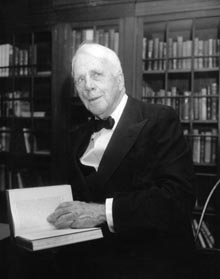
Those of you who read this blog regularly may know that I'm a fan of Robert Frost. A big fan, actually. I consider him a poet of surface simplicity and great underlying complexity, a complexity I neither saw nor understood when young. But perhaps I felt it and sensed it.
I think Frost can be appreciated on both levels, actually. But it's the second I'm interested in writing about today.
Here's the poem, "The Road Not Taken," to refresh your memory:
Two roads diverged in a yellow wood,
And sorry I could not travel both
And be one traveller, long I stood
And looked down one as far as I could
To where it bent in the undergrowth;
Then took the other, as just as fair,
And having perhaps the better claim,
Because it was grassy and wanted wear;
Though as for that the passing there
Had worn them really about the same,
And both that morning equally lay
In leaves no step had trodden black.
Oh, I kept the first for another day!
Yet knowing how way leads on to way,
I doubted if I should ever come back.
I shall be telling this with a sigh
Somewhere ages and ages hence:
Two roads diverged in a wood, and I--
I took the one less traveled by,
And that has made all the difference.
Like much of Frost, it seems to say one thing--it even does say that one thing--and yet on further study it also is saying something else, something more difficult to discern. It's that second "something," combined with the first, that give the poem its great resonance and power.
On the surface, of course, it's a lovely poetic expression of an obvious and perhaps even cliched thought: we come to a crossroads in life, make a decision , and that decision affects our entire future.
Or does it?
The poem is also about the speaker, an older person looking back and telling a tale--"constructing a reality" as it were--in reminiscence. The poem contains a set of lines that the casual reader can ignore or think unimportant, but good poets such as Frost rarely waste words.
Why does he initially describe the road he takes as less-traveled ("it was grassy and wanted wear") and then immediately contradict himself ("Though as for that the passing there/Had worn them really about the same")? Earlier, too, he has said the other road was "just as fair"--another sign of equality. And then, just to make sure we haven't missed it, he adds "And both that morning equally lay/In leaves no step had trodden black." Different, or equal? What gives here?
Well, as Frost himself said, "It's a trick poem--very tricky." But it's more than tricky, and more than a joke or a puzzle, because it contains both thoughts at once, and the juxtaposition makes it even more profound. How can we ever know the result of the decisions we make? We can't, because the road not taken--the one we don't choose--has consequences we can't see. We can only guess at any of this, and then later sit back and reflect and tell tales that sound like an explanation. And perhaps the explanation is even true--who knows?
I'm reminded--as I so often am--of one of my very favorite authors, Milan Kundera. He begins The Unbearable Lightness of Being with a reflection on Nietzsche's strange notion of eternal return--that in some dimension, our lives repeat again and again:
The idea of eternal return is a mysterious one, and Nietzsche has often perplexed other philosophers with it: to think that everything recurs as we once experienced it, and that this recurrence itself recurs ad infinitum? What does this mad myth signify?...
If eternal return is the heaviest of burdens, then our lives stand out against it in all their splendid lightness.
Kundera describes his vacillating hero, Tomas, in the throes of making a decision about whether or not he is in love with a certain woman:
He remained annoyed with himself [for not knowing what he should do] until he realized that not knowing what he wanted was actually quite natural.
We can never know what to want, because, living only one life, we can neither compare it with our previous lives nor perfect it in our lives to come...There is no means of testing which decision is better, because there is no basis for comparison. We live our lives without warning, like an actor going on cold.
We come to that proverbial fork in the road and a decision must be made. We make it, sometimes after a great deal of vacillation. And then we tell ourselves--with either satisfaction, regret, or ambivalence--that our decision, the road we took, "has made all the difference."
And perhaps, indeed, it has. The poet doesn't have the answer. But he's awfully good at stating the question, and presenting the paradox in words and images that speak to the heart as well as the mind.
Sunday, January 01, 2006
New Years Day
I'm taking the day off, just relaxing. At the moment I'm enjoying my new computer, which is finally connected and running.
Once again, Happy New Year to you all--and see you tomorrow!
Once again, Happy New Year to you all--and see you tomorrow!
Subscribe to:
Posts (Atom)